- TL;DR
- What a power surge actually does to an air conditioner
- Signs a surge has already damaged your AC
- Not every dead AC after an outage is surge damage
- What to do in the first 30 minutes
- What a technician checks, and what it can cost
- Heat pumps, mini splits and VRF: why surges matter more
- Who pays: insurance, warranties and the utility
- How to protect your AC from the next surge
- Our perspective: what we see after surges
- Need help now? Talk to LC Heating & Air
- FAQ
- Sources
- Recommended

A power surge can damage an air conditioner, and the parts that fail first are usually the small electrical ones: the control board, the capacitor, the contactor and the thermostat. If your AC went quiet, hums without starting, or keeps tripping the breaker after a lightning storm, a grid flicker or a power outage, switch the system off at the thermostat and call a licensed technician. Do not keep trying to restart it. Repeated restarts can turn a small electrical failure into a bigger one.
This guide walks you through what a surge does to an air conditioner, which checks are safe for a homeowner, what a repair usually involves, and how to keep it from happening again. We are LC Heating & Air, and we repair and install air conditioners, heat pumps, mini splits and VRF systems across Los Angeles. Most of what follows comes from what we see on service calls, backed by electrical safety sources where a number or rule is involved.
TL;DR
- Signs of surge damage: an outdoor unit that will not start, a hum with no airflow, a breaker that trips again right away, or a dead thermostat.
- Safe first steps: turn the system off at the thermostat, check the breaker, reset it once (OFF, wait 5 minutes, ON) and stop there if it trips again.
- Never open the panels yourself. Electrical contact is the leading danger for HVAC mechanics, and capacitors can hold a charge.
- Check your homeowners policy and any home warranty contract before you pay out of pocket. Do not assume either covers surge damage.
- Whole-home surge protection at the main panel, installed by a qualified electrician, is the strongest prevention. Unplugging is the only real defense against a direct lightning strike.
What a power surge actually does to an air conditioner
A power surge, also called transient voltage, is a sudden and unwanted rise in voltage that can damage, degrade or destroy sensitive electronics. Your AC is full of them. The outdoor unit has a compressor, a fan motor, a capacitor and a contactor. Indoors you have a blower, a control board and a thermostat. Modern systems add communicating controls and inverter boards.
The damage comes in two forms:
- Immediate failure. A surge can create an electrical arc that generates intense heat, damaging components at once or wearing them down gradually. That is the unit that dies during the storm.
- Gradual degradation. The same source notes that repeated smaller surges can shorten the life of equipment without any obvious failure. That is the AC that “just stopped working” two summers later, with no storm to blame.
Think of a healthy capacitor as a small but mighty component: it gives the motors the jolt they need to start. When a surge weakens it, the motor hums, struggles and eventually quits.
Where surges come from
Most people blame lightning or the utility. The reality is less dramatic. The National Electrical Manufacturers Association estimates that 60 to 80 percent of surges start inside the home or business, from large appliances cycling on and off. Your air conditioner is one of those appliances.
That is why a house with no recent storm can still have a stressed electrical system. It also explains why protection at the main panel matters more than most homeowners expect.
Signs a surge has already damaged your AC
Surge damage rarely announces itself. Look for these patterns, especially if they began right after a storm, a blackout or a flicker of the lights:
- The outdoor unit will not start. The indoor blower may run while the outside fan and compressor stay silent. A failed contactor, capacitor or control board is common here.
- A hum or buzz with no airflow. The motor is trying to start and cannot. Our guide to an AC buzzing noise covers what that sound means and when to stop.
- The breaker trips again immediately. Carrier says that if a breaker trips right after being reset, it points to a deeper electrical fault that needs professional inspection.
- The thermostat is blank or unresponsive. The thermostat is low voltage and often the first casualty. A blank screen can also be a tripped safety switch, so it is a clue, not a verdict.
- Weak or warm air. If the system runs but does not cool, work through our home AC not cooling checklist first. If nothing there explains it, an electrical failure is a likely candidate.
- A burning smell or visible scorching. Switch the system off at the thermostat and the breaker, and call for service right away. If you see smoke or flames, call 911.
If the unit simply will not turn on, our AC not turning on guide and the system won’t start wiki walk through the non-surge causes too, such as a clogged condensate drain or a tripped float switch.
Not every dead AC after an outage is surge damage
Before you assume the worst, know that many systems have a built-in delay. Some air conditioners and thermostats hold off for several minutes after power returns, so the compressor is not slammed with a restart while pressures are still high. Give the system ten to fifteen minutes after the power returns before you decide anything is broken.
Other harmless explanations include:
- A thermostat that reset itself and lost its schedule or mode.
- A tripped breaker that protected the system as designed.
- A dead thermostat battery, which often fails around the same time as an outage.
- A float switch that shut the unit down because of a clogged condensate line.
If you have waited and the system still does not respond, move on to the steps below.
What to do in the first 30 minutes
The goal is to avoid making things worse and to gather what a technician and an insurer will want to know.
- Turn the thermostat to OFF. This stops the system from trying to start against a fault.
- Look at the breaker panel. Find the breaker for the air conditioner. Carrier’s guidance is that you can switch a tripped breaker fully OFF, wait 5 minutes, then switch it ON. Try this once.
- If it trips again, stop. Leave it off. Our AC breaker trips guide explains why one reset is the rule and what repeated resets can do.
- Check the outdoor disconnect. It is the box on the wall near the condenser. Make sure it is seated and not visibly burned. Do not pull it open.
- Do not open any panel. The Electrical Safety Foundation International reports that, according to OSHA, 90 percent of electrical fatalities among HVAC mechanics happen on contact with energized equipment or parts. Professionals work with meters, discharge tools and training. A homeowner with a screwdriver should not.
- Photograph and note everything. Record the date, time and weather, which appliances failed, and any utility outage notice. You may need this for an insurance or utility claim.
- Check other electronics. If the TV, router, refrigerator or other appliances also act up, tell the technician and your insurer. It points to a house-wide event.
If it is a hot day and you have someone in the home who is elderly, very young or medically fragile, tell us when you call. We run emergency HVAC and 24-hour AC repair across Los Angeles.
What a technician checks, and what it can cost
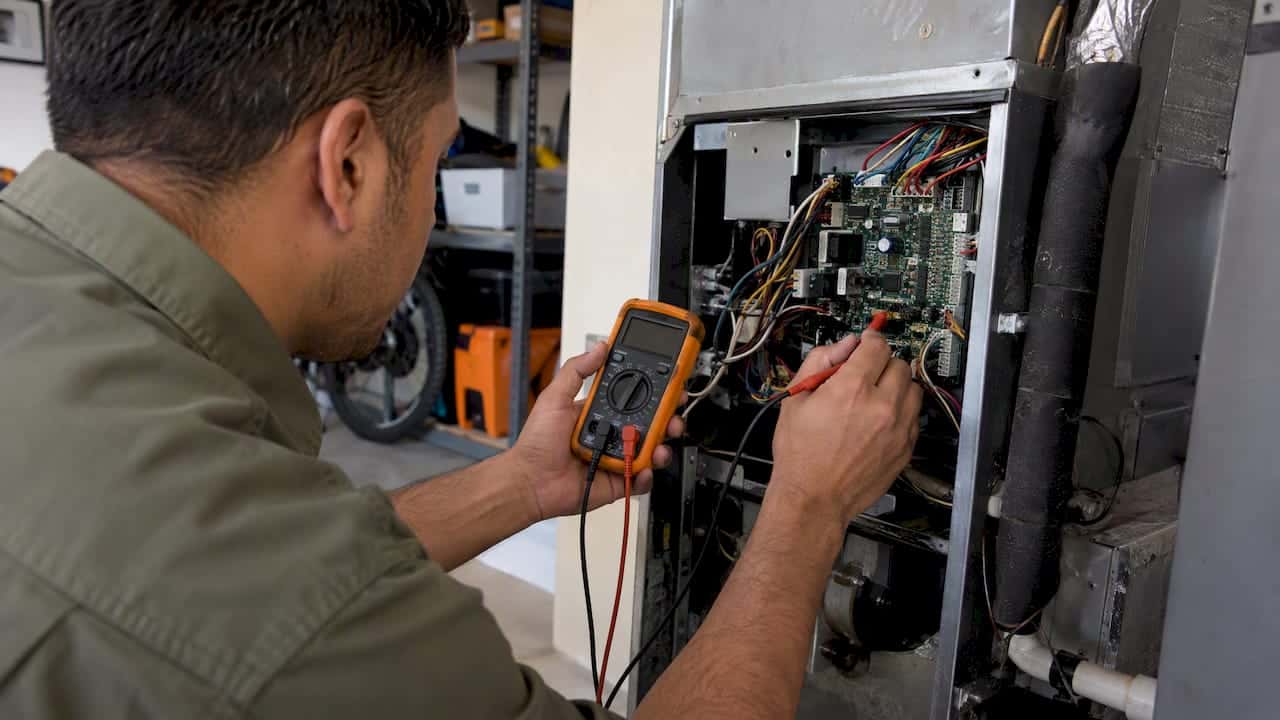
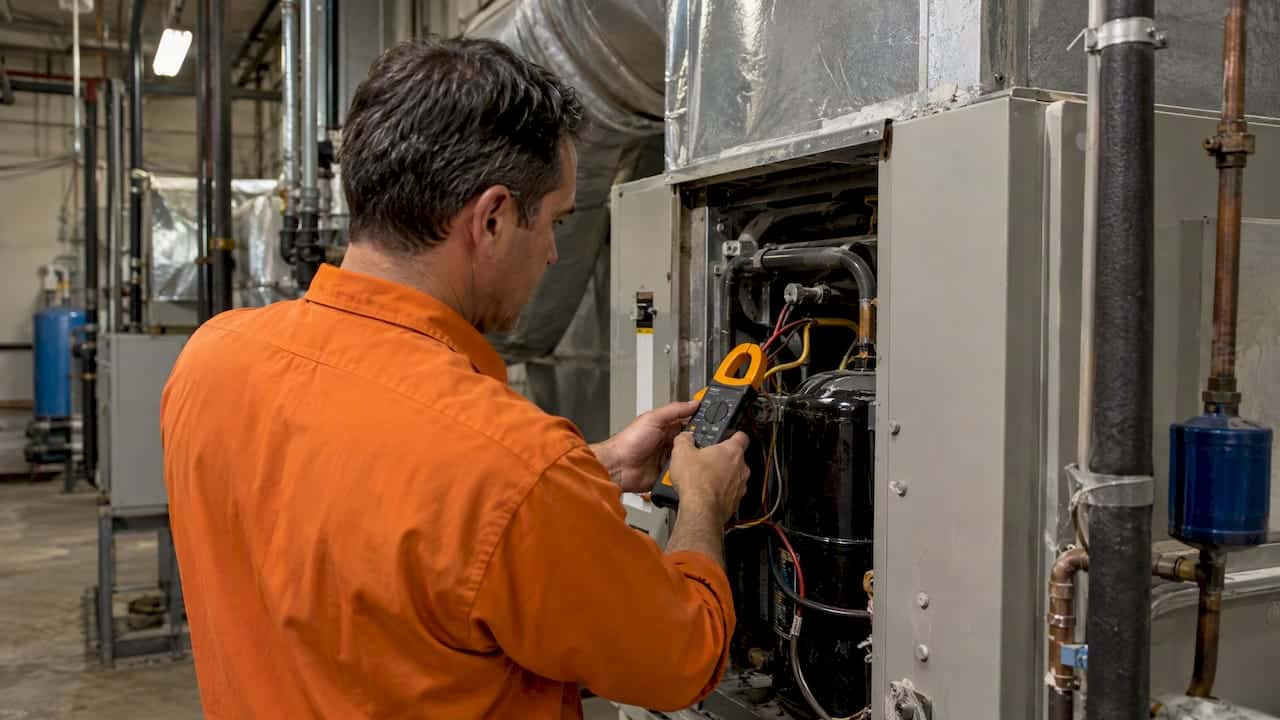
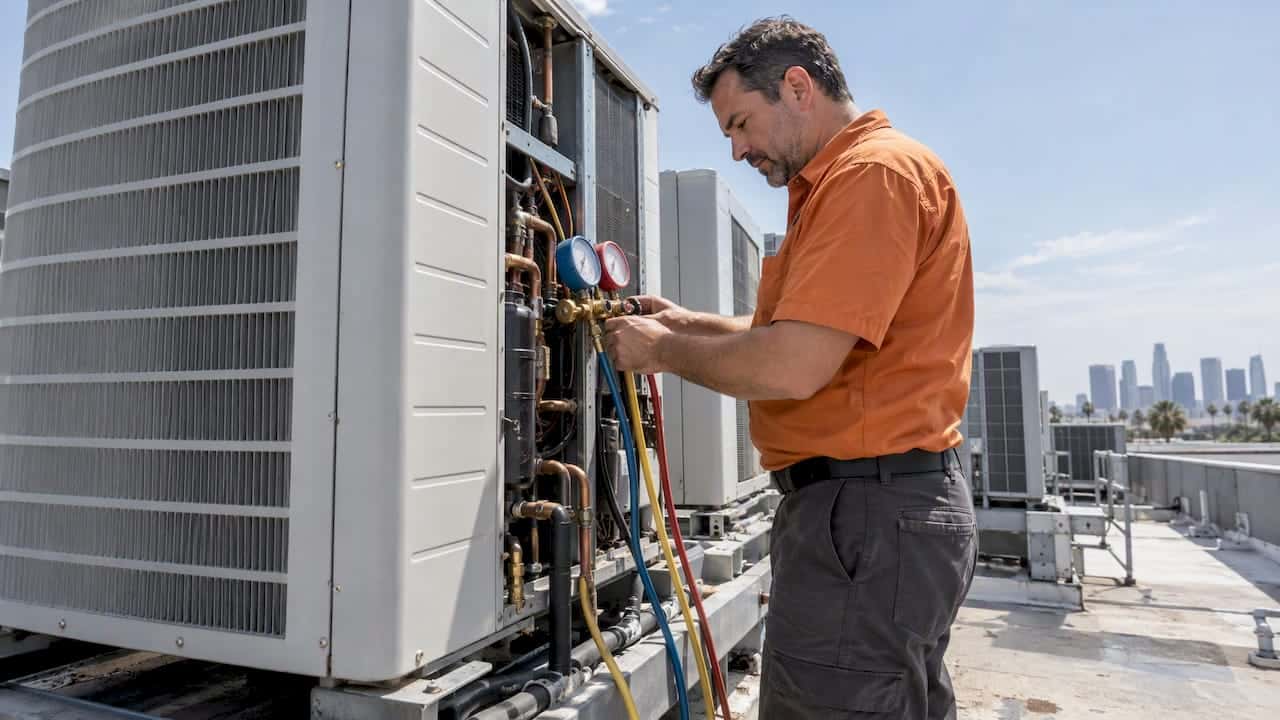
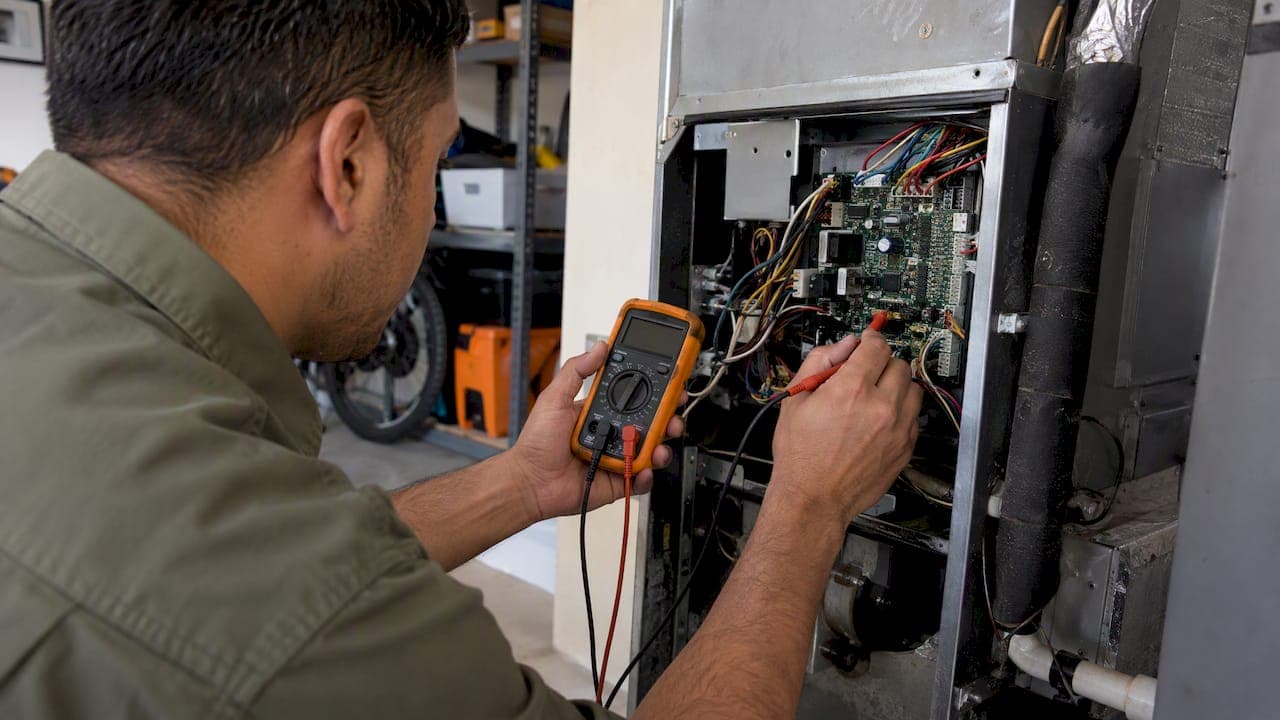
A surge can hit several parts at once, so a good diagnosis does not stop at the first failure. Carrier notes that professional diagnosis of electrical faults typically takes 1 to 3 hours. Here is what we generally work through:
| Component | What it does | Typical sign when damaged |
|---|---|---|
| Capacitor | Gives motors a start boost | Hum, no start, fan spins only when pushed |
| Contactor | Switches power to the outdoor unit | Outdoor unit silent, or stuck running |
| Control board | Directs the whole sequence | No response, odd error codes, partial operation |
| Fan or blower motor | Moves air | Burning smell, tripping breaker, no airflow |
| Compressor | Pumps refrigerant | Breaker trips on start, loud hum, no cooling |
| Thermostat and low-voltage wiring | Sends commands | Blank screen, no signal to the unit |
Our service call is from 125 USD, a one-off fee. We do not charge surprise diagnostic fees, and repairs are quoted at a flat rate before work begins, so you decide with a number in front of you. We do not publish repair prices because they depend on which parts failed, and we would rather give you an exact figure after diagnosing than a guess before.
Repair or replace?
A surge makes people think the whole system is finished. Often it is not. A capacitor or contactor failure is a small repair. A failed control board costs more but is still usually a better value than a new system on a unit in good shape.
Replacement starts to make sense when several things line up:
- The compressor itself has failed and the system is already well into its life.
- The repair cost is a large share of a new system and the unit uses older refrigerant.
- The system has needed repeated electrical repairs.
- You were already considering an efficiency upgrade, such as a heat pump.
We will tell you plainly if a repair is the better choice. We do not push replacement. If replacement is right, our published installation ranges are AC installation at 4,000 to 9,000 USD and heat pump installation at 5,500 to 12,000 USD, one-off, with financing options on the same page. The final figure depends on size, ductwork and the home.
Heat pumps, mini splits and VRF: why surges matter more
Heat pumps, ductless mini splits and commercial VRF systems are our specialty, and they deserve a note of their own. They rely on more electronics than a basic single-stage air conditioner: variable-speed compressors, inverter boards, communicating controls and, on multi-zone systems, a link between the outdoor unit and each indoor head.
That has two practical consequences:
- A surge can damage more than one board. On a multi-zone mini split, the outdoor board and one or more indoor boards can fail together, and error codes can point in several directions at once.
- Diagnosis needs manufacturer-specific knowledge. Error codes, communication wiring and board replacement differ by brand. Guesswork on these systems is expensive.
A heat pump also works year-round, so a surge-damaged unit can leave you without heat as well as cooling. If you are in a Hollywood, Pasadena or Valley home and your heat pump or mini split stopped after an electrical event, our heat pump and mini split repair team can diagnose it. For businesses, we also service commercial VRF systems.
If you are replacing a surge-damaged system and want to move to a heat pump, see our heat pump installation page. We also help homeowners with California requirements and rebates on heat pumps, which change over time, so we confirm what applies when you call.
Who pays: insurance, warranties and the utility
Before you pay for surge repairs, check three places.
Homeowners insurance. Coverage for surge damage depends on your policy, its exclusions and the cause. Read your declarations page or call your agent. Do not assume it is covered.
Home warranty. The California Department of Insurance explains that home protection contracts and homeowners insurance are different products. Warranties generally cover mechanical breakdown from normal wear, while homeowners insurance addresses damage from major external events. A surge sits in a gray area, so read the contract limits and exclusions before you rely on it.
Your utility. If you believe a utility-side event caused the damage, the Los Angeles Department of Water and Power has a claims procedure. It asks you to be specific about the incident and to document your loss with bills, receipts and invoices. That is why we suggested photographing everything and keeping the repair invoice. We can give you a written diagnosis that describes what failed. We cannot promise a claim will be approved.
If you are a business owner dealing with repeated power quality problems, LADWP also publishes guidance on common power quality issues, including transients and voltage sags.

How to protect your AC from the next surge
No single device does everything, so think in layers.
Layer 1: whole-home surge protection
Electrical safety experts describe two tiers: point-of-use protection (good) and whole-home protection (best). Whole-home devices are installed at the electrical panel by a qualified electrician and guard major appliances against both internal and external surges. Since most surges start inside the house, a device at the panel addresses the most common source.
The National Electrical Code has moved in this direction. As of the 2020 edition, new or renovated homes must have a listed Type 1 or Type 2 surge protective device. If your home is older and has never been renovated, it may have none. An electrician can tell you what is installed.
Layer 2: protection at the outdoor unit
Some homeowners add a dedicated device at the condenser disconnect. Ask your electrician whether it makes sense alongside a panel-level device for your system, particularly if you have a heat pump or mini split with sensitive boards. Surge protectors also wear out: even genuine ones can degrade over time or after one major surge, so have them checked after a big event.
Layer 3: know what is not protection
Many power strips are just extension cords with extra outlets, and offer no surge protection. A central air conditioner is hardwired and cannot be plugged into one anyway. Point-of-use strips are for your TV and computer, not your HVAC system.
Layer 4: when a storm is coming
The ESFI states that no surge device can guarantee protection against a direct lightning strike, and that unplugging sensitive equipment is the most effective step. You cannot unplug a central AC, but you can turn the thermostat to OFF and switch off the dedicated breaker during a severe electrical storm. Turn it back on after the storm passes and the power has been stable for several minutes. Never go outside to touch the disconnect during lightning.
Layer 5: a healthy, maintained system
A worn capacitor or loose connection is a weaker link when a surge arrives. During a tune-up we check electrical connections, capacitors and contactors, which is where a small problem can be found before it becomes a failure. Our HVAC maintenance plan runs 180 to 250 USD per year.
Our perspective: what we see after surges
After more than twenty years working on Los Angeles homes, our view is simple: surge damage is rarely about one bad night. It is about a system with little margin and no protection.
We see three patterns. First, homeowners who keep resetting a tripping breaker until the compressor burns out, turning a capacitor job into a much bigger bill. Second, older and historic homes with aging panels and no surge device, where nobody has ever looked at the electrical side of the HVAC. Third, newer heat pump and multi-zone mini split installations where one inexpensive protective step could have saved an expensive board.

Our approach is to diagnose honestly. We tell you what failed, what it costs at a flat rate, and whether the system is worth saving. If the unit is fine and the problem is a breaker or thermostat, we say so. If it needs replacing, we explain why and show the options, including heat pumps and the rebates that may apply. We would rather earn a call next summer than sell a system you did not need today.
And one request: if you suspect surge damage, call before you try to power through it. The cheapest surge repair is the one you stop making worse.
— Leo
Need help now? Talk to LC Heating & Air
If your AC, heat pump or mini split stopped after a surge, we offer same-day service in Los Angeles, with a service call from 125 USD and flat-rate repair pricing. Start at our AC and heat pump repair services page, or call us at (323) 970-3113. If it is an after-hours emergency, use our 24-hour emergency line page.
FAQ
Can a power surge damage an AC unit?
Yes. A surge can overheat or destroy components like the capacitor, contactor, control board and motors, or wear them down over time. The damage may show up at once or months later. If your AC stopped working after a storm or outage, have a technician check it.
Should an AC unit be plugged into a surge protector?
No, not a plug-in strip. Central air conditioners are hardwired, and most power strips offer no surge protection anyway. The better approach is whole-home protection at the panel, installed by a qualified electrician, sometimes paired with a device at the outdoor disconnect. A window unit can be plugged into a properly labeled surge protector, but check the manufacturer’s instructions first.
Is it safe to reset the breaker after a surge?
One reset is generally fine. Turn the breaker fully OFF, wait 5 minutes, then switch it ON. If it trips again, leave it off and call a professional, because that signals a deeper electrical fault. Do not open the unit yourself.
Will insurance or a home warranty cover surge damage to my AC?
It depends on your policy or contract. The California Department of Insurance says warranties and homeowners insurance cover different things, so read the exclusions in both before assuming coverage. Keep your photos, the date of the event and the repair invoice to support any claim.
Should I repair or replace my AC after a surge?
If the failed part is a capacitor, contactor, thermostat or board on a system in good shape, repair is often the better value. If the compressor failed on an older unit, or the system keeps needing electrical repairs, replacement deserves a look. We give you a flat-rate repair price and a straight opinion, so you can compare.
Sources
- Surge and Protect, ESFI
- Impact of Transient Overvoltage on Equipment, NEMA via ESFI
- Surge Protection: Keeping your Electronics and Home Safe, ESFI
- Surge Protective Devices, ESFI
- AC Unit Not Turning On? Troubleshooting Steps, Carrier
- Construction Safety: Heating, Air Conditioning, and Refrigeration Mechanics, ESFI
- Home Protection Contracts, California Department of Insurance
- Claims Procedure, LADWP
- How to Solve Common Power Quality Issues, LADWP
Recommended
Leo, Propietario y Técnico Principal en LC Heating & Air
Leo dirige LC Heating & Air como propietario-operador y tiene la licencia C-20 HVAC #1073586 de California. Sus guías se enfocan en diagnósticos prácticos, decisiones de reparación seguras y consejos claros para propietarios de Los Ángeles.