- Why Is My AC Tripping the Breaker? Quick Checklist
- Safe Steps to Troubleshoot an AC That Keeps Tripping the Breaker
- Does Trip Timing Tell You What’s Wrong?
- When a Tripping Breaker Means an Electrical Problem, Not an AC Problem
- When to Call a Pro (and What They’ll Actually Check)
- How LC Heating and Air Conditioning Diagnoses a Tripping AC
- What Causes an Overloaded Circuit, and How Is Load Calculated?
- Does the Wrong Breaker Type or Rating Cause Trips?
- Maintenance Habits That Actually Stop Breaker Trips
- Can Power Surges or Voltage Fluctuations Trip Your AC Breaker?
- Our Take: Diagnose First, Reset Second
- Get Your AC Diagnosed Before It Trips Again
- Sources
- FAQ
- Recommended
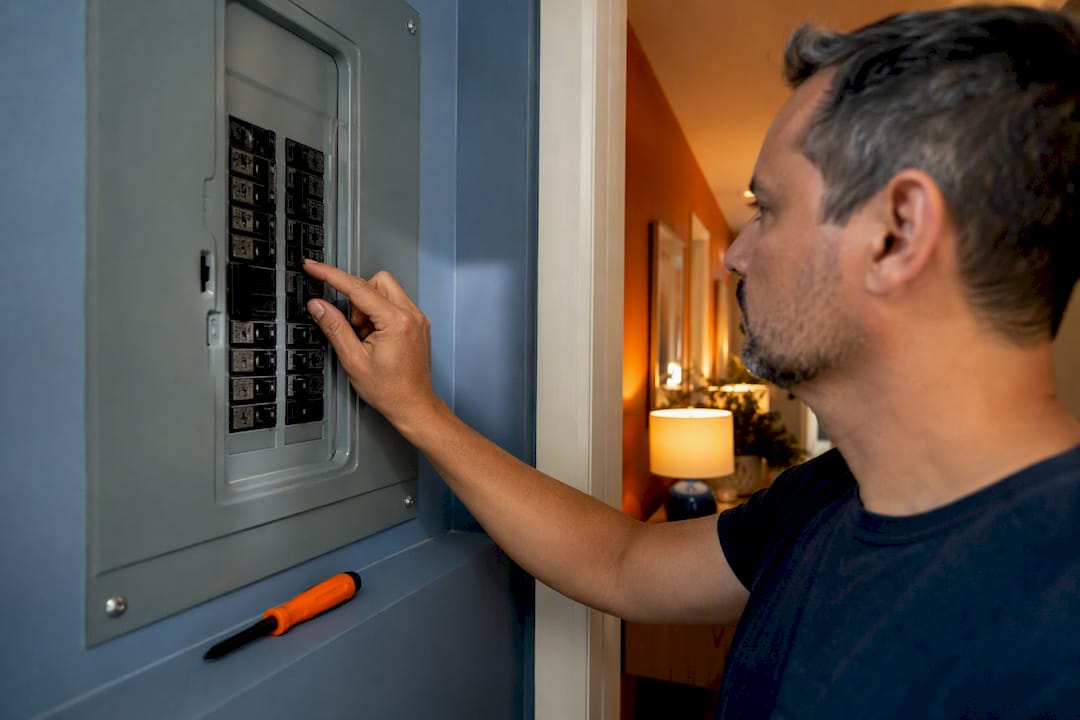
Your AC breaker trips for one of four reasons: restricted airflow, a failing start component, an electrical fault, or a breaker that’s simply worn out. The fix starts with one safe step. Set the thermostat to OFF, let the system sit, then reset the breaker once. If it trips again immediately or you smell burning, stop resetting and call a licensed electrician.
TL;DR:
- Breaker trips caused by airflow restrictions, such as dirty filters or blocked coils, account for up to 40% of homeowner cases.
- Timing of the trip, like instant or after several minutes of operation, helps diagnose whether the issue is electrical, airflow, or component failure.
- Over time, a breaker that trips at normal load or feels warm likely indicates a failing breaker, not just an overload.
- Voltage surges during storms can cause trips and damage components, making a whole-home surge protector a worthwhile investment if issues persist.
- Regular maintenance, including filter changes and coil cleaning, can prevent most trips and reduce the need for professional repairs.
Why Is My AC Tripping the Breaker? Quick Checklist
Before you touch the panel again, run through these six causes. Most homeowners can rule out at least half of them just by looking and listening.
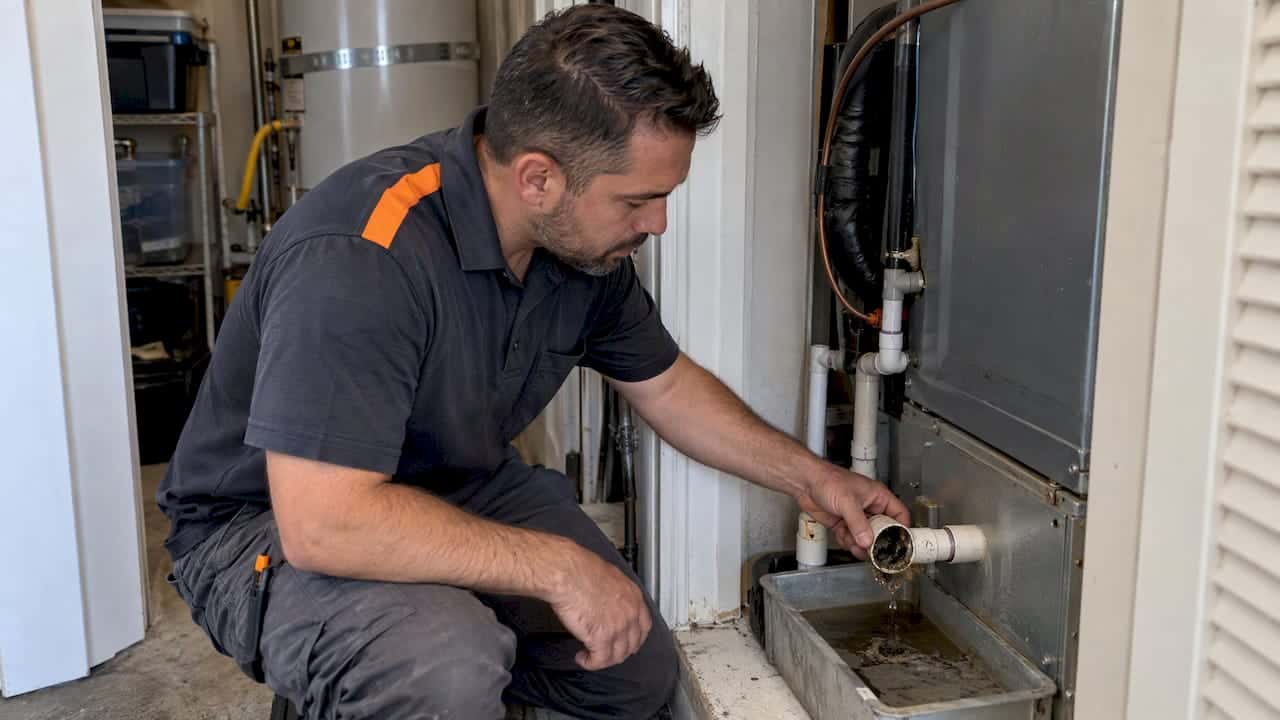
- Dirty air filter. Reduced airflow forces the compressor to work harder, and you’ll often see ice on the refrigerant lines. Trips hit 10 to 30 minutes into a cycle.
- Blocked condenser coil. The outdoor unit runs hot to the touch, and trips cluster on the hottest days of the week.
- Failing start or run capacitor. Listen for clicking or humming right as the unit tries to start. A weak HVAC capacitor can cause startup amp spikes several times higher than normal.
- Compressor hard-start or seizure. The unit runs briefly, then trips, sometimes with grinding noises or oil spots near the outdoor unit.
- Loose wiring or a short circuit. This trips the breaker instantly and can come with a burning smell or a warm electrical panel.
- A fatigued breaker. It trips even under normal load and may feel warm. This one needs an electrician, not a wrench.
Safe Steps to Troubleshoot an AC That Keeps Tripping the Breaker
Work through these in order. Skipping ahead to the breaker panel before checking the basics is how homeowners waste a service call on a $15 filter problem, or worse, mask a real electrical fault.
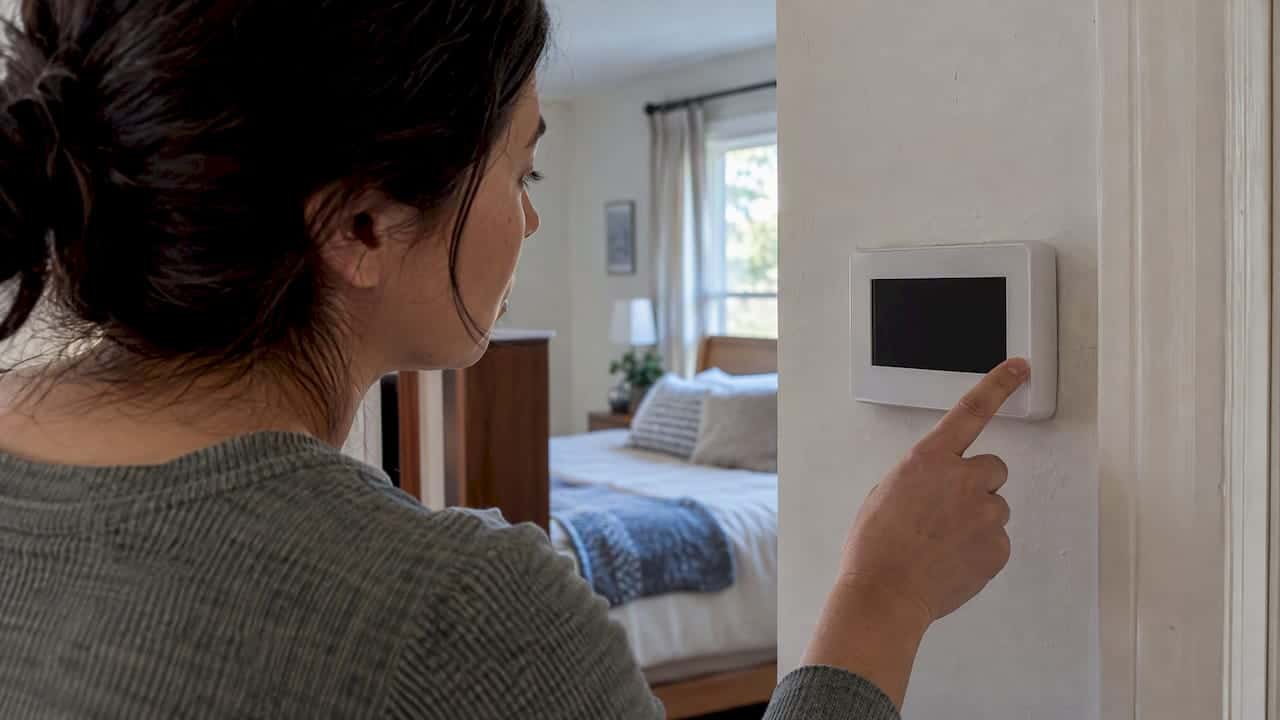
- Turn the thermostat OFF first. Give the system a few minutes of complete rest before you touch anything electrical. This keeps the compressor from trying to restart under load while you’re working.
- Pull the air filter and check it against the light. If you can’t see light through it, replace it. If you found ice on the indoor coil or refrigerant lines, wait 30 to 60 minutes for it to fully melt before restoring power.
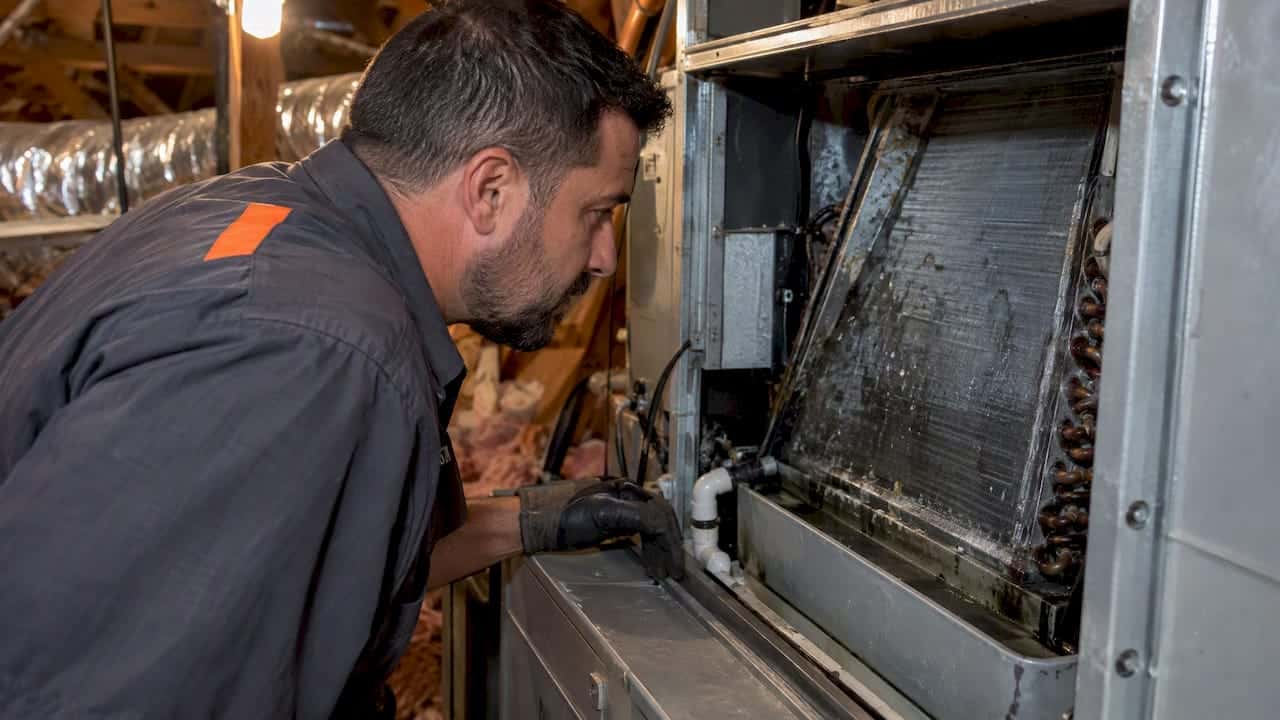
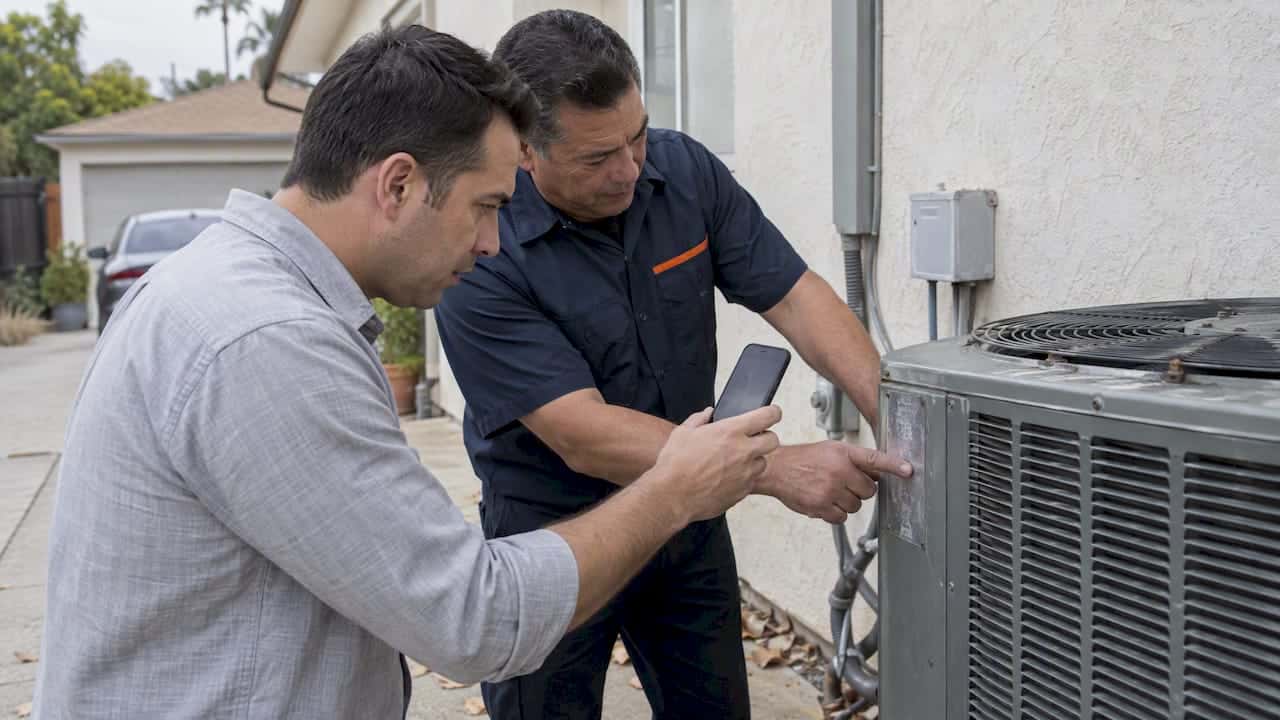
- Walk outside and clear the condenser. Remove leaves, grass clippings, and debris within 2 to 3 feet of the unit. Look at the fins. If they’re caked with dirt, a gentle rinse with a garden hose (never a pressure washer) can restore airflow.
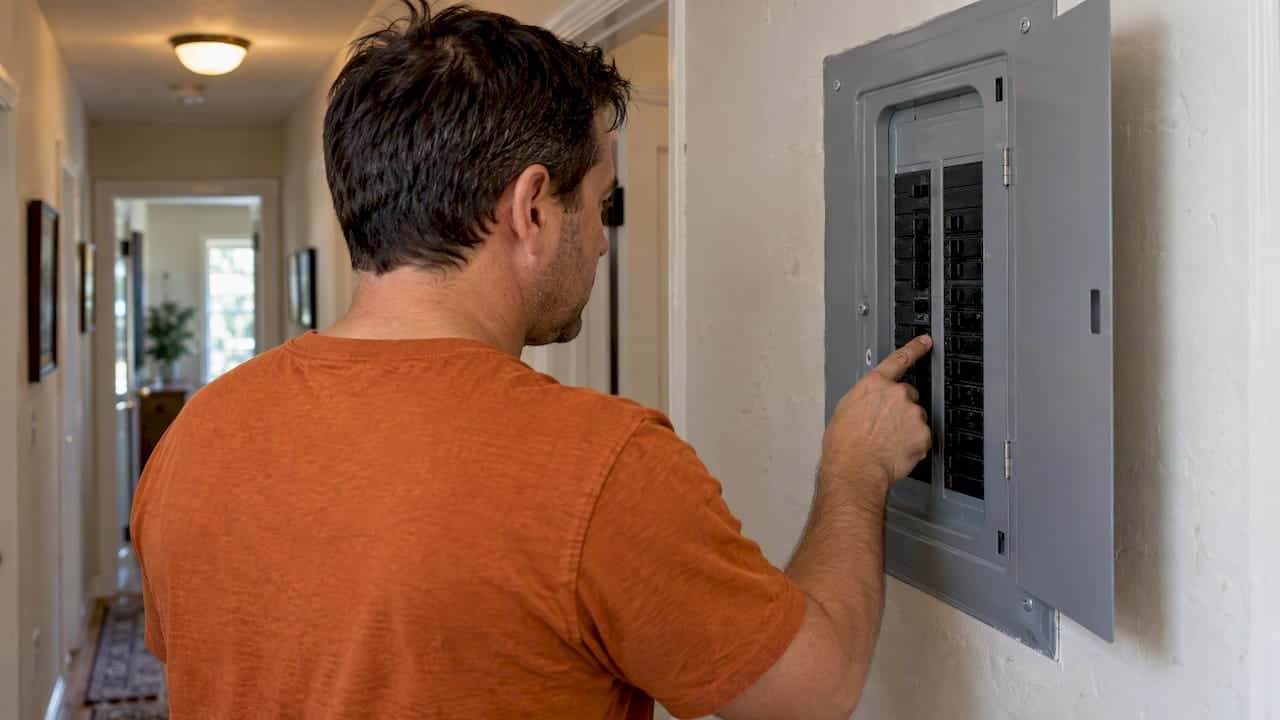
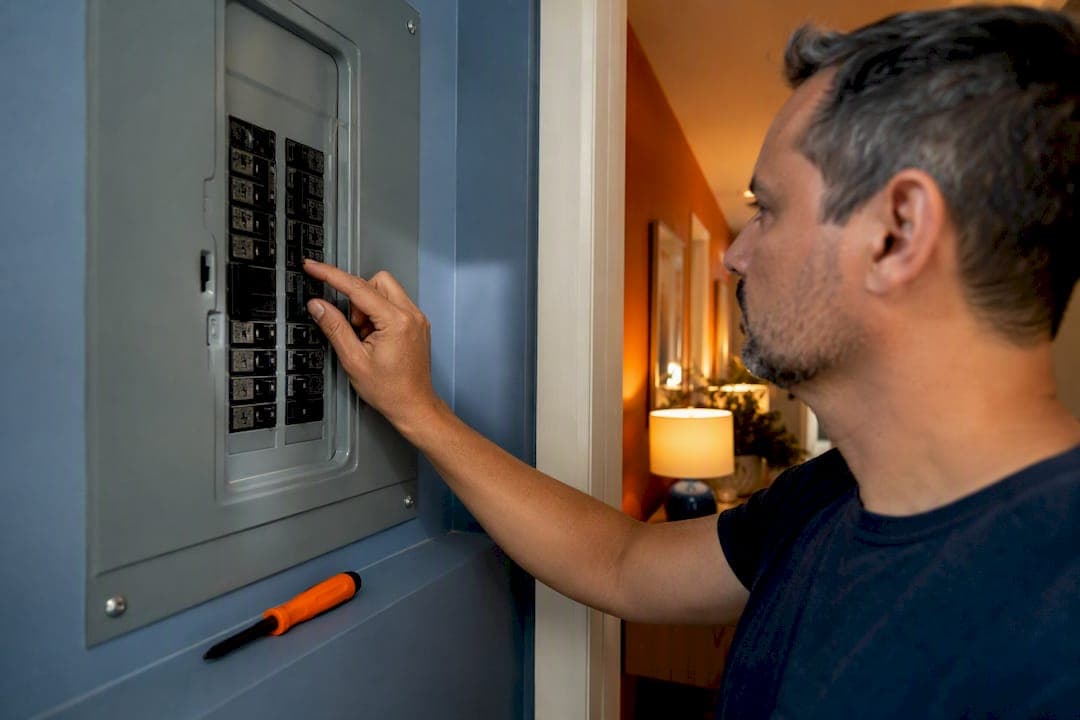
- Reset the breaker correctly, once. Push it firmly to OFF, wait about 30 seconds, then switch it back ON. This single-reset procedure gives pressures and temperatures inside the system time to normalize.
- Wait before restoring the thermostat. Give it another 30 to 60 minutes after the breaker reset before you turn the AC back on. Restarting too soon is one of the most common reasons a reset “fails.”
- Watch and listen at startup. Does it trip the instant you flip the thermostat back on? Does it hum or click for a few seconds first? Does it run fine for ten minutes and then trip? Write this down. It’s the single most useful piece of information you can hand a technician.
Never up-rate the breaker to a higher amperage to stop it from tripping, and never bypass a fuse or open the electrical compartment yourself. A breaker trips to protect the wiring and the compressor. Overriding that protection risks a fire, not just a repair bill.
Pro Tip: Keep a simple log on your phone: date, time of day, outdoor temperature, and how long the unit ran before it tripped. Three data points like that can cut a diagnostic visit from an hour to fifteen minutes.
If the hard-start pattern sounds familiar, our guide on what to do when your HVAC system won’t start walks through the same symptoms in more depth.
Does Trip Timing Tell You What’s Wrong?
Yes, and it’s the fastest diagnostic clue you have. Timing the trip against what you observed narrows the cause before a technician ever shows up.
- Trips the instant you reset it. This points to a short, a ground fault, or a bad breaker. Stop resetting and call an electrician.
- Trips within the first few seconds of startup. Usually a failing capacitor, a stuck contactor, or a compressor struggling to overcome locked-rotor resistance.
- Trips after several minutes of normal running. Almost always airflow restriction, a dirty coil, or occasionally low refrigerant charge.
- Only trips on the hottest days. The coil can’t reject heat fast enough, or the circuit is running right at its limit and any added heat load pushes it over.
Airflow problems deserve special attention here. Dirty filters and blocked coils are consistently cited as the top cause of AC breaker trips across HVAC guides, with some estimates putting filter-related trips around 40% of homeowner cases. That’s a filter change and a coil rinse solving nearly half the calls we get.
When a Tripping Breaker Means an Electrical Problem, Not an AC Problem
A breaker that trips under a genuine overload is doing its job. A breaker that trips at normal load, feels warm to the touch, or has visible scorch marks around it has a different problem: it’s failing.
Breakers age. Repeated trips, especially the kind caused by ignoring a hard-starting compressor and resetting it over and over, put thermal stress on the internal mechanism. Eventually it starts tripping below its rated current, a condition electricians call nuisance tripping. The only way to tell a legitimately tripping breaker from a failing one is testing, not guessing.
A breaker that trips repeatedly at what should be a safe load isn’t being overly cautious. It’s telling you either the load exceeds what the circuit was designed for, or the breaker itself has degraded past its rated tolerance. Guessing which one it is by feel gets people hurt.
Electricians confirm breaker health with a visual and thermal inspection, then verify actual draw against the rated capacity using clamp-meter amp testing. That single measurement separates “your AC is drawing too much” from “your breaker can’t hold what it used to.”
Call an electrician immediately if you notice any of these:
- The breaker panel feels warm or you see discoloration around the switch.
- There’s a burning smell anywhere near the panel or the outdoor unit.
- The breaker trips the instant you reset it, with no delay.
- You’ve reset it more than once already today.
Never replace a breaker with a higher-rated one to make the tripping stop. It’s a fire hazard, it can damage the compressor, and in most jurisdictions it violates electrical code.
When to Call a Pro (and What They’ll Actually Check)
Stop the DIY checklist and call for professional help the moment you hit any of these:
- You smell burning plastic or ozone anywhere near the unit or panel.
- The breaker won’t stay reset, even once.
- There’s visible scorching, melting, or damage on the breaker or wiring.
- The AC still trips after you’ve changed the filter and cleaned the coil.
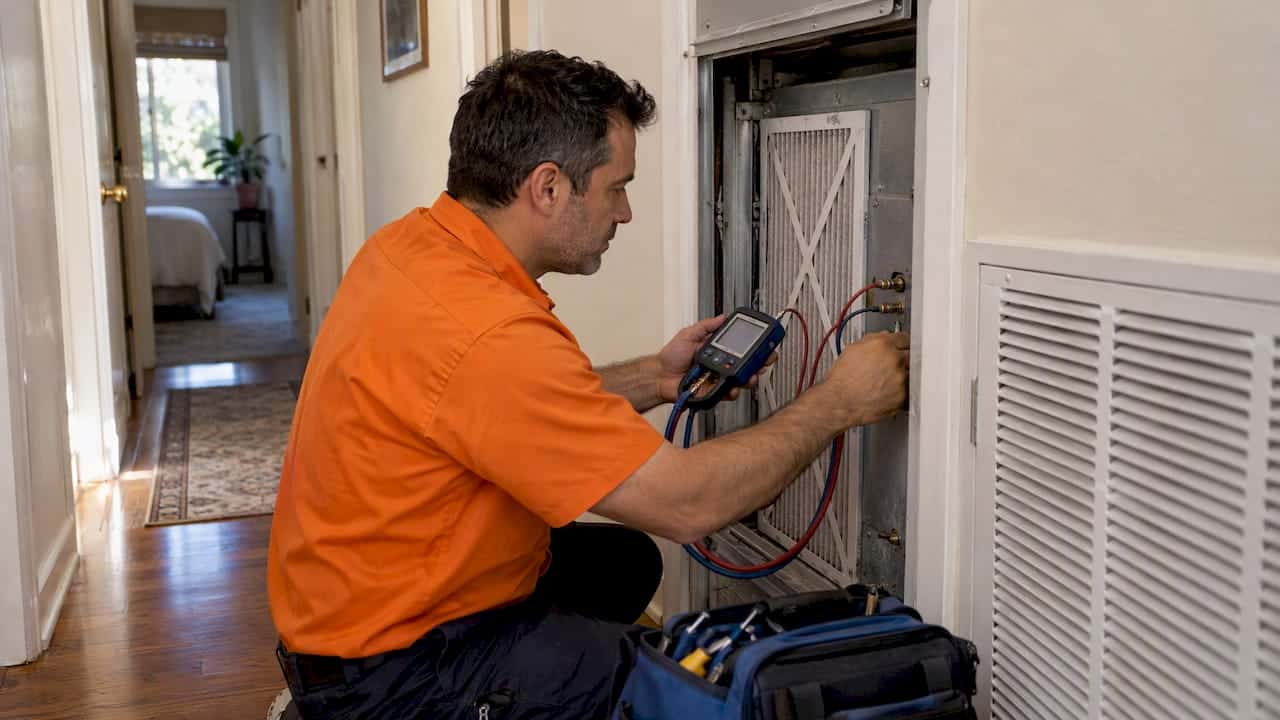
An HVAC technician’s visit typically includes a clamp-meter check of running and startup amp draw, a capacitor and contactor test, a locked-rotor check on the compressor, refrigerant pressure verification, and a full coil and airflow inspection. If the fault turns out to be electrical rather than mechanical, an electrician handles panel inspection, breaker replacement, correct circuit sizing, and wire continuity and grounding checks.
Before you call, have three things ready: the exact trip timing you observed, any unusual noises or smells, and whether ice or hissing showed up on the lines. That short list of details is often the difference between a one-visit fix and a callback. If you’re not sure whether the issue is a no-start condition or a trip, our page on AC units that won’t turn on covers the overlap.
How LC Heating and Air Conditioning Diagnoses a Tripping AC
Leo has spent over 20 years running HVAC calls across Los Angeles, and the pattern hasn’t changed much: most breaker trips trace back to airflow or a tired capacitor, not a mystery. LC Heating and Air Conditioning’s technicians start every diagnostic visit with safety, then move to clamp-meter amp testing to confirm exactly what the compressor is drawing against what the breaker and wiring can actually handle.
You get a flat-rate estimate before any repair starts, not a surprise invoice after the fact. On a same-day visit, the outcome is usually one of three things: a filter and coil cleaning that solves it on the spot, a capacitor swap, or an honest referral to a licensed electrician when the fault sits in the panel rather than the AC itself.
What Causes an Overloaded Circuit, and How Is Load Calculated?
An overloaded circuit happens when the total electrical demand on a breaker exceeds what it’s rated to carry continuously. For a dedicated AC circuit, that usually means the compressor and fan motor are drawing more amperage than the wiring and breaker were sized for, often because of a failing part rather than the circuit itself being wrong from day one.
Electricians calculate the safe load using the equipment’s rated running amps and locked-rotor amps, then apply the standard safety margin required by electrical code, typically 125% of the continuous load. If your AC’s nameplate lists a running current of 20 amps, the circuit needs to be sized well above that, not right at the edge.
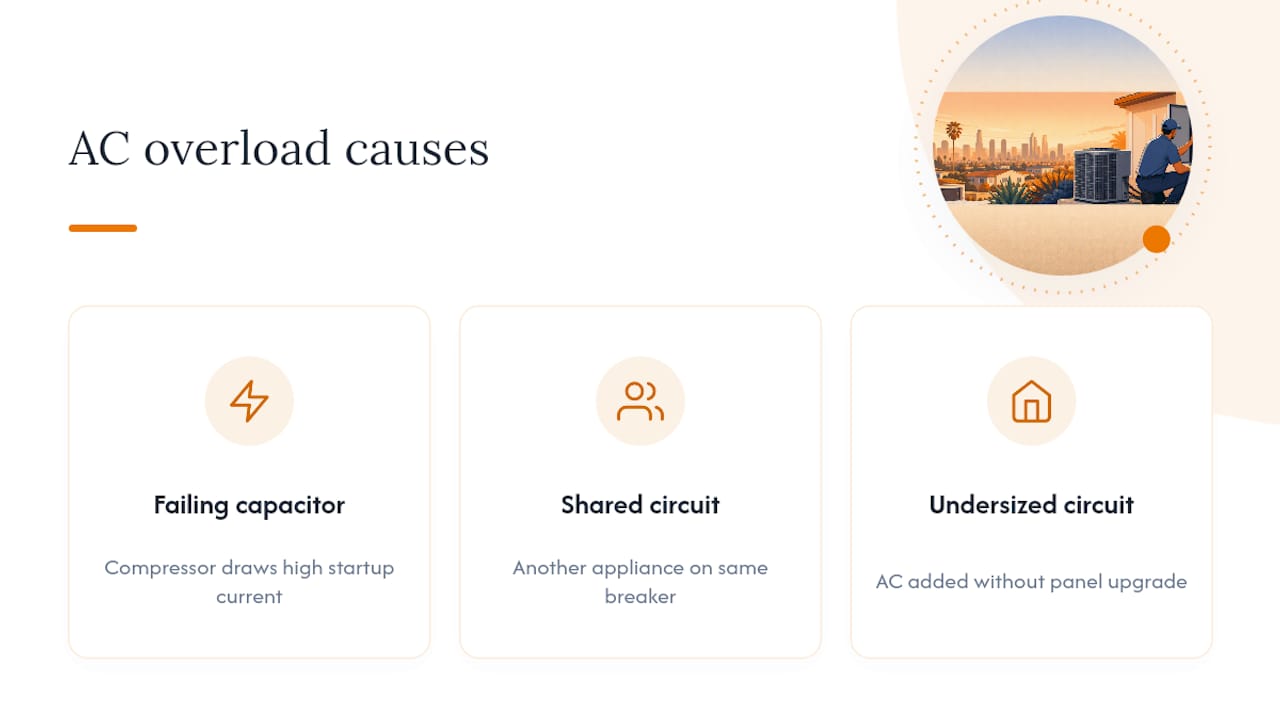
Overloads on an AC circuit usually come from one of three places: a compressor drawing abnormally high startup current because of a failing capacitor, a second appliance sharing the same circuit as the AC (a common mistake in older homes with limited panel space), or a unit that was simply installed on an undersized circuit to begin with. That last one shows up more often in older properties that were wired for a smaller window unit and later upgraded to central air without a corresponding panel upgrade.
This is why a technician doesn’t just look at the AC. Verifying the circuit itself was sized correctly for the equipment it’s running is part of a proper diagnostic, not an afterthought.
Does the Wrong Breaker Type or Rating Cause Trips?
Yes, and mismatches are more common than most homeowners realize, especially in homes that have changed HVAC equipment over the years without a matching panel update. Every AC unit has a maximum overcurrent protection rating listed on its nameplate. The breaker protecting that circuit needs to match, not just be “close enough.”
A breaker rated too low for the equipment trips constantly under completely normal operation, even with a healthy AC. A breaker rated too high fails to trip when it should, which lets a genuine short or overload keep drawing current instead of shutting off, and that’s the scenario that leads to melted wiring or fire.
Standard breakers and AFCI (arc-fault circuit interrupter) or GFCI (ground-fault circuit interrupter) breakers also serve different purposes. Some jurisdictions require specific protection types for certain circuits. Installing the wrong type isn’t just a performance problem, it can be a code violation. This is exactly why breaker swaps belong to a licensed electrician who can confirm the rating and type against both the equipment nameplate and local code, not to a homeowner grabbing whatever breaker looks similar at the hardware store.
Maintenance Habits That Actually Stop Breaker Trips
Most repeat trips are preventable, and the fixes are unglamorous. Change your air filter every 60 to 90 days during cooling season, more often if you have pets or live near construction dust. A dirty filter is still the top offender behind AC breaker trips, and it’s the cheapest one to prevent.
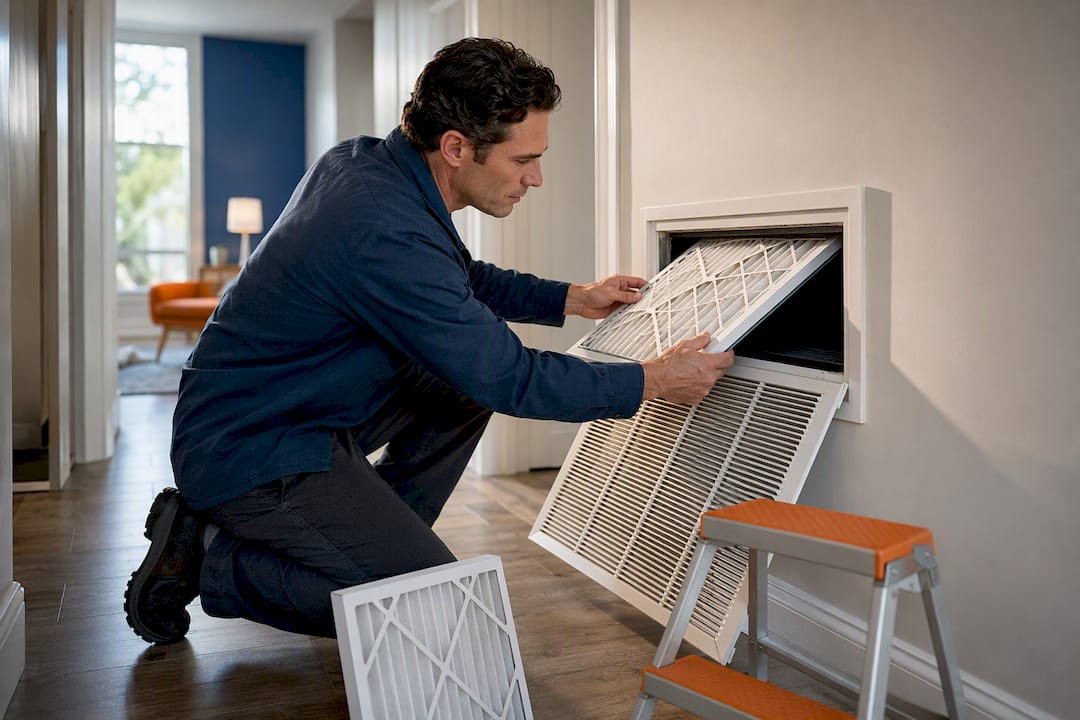
Schedule a coil cleaning once a year, ideally in spring before the first heat wave. Keep 2 to 3 feet of clearance around the outdoor unit year round, not just when you happen to notice weeds growing through the fins. Have a technician test capacitors annually, since they degrade gradually and often fail without warning right when you need cooling most. And don’t ignore a breaker that’s tripped once. A single trip that resolves cleanly after a filter change is normal. A second trip within the same week means something is progressing, not resolving on its own.
Can Power Surges or Voltage Fluctuations Trip Your AC Breaker?
Yes. Voltage fluctuations, brownouts, and power surges from the utility grid or nearby lightning strikes can push current spikes through your AC circuit that trip the breaker even when every component inside the unit is healthy. This is more common during summer storm season and in areas with older utility infrastructure.
A surge doesn’t just risk a trip. It can degrade a capacitor or circuit board over repeated exposure, which is part of why a unit that survived years of normal operation can suddenly start having capacitor failures after a rough storm season. A whole-home surge protector installed at the panel is a reasonable safeguard if your area sees frequent grid instability, and it’s a conversation worth having with an electrician rather than an HVAC technician, since it protects the whole house, not just the AC.
If your AC trips during or right after a storm but runs fine otherwise, that’s a different diagnostic path than a unit tripping on a calm, sunny afternoon. Mention the weather conditions when you call for service. It matters.
Our Take: Diagnose First, Reset Second
The conventional advice treats a tripped breaker like a nuisance to clear, not a symptom to investigate. That’s backwards. A breaker tripping is your electrical system doing exactly what it’s designed to do: stopping current before something overheats. The homeowner’s job isn’t to make the tripping stop as fast as possible. It’s to figure out why it happened once, safely, before it happens again.
Where most guides fall short is treating every trip the same. They don’t. An immediate trip on reset and a trip after twenty minutes of quiet running are different problems requiring different fixes, and conflating them sends people down the wrong path, usually straight to “just replace the breaker” when the real issue is a $30 capacitor or a dirty filter.
Prioritize observation over action. Note the timing, note the sounds, check the filter and the coil before you touch the panel a second time. That fifteen minutes of attention is worth more than a dozen resets, and it’s exactly what tells a technician where to start.
— Leo
Get Your AC Diagnosed Before It Trips Again
LC Heating and Air Conditioning gives you something most HVAC calls in Los Angeles don’t: an honest, flat-rate estimate before any repair starts, not a surprise bill after the diagnostic. If your AC keeps tripping the breaker, our technicians run the same clamp-meter amp testing described above on-site, so you know whether you’re looking at a filter, a capacitor, or a wiring issue that needs an electrician, before you agree to any repair.

We offer same-day availability when a breaker trip signals a real safety risk, and our AC repair service covers diagnostics and repair under one flat rate, no escalating charges once the technician is on-site. If you’d rather browse what a proper fix involves first, our HVAC how-to guides cover more of these DIY-safe checks. Ready to get it looked at? Call (323) 970-3113 or book a visit through LC Heating and Air Conditioning today.
Sources
- AC Breaker Keeps Tripping? Complete Troubleshooting Guide 2026 — AboutDarwin
- HVAC compressor hard start — InspectApedia
- Troubleshooting a tripped circuit breaker — Today’s Homeowner
- How to reset a tripped AC breaker safely — YourK AC
FAQ
How Do I Fix an AC That Keeps Tripping the Breaker?
Start by checking and replacing the air filter, then clear debris from around the outdoor unit and clean the condenser coil if it’s dirty. If a single correct breaker reset still results in a trip, stop and call a technician instead of resetting again.
Is It Safe to Reset a Tripped AC Breaker?
One reset, done correctly, is safe: switch the breaker fully OFF, wait about 30 seconds, then switch it ON, and wait 30 to 60 minutes before restarting the thermostat. Resetting it repeatedly without finding the cause raises the risk of compressor damage or overheated wiring.
How Do I Tell if My AC Breaker Is Bad?
A breaker that trips at normal load, feels warm to the touch, or shows scorch marks is likely failing rather than just protecting an overloaded circuit. Only a licensed electrician using clamp-meter testing and a thermal inspection can confirm true breaker health.
Will Low Refrigerant Cause a Breaker to Trip?
Low refrigerant can contribute to a trip indirectly, usually by forcing the compressor to run longer and harder to reach set temperature, which raises amp draw over time. It typically shows up as a trip after several minutes of running rather than an immediate trip at startup.
When Should I Stop Troubleshooting and Call LC Heating and Air Conditioning?
Call immediately if you smell burning, the breaker won’t hold after one reset, or the AC still trips after you’ve cleaned the filter and coil. LC Heating and Air Conditioning offers same-day diagnostic visits with on-site amp testing and flat-rate pricing across Los Angeles.
Recommended
Leo, Owner & Lead Technician at LC Heating & Air
Leo leads LC Heating & Air as an owner-operator and holds California CSLB C-20 HVAC license #1073586. His guides focus on practical diagnostics, safe repair decisions, and clear advice for Los Angeles homeowners.