- TL;DR
- What you are maintaining
- Why VRF maintenance is different from a standard system
- How often VRF systems need service
- The VRF maintenance checklist
- The two problems we see most: dirty coils and incorrect charge
- Refrigerant leaks and EPA rules
- What good maintenance saves
- How long a well-kept system lasts
- Warning signs between visits
- Choosing a VRF service contractor
- Our perspective on VRF maintenance
- VRF and heat pump service from LC Heating & Air
- FAQ
- Sources
- Recommended

VRF system maintenance comes down to three things: clean filters and coils, a technician who reads the system’s data and error history, and a refrigerant check by someone licensed to handle it. For most commercial buildings in Los Angeles, we recommend a professional visit twice a year, with simple filter care in between. The details below explain what each visit should cover and what happens when it gets skipped.
VRF stands for variable refrigerant flow. These systems are efficient and flexible, but they are not forgiving. One outdoor unit feeds many indoor units, so a small neglected problem can affect the whole building.
TL;DR
- Plan on professional service twice a year, ideally before the cooling season and before the heating season. Heat pump VRF systems work in both modes, so both seasons count.
- Filters and outdoor coils are the two jobs that matter most. Dirty ones restrict airflow, and that can end in compressor failure.
- Never ignore an error code. On a VRF system, one failing compressor can push the others to work harder.
- Use a contractor trained on your manufacturer’s controls and able to document refrigerant levels and leak checks.
- LC Heating & Air services commercial VRF and heat pump systems across Greater Los Angeles. Call (323) 970-3113 to book.
What you are maintaining
The U.S. Department of Energy describes a VRF system as a split system with a single refrigerant circuit, at least one variable-speed compressor, and multiple indoor fan coil units that are individually controlled. In plain terms, it is a heat pump or air conditioner that sends exactly as much refrigerant to each room as that room needs.
That design is why VRF is popular in offices, restaurants, medical suites, boutique hotels, and multifamily buildings. You get zone control without ductwork running everywhere. If you want the background on how the technology works, our guide to understanding VRF systems covers benefits and applications.
The same design shapes maintenance. A VRF system has these main parts to look after:
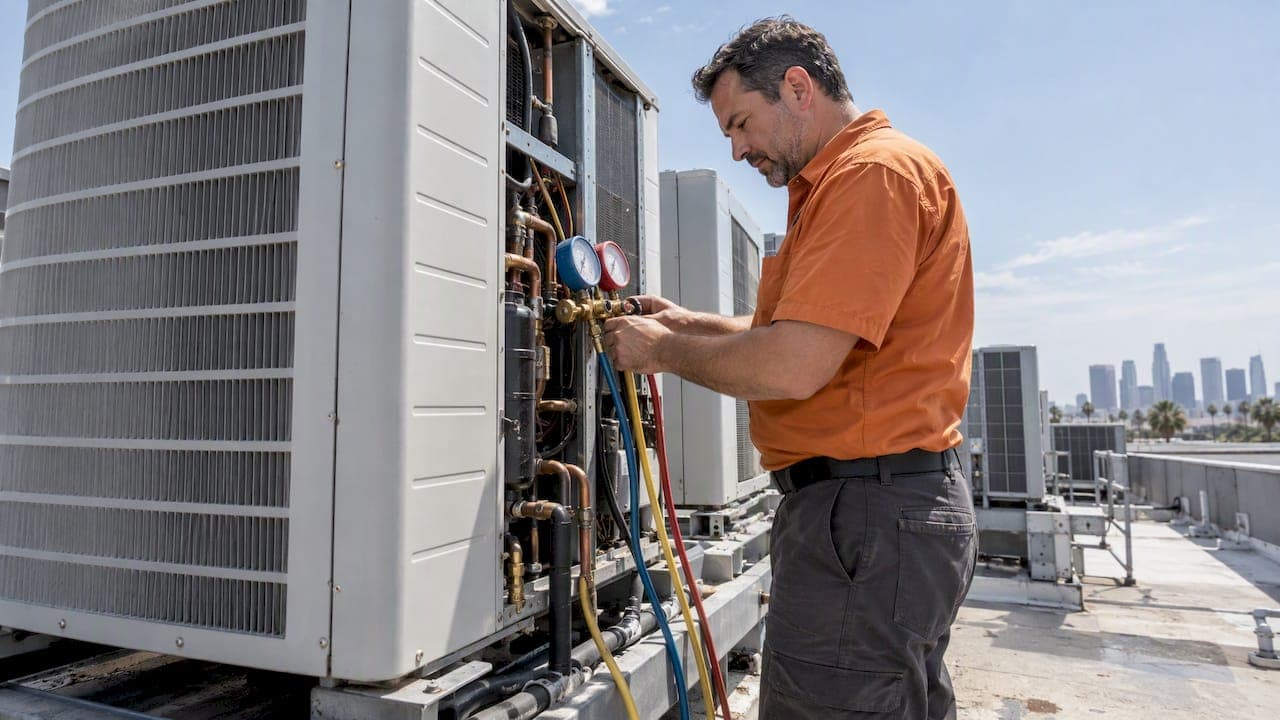
- Outdoor unit. It houses the variable-speed compressors, the inverter controls, the fans, and the condenser coil.
- Indoor units. These can be wall, ceiling cassette, ducted, or floor-mounted. Each has a filter, a coil, a fan, and a condensate drain.
- Refrigerant piping. Long runs connect everything. Joints, insulation, and brazing quality all matter.
- Controls and communication. Wired or wireless controllers, branch controllers, and the network that ties them to the outdoor unit.
Why VRF maintenance is different from a standard system
People often assume VRF needs less care because it has fewer moving parts than older equipment. The system does run more efficiently, but efficiency depends on everything staying within design conditions.
According to Kelley Cramm of ASHRAE, most ongoing VRF problems trace back to improper installation and a lack of routine maintenance. That matches what we see in the field. A system that was installed well and then looked after tends to be quiet, steady, and uneventful for years.
Three features make VRF less forgiving:
- Compressors run at variable, often high speeds, and often year-round. The ASHRAE discussion notes that if one compressor fails, others may overspeed to compensate, which can lead to cascading and expensive failures.
- Condenser coils collect dirt quickly. Many VRF units use micro-fin condensers, which trap dirt and debris more readily than older fin-tube designs. In Los Angeles, add construction dust, ash during fire season, and city grime.
- Controls are proprietary. ASHRAE’s Guideline 41 addendum says maintenance personnel should have manufacturer-specific training on VRF controls, because the system depends on the manufacturer’s own control logic.
How often VRF systems need service
There is no single number that fits every building, but a sensible baseline is clear.
| Task | Who does it | Typical frequency |
|---|---|---|
| Check and clean or replace indoor filters | On-site staff, or technician | Monthly to quarterly, depending on use |
| Visual check of indoor units and drains | On-site staff | Monthly |
| Outdoor coil cleaning | Technician | At least twice a year |
| Full inspection, electrical, refrigerant, controls | Technician | Twice a year |
| Error code and runtime history review | Technician | Every visit |
| Refrigerant leak check and records | Licensed technician | At least annually, and any time performance drops |
The twice-a-year coil guidance comes from the ASHRAE discussion cited above, which says outdoor coils should be cleaned at least twice per year. Our own recommendation is to schedule the two visits in spring, before the first hot stretch, and in early fall, before heating season. Heat pump VRF runs hard in both seasons, so skipping either leaves a gap.
Some buildings need more. A restaurant with kitchen grease in the air, a salon, a dental office, or a unit next to a busy street will load filters and coils faster. Raise the filter schedule first.
The VRF maintenance checklist
Use this as a working checklist for your own staff and as a way to judge a contractor’s service report. If a visit report is a single line saying “system checked,” ask for more detail.
Tasks your on-site team can handle
- Replace or wash indoor unit filters on schedule. Reduced airflow is where trouble starts.
- Look at each indoor unit for water stains, unusual noise, or weak airflow.
- Make sure nothing is stacked against the outdoor unit. Leave clearance for airflow.
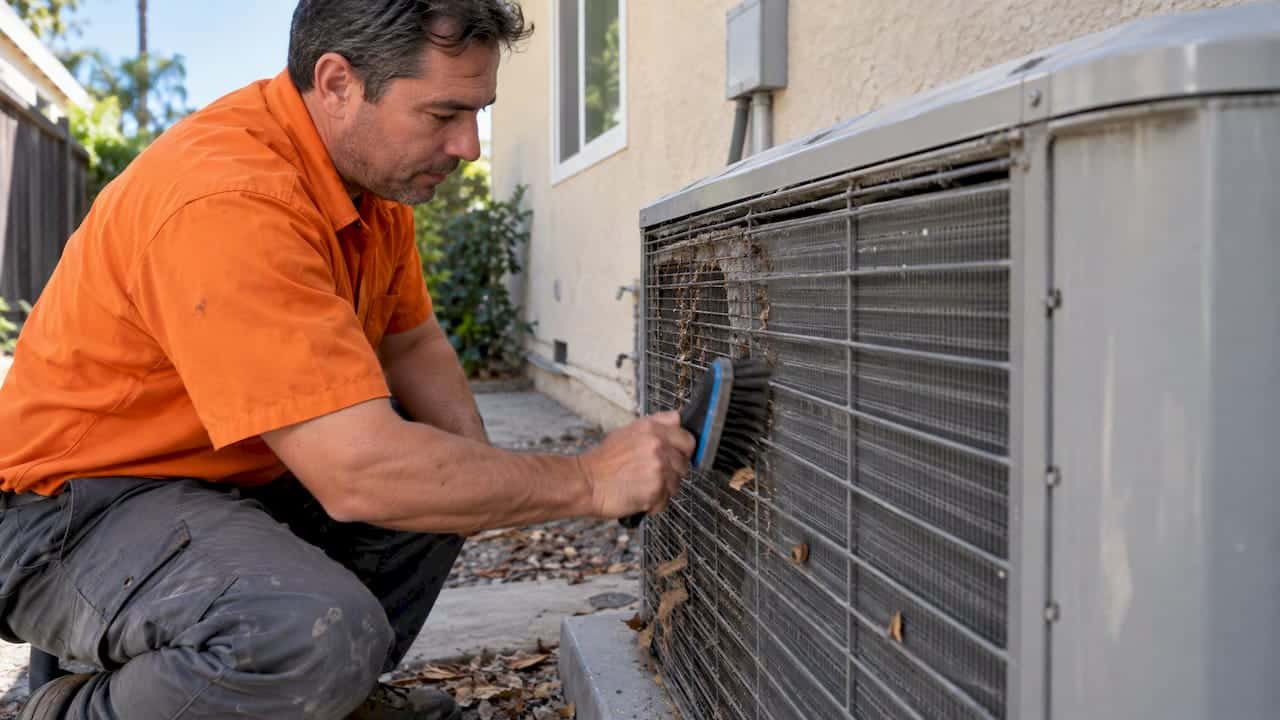
- Remove loose leaves, paper, and debris from around the outdoor unit. Do not pressure-wash micro-fin coils yourself, since bent fins make airflow worse.
- Keep a simple log: date, zone, what you noticed. Patterns help a technician diagnose faster.
- Write down any error code that appears on a controller, along with the time.
We get asked whether owners can clean condenser coils themselves. For a small residential unit, there is a safe method, and we explain it in our guide on cleaning condenser coils without removing them. For a commercial VRF outdoor unit with micro-fin coils, high voltage, and a rooftop or mechanical-room location, leave it to a trained technician.
Tasks for a trained technician
Airside and indoor units
- Inspect and clean indoor coils, blower wheels, and drain pans.
- Test condensate pumps and clear drain lines.
- Confirm that louvers and fans operate without abnormal noise.
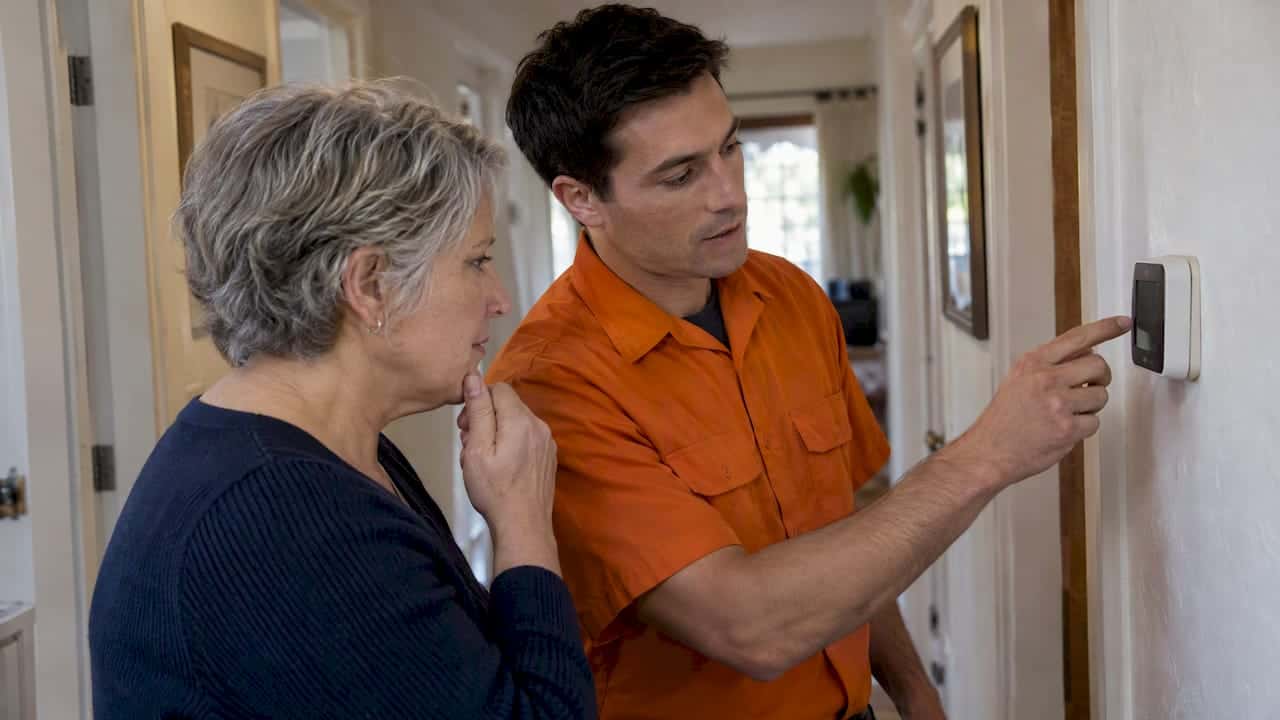
- Check that each zone controller communicates and holds its setpoint.
Outdoor unit
- Clean condenser coils thoroughly with the right method for the coil type.
- Check fan motors, bearings, and blades.
- Inspect electrical connections for heat discoloration and tighten as needed.
- Measure compressor current draw and compare it to the nameplate and previous visits.
- Check the inverter and control boards, and look for signs of moisture or pests.
Refrigerant circuit
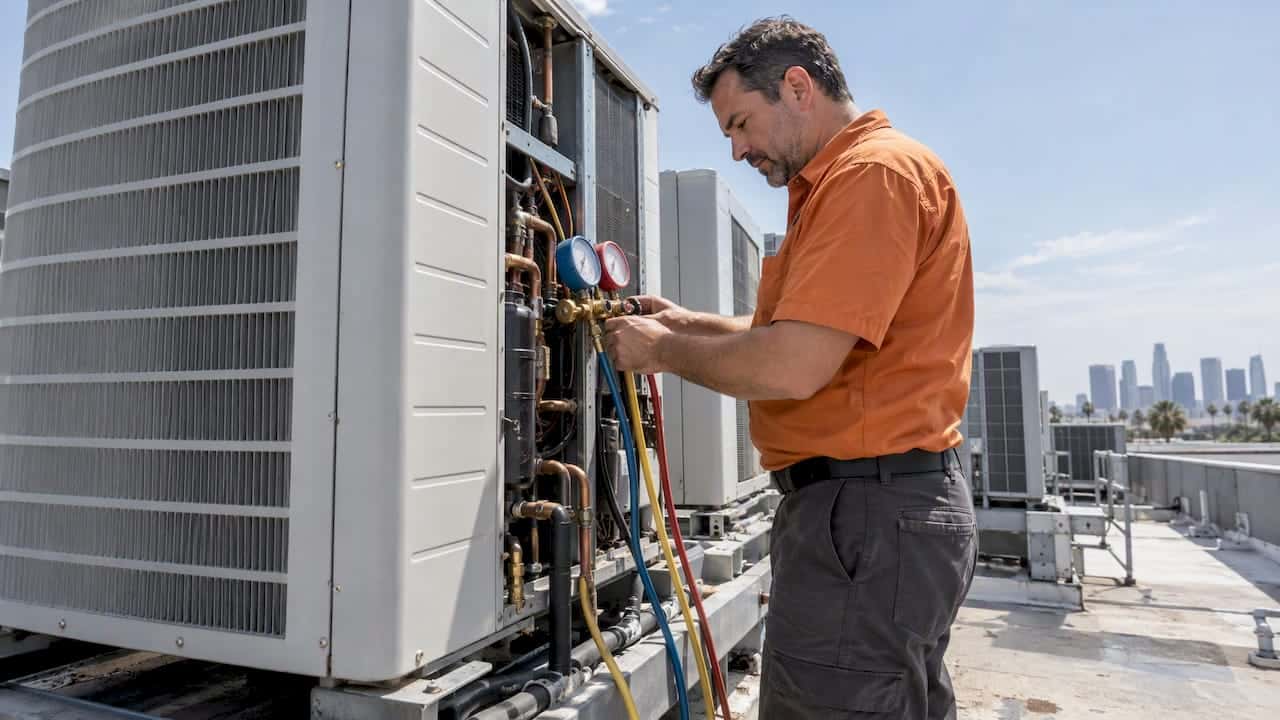
- Check operating pressures and temperatures against the manufacturer’s expected values.
- Inspect piping insulation and look for oil stains at joints and fittings, which can indicate a leak.
- Confirm that the charge reflects the actual installed piping, not just the design drawings.
Controls and data
- Pull the error code history and review it, including resolved codes.
- Verify the schedules, setpoints, and any lockouts or limits set by previous staff.
- Check the communication network between indoor units, branch controllers, and the outdoor unit.
- Review any connection to your building management system.
Documentation
You should receive a written report with readings, work done, and recommended repairs ranked by urgency. Keep it with your equipment records.
The two problems we see most: dirty coils and incorrect charge
Airflow
If indoor filters clog, airflow drops, and the coil can ice up or the compressor can work harder. If outdoor coils clog, head pressure climbs. ASHRAE’s discussion links neglected filters and coils to reduced airflow that can lead to compressor failure. A compressor is the most expensive part of the system, so filters and coils are the cheapest insurance you have. Our article on AC compressor failure symptoms lists the warning signs. For warranty questions, see what homeowners and owners should know about compressor warranties, since skipped maintenance can complicate a claim.
Refrigerant charge
VRF charge is not a simple top-off. When field installation differs from the design drawings, the charge must be recalculated with the manufacturer’s software. The same source says that failing to update it often leads to overcharging, a common cause of early compressor failure. If your building was modified after the original install, such as a tenant improvement that moved indoor units, ask whether the charge was ever recalculated.

Refrigerant leaks and EPA rules
Leaks cause lost capacity, higher bills, and compressor damage. For larger systems they also bring a legal duty. Under EPA Section 608, owners of comfort-cooling equipment holding a full charge of 50 pounds or more of ozone-depleting refrigerant must take corrective action when the leak rate exceeds 10% over 12 months. The EPA’s page also lists higher trigger rates for commercial refrigeration and industrial process refrigeration.
Two cautions. First, whether a particular VRF system falls under this rule depends on its refrigerant type and total charge, so confirm it with a certified technician who has your equipment’s nameplate data. Second, refrigerant rules in California continue to change. Our guide on AC refrigerant leak repair and current rules and our quick guide to HVAC refrigerants are good places to start before you plan a repair or replacement.
What good maintenance saves
The Department of Energy estimates that organizations can reduce annual energy bills by 5 to 20 percent by following operations and maintenance best practices for HVAC equipment. That is a range for commercial HVAC in general, not a promise for any one building. But a VRF system with clean coils, correct charge, and sensible schedules sits at the efficient end of what the technology can do.
Energy savings also come from operation, not only repair. Setpoints, schedules, and zone control all matter. For a broader look at how smart operation cuts energy use in buildings, see these practical examples of efficient building technology, published by a German engineering firm. The principles carry over, even though codes and equipment differ from California’s.
How long a well-kept system lasts
We do not publish a fixed lifespan, because it varies with the brand, the climate, the load, and the care. What we can say is that neglected systems fail early and well-kept systems get far more of their design life. A system serviced twice a year, with clean coils and a documented history, is also easier to sell, lease, or insure than one with no records.
Warning signs between visits
Call a technician rather than waiting for the next scheduled visit if you notice:
- Any error code that returns after a reset.
- One zone that is never comfortable while others are fine.
- Ice on indoor coils or refrigerant lines.
- Water dripping from an indoor unit.
- Outdoor unit noise that changes, such as rattling, humming, or short cycling.
- A sudden jump in the electric bill with no change in use.
- Systems that run constantly without reaching setpoint.
Do not keep resetting the breaker. Repeated restarts can damage compressors and boards, and they erase clues a technician needs.
Choosing a VRF service contractor
Because VRF is proprietary, a general HVAC handyman is not enough. Ask these questions before you hire:
- Which manufacturers are your technicians trained on? The answer should match your equipment.
- Can you read and interpret the controller and error history? Ask for a sample report.
- How do you handle refrigerant? You want licensed technicians, leak checks, and records.
- How is pricing handled? Ask whether you will be quoted a flat price before work begins, or billed open-ended after a diagnostic fee.
- Can you respond the same day? In a Los Angeles summer, a down system in an office or restaurant costs money by the hour.
- Will you tell me when a repair is enough? A good contractor does not push replacement when a repair will do.
Also ask for the system’s commissioning and as-built records. If you do not have them, a technician can help you rebuild a basic file during the first visit.
Our perspective on VRF maintenance
We have worked on Los Angeles heating and cooling for more than twenty years, from historic homes to modern multi-zone heat pump systems and commercial VRF. Heat pumps, mini splits, and VRF are our specialty.
Here is what we have learned. Most VRF emergencies are not surprises. They are the last step in a chain that started with a clogged filter, a dirty coil, a small leak, or an error code nobody followed up on. Owners often call us when the system stops, but the signs were there months earlier.
We also believe the customer should know the price before the work starts. That is why we use flat-rate pricing for repairs and do not charge surprise diagnostic fees. We want you to make a calm decision based on honest findings. If your system needs a repair, we will say so. If it does not need replacement, we will not suggest it.
Our advice for any VRF owner: pick a schedule, put it on the calendar, and keep the paperwork. Twice-yearly service is cheaper than one compressor.
— Leo
VRF and heat pump service from LC Heating & Air
If you manage a commercial property in Los Angeles, Hollywood, Beverly Hills, Bel Air, Brentwood, or nearby, we can service your VRF or heat pump system. We handle commercial HVAC, heat pump service, mini split repair, and emergency repair, and our HVAC maintenance service and preventive maintenance program are built around the kind of schedule described above.
A service call starts from $125. Our residential maintenance plan runs $180 to $250 per year. Pricing for commercial VRF work depends on the system, so call (323) 970-3113 and we will talk through your equipment.
Planning to add or replace a system? We install heat pumps and mini splits as well. See heat pump installation in Los Angeles, or look at financing options for larger projects.
FAQ
How often should a VRF system be serviced?
For most commercial buildings we recommend professional service twice a year, with filter checks monthly or quarterly in between. ASHRAE’s discussion says outdoor coils should be cleaned at least twice yearly. Heavy-use or high-grease environments may need more.
Can my own maintenance staff service a VRF system?
They can handle filters, visual checks, and keeping the area around the unit clear. Coil cleaning, electrical work, refrigerant work, and controls need a trained technician. ASHRAE guidance calls for manufacturer-specific training on VRF controls, which most in-house teams do not have.
What happens if a VRF system is not maintained?
Airflow drops, efficiency falls, and compressors work harder. ASHRAE’s Kelley Cramm points to lack of routine maintenance, along with poor installation, as a root cause of most ongoing VRF problems. Neglect can end in compressor failure and a repair bill far larger than the cost of service.
Does VRF maintenance include a refrigerant check?
Yes. A technician should check pressures, look for signs of leaks, and confirm the charge fits the installed piping. Larger systems may also carry EPA leak-repair duties under Section 608, so keep service records.
What does VRF stand for?
It stands for variable refrigerant flow. The system varies the amount of refrigerant it sends to each indoor unit, so each zone gets the heating or cooling it needs.
Sources
- Variable Refrigerant Flow Air Conditioners and Heat Pumps, U.S. Department of Energy
- ASHRAE Journal Podcast Episode 29
- ASHRAE Addendum d to Guideline 41-2020
- Stationary Refrigeration Leak Repair Requirements, U.S. EPA
- Preventative Maintenance for Commercial HVAC Equipment, Better Buildings
Recommended
Leo, Propietario y Técnico Principal en LC Heating & Air
Leo dirige LC Heating & Air como propietario-operador y tiene la licencia C-20 HVAC #1073586 de California. Sus guías se enfocan en diagnósticos prácticos, decisiones de reparación seguras y consejos claros para propietarios de Los Ángeles.