- Why your AC system needs annual service: the core reasons
- What does an annual AC service actually include?
- How does annual maintenance affect your energy bills?
- How annual servicing extends your AC’s lifespan and prevents major breakdowns
- When and how often should you schedule AC service?
- Key takeaways
- Why I think most homeowners wait too long to schedule service
- Schedule your annual AC service with LC Heating and Air Conditioning
- FAQ
- Recommended
Why Your AC System Needs Annual Service to Last

TL;DR:
- Annual AC service involves professional cleaning, inspection, and maintenance to improve efficiency and prevent costly breakdowns. Regular servicing extends your system’s lifespan to 15-20 years and saves up to 15% on energy bills by maintaining optimal performance. Scheduling in spring before peak season and documenting all maintenance helps protect warranties and ensures reliable cooling.
Annual air conditioning service is defined as a professional inspection, cleaning, and tune-up of your AC system performed once a year to maintain efficiency, prevent breakdowns, and extend operational life. Most homeowners don’t schedule this until something goes wrong. That reactive approach costs far more than the $75 to $200 a typical tune-up runs. Your AC system works against heat, humidity, and constant mechanical stress every cooling season. Without annual attention to filters, coils, refrigerant lines, and electrical components, that stress compounds quietly until you’re facing a repair bill or a full replacement.
Why your AC system needs annual service: the core reasons
The short answer is this: an AC system is a mechanical system, and mechanical systems degrade without maintenance. The longer answer involves understanding exactly what degrades, how fast, and what it costs you when it does.
Dirty filters reduce airflow and efficiency, and coil dirt accumulates over time even when filters are clean. That combination creates a compounding problem. Restricted airflow means your system works harder to move the same amount of cooled air. Fouled coils mean heat transfer is less effective, so the system runs longer cycles to reach your set temperature. Both problems show up on your energy bill before they show up as a breakdown.
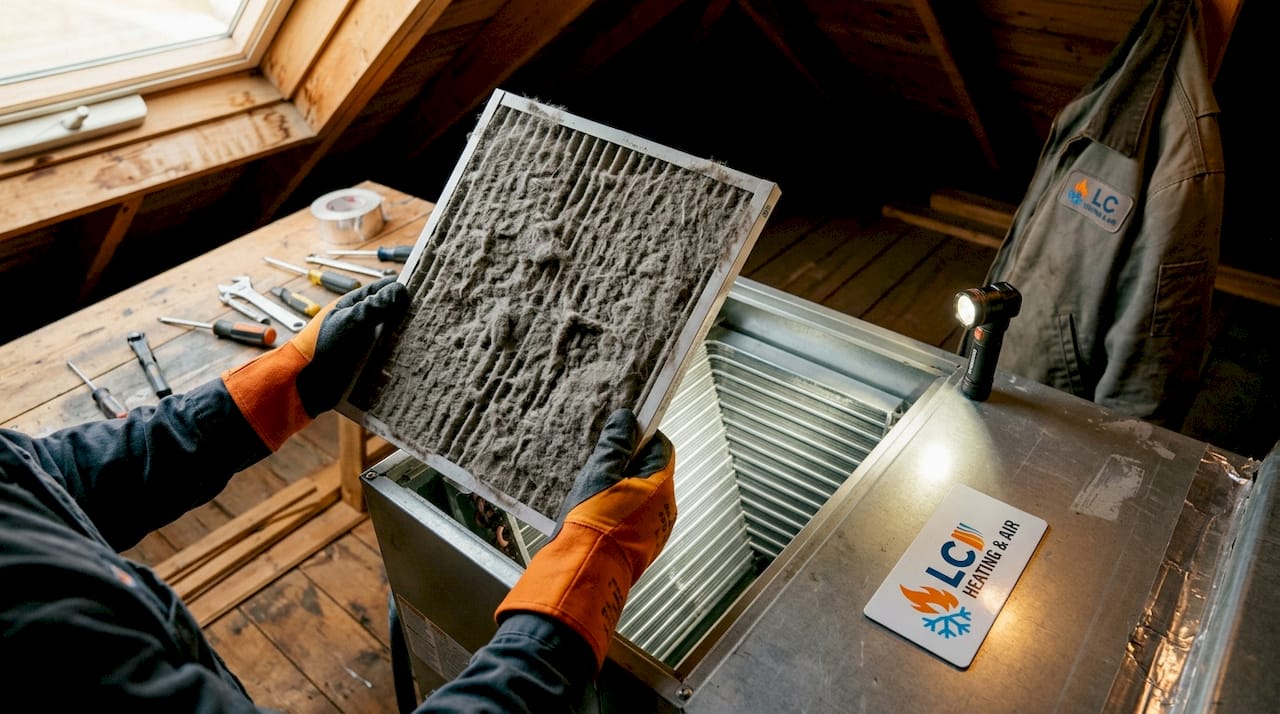
There’s also a misconception worth addressing directly: if your AC is still cooling, you might assume it doesn’t need service. That thinking is expensive. Unseen dirt buildup silently reduces efficiency and comfort long before the system fails outright. A system running at 80% efficiency feels fine until you compare your July utility bill to what it was three years ago.
Annual service also protects your warranty. Major manufacturers require documented annual service from licensed technicians to maintain 10-year parts warranty eligibility. Skip a year and you may be paying out of pocket for a compressor replacement that should have been covered.
What does an annual AC service actually include?
A professional annual AC service covers far more than swapping out a filter. Each task on the checklist addresses a specific failure point in the system.
Here’s what a thorough service visit covers:
- Air filter inspection and replacement. A clogged filter is the single most common cause of reduced airflow. Technicians check filter condition and replace or clean it based on type and usage.
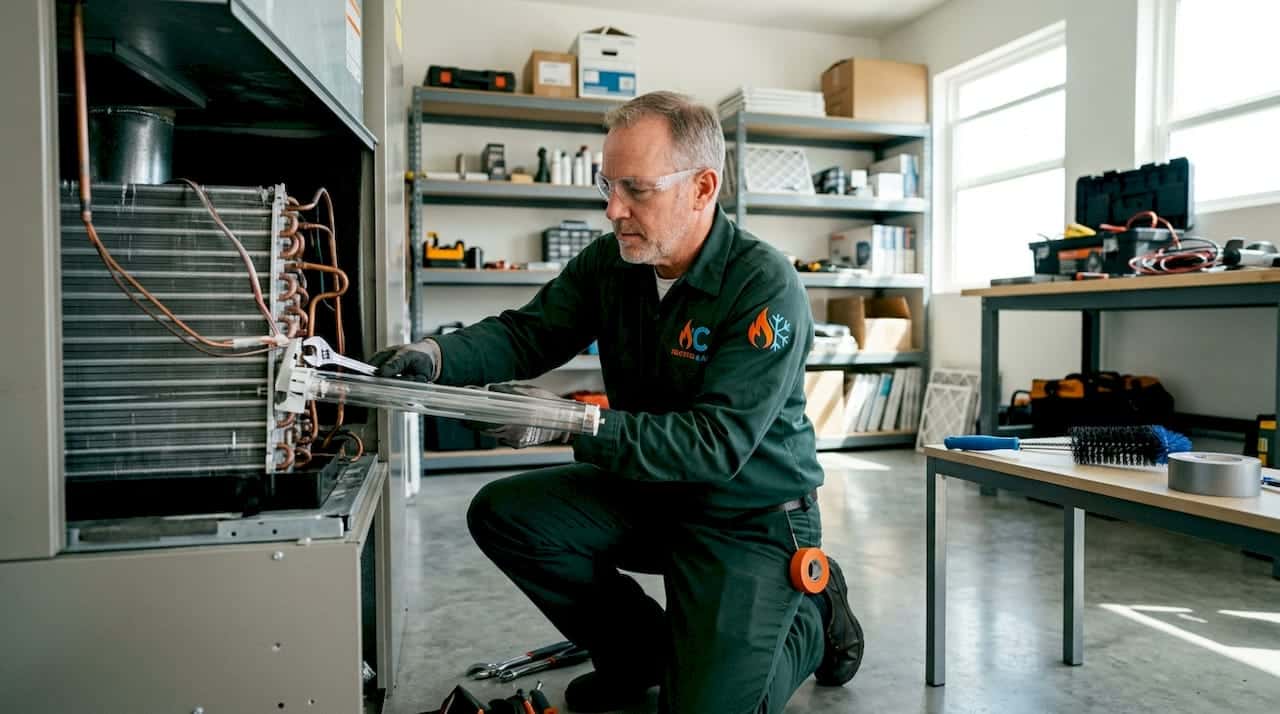
- Evaporator and condenser coil cleaning. Coils absorb and release heat. When they’re coated in dust or debris, heat absorption drops significantly, forcing the system to run longer. This is one of the most impactful tasks in any service visit.
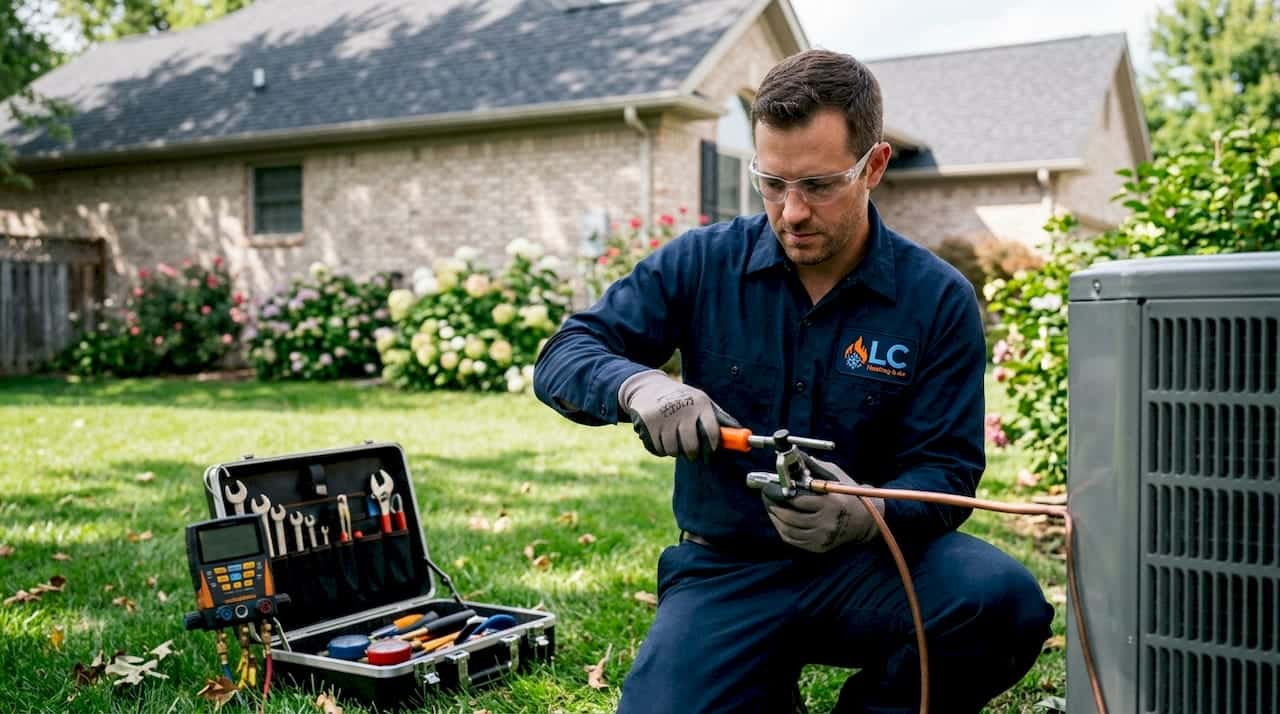
- Refrigerant level check and leak inspection. Low refrigerant doesn’t just reduce cooling. It causes the compressor to work under stress, shortening its life. Technicians check levels and inspect lines for leaks.
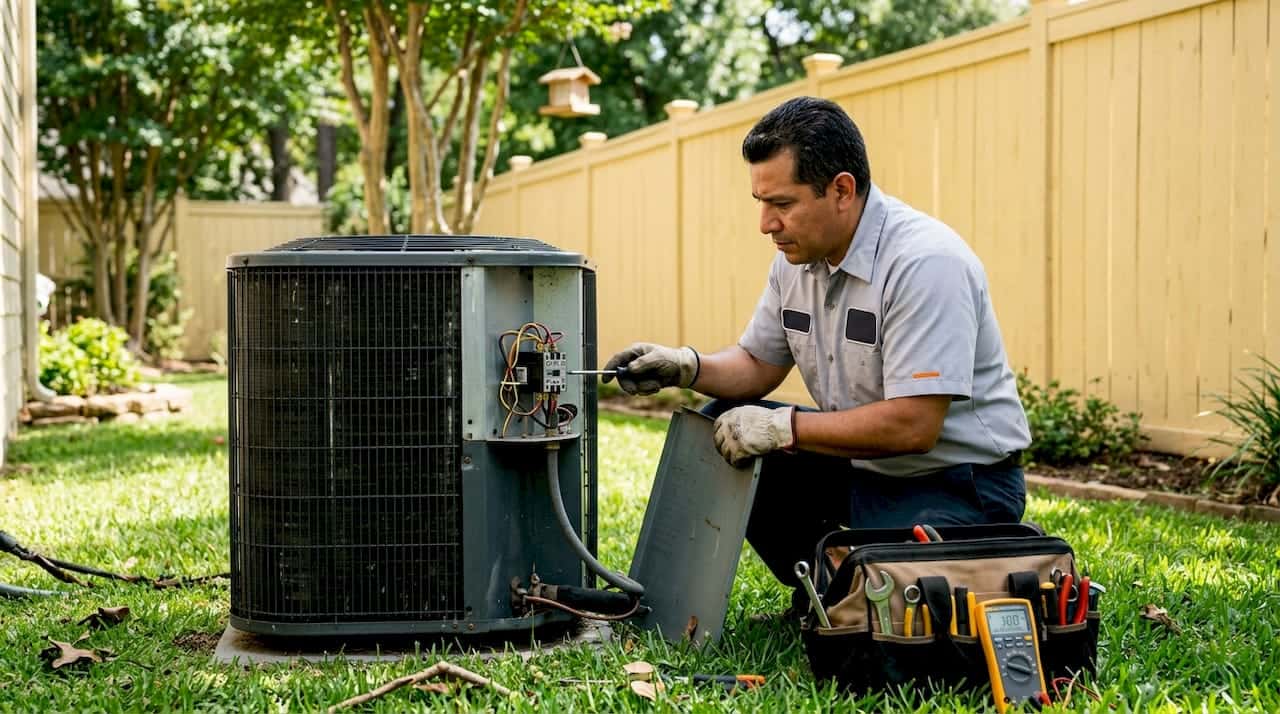
- Electrical connection inspection and tightening. Loose connections cause voltage fluctuations that damage components over time. Technicians also test capacitors, which are small but critical components that start and run the motors.
- Thermostat calibration. A miscalibrated thermostat causes the system to cycle incorrectly, wasting energy and creating uneven comfort.
- Condensate drain clearing. A blocked drain line causes water to back up, leading to moisture damage, mold growth, and system shutdowns.
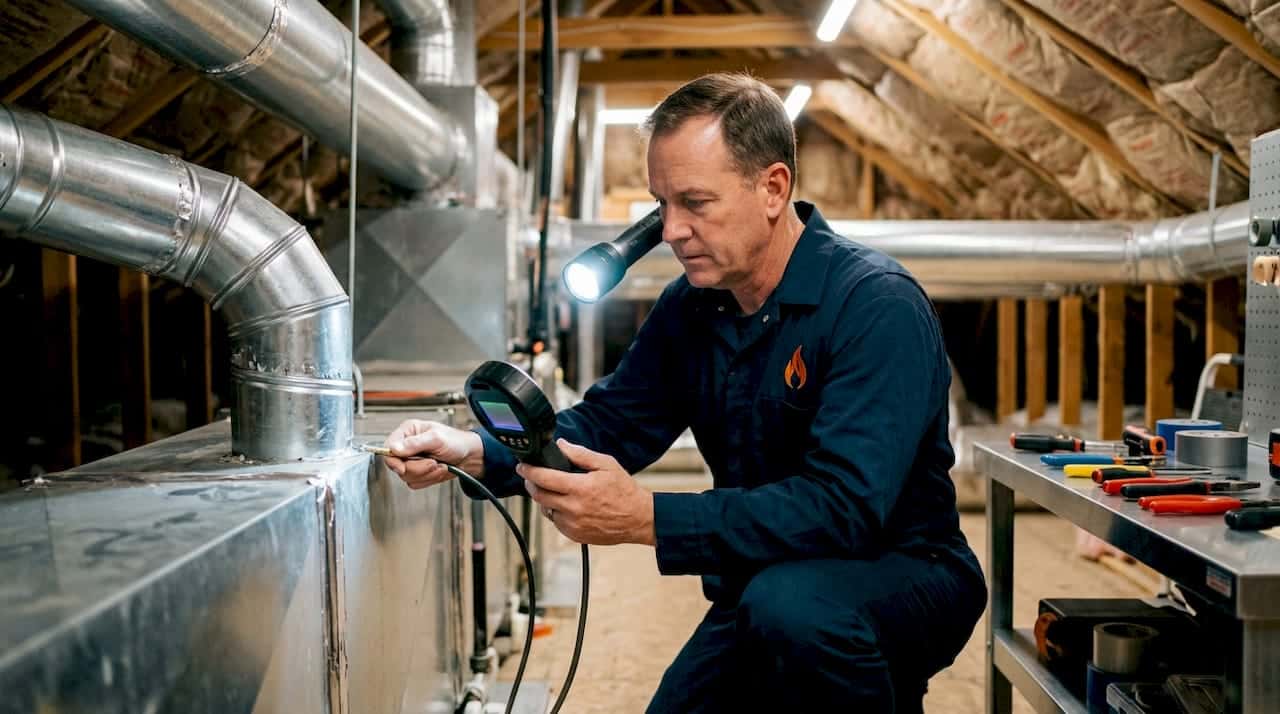
- Airflow and duct inspection. Technicians check that air is moving freely through the system and that no obvious duct issues are restricting delivery.
ENERGY STAR HVAC maintenance checklists specify all of these tasks as necessary for maintaining rated efficiency. Each one addresses a different failure mode, which is why skipping the service means leaving multiple vulnerabilities unaddressed.
Pro Tip: Ask your technician to show you the before-and-after condition of your coils. Seeing the dirt removed from a coil that “seemed fine” is one of the most convincing arguments for annual service you’ll ever encounter.
Broken or worn capacitors are a frequent cause of AC failure. Routine capacitor testing during maintenance catches these small issues early, before they cause the compressor or fan motor to fail. A capacitor replacement costs around $150 to $300. A compressor replacement costs $1,200 to $2,500 or more.
How does annual maintenance affect your energy bills?
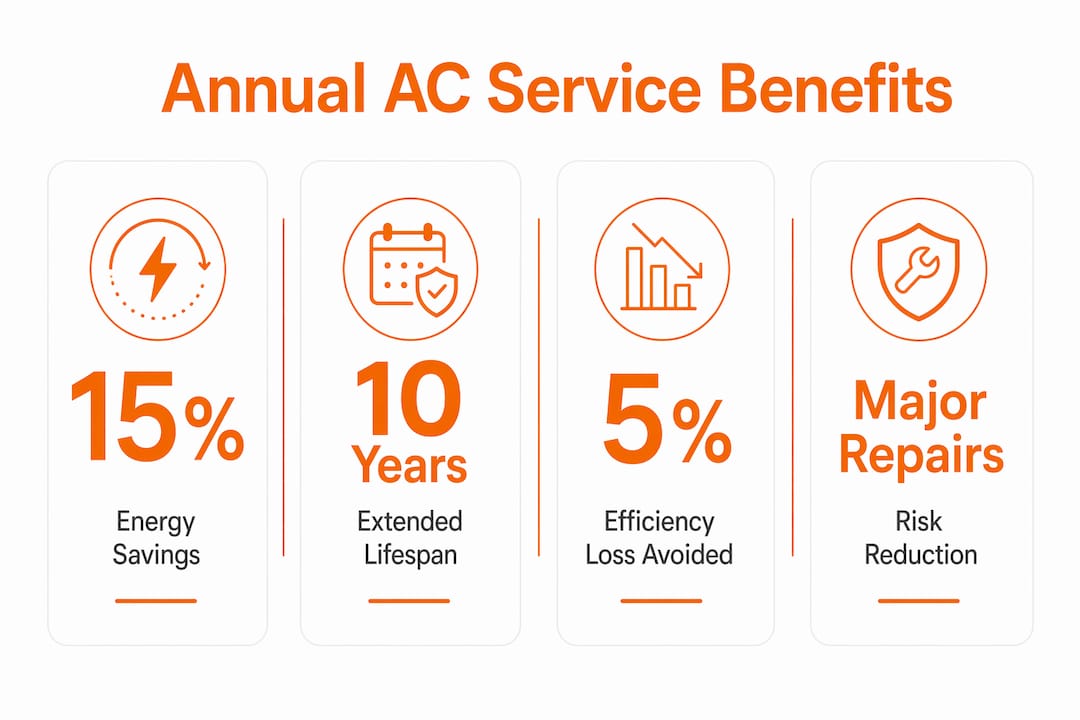
Neglecting maintenance creates a slow, invisible drain on your energy budget. Without annual service, efficiency drops about 5% per year. That means a system that was running at full efficiency when installed is operating at 75% efficiency after five years of no service. You’re paying full price for three-quarters of the cooling output.
That 5% annual decline translates directly to higher monthly utility costs. For a household spending $200 per month on cooling during summer, a 25% efficiency loss adds up to $50 extra per month, or $150 to $200 over a typical three-month cooling season. Over five years, that’s close to $1,000 in unnecessary energy costs, far more than the cost of five annual tune-ups.
Maintaining your system properly can deliver up to 15% energy savings compared to a neglected system. That figure reflects the combined benefit of clean coils, proper refrigerant levels, and correct airflow. Each factor contributes independently, and together they keep the system operating at or near its rated SEER (Seasonal Energy Efficiency Ratio) value.
There’s also the issue of system cycling. Poor maintenance causes irregular cycling, where the system starts and stops more frequently than designed. Short cycling wastes energy and puts mechanical stress on the compressor every time it starts. A well-maintained system holds proper cycle times, which saves energy and reduces wear simultaneously.
Attic insulation also plays a role in how hard your AC works. If your attic isn’t properly insulated, heat bleeds into your living space and forces the AC to compensate. Pairing attic insulation improvements with annual AC service gives you the best possible efficiency outcome.
How annual servicing extends your AC’s lifespan and prevents major breakdowns
The average AC system lasts 8 to 10 years without regular maintenance. With consistent annual service, that lifespan extends to 15 to 20 years. That’s a potential difference of a full decade before you face a $5,000 to $12,000 system replacement.
Here’s a direct comparison of what that looks like in practice:
| Scenario | Expected lifespan | Major repair risk | Warranty status |
|---|---|---|---|
| Annual professional service | 15 to 20 years | Low, issues caught early | Maintained with documentation |
| No regular maintenance | 8 to 10 years | High, failures compound | Voided without service records |
The components most protected by annual service are the compressor, the capacitors, and the refrigerant system. The compressor is the most expensive single component in your AC. It fails when it runs low on refrigerant, overheats from dirty coils, or is stressed by electrical issues. Annual service addresses all three of those root causes before they reach the compressor.
Pro Tip: Keep a folder with your service records, including technician notes and any parts replaced. Manufacturers and home warranty companies both require this documentation when you file a claim. A missing service record from one year can void coverage on a $2,000 repair.
Small repairs caught during annual service also delay major component replacement. A technician who finds a refrigerant leak and fixes it for $200 is preventing a compressor failure that costs ten times more. That’s the core financial logic behind preventative maintenance: you pay a small, predictable cost to avoid a large, unpredictable one. The cost comparison between regular maintenance and emergency repairs consistently favors the former.
When and how often should you schedule AC service?
Annual service is the baseline recommendation for most residential AC systems. The timing and frequency can shift based on your climate, system age, and usage patterns.
- Schedule in spring, before peak cooling season. Spring tune-ups reduce breakdown risk during heat waves and give technicians time to order parts and complete non-urgent repairs before temperatures climb. In Los Angeles, that means scheduling in March or April before the summer heat arrives.
- Consider biannual service if you run your system year-round. In climates where AC runs nine or more months per year, a second service visit in fall makes sense. The system accumulates more wear and more debris in a longer operating season.
- Increase frequency for older systems. Systems over ten years old benefit from twice-yearly inspections. Components are closer to the end of their design life, and catching issues early becomes more important.
- Adjust for heavy use in multi-unit properties. Property managers overseeing apartment buildings or commercial spaces should treat annual service as a minimum. High-occupancy buildings run systems harder and longer than single-family homes.
- Always use a licensed HVAC technician. Pre-season maintenance by qualified professionals minimizes emergency repairs and ensures warranty compliance. DIY filter changes are fine between visits, but the full inspection requires tools and training that go beyond what most homeowners have.
A structured HVAC maintenance plan takes the scheduling burden off your plate entirely. You set it up once, and the service gets done on time every year without you having to remember or coordinate.
Key takeaways
Annual AC service is the single most cost-effective action you can take to protect your system’s efficiency, lifespan, and warranty coverage.
| Point | Details |
|---|---|
| Efficiency loss without service | Systems lose about 5% efficiency per year without maintenance, raising energy bills steadily. |
| Lifespan with regular care | Serviced systems last 15 to 20 years versus 8 to 10 years without maintenance. |
| What service covers | Coil cleaning, filter replacement, refrigerant checks, electrical inspection, and drain clearing. |
| Warranty protection | Most manufacturers void 10-year parts warranties without documented annual professional service. |
| Best time to schedule | Spring, before peak cooling season, gives the most protection and flexibility for repairs. |
Why I think most homeowners wait too long to schedule service
After more than two decades working on AC systems across Los Angeles, I’ve seen the same pattern repeat itself. A homeowner calls in July because their system stopped cooling. We come out, diagnose the problem, and find something that would have cost $150 to fix in April. By July, the compressor has been stressed for months, the repair is now $800, and we’re in the middle of a heat wave with a two-day wait for parts.
The frustrating part is that this is almost always preventable. The signs were there. The system was running longer than usual. The energy bills had crept up. But because the air coming out of the vents was still cold, the homeowner assumed everything was fine. That assumption is the most expensive mistake I see people make.
What I’ve found is that homeowners who schedule service in spring, before they need the AC, almost never call us for emergency repairs. Their systems run longer, their bills stay lower, and they replace equipment on their own timeline rather than in a panic. The math is simple: a $150 tune-up versus a $2,000 repair or a $10,000 replacement. The tune-up wins every time.
My honest advice is to treat your AC service the same way you treat an oil change. You don’t wait for the engine to seize. You do it on schedule because you know what happens when you don’t. The impact on your energy bills alone justifies the cost of annual service within the first cooling season.
— Leo
Schedule your annual AC service with LC Heating and Air Conditioning
If your AC hasn’t been serviced this year, now is the right time to get it done before the heat arrives.

LC Heating and Air Conditioning has served Los Angeles homeowners and property managers for over 20 years, with transparent flat-rate pricing and no surprise fees. Whether you have a single-zone system in a historic home or a multi-zone setup across a rental property, the team at LC Heating and Air Conditioning provides honest diagnostics and professional service that keeps your system running at peak performance. Book your AC tune-up in Los Angeles today, or visit LC Heating and Air Conditioning to learn about annual maintenance plans that take the guesswork out of scheduling.
FAQ
Why does an AC system need service every year?
Annual service prevents the gradual efficiency loss, component wear, and dirt buildup that reduce performance and increase energy costs. Without it, systems lose approximately 5% efficiency per year and face significantly higher breakdown risk.
What happens if you skip AC maintenance for several years?
Skipping maintenance causes coil fouling, refrigerant loss, electrical degradation, and compressor stress that compound over time. Systems without regular service typically fail 5 to 10 years earlier than maintained systems and often lose manufacturer warranty coverage.
How much does an annual AC tune-up cost?
A professional AC tune-up typically costs between $75 and $200, depending on system size and location, and takes one to two hours to complete. That cost is a fraction of what a single emergency repair or early system replacement would run.
What are the signs your AC needs service right away?
Longer run times, rising energy bills, uneven cooling, unusual noises, and ice on the coils are all signs your AC needs attention. These symptoms indicate that maintenance has been deferred too long and a professional inspection is overdue.
How often should AC be serviced in a hot climate like Los Angeles?
In Los Angeles, where cooling seasons are long and systems run hard, annual spring service is the minimum. Systems over ten years old or those running year-round benefit from a second service visit in fall to address accumulated wear before the next cooling season.
Recommended
Leo, Owner & Lead Technician at LC Heating & Air
Leo leads LC Heating & Air as an owner-operator and holds California CSLB C-20 HVAC license #1073586. His guides focus on practical diagnostics, safe repair decisions, and clear advice for Los Angeles homeowners.