- TL;DR
- What power stealing means in a thermostat
- Signs your thermostat has a power stealing problem
- Why modern systems struggle with power stealing
- Quick diagnostic table
- How to check whether you have a C wire
- Fix 1: add a dedicated C wire
- Fix 2: use a C-wire power adapter
- Fix 3: choose a thermostat that does not need a C wire
- Heat pumps, mini splits and VRF: where power matters most
- When to call a technician
- Our perspective on power stealing
- Get it fixed right the first time
- What to ask before you buy a new smart thermostat
- FAQ
- Sources
- Recommended

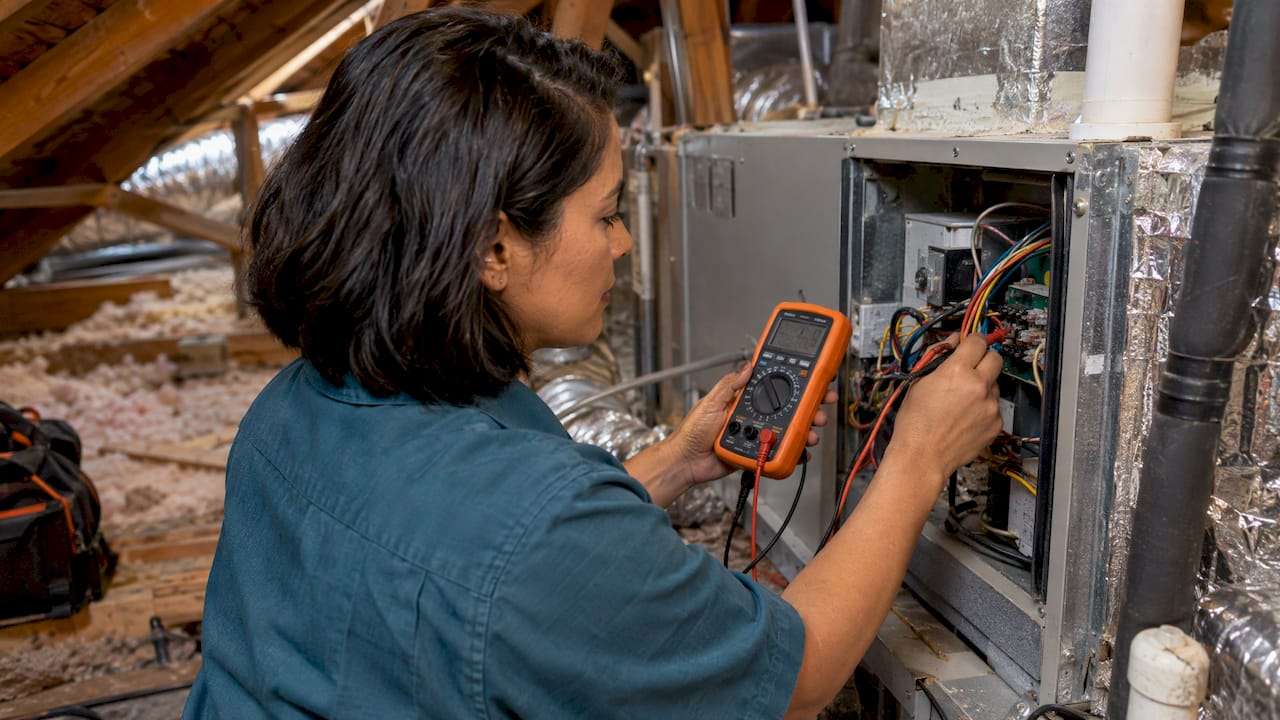
If your thermostat reboots, drops Wi-Fi, short cycles your system or shows a blank screen, power stealing is a likely cause. A power-stealing thermostat has no dedicated common wire (C wire). It borrows a tiny amount of electricity through the heating or cooling wires instead. Some systems tolerate that. Others, especially newer heat pumps and variable-speed equipment, do not. The lasting fix is to give the thermostat a real C wire, or a properly installed adapter that does the same job.
This guide explains how power stealing works, the symptoms that point to it, how to check your own setup safely, and your options for fixing it. We install and repair heat pumps, mini splits and VRF systems across Greater Los Angeles, so we pay special attention to heat pump systems, where these problems show up most often.
TL;DR
- Power stealing means a thermostat without a C wire trickles power from the heating or cooling circuit to run itself. Modern smart thermostats draw more than older models, so the borrowed power often falls short.
- Typical signs: a dead or flickering display, Wi-Fi dropouts, short cycling, a fan that never stops, a system that starts on its own, or error codes on your thermostat.
- The most reliable fix is a dedicated C wire from the HVAC control board to the thermostat. A C-wire power adapter or a thermostat that does not need a C wire are the alternatives.
- Always switch off HVAC power at the breaker before touching thermostat wiring, and photograph and label every wire first.
- Heat pumps and variable-speed air handlers are the most likely to react badly to power stealing.
What power stealing means in a thermostat
Your thermostat is a small computer. It needs a steady supply of 24-volt power. Most homes with a C wire get that power directly from the transformer. Homes without one have only the wires that carry the signals to turn heat, cooling and the fan on and off.
A power-stealing thermostat works around that gap. According to Honeywell Home, this approach, which it calls phantom power, takes power from both the heating and cooling circuits and stores it in a supercapacitor. When the equipment is idle, a small trickle charges the capacitor. When the equipment is running, the thermostat can draw more.
A published thermostat patent describes the same idea. The thermostat lets a small current flow through the equipment’s load coil during idle periods, below the level that would switch the equipment on. It can also draw power through a small voltage drop across its own switch.
That is clever engineering, and for a basic programmable thermostat it can work for years. The trouble starts when the thermostat needs more power than the trickle can supply, or when the HVAC control board is too sensitive to ignore the trickle.
Signs your thermostat has a power stealing problem
Power problems rarely announce themselves. They look like a dozen other issues, so it helps to know the pattern. Google’s Nest support page on the common wire lists these symptoms of inconsistent power:
- Reduced battery life
- A display that will not turn on
- Disabled motion sensing
- Occasional Wi-Fi disconnection
- Unexpected system operation or strange noises
- Heating or cooling that stays on or cycles repeatedly
- “Delayed” or “Starts in” messages
- Fan problems
- Error codes such as E1, E297, N260, N261, N410 or N411
The same page notes that heating-only, cooling-only, zone-controlled and heat pump systems are among those that need a C wire or a compatible power accessory.
Mysa’s support team adds three consequences: short cycling (the system turning on and off in rapid bursts), weaker Wi-Fi connectivity and extra wear on heating and cooling equipment.
What it looks like at home
A few scenarios we hear about from Los Angeles homeowners:
- The thermostat goes blank on the hottest afternoon. Cooling is running, the house is warming up, and the screen dies. The thermostat used up its stored charge and could not recover.
- The AC clicks on and off every few minutes. The compressor keeps getting short signals. That is hard on the equipment and drives up your bill.
- The fan will not stop. The control board reads the borrowed current as a call for the fan.
- The smart thermostat keeps going offline. It is rebooting because it cannot hold a steady voltage.
If any of these sound familiar, see our guide to troubleshooting no power to a thermostat and our safe checks for a blank thermostat screen before assuming the thermostat itself is bad.
Why modern systems struggle with power stealing
Three changes in HVAC equipment have made power stealing less dependable than it used to be.
1. Thermostats now draw more power
Color touchscreens, Wi-Fi radios and sensors all use electricity. A technical tip from the HVAC distributor Munch Supply states that modern thermostats with high-resolution displays and smart features can draw significant power. It says a dedicated C wire is required to power them reliably.
2. Control boards got more electronic
The same tip explains that integrated furnace controls and modern control boards use solid-state electronics to detect calls for heating or cooling. These often do not provide enough electrical load for a power-stealing thermostat to work reliably. It also notes that with newer A2L refrigerant requirements, control boards that supply power to outdoor components remove the contactor coil from the power path. That eliminates the thermostat’s indirect connection to common.
In plain terms: the old trick of borrowing power through a relay coil no longer has a coil to borrow through.
3. Sensitive equipment reads the trickle as a command
One smart thermostat guide explains that a brief power-stealing pulse can be misread by sensitive systems as a call to turn on. That creates a loop of rapid on-off cycling. An HVAC technician will recognize this as classic short cycling.
Heat pumps add another wrinkle
Heat pumps have a reversing valve, wired to the O/B terminal. Depending on the system, that wire is energized continuously in one mode. A troubleshooting write-up on heat pump and ECM air handler lockouts explains that this changes the current budget power stealing relies on. It also reports that a system with both a variable-speed ECM air handler and an O/B wire is among the likeliest to fail with power stealing. We see this combination often in the Los Angeles area as more homeowners switch to heat pumps.
Quick diagnostic table
| What you notice | Likely power stealing link | First safe step |
|---|---|---|
| Blank screen while the system runs | Capacitor not recharging | Check for a C wire at the wall plate |
| Wi-Fi keeps dropping | Voltage dipping under load | Review the power test in the thermostat menu |
| AC or heat cycles on and off rapidly | Trickle current read as a call | Turn the system off and book a diagnosis |
| Fan runs constantly | Control board sees phantom call | Check fan setting, then have wiring checked |
| “C wire isn’t getting power” message | Loose or dead C wire | Reseat the wire with power off at the breaker |
| Heat pump locks out or shows a wiring fault | Reversing valve and trickle conflict | Have a technician check the O/B and C wiring |
This table points you toward a cause. It does not replace a diagnosis, because a failing transformer, a blown fuse on the control board or a shorted wire can look identical. Our guide to thermostat wire shorts covers those.
How to check whether you have a C wire
This check is safe for most homeowners when you follow the steps in order. Honeywell Home’s C wire guide describes the process:
- Turn off power at the breaker or switch that feeds your furnace or air conditioner.
- Confirm the system is off by changing the thermostat setting and checking that nothing responds within 5 minutes.
- Remove the thermostat faceplate from its wall plate.
- Look for a wire connected to the terminal marked C.
Before you disconnect anything, take a clear photo of the wiring and label each wire with the terminal letter. Inspectapedia gives the same advice: never disconnect control wires at HVAC equipment without first documenting the colors and terminal IDs.
If there is a wire in C, and the thermostat still has trouble, the wire may not be connected at the other end, or the transformer may be weak. If C is empty, look at the bundle behind the plate for an unused wire, often blue or black, tucked back into the wall. That spare wire may be usable.
Fix 1: add a dedicated C wire
This is the permanent solution. Munch Supply’s tip states that once a common wire is connected, the thermostat no longer tries to steal power through the control board, and the operating issues are resolved.
The usual process, as Honeywell Home outlines it, is to turn off power, photograph and label the wiring, find the control board, connect an unused wire to its C terminal, and close the cover. At the thermostat end, the same wire goes to C.
Two points matter here:
- Spare wire or no spare wire. If the cable behind the wall has an unused conductor, the job can be quick. If it has only the minimum, someone has to run new cable.
- Who does it. Google’s support page says a new C wire installation generally requires a professional. It says that if you are comfortable troubleshooting your system and take precautions, you may be able to fix C wire issues yourself, but always turn off HVAC power at the breaker first.
In older Los Angeles homes with plaster walls, long cable runs or decades-old wiring, running new thermostat cable can take some planning. Our thermostat upgrade wiring tips and smart thermostat compatibility steps explain what to check before you buy a new thermostat.
Fix 2: use a C-wire power adapter
When a new wire is impractical, an adapter can create a common connection from existing wires. Honeywell Home says C wires are required on all Resideo WiFi thermostats and lists the options when one is missing: check for an unused wire, use a C-wire adapter, or call an HVAC professional.
The installation guide for the Resideo C-Wire Power Adapter says the product replaces the need for a C wire. It should be installed only if you have no C wire available. On zoned systems it goes between the thermostat and the zoning panel, not between the zoning panel and the HVAC equipment. That detail is easy to get wrong, and a mistake can leave you with a thermostat that works worse than before.
Mysa’s product page says its adapter provides continuous 24 VAC power by repurposing existing wiring. It is designed for two-wire heat-only and cool-only systems with just R and W, or R and Y, at the thermostat. Older systems without adequate 24V power can use an external 24 VAC transformer, and one transformer can power up to three adapter-thermostat combinations.
Adapters are often used with accessories such as extenders and relay panels. Munch Supply’s tip lists common wire adapters, extenders, equipment interface modules and relay panels as ways to free up an existing conductor when the wiring has no spare.

Fix 3: choose a thermostat that does not need a C wire
The same Munch Supply tip lists a third option: install a thermostat designed to work without a common wire or power stealing. Some basic non-smart models run on batteries. That can be a sensible choice for a simple system, though you give up the smart features. If you want a connected thermostat, a C wire is the better path.
Heat pumps, mini splits and VRF: where power matters most
Heat pumps are our specialty, so here is how this plays out on the equipment we work on most.
Ducted heat pumps. These often pair a variable-speed air handler with an O/B reversing valve wire, the combination the troubleshooting write-up above flags as the likeliest to fail with power stealing. If your new heat pump came with a thermostat that keeps rebooting, or the system locks out soon after a thermostat swap, wiring is a prime suspect. A proper C wire is usually the right answer.
Mini splits. Most ductless mini splits use their own remote or wall controller and communicate with the outdoor unit through a dedicated cable. They typically avoid the power-stealing issue. If you use a third-party smart controller, it may bring its own power requirements, so check what the controller needs.
Commercial and VRF systems. Commercial controls have their own power and communication wiring. Power stealing is rarely the issue there, but control wiring faults can imitate it. If a commercial thermostat or controller keeps dropping out, a technician should trace the control circuit instead of swapping parts.
If you are planning a heat pump upgrade, ask whether your existing thermostat wiring has a C wire before the installers arrive. Our heat pump installation page explains how we plan the controls as part of the job.

When to call a technician
Some problems are fine to check on your own. Others call for a professional. Call someone if:
- There is no spare wire and you are not sure how to run new cable
- The thermostat keeps losing power even with a C wire connected, which can mean a weak transformer or a blown fuse on the control board
- You have a zoned system, a heat pump with an ECM air handler, or a multi-stage setup
- Your system has short cycled or locked out repeatedly
- You smell burning or see damaged wires
Google’s support page says that if the C wire still is not getting power after you reseat it with the power off, you should contact a pro. We agree.
Before you reach for a screwdriver, our checklist of common thermostat wiring mistakes to avoid and five quick thermostat checks can save you a service visit or help you describe the problem accurately.
Our perspective on power stealing
We see power stealing problems most often right after a thermostat upgrade. A homeowner installs a smart thermostat, it works for a few weeks, and then the trouble starts: odd cycling, a screen that goes dark, an app that keeps losing the system. The thermostat usually gets the blame. In our experience the wiring is the thing to look at first.
Our approach is to find the actual cause before suggesting anything. A good diagnosis traces the power path, checks the transformer and control board, and confirms what the thermostat needs. Then you get a clear flat-rate price for the fix. We do not believe in surprise diagnostic fees or pressure to replace equipment that has a simple wiring problem.
Heat pumps and mini splits are where we spend our days, and the controls on those systems deserve extra care. A heat pump with a variable-speed air handler and a reversing valve should have a steady, dedicated common connection. We would rather run the proper wire once than leave you with a workaround that comes back in a hot August week.
If your thermostat is misbehaving, you do not have to guess. Tell us what it is doing, and we will tell you honestly what it takes to fix it.
Leo
Get it fixed right the first time
If your thermostat is acting up, a technician can check the C wire, the transformer, the control board and the thermostat settings in one visit. Our service call starts at $125 as a one-off fee, and repairs are quoted at a flat rate, so you know the cost before work begins. You can see how that works on our service call page.

We handle thermostat wiring, heat pump services, mini split repair and commercial VRF service across Greater Los Angeles, including Hollywood, Beverly Hills, Bel Air and Brentwood. Call us at (323) 970-3113 to book. If the diagnosis points to a new system, heat pump installation is published at $5,500 to $12,000, and you can review financing options before you decide. A maintenance plan at $180 to $250 per year includes regular checks that catch weak wiring and worn parts early.
What to ask before you buy a new smart thermostat
Most power stealing problems start at the store shelf. A little planning avoids them.
- Check the wall plate first. Open your current thermostat and see if a wire sits in C. A photo is enough to take with you.
- Read the compatibility requirements. Manufacturers publish them. Heating-only, cooling-only, zoned and heat pump systems are often the ones that need a C wire or accessory.
- Know your equipment. Note whether you have a heat pump, a variable-speed air handler or a zoning panel.
- Plan for the wire. If there is no C wire, decide whether to run one, use an adapter, or choose a thermostat that does not need it.
- Have someone check the transformer. A weak or overloaded transformer causes the same symptoms as power stealing.
You will get a more stable system, a longer-lasting thermostat and fewer surprise service calls.
FAQ
What does power stealing thermostat mean?
It means the thermostat has no dedicated common wire, so it draws a small amount of power through the heating or cooling wires to run itself. It stores that energy in a capacitor or battery. Newer smart thermostats use more power than this method can always provide.
How do I know if my thermostat is power stealing?
Open the thermostat with the HVAC power off at the breaker, remove the faceplate and look at the wall plate. If the C terminal has no wire, the thermostat is likely power stealing. Take a photo of the wiring first. If you are unsure what you are seeing, a technician can confirm it quickly.
How do I add a C wire to a thermostat?
Turn off power, photograph and label the wires, find the control board, connect an unused wire from the thermostat cable to its C terminal, and connect the other end to C at the thermostat. If the cable has no spare wire, new cable or an adapter is needed. Google’s support guidance says new C wire installation generally requires a professional.
Can power stealing damage my HVAC system?
It can add wear. Short cycling, where the system switches on and off in rapid bursts, is hard on the equipment. Fixing the power supply removes the cause, so a C wire or adapter is worth doing sooner rather than later.
Does a heat pump need a C wire?
Often yes. Google’s support page lists heat pump systems among those that require a C wire or a compatible power accessory. Heat pumps with variable-speed air handlers and reversing valve wiring are especially sensitive, so have the wiring checked if your thermostat is unstable.
Sources
- Honeywell Home: What is phantom power or power stealing?
- Honeywell Home: What is a C-wire and how it works
- Google Patents: US20160138823A1, adaptive power-stealing thermostat
- Google Home and Nest Help: the common or C wire
- Mysa Support: understanding your C-wire and the power adapter
- Munch Supply: power-stealing thermostats and modern HVAC systems
- Thermostating: C-wire, variable-speed heat pump and lockouts
- Inspectapedia: how to add a common wire
- Resideo C-Wire Power Adapter installation guide
- Mysa C-Wire Power Adapter
Recommended
Leo, Propietario y Técnico Principal en LC Heating & Air
Leo dirige LC Heating & Air como propietario-operador y tiene la licencia C-20 HVAC #1073586 de California. Sus guías se enfocan en diagnósticos prácticos, decisiones de reparación seguras y consejos claros para propietarios de Los Ángeles.