- TL;DR
- What static pressure actually is
- Why it matters for comfort, bills and equipment
- Signs your static pressure may be too high
- How technicians measure static pressure
- What is a good static pressure reading?
- What causes high static pressure
- How static pressure problems get fixed
- What this costs in Los Angeles
- Our perspective: measure first, then decide
- Have your airflow measured by a local team
- What you can check yourself
- FAQ
- Sources
- Recommended

Static pressure is the resistance your air handler or furnace blower has to overcome to move air through the filter, coil, ductwork and vents. It is measured in inches of water column (in. w.c.), and for most homes a total external reading of about 0.5 in. w.c. or less is the target. Much higher than that, and your system is working too hard for the air it delivers.
This guide explains what the number means, how a technician measures it, what a reading like 0.76 tells you, and what to do about it. If you live in Los Angeles and your rooms are uneven, your blower is loud or your bills have crept up, static pressure is one of the first things worth checking.
TL;DR
- Static pressure is airflow resistance. Think of it as blood pressure for your ductwork: too high means the system is straining.
- Technicians measure it with a manometer at two points, add the readings to get total external static pressure (TESP), and compare it with the equipment nameplate.
- Around 0.5 in. w.c. or less is the usual goal for residential systems, and readings near 0.8 in. w.c. or higher often signal trouble.
- The usual culprits are clogged or overly restrictive filters, dirty coils, undersized or kinked ducts and too few return grilles.
- Fixing the cause (not just swapping the equipment) protects efficiency, comfort and the life of your blower motor.
What static pressure actually is
Air moving through a duct has two kinds of pressure. Velocity pressure comes from the air’s motion. Static pressure is the force the air pushes with against the duct walls and components, and it represents resistance to airflow. Add the two together and you get total pressure, which an HVAC textbook from Raritan Valley Community College defines as the algebraic sum of static and velocity pressure. The same text notes that static pressure is measured in inches of water column.
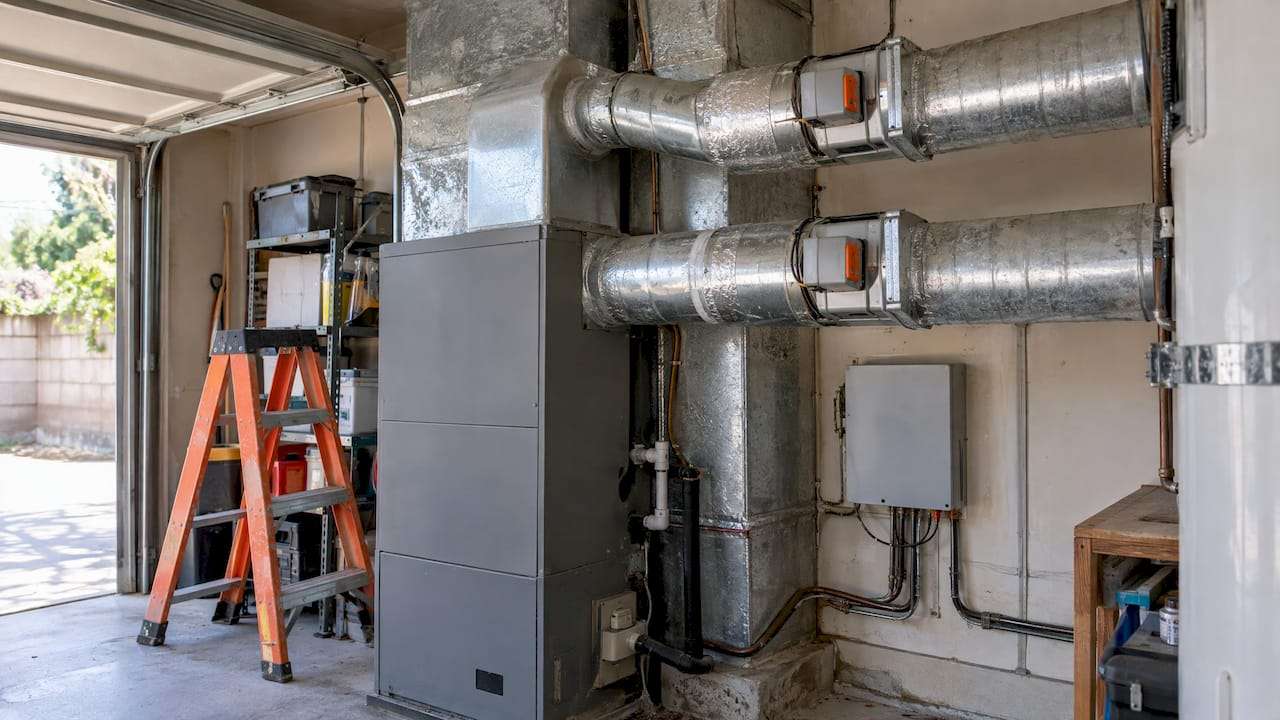
A simple way to picture it: breathe through a wide drinking straw, then through a coffee stirrer. Same lungs, very different effort. Your blower is the lungs. The filter, evaporator coil, heat exchanger, ducts, bends and registers are the straw. Every one of them adds resistance, and the blower has to beat the total.
Fan makers care about this number because it decides how much air a fan actually moves. The Air Movement and Control Association says static pressure is commonly used to specify fan performance. A blower rated for 1,200 cubic feet per minute (CFM) at 0.5 in. w.c. will deliver noticeably less when your ducts push back at 0.9.
Total external static pressure (TESP)
When technicians say “static pressure,” they usually mean TESP: the combined resistance outside the blower cabinet itself. It is the sum of the pressure on the return side (a negative number, read as positive for the math) and the pressure on the supply side. The equipment nameplate lists the manufacturer’s rated TESP, and that is the number a technician compares your home against.
Why it matters for comfort, bills and equipment
High static pressure is rarely dramatic. It shows up as small annoyances that add up:
- Higher energy use. When static pressure is high, blower motors work harder, which reduces motor efficiency and raises energy use.
- Uneven rooms. Added resistance can cut airflow to rooms far from the unit, leaving them warmer in summer and cooler in winter.
- Noise. Whistling registers, rumbling ducts and a blower that sounds like it is laboring.
- Wear. The same source notes more wear on system components, including the blower motor and the coil.
In Los Angeles, where an AC may run for months, a duct system that strains the blower costs real money over a season. While a duct fix is being planned, some homeowners add a room fan to move air in the hottest spots, but a fan only masks the symptom. The restriction is still there.
Heat pumps and mini splits feel it too
A heat pump that ducts air through your home has the same blower, coil and ductwork as a conventional AC, and it runs in both seasons. Restricted airflow in heating mode can make the system seem weak, and in cooling mode it can let the coil run too cold. That is why a heat pump that “doesn’t heat well” or “won’t cool the back bedroom” often turns out to have a duct problem rather than a refrigerant problem.
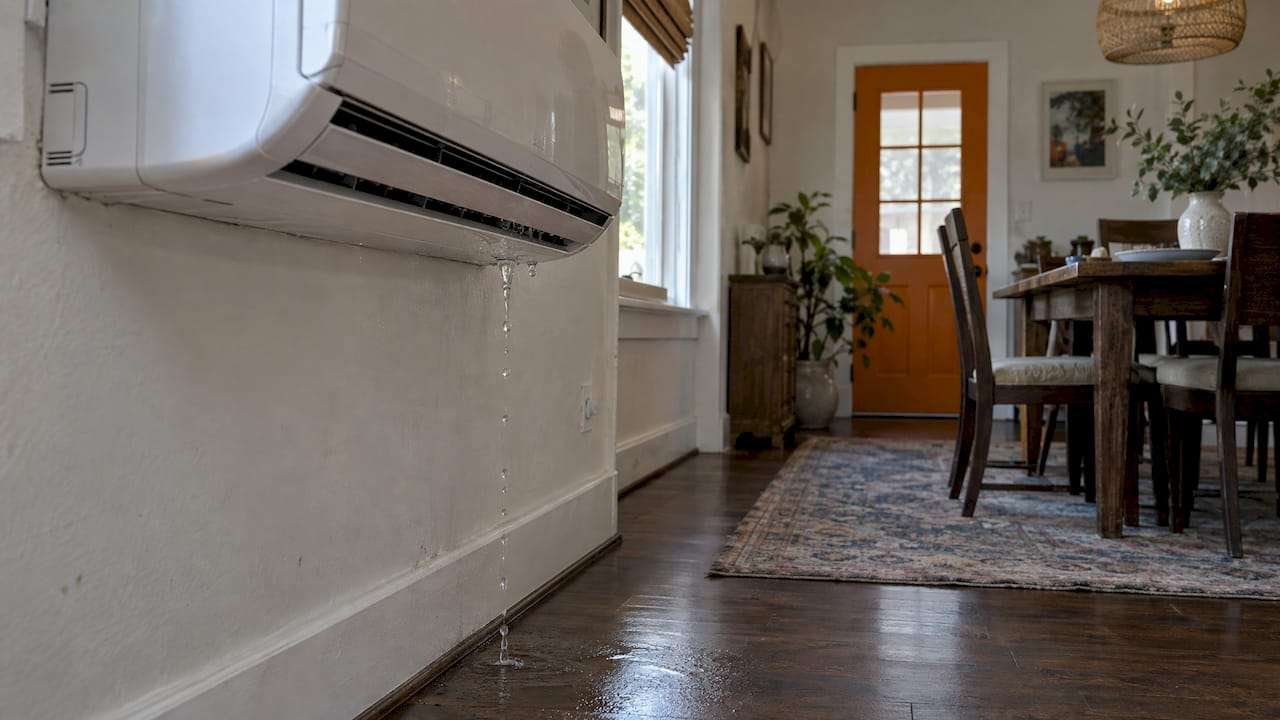
Ductless mini splits are different: there is no duct system to restrict air, so the concept applies mostly to their ducted cousins (concealed-duct and multi-zone ducted units, which have a small available static pressure rating). If your mini split has weak airflow, the cause is more often a dirty filter, coil or blower wheel. Our heat pump service team diagnoses both types.
Signs your static pressure may be too high
No homeowner can read static pressure without a gauge, but your house gives clues:
- One or more rooms never reach the thermostat setting, especially rooms at the end of a long duct run.
- The blower is loud, or registers whistle.
- Your energy bills climbed with no change in habits.
- The evaporator coil freezes, or the AC short-cycles.
- The furnace overheats and shuts off on its limit switch.
- Dust blows from vents or collects around registers. We cover that in our guide on dust coming from vents.
None of these proves static pressure is the cause. Low refrigerant, a failing capacitor or a dirty coil can cause several of them. That is the value of measuring: it turns a guess into a number.
How technicians measure static pressure
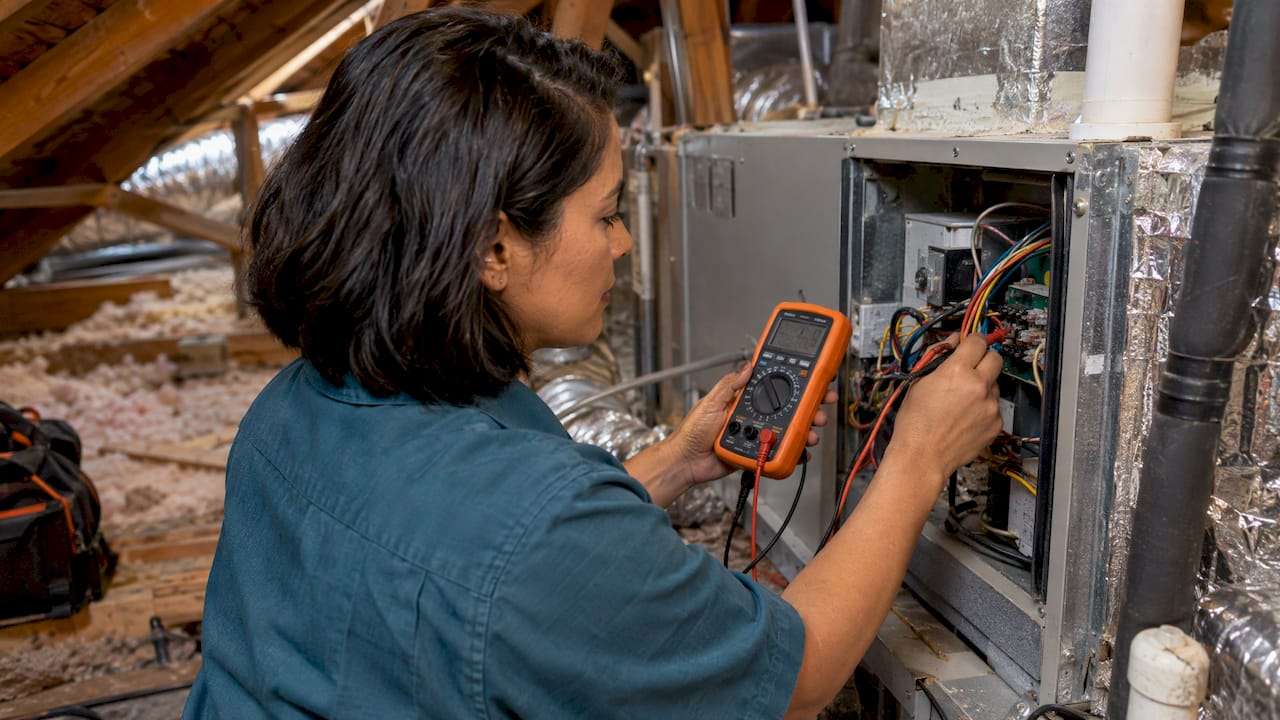
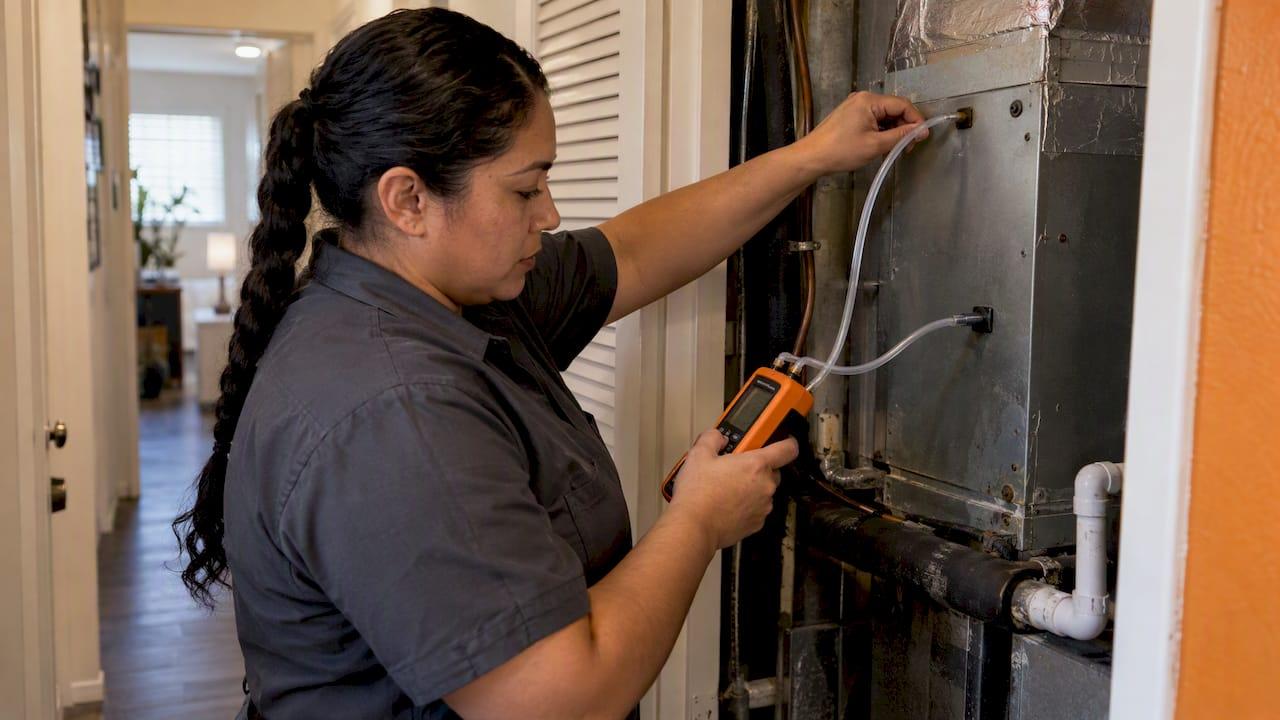
The tool is a manometer, a gauge that reads small pressure differences in inches of water column. A digital dual-port model is common. The process, in plain terms:
- Drill or use test ports. A tech makes small holes (later plugged) or uses existing ports on both sides of the blower and coil.
- Read the return side and the supply side. According to ACCA, technicians use a dual-port manometer at two test sites and add the readings to find TESP. For a typical upflow gas furnace, one port goes where air enters the furnace after the filter, and the other where air exits the furnace, placed before any external coil.
- Point the probe correctly. HVAC School advises using a static pressure tip pointed against the airflow so velocity pressure doesn’t skew the reading.
- Compare with the nameplate. The measured TESP goes against the manufacturer’s rated value.
- Find where the resistance lives. This is called pressure profiling: a series of readings across components shows which one is eating the pressure budget.
Worked example
The Bonneville Power Administration’s program materials give a clean example. A technician measures 0.28 in. w.c. on the return side and 0.34 in. w.c. on the supply plenum. Added together, that is 0.62 in. w.c. of external static pressure. The tech then reads the manufacturer’s fan table at the blower speed setting to estimate real airflow. At 0.62, the blower is already past the ideal range, so airflow will be lower than the nameplate promises.

The filter test
A useful trick: compare readings with and without the filter in place. That lets a technician find the specific pressure drop the filter itself contributes. The National Comfort Institute suggests the pressure drop across a furnace air filter should ideally be limited to about 20% of the rated static pressure budget, and the coil to no more than 40% in a residential furnace. Those percentages show why a thick, high-MERV filter on an older duct system can cause trouble.
What is a good static pressure reading?
A common question is whether 0.76 is good. Here is the guidance. ACHR News reports that for residential and light commercial systems, TESP is generally desired at 0.5 in. w.c. or less, while 0.8 in. w.c. or higher can indicate trouble on most newer residential equipment. The BPA program materials say a program allows up to 0.8 in. w.c., yet most manufacturers suggest 0.5 or less.
| TESP reading (in. w.c.) | What it usually means |
|---|---|
| 0.5 or less | Within the typical design target for most residential equipment |
| 0.5 to 0.8 | Above target: worth finding the restriction, since airflow and efficiency are slipping |
| 0.8 or higher | Likely trouble on most newer systems: investigate duct, filter, coil and return sizing |
So 0.76 is not good. It is not a disaster either, but it is close to the line and above what most manufacturers want. Always judge against the rated TESP on your own nameplate, because a unit built for higher static pressure tolerates more than a standard one.
Two other questions come up often. The “$5,000 rule” for AC is a rule of thumb about repair cost versus replacement, not a static pressure measure, and the “2 foot rule” is a duct-layout shortcut some installers cite. Neither replaces a measured reading and a load calculation, so we would not make a decision based on them.
What causes high static pressure
Most problems fall into a few buckets. The EPA’s indoor air quality guidance notes that loaded filters increase pressure drop and reduce airflow, and that long runs of flexible duct with sharp bends cause excessive friction.
Filters that are too restrictive or too dirty
The most common and cheapest cause. A pleated filter with a high MERV rating can be great for air quality, but if your return is small, it chokes the system. Check the filter first, and ask your technician for a filter pressure-drop reading before you buy something denser.
Dirty or undersized evaporator coils
Dust and debris build up on the coil face and reduce the openings air passes through. Sometimes the coil itself is too deep or too tight for the duct system. When a coil is truly the problem, replacement matching the air handler is the fix, and we stock a range of matched evaporator coils, such as this ADP evaporator coil, for that situation.
Undersized, crushed or kinked ducts
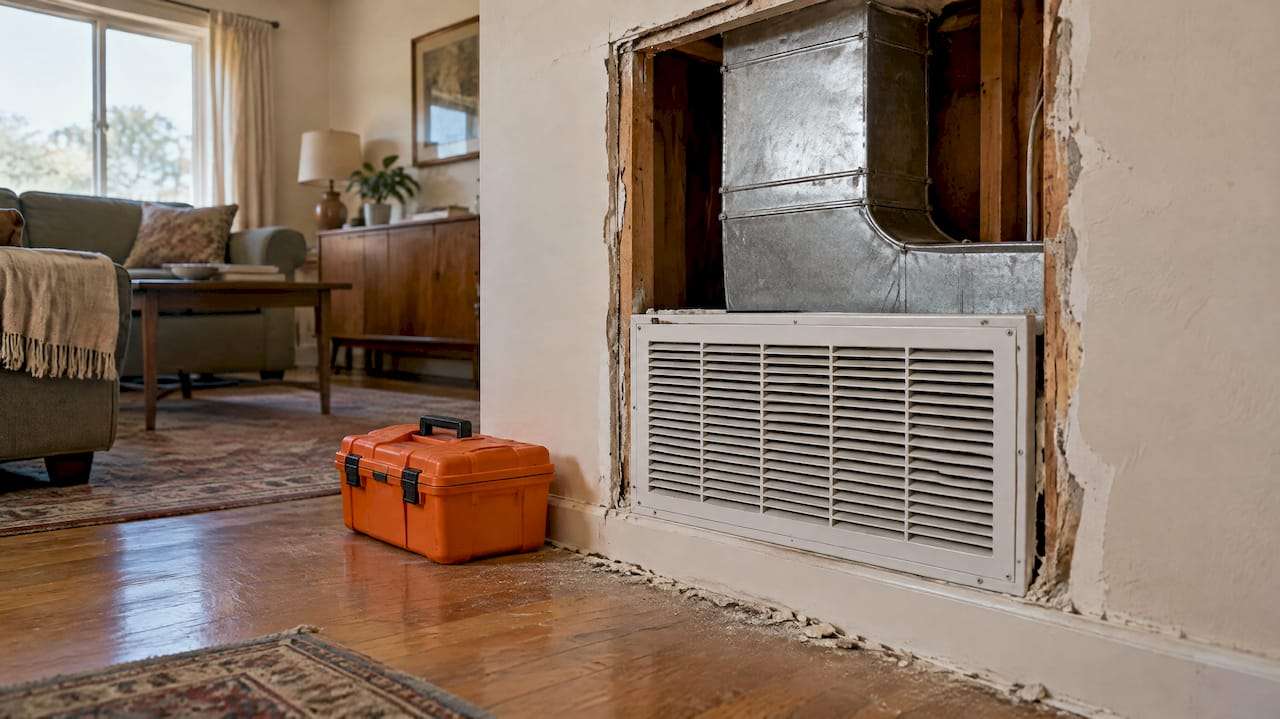
Small trunk lines, crushed flex duct and long, sagging runs all push the number up. The EPA also points out that real-world ductwork often differs from its design because it has to share space with structural members and other building systems, and those differences add friction.
This is especially common in older Los Angeles homes. Bungalows and mid-century houses frequently have ducts squeezed through tight attics or crawlspaces, or an AC added decades after the original furnace. We have rebuilt that kind of system; see our attic ductwork redesign case study for what that looks like in practice.

Not enough return air
A system with one small return grille for a large house is a classic restriction. Air has to get back to the blower as easily as it leaves. Closed doors and bedrooms without return paths make the problem worse.
Too many closed or blocked supply registers
Closing vents to “push air to other rooms” usually raises static pressure and cuts total airflow. Keep registers open unless a technician tells you to balance them.
Oversized equipment on small ducts
Swapping in a bigger AC or heat pump without changing the ducts is a recipe for high static pressure. More tons means more airflow demanded from the same pipes.
How static pressure problems get fixed
The repair matches the cause:
- Replace or downgrade the filter. Use a filter that fits the return size and the blower’s capability, or enlarge the filter rack.
- Clean the coil and blower wheel. Restores open surface area.
- Add or enlarge returns. Often the single most effective fix in homes with one central return.
- Replace crushed or kinked flex duct. Straighter, shorter, properly supported runs.
- Resize the trunk or branches. When the system was never designed well, this is a true duct redesign.
- Adjust blower speed. A technician can tune the speed tap to the actual static pressure, but this is a compromise rather than a cure.
Technicians can also use the measured readings to work with design tools. The U.S. Department of Energy’s Building America guidance describes an external static pressure worksheet designers use to track component pressure losses so the total matches what the equipment can deliver.
California adds airflow verification
California’s energy code takes airflow seriously. The California Energy Commission’s residential compliance manual explains that adequate airflow is critical for cooling efficiency, and that Section 150.0(m)13 requires system airflow and watt draw to be HERS-verified in applicable installations. That manual is from the 2019 code cycle, so requirements for your project may have been updated. A good contractor confirms the current rules before a new install or major duct alteration, which is part of why we pay attention to California requirements on every job.
What this costs in Los Angeles
The fix can be as cheap as a filter or as big as a duct redesign. Here is what we publish:
| Service | Published price |
|---|---|
| Service call | From $125 |
| Ductwork replacement | $3,000 to $8,000 |
| Heat pump installation | $5,500 to $12,000 |
| Mini split installation | $3,500 to $20,000 |
| HVAC maintenance plan | $180 to $250 per year |
Our repairs are flat-rate, so you hear the price before we start work. Installation ranges depend on home size, number of zones and duct condition, and we look at the ducts before quoting. Financing options are available for larger jobs.
Our perspective: measure first, then decide
We see the same story often. A homeowner is told the AC is “too old” or the heat pump is “undersized,” and replacement is the only answer. Then we measure, and the equipment is fine. A crushed flex run, a returns problem or a filter that is too dense was choking the system.
That matters because installing a brand-new heat pump on a duct system with 0.9 in. w.c. of static pressure gives you the same complaints with a bigger bill. A new system should be matched to the ducts, or the ducts should be fixed with it. We have worked with historic Los Angeles homes, modern multi-zone heat pumps and commercial VRF systems, and static pressure and airflow are among the first things we check on all of them.
Our approach is simple: honest diagnostics, a number you can see, a flat-rate price and no pressure to replace what still works. If a replacement is the right answer, we say so and explain why. Heat pumps, mini splits and VRF are our specialties, and we also know the California rules and rebates that can lower the cost of a heat pump upgrade.
— Leo
Have your airflow measured by a local team
If your rooms are uneven, your blower is loud or a technician has quoted you a replacement without testing, ask for a static pressure reading first. We take TESP, check the filter and coil drop, look at the returns and tell you what we find, with a flat-rate quote for the fix.

You can book a service call from $125, see our full list of repair services, or call us at (323) 970-3113. We serve Hollywood, West Hollywood, Beverly Hills, Bel Air, Brentwood and the rest of Greater Los Angeles. Ongoing, a yearly tune-up and maintenance visit keeps filters, coils and blowers clean, which keeps static pressure from creeping up.
What you can check yourself
You do not need a manometer for the basics. Three quick checks are safe for any homeowner:
- Look at the filter. If it is gray and matted, replace it with the size and rating your system calls for.
- Open all registers and interior doors. Make sure furniture, rugs and curtains are not covering vents or return grilles.
- Listen and feel. Whistling at a register or weak airflow at the farthest room is information to pass to your technician.
Leave the rest to a professional. Drilling test ports, opening the blower compartment or cutting into ducts can damage equipment and, on gas furnaces, create a safety problem.
FAQ
What is static pressure in an HVAC system?
It is the resistance air meets as it travels through your filter, coil, ducts and vents. It is measured in inches of water column. The higher the number, the harder your blower works to move the same amount of air.
What is a good static pressure for a home AC or heat pump?
For most residential systems, total external static pressure of about 0.5 in. w.c. or less is the goal, and readings of 0.8 or higher can indicate trouble. Your equipment nameplate lists its own rated TESP, which is the number a technician should compare against.
Is 0.76 static pressure good?
It is above what most manufacturers want and close to the 0.8 level where problems commonly appear. It means airflow is likely reduced. A technician should find where the pressure drop is coming from, starting with the filter, coil and returns.
How do you measure static pressure?
A technician uses a manometer with test ports before and after the blower and coil, then adds the return and supply readings to get TESP. The probe tip faces into the airflow so the reading excludes velocity pressure. The result is compared with the nameplate rating.
Can high static pressure damage a heat pump or AC?
It can shorten equipment life. The blower motor works harder and wears faster, and low airflow can contribute to frozen coils or overheating. Having it measured early is cheaper than replacing a motor or compressor later.
Sources
- What is static pressure and how does it affect HVAC performance (AAON)
- Airflow Basics, Raritan Valley Community College
- The Fundamentals of Airflow (AMCA)
- Use Static Pressure Measurement to Pinpoint Duct Deficiencies (ACCA)
- Static Pressure, Manometers, and Magnehelics (HVAC School)
- PTCS External Static Pressure (Bonneville Power Administration)
- Static Pressure Readings Offer a Path to Optimal System Performance (ACHR News)
- Profiling an HVAC System (National Comfort Institute)
- Appendix B: HVAC Systems and Indoor Air Quality (EPA)
- Air Distribution Basics and Duct Design (U.S. Department of Energy, Building America)
- 2019 Residential Compliance Manual, HVAC Requirements (California Energy Commission)
- Types of room fans explained
Recommended
Leo, Propietario y Técnico Principal en LC Heating & Air
Leo dirige LC Heating & Air como propietario-operador y tiene la licencia C-20 HVAC #1073586 de California. Sus guías se enfocan en diagnósticos prácticos, decisiones de reparación seguras y consejos claros para propietarios de Los Ángeles.