- TL;DR
- What an activated carbon filter is and how it works
- What carbon filters can and cannot remove
- Carbon filter vs. a standard particle filter
- Will a carbon filter restrict airflow?
- Two kinds of carbon filters: thin and thick
- How to choose the right size and fit
- Carbon filters with heat pumps, mini splits and multi-zone systems
- How often to replace an activated carbon filter
- Our perspective on carbon filters
- Get the right filter and a system that can handle it
- FAQ
- Sources
- Recommended

An activated carbon HVAC filter traps gases, odors and vapors that an ordinary pleated filter lets straight through. It does this by adsorption: odor molecules stick to the carbon’s surface. It is a good fit for cooking smells, pet odors and some chemical fumes. It is not a cure for carbon monoxide, mold or moisture, and a thick carbon filter can choke a system that was not built for it. Here is how to decide whether you need one, what to buy, and how to install it without hurting your equipment.
TL;DR
- Activated carbon captures gases and odors. A standard filter captures particles like dust, pollen and pet dander. They do different jobs.
- Carbon can reduce hydrocarbons, many aldehydes, organic acids and everyday household odors. It does not stop carbon monoxide, radon, ammonia or hydrogen sulfide, and it is weak on formaldehyde.
- Dense filters can restrict airflow. Have a technician confirm your blower and filter slot can handle the filter before you switch.
- Thin carbon-impregnated filters hold little carbon and wear out quickly, often within a few weeks. Check them early and often.
- Not sure what fits your system? Call LC Heating & Air at (323) 970-3113 and we will check it for you.
What an activated carbon filter is and how it works
Activated carbon is a carbon-rich material, such as coal or coconut shell, that has been heat-treated until it is full of microscopic pores. Those pores give a small amount of carbon an enormous internal surface area.
The filter works through adsorption, which is different from absorption. According to ACHR News, gas molecules touch the carbon surface, are pulled into the internal pores by unbalanced forces, condense into a liquid-like state and stay trapped there. Nothing is burned or neutralized. The pollutant is simply held on the carbon until the surface fills up.
That last point matters. A carbon filter has a limited capacity. Once the pores are full, odors pass through again, and in some cases trapped compounds can be released. So a carbon filter is a consumable that needs a schedule, not a permanent upgrade.
You will see the same product called a charcoal filter, a carbon filter or an odor-reduction filter. In a home HVAC system they all describe the same idea: a filter that adds a gas-capturing layer to the usual particle-catching media.
What carbon filters can and cannot remove
The EPA’s technical summary of residential air cleaners gives the clearest picture. Activated carbon effectively adsorbs most hydrocarbons, many aldehydes and organic acids, and it removes ozone through chemisorption. In plain terms, that covers many everyday household odors, including cooking smells and pet odors.
The same document is just as direct about the limits. Carbon is generally ineffective against:
- Carbon monoxide
- Radon
- Ammonia
- Hydrogen sulfide
- Low molecular weight aldehydes such as formaldehyde
That list has a safety consequence. A carbon filter is not a safety device. If you worry about carbon monoxide from a furnace, you need working CO alarms and a professional combustion inspection, not a different filter.
Mold and moisture
Filters also do not fix mold. The EPA’s guide to air cleaners in the home notes that filters do not address mold growth or moisture problems. The moisture source has to be removed. If a musty smell returns after you put in a carbon filter, look for a wet evaporator coil, a clogged condensate drain or leaking ductwork. A carbon layer will only mask it for a while.
Where carbon helps most in Los Angeles homes
Most of the callers we hear from describe the same situations: cooking odors that linger in an open floor plan, pet smells, odors from a nearby busy street, or fumes after painting or a remodel. Those are all gas and vapor problems, which is the category carbon is built for. Dust on shelves and visible particles coming from vents are a different problem. For that, see our article on dust coming from vents.
Carbon filter vs. a standard particle filter
These two filter types answer different questions. A particle filter asks “how many tiny solids get caught?” A carbon filter asks “how many gas molecules get adsorbed?”
| Standard pleated filter | Activated carbon filter | |
|---|---|---|
| Targets | Dust, pollen, dander, lint, some smoke particles | Odors, vapors, some volatile chemicals |
| Rated by | MERV | Product specifications and amount of carbon |
| Main risk | Too dense for the blower if the MERV is too high | Too little carbon to last, or too much resistance if the bed is thick |
| Typical use | Every system, all the time | Added when odors or fumes are a concern |
What the MERV rating tells you (and doesn’t)
MERV measures how well a filter catches particles. It says nothing reliable about gas removal. The EPA points out that there is no widely used performance rating for gas-removal filters, the way CADR exists for particles. Its advice is to rely on product specifications and make sure the filter holds enough material to work. In practice, that means comparing how much carbon is actually in the filter, not just reading the front of the box.
The Ohio State Health & Discovery guidance quotes Dr. Bisesi, who says that in typical homes the overall quality of the particle filter, meaning its MERV rating, matters most. Activated carbon is an optional enhancement for specific odor concerns. We agree with that order of priorities. Get the particle filtration right first, then add carbon if odors are your problem. If you want a refresher on the rating scale, read our guide to what a MERV filter rating means.
Will a carbon filter restrict airflow?
It can. This is the question that matters most to your equipment, and it is where we see the most mistakes.
According to the EPA Indoor airPLUS technical bulletin on filtration, higher-performance filters can restrict airflow. Ducts and filter boxes should be sized to accommodate them so the blower motor’s limit is not exceeded. The bulletin recommends ACCA Manual D to design duct systems that can handle the filter’s static pressure limits.
Dr. Bisesi makes a similar point in the Ohio State article: some HVAC systems cannot tolerate dense filtration because they cannot efficiently pull air through it, and that can cause excessive motor wear.
The University of Illinois EnergySense Center adds an energy angle. Chemical filters do not add energy, but they can indirectly raise energy use if they cause a big pressure drop and the fan has to work harder.
Signs your system is struggling with a dense filter
- Weak airflow from supply registers
- A blower that sounds louder than usual
- Rooms that take longer to cool or heat
- An AC coil that ices up
- A furnace that shuts off on its high-limit switch
If you notice any of these after changing filters, go back to your previous filter and call a technician. A service call with us starts from $125 one-off, and we can measure static pressure so the answer is a number, not a guess.
Runtime matters too
The EPA also notes that an in-duct air cleaner is limited by how long the system actually runs. If the blower is off, the filter is not cleaning anything. Homes that only run the fan when the AC or heat is calling will see less benefit than homes that circulate air more often. Ask us what fan setting makes sense for your equipment before you change it.
Two kinds of carbon filters: thin and thick
Not every “carbon” filter is built the same way. The difference decides how long it lasts and how much it resists airflow.
Carbon-impregnated filters are particle filters with a thin layer of carbon. According to the University of Illinois, they combine particle and gas removal with lower airflow resistance, but they hold less carbon and need replacing more often, sometimes every few weeks. These fit the standard 1-inch slot in most Los Angeles homes, which is why they are so common.
Thick-bed or pleated-cell carbon filters hold much more carbon. More carbon means more capacity, but also more resistance to airflow and usually a deeper cabinet. They are typically used where a system was designed for them, or where we add a dedicated filter housing.

A useful way to think about it: a thin carbon layer is fine for light, occasional odor control. If you have a persistent problem, such as a strong chemical source or heavy smoke exposure, a thicker bed in a properly sized housing does the job better, and we would rather design that than squeeze it into a slot that was never meant for it.
How to choose the right size and fit
Start with what you already have.
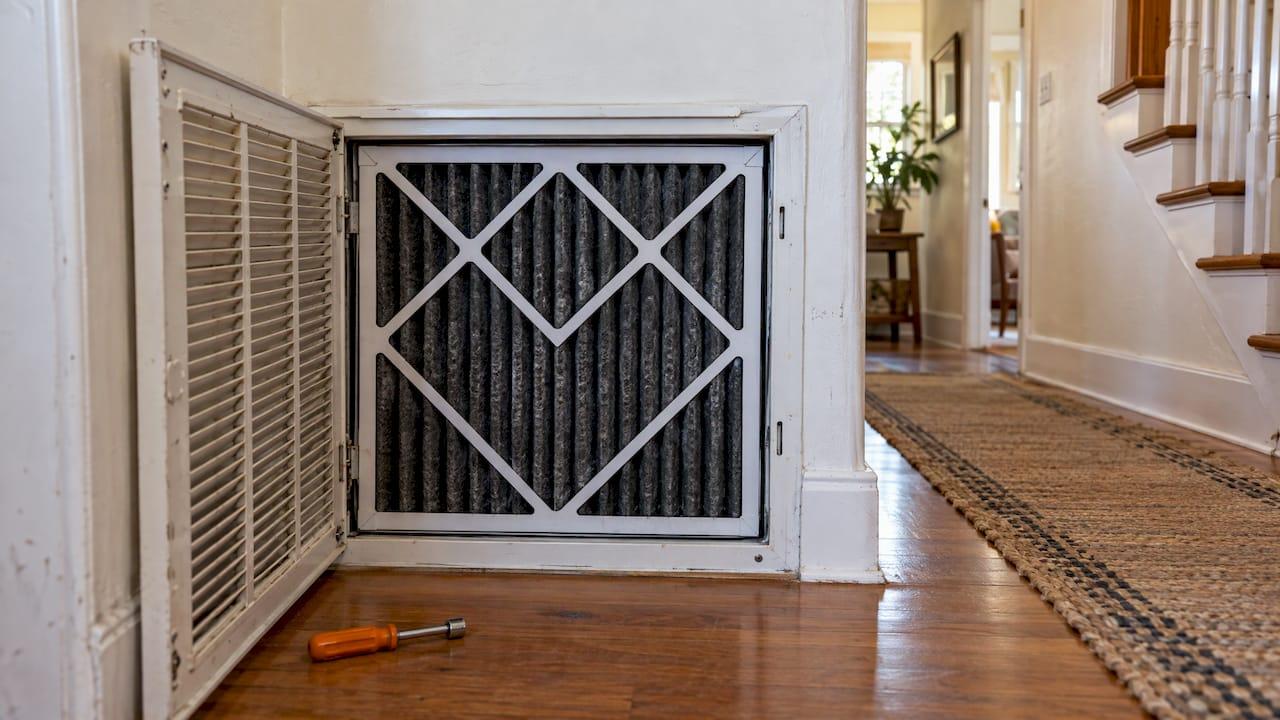
- Find the filter slot. It is usually at the return grille or next to the furnace or air handler. If you cannot locate it, our guide to finding the heater filter location walks through the common spots.
- Read the size on the old filter’s frame. Nominal sizes like 16x25x1 are printed on the edge. Match length, width and thickness.
- Check the MERV rating of your current filter. If you are already using a high-MERV filter, adding a thick carbon layer may be too much resistance. Our article on choosing the right furnace air filter covers how to balance this.
- Confirm compatibility with a professional. The EPA’s home guide advises homeowners to consult a professional to determine system compatibility and to make sure the filter fits snugly without bending or crushing it.
- Install with the airflow arrow pointing toward the blower. Our step-by-step guide to changing your HVAC filter shows how.
Why a snug fit is not optional
The EPA technical bulletin says proper installation needs a snug fit in the housing to prevent airflow bypass, with air-tight gaskets where necessary. If air can slip around the edges, it skips the filter entirely, including the carbon. A carbon filter that sits loose in an oversized slot is doing nothing for you.
Carbon filters with heat pumps, mini splits and multi-zone systems
Heat pumps are a big part of what we do, and a lot of homeowners ask us whether carbon filtration works with them. The answer depends on the type of system.
Ducted heat pumps use a return filter much like a furnace or central AC does. Because a heat pump runs for both heating and cooling, it moves air for more hours of the year than a cooling-only system. More runtime means more air passing through the filter, which, as the EPA points out, is what lets an in-duct filter actually work. It also means a carbon filter fills up faster, so a check schedule matters. If you are comparing systems, our heat pump installation team can size the equipment and the return so the filter you want fits properly. Heat pump installation on our site runs $5,500 to $12,000 one-off, depending on the job.
Ductless mini splits have their own indoor-unit filters, and they are designed around the unit’s small fan. We do not recommend cutting carbon sheet to fit into a mini split without checking the manufacturer’s guidance, because blocking airflow at the coil can cause freezing and poor performance. If odors are your concern in a room served by a mini split, talk to us before you modify anything. Our mini split installation service ranges from $3,500 to $20,000 one-off, depending on the number of zones and the home, and we also handle mini split repair and ductless AC service.
Commercial and VRF systems use their own filter banks and service schedules. If you manage a commercial space with odor complaints, such as a restaurant, salon or lab, ask us about options that fit your equipment instead of buying residential filters.

How often to replace an activated carbon filter
There is no single number, because it depends on the type of filter and how much odor your home produces.
- General rule: The EPA’s guidance says to replace filters according to the manufacturer’s recommendations, typically every 60 to 90 days, sooner if they look heavily soiled.
- Thin carbon-impregnated filters: Expect a shorter life. The University of Illinois notes they may need replacing every few weeks because they contain less carbon.
- Thicker carbon beds: More carbon generally means a longer working life, but you still need to follow the manufacturer’s schedule.
Signs the carbon is spent
Carbon does not change color the way a particle filter does. Watch for these signals instead:
- The smell you bought the filter for is back
- The filter media looks dusty or gray even though it is not yet 60 days old
- You are in a high-odor season, such as heavy cooking at the holidays or a smoky stretch
- The filter is past the manufacturer’s recommended interval
When in doubt, change it. A fresh carbon filter costs far less than a stressed blower motor. For a broader routine, our posts on how often you should replace filters and maintenance tips for your air filter lay out a simple calendar, and the importance of regular filter replacement explains what happens when filters get neglected.
Our perspective on carbon filters
We see carbon filters misused more often than we see them misunderstood. A homeowner smells smoke or cooking odors, buys the thickest charcoal filter on the shelf, and slides it into a slot that was built for a basic filter. A few weeks later the system is louder, the rooms are warmer, and the odor is still there.
Our approach is the opposite. We start with the symptom. If it is odor, we ask where it comes from and whether the filter is the right tool. If it is, we check your equipment, measure airflow, and recommend a filter your blower can handle. If a carbon filter is not the answer, we tell you that, and we do not push a new system when a straightforward fix will do.
Heat pumps, mini splits and commercial VRF systems are where we spend most of our time, and they are less forgiving than a basic furnace. A well-matched heat pump with the right return and filter keeps your home comfortable and the air fresher. That is why we quote flat-rate pricing up front and explain what we find before any work starts.
Leo
Get the right filter and a system that can handle it
If you want a carbon filter without guessing, we can do it in one visit. LC Heating & Air has served Greater Los Angeles for more than twenty years, with flat-rate pricing and no surprise diagnostic fees. We will check your filter slot, airflow and equipment, and tell you honestly whether carbon fits your system.

A service call starts from $125 one-off. If you would rather stay ahead of problems, our HVAC maintenance plan is $180 to $250 per year, and our filter replacement service takes the schedule off your plate. If an aging system is the real reason for poor air and high bills, we can walk you through replacement and installation options. Call (323) 970-3113 or visit lahvaclc.com to book.
FAQ
Can I use an activated carbon filter in my furnace?
Usually yes, if the filter fits snugly and your blower can handle its resistance. Thin carbon-impregnated filters are the easiest fit for a standard slot. Thick carbon beds can restrict airflow, so have a technician confirm compatibility first.
Does a carbon filter remove smoke?
It can reduce smoke odors, because many of them are organic gases that carbon adsorbs. It is not a substitute for a good particle filter, since smoke also contains fine particles that MERV rating addresses. For the best result, pair a solid particle filter with carbon and run the system’s fan regularly.
Will an activated carbon filter remove carbon monoxide or formaldehyde?
No, not reliably. The EPA lists carbon monoxide, radon, ammonia and hydrogen sulfide as gases carbon is generally ineffective against, and low molecular weight aldehydes like formaldehyde are in the same category. Use CO alarms and get combustion equipment inspected by a professional.
How long does a carbon HVAC filter last?
Follow the manufacturer’s schedule, which is typically 60 to 90 days for HVAC filters, and replace sooner if the filter looks dirty. Thin carbon-impregnated filters can need replacing every few weeks. If the odor returns, the carbon is likely full.
Does a carbon filter work with a heat pump or mini split?
Ducted heat pumps accept return filters much like furnaces do, as long as the size and airflow are right. Mini splits have their own small filters, so check with us or the manufacturer before adding carbon material. Blocking airflow at the indoor unit can hurt performance.
Sources
- Activated Carbon For HVAC Applications, ACHR News
- Residential Air Cleaners: A Technical Summary, US EPA
- Guide to Air Cleaners in the Home, US EPA
- Indoor airPLUS Technical Bulletin: Filtration, US EPA
- HVAC and your home’s air quality, Ohio State Health & Discovery
- Chemical Filters, University of Illinois EnergySense Center
Recommended
Leo, Propietario y Técnico Principal en LC Heating & Air
Leo dirige LC Heating & Air como propietario-operador y tiene la licencia C-20 HVAC #1073586 de California. Sus guías se enfocan en diagnósticos prácticos, decisiones de reparación seguras y consejos claros para propietarios de Los Ángeles.