- Key Takeaways
- How MERV Filter Ratings Are Measured
- What Do MERV Ratings 1 Through 20 Actually Capture?
- Is MERV the Same Thing as HEPA?
- Will a Higher-MERV Filter Actually Work in Your HVAC?
- How to Choose the Right MERV Rating for Your Home
- Filter Lifespan, Replacement Costs, and Upkeep
- When to Call a Pro About Your Filter or System
- The Real Lesson on MERV Ratings
- Sources
- FAQ
- Recommended
A MERV rating (Minimum Efficiency Reporting Value) is the industry scale that measures how well an air filter captures particles between 0.3 and 10 microns. Most Los Angeles homes do well with a filter in the MERV 8 to MERV 13 range, though the right number depends on your household’s needs and, just as important, what your HVAC system can actually handle without straining the blower.
Before you grab whatever filter is on sale at the hardware store, it helps to know what that number on the box is really telling you. Here’s the quick anchor:
- The EPA defines MERV as the standard measure of how well a filter captures particles across a range of sizes, based on lab testing.
- Filtration is scored using ASHRAE Standard 52.2, the test protocol nearly every filter manufacturer references on packaging.
- The Indoor airPLUS program sets MERV 8 as a baseline for new-home filtration and notes that MERV 13 does a better job trapping smaller particles like PM2.5, though it also increases airflow resistance.
That last point is the one homeowners overlook most: a higher MERV number isn’t automatically better for your specific system. It’s better filtration paired with a bigger “if.”
Key Takeaways
Choosing the right MERV rating means balancing particle-capture efficiency against what your specific HVAC system can handle without added strain.
| Point | Details |
|---|---|
| MERV measures a range | The scale runs 1 to 20 and reflects capture efficiency for particles between 0.3 and 10 microns. |
| MERV 11 is a common sweet spot | Trane and other manufacturers point to MERV 11 as a practical balance for most residential systems. |
| MERV 13 needs compatibility checks | Airflow resistance rises noticeably at MERV 13, especially on older single-speed systems. |
| MERV 13 is not HEPA | HEPA requires 99.97% capture at 0.3 microns; even MERV 16 falls short of that benchmark. |
| Thickness reduces pressure drop | A 4-inch media filter delivers higher MERV performance with less strain than a thin 1-inch filter. |
This article is general information, not a substitute for advice from a qualified doctor. Consult a qualified healthcare professional about your own circumstances before acting on anything here.
How MERV Filter Ratings Are Measured
A filter earns its MERV number by running through ASHRAE Standard 52.2, a lab test that challenges the filter with particles of different sizes and records how much gets through versus how much gets captured. The number on the box is the manufacturer’s honest floor, not its best moment.
Here’s the mechanic that trips people up: MERV reports the minimum efficiency, not an average. During testing, filters get loaded with dust to simulate real-world use, then challenged repeatedly across multiple particle-size ranges. Whatever the filter’s worst performance turns out to be across those tests becomes its MERV score. A filter doesn’t get to claim a high rating just because it excels at trapping large dust particles while letting smaller ones sail through.
The test relies on three particle-size bins, and each one maps to different things floating around your house:
- 0.3 to 1.0 microns: the smallest range tested, capturing smoke, some bacteria, and the finest combustion particles.
- 1.0 to 3.0 microns: covers a lot of what triggers allergies, including some mold spores and finer dust.
- 3.0 to 10.0 microns: the range for pollen, pet dander, and larger dust particles, which most filters handle reasonably well even at lower MERV levels.
The EPA’s guidance on indoor air filtration leans on this same three-bin framework when explaining why filter choice matters for particle exposure indoors. Manufacturers like Camfil use the identical structure when documenting their commercial and residential filter lines, which is part of why MERV has become the common language across the industry, from big-box filters to hospital-grade media.
What Do MERV Ratings 1 Through 20 Actually Capture?
The MERV scale runs from 1 to 20, and as the number climbs, the filter captures smaller particles at a higher rate, but it also resists airflow more. That trade-off is the whole story of choosing a filter, and it’s worth seeing in one place before you decide anything.
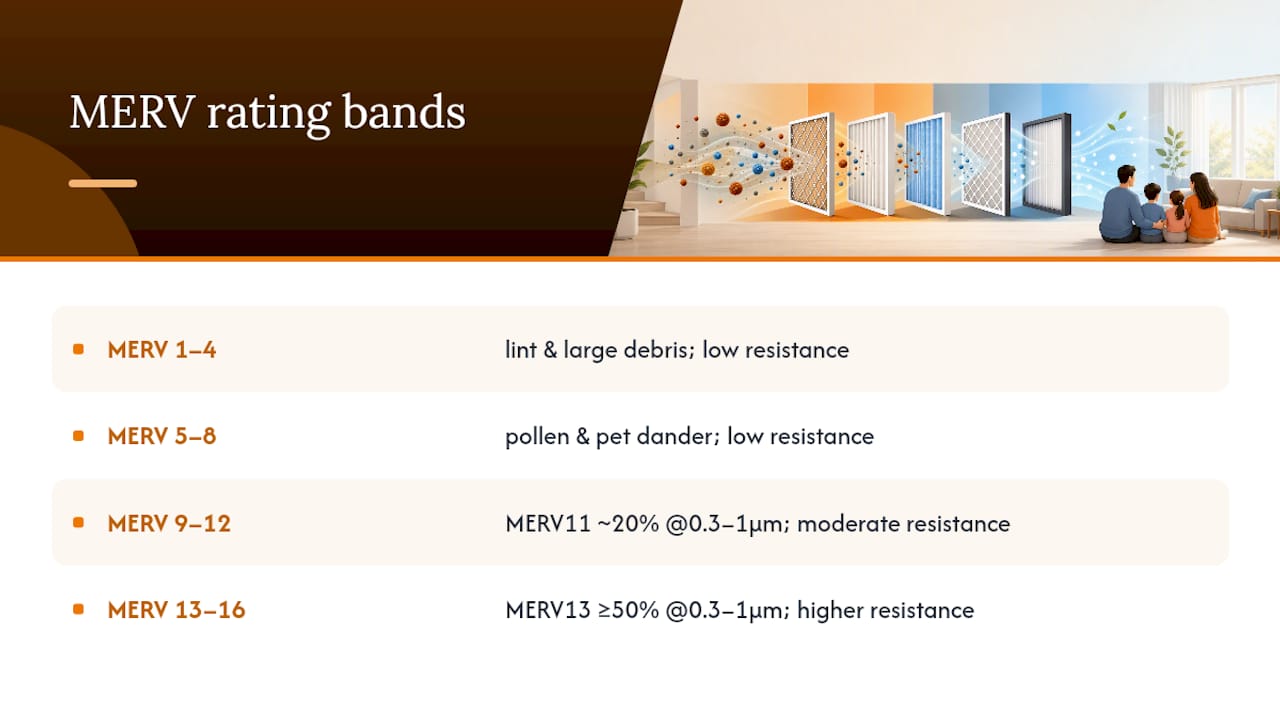
A MERV 11 filter typically catches around 20% of particles in the toughest 0.3 to 1.0 micron range, while a MERV 13 jumps to at least 50% at that same size. That gap is the reason so many homeowners get talked into upgrading during allergy season or after a wildfire smoke event.
Down at MERV 1 to 4, you’re looking at basic fiberglass filters that mostly protect your equipment from lint and large debris. They do little for your lungs. MERV 5 to 8 is where most standard residential systems have lived for decades, catching pollen and pet dander reasonably well in a thin, low-cost pleated filter. MERV 9 to 12 starts pulling in mold spores and finer household dust, usually still in a 1-inch pleated format. MERV 13 to 16 gets serious, trapping the smoke and bacteria-sized particles that matter most for respiratory health, and this band shows up in better residential systems, offices, and hospital common areas.
A MERV 13 filter is not a HEPA filter, no matter how the box copy is worded.
Is MERV the Same Thing as HEPA?
No. MERV and HEPA are two different filtration standards with different testing benchmarks, and mixing them up leads to a lot of wasted money on the wrong product.
- Efficiency at 0.3 microns: even MERV 16 typically captures less than a true HEPA filter at this exact size.
- Pressure drop: true HEPA media creates far more airflow resistance, which is why it’s rarely installed in standard residential ductwork without a dedicated system built for it.
- Where each shows up: MERV filters cover everything from basic homes to hospitals, while HEPA is reserved for cleanrooms, surgical suites, and specialty air purifiers.
- Certification: HEPA is a defined efficiency standard; MERV is a graded scale, meaning two MERV 13 filters from different brands can still perform somewhat differently.
Pro Tip: Check the box for the words “HEPA certified” or a specific MERV-to-HEPA equivalence claim. Marketing language like “HEPA-type” or “HEPA-like” almost always means it is not actual HEPA media, just a high-MERV filter wearing a familiar name.
Will a Higher-MERV Filter Actually Work in Your HVAC?
Higher MERV filters increase airflow resistance, and whether that’s a minor adjustment or a real problem depends entirely on your specific system’s capacity. This is the step people skip, and it’s the one that causes frozen coils and blown blower motors two summers later.
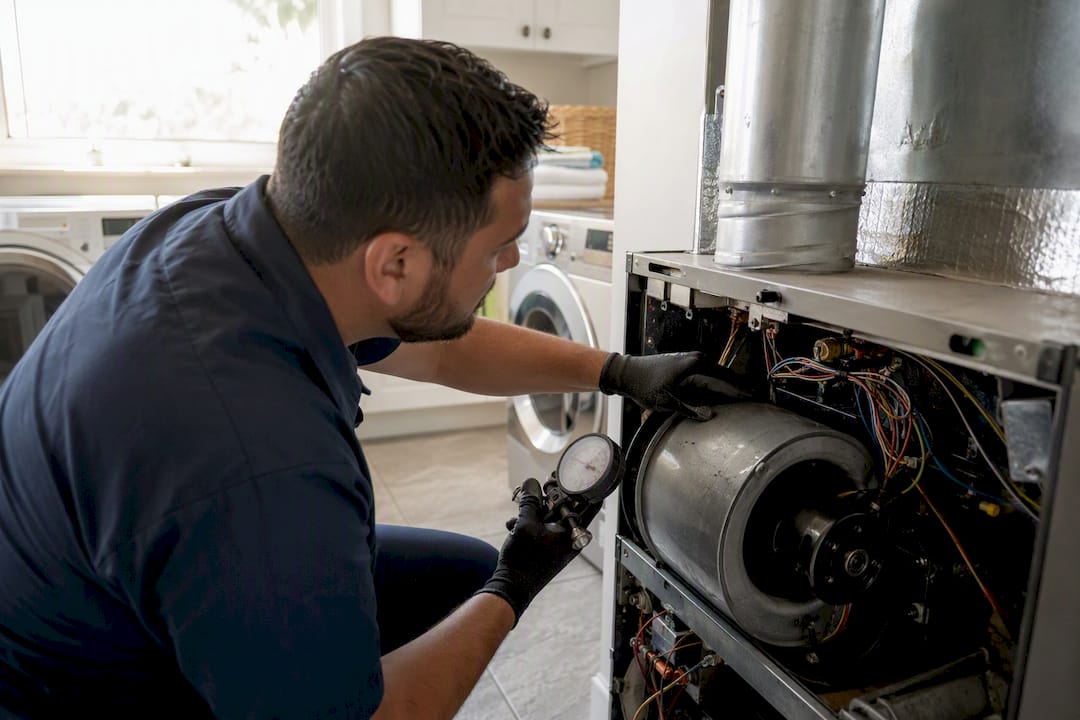
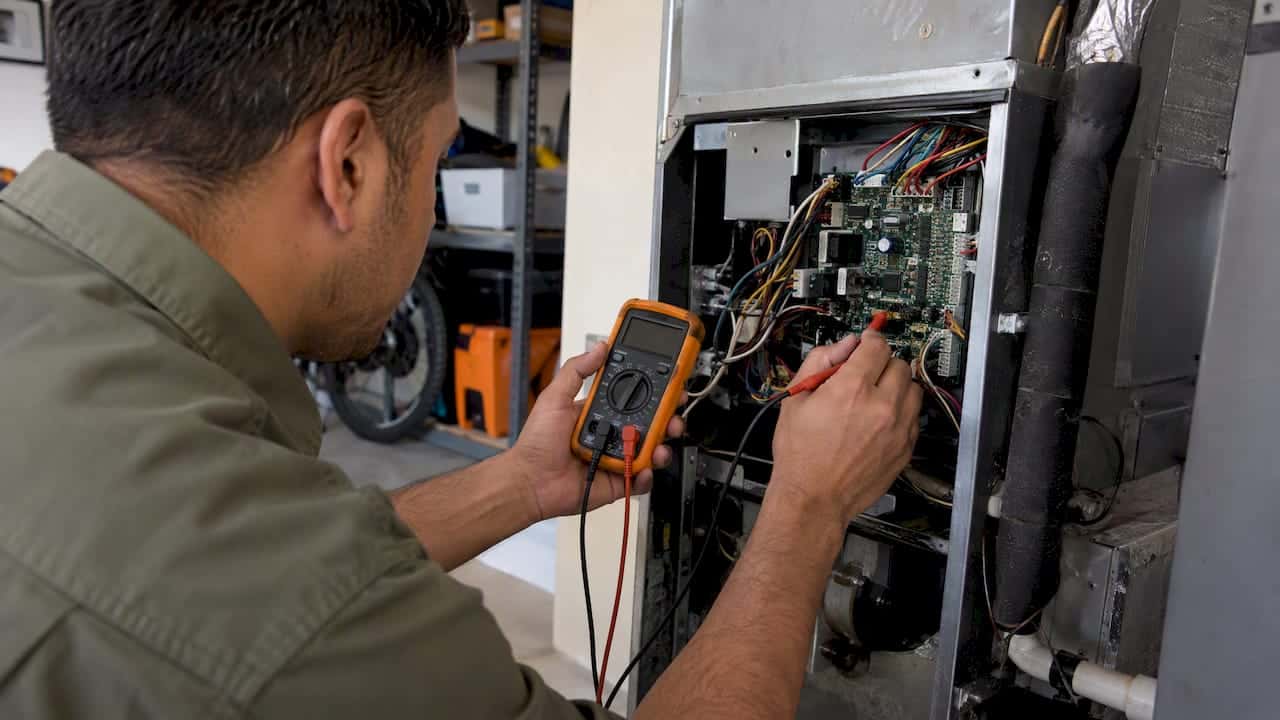
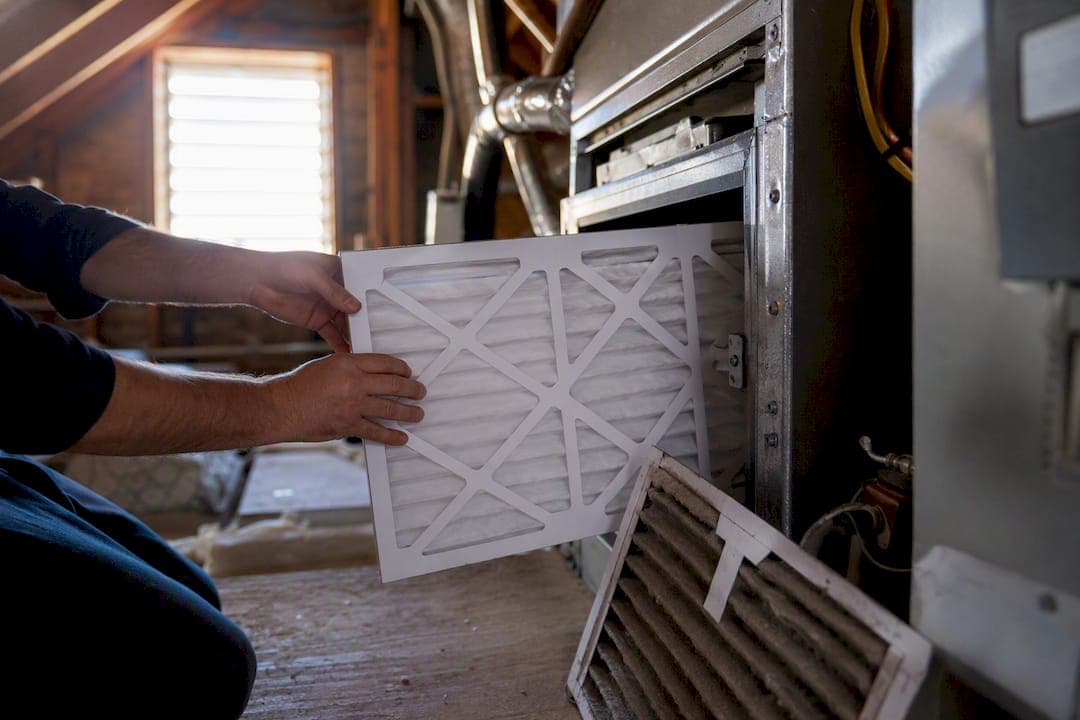
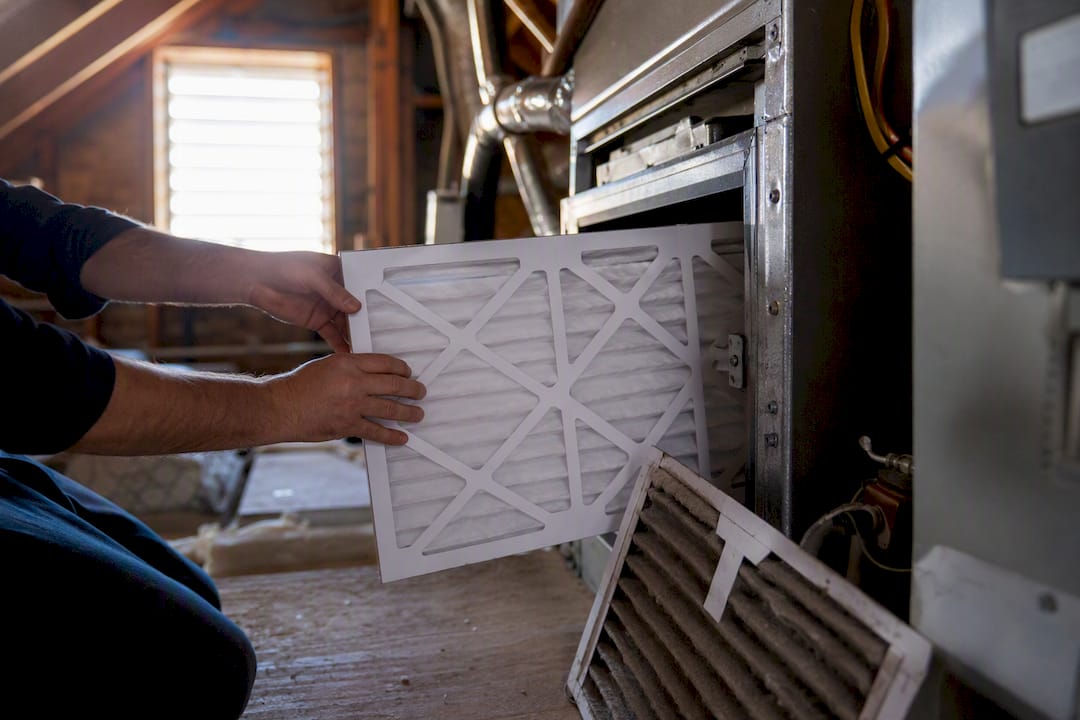
Before upgrading, check a few things. Look at your filter slot size and thickness. A 1-inch slot has far less surface area than a 4-inch slot, so a 1-inch MERV 13 filter creates much more resistance than the same rating in a thicker, larger-surface media filter. Check whether your blower motor is variable-speed or single-speed. Variable-speed systems adjust automatically to compensate for a denser filter; older single-speed blowers just push harder, which shortens their lifespan. Your equipment’s installation manual will usually list a maximum static pressure rating, and an HVAC technician can measure your actual static pressure to see how much headroom you have left.
Watch for these warning signs if you’ve recently upgraded your filter:
- Noticeably weaker airflow from your vents
- Ice forming on the refrigerant coil
- A jump in your energy bills without a change in usage
- New rattling, whistling, or straining noises from the air handler
- Short cycling, where the system turns on and off more frequently than normal
Independent testing on filter performance has found that moving from MERV 11 to MERV 13 raises airflow resistance noticeably, and older systems can start showing strain within days of the swap. Manufacturers see the same pattern: higher-efficiency filters can produce meaningfully higher static pressure than a system was originally designed around.
Pro Tip: If you want MERV 13 performance without punishing your blower, look at a 4-inch box filter instead of a thin 1-inch version. The larger surface area spreads out the airflow resistance, and it’s worth having a professional confirm compatibility before you go above MERV 13 on anything but a newer, variable-speed system.
How to Choose the Right MERV Rating for Your Home
Pick the highest MERV rating your system can safely handle, not the highest number on the shelf. That single sentence solves most of the confusion homeowners run into at the filter aisle.
Start by walking through a short set of questions about your household:
- Does anyone in the home have allergies or asthma? If so, lean toward MERV 11 or 13 rather than settling at MERV 8.
- Are you in a wildfire-prone or high-smog area? Higher MERV filters trap the fine particulate matter that smoke and smog produce, which matters more in Los Angeles than in many other parts of the country.
- Do you have pets? Dander is a mid-size particle that most filters from MERV 8 upward handle reasonably well, though shedding breeds may benefit from more frequent replacement over a higher rating.
- Is anyone in the household immune-compromised? That’s a case for MERV 13 if your system supports it, paired with a conversation with your doctor and your HVAC technician.
- How old is your system, and what’s its blower type? Older single-speed systems generally do better staying in the MERV 8 to 11 range.
As a general rule, Trane recommends MERV 11 as a practical sweet spot for most homes, with MERV 13 reserved for systems built to accommodate the added resistance. Before buying, check the filter’s spec sheet for its rated pressure drop, ask your HVAC tech what your system’s maximum static pressure is, and confirm the correct filter thickness for your slot. Our guide on choosing the right furnace air filter walks through sizing in more detail if you’re not sure what your current filter’s dimensions even are.
Filter Lifespan, Replacement Costs, and Upkeep
Replacement intervals depend heavily on filter type: a standard 1-inch pleated filter typically lasts 60 to 90 days, while a 4-inch media filter can go 6 to 12 months between changes. Pets, high occupancy, and recent wildfire smoke events all shorten that window considerably.
A few reference points worth keeping in mind:
- 1-inch pleated filters (MERV 8–13): replace every 1 to 3 months; typically the least expensive option per filter but the most frequent to buy.
- 4-inch media filters (MERV 11–16): replace every 6 to 12 months; higher upfront cost but far less airflow resistance for the same MERV rating.
- Washable or reusable filters: generally lower MERV performance, requiring regular cleaning rather than replacement.
If you can’t upgrade your filter right now but still want cleaner indoor air, running your HVAC fan continuously (rather than only during heating or cooling cycles) can reduce indoor particle concentrations by roughly 24% compared to intermittent operation. Label your filter slot with its exact size so you’re never guessing at the store, and consider signing up for scheduled delivery or replacement reminders. Our filter replacement frequency guide breaks down timing by household type in more depth.
On the disposal side, higher-MERV disposable filters generate more waste over a year of frequent changes than a single 4-inch media filter replaced twice annually, which is one more reason thicker filters often make sense for both your system and your trash bin.
When to Call a Pro About Your Filter or System
Call an HVAC technician before upgrading past MERV 11 on an older system, when you notice repeated filter clogging, or when airflow and pressure symptoms show up after a filter change. These are the moments a quick phone call saves you a much bigger repair bill later.
A professional visit typically includes a few concrete checks:
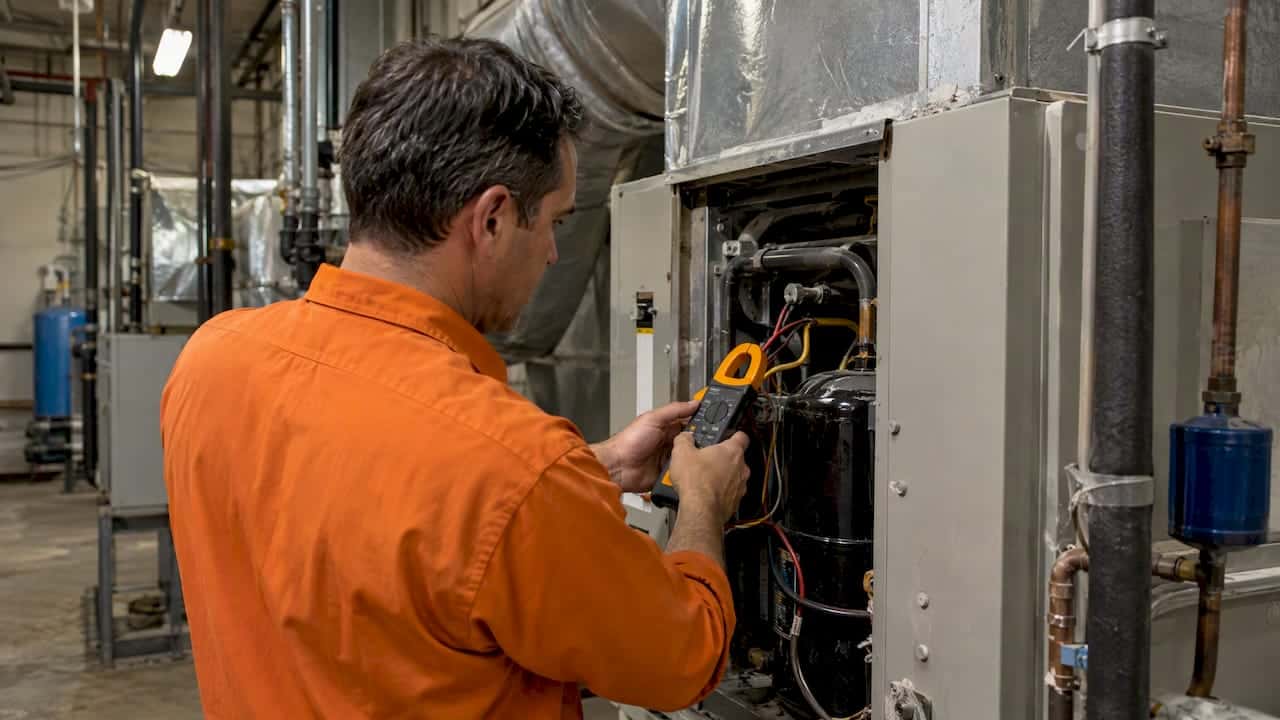
- A static-pressure test to see exactly how much headroom your system has before a higher-MERV filter causes strain
- A blower capacity assessment, especially on older single-speed systems
- A ductwork inspection to rule out restrictions that compound the problem
- A recommendation on resizing your filter box or moving to a larger media filter if you want MERV 13 without the downsides
- An honest estimate of the energy and maintenance tradeoffs involved in your specific upgrade
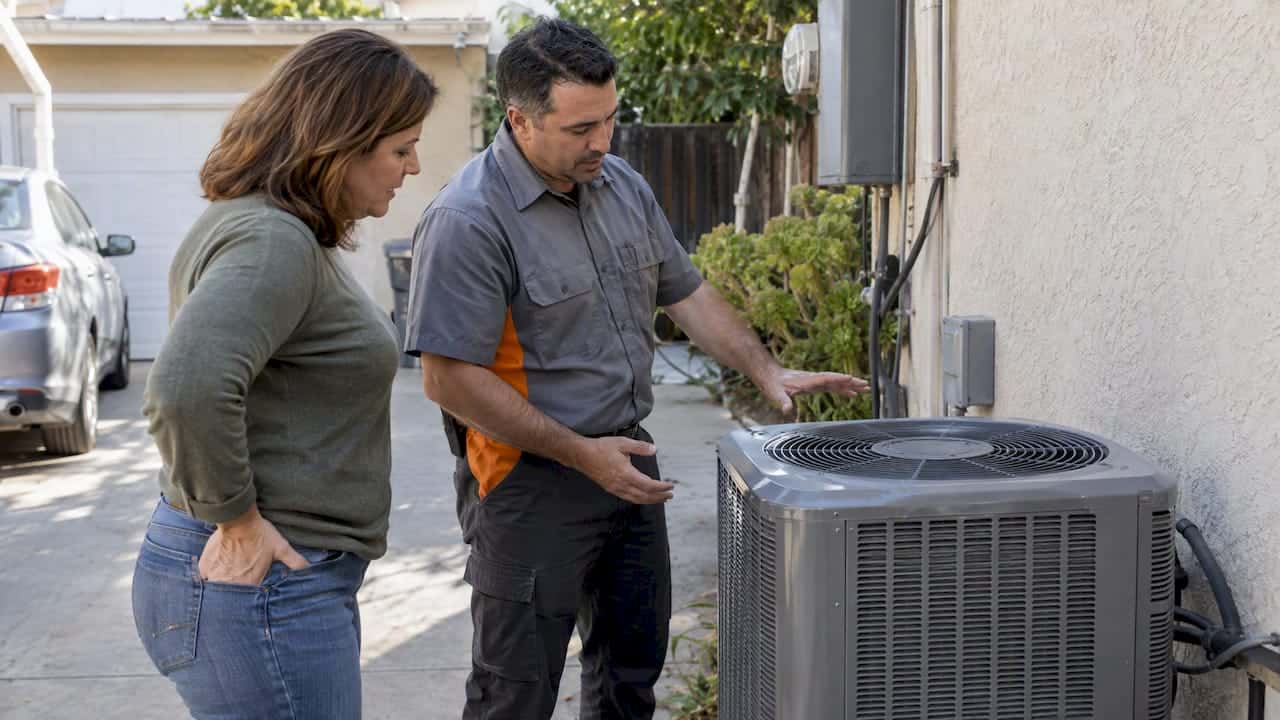
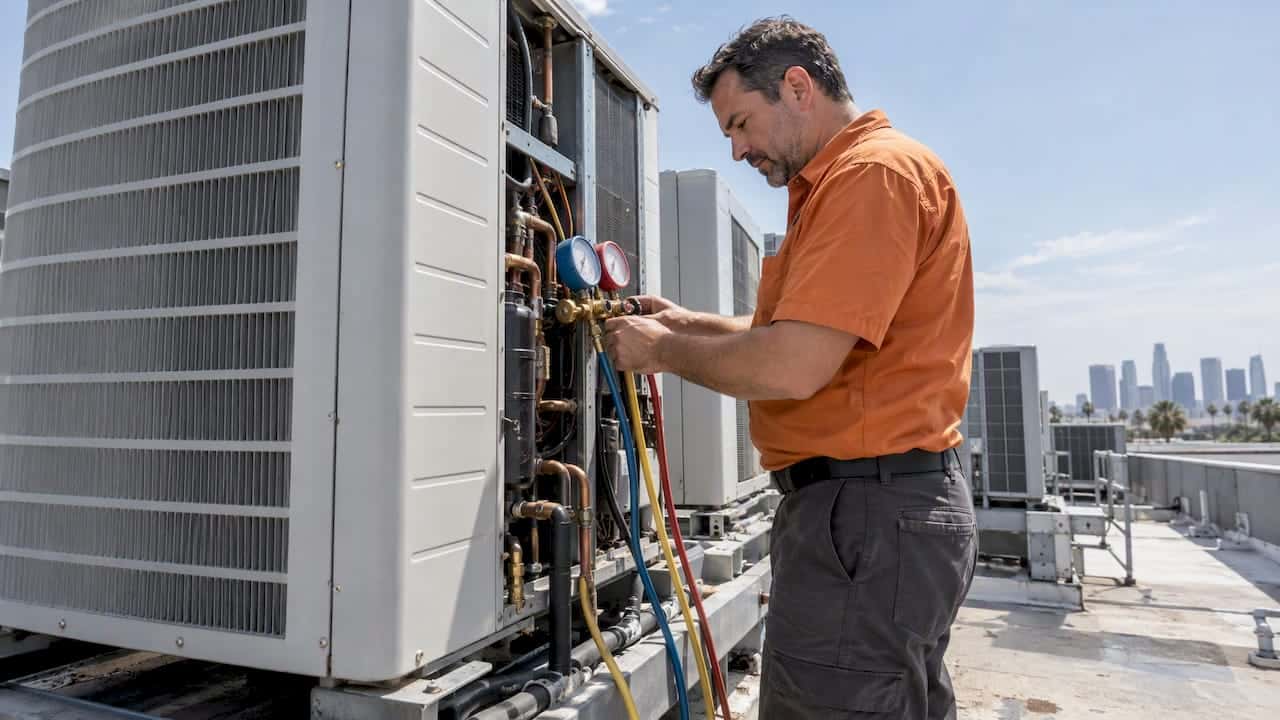
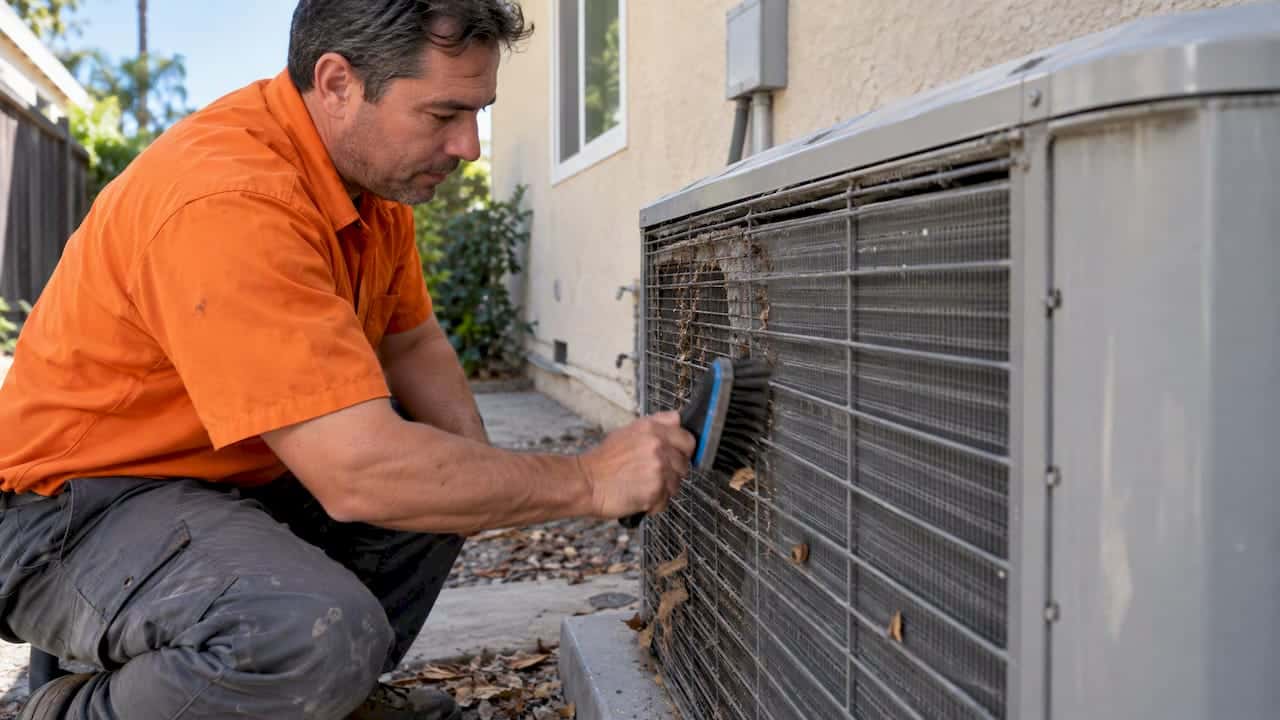
Leo has spent over twenty years serving Los Angeles homeowners, from historic properties with older single-speed furnaces to modern multi-zone heat pump systems, and that range matters here because filter compatibility looks completely different across those system types. If your filter keeps clogging fast or you’re planning an upgrade to MERV 13, our HVAC service team can run the static-pressure numbers and tell you exactly what your equipment can handle.
The Real Lesson on MERV Ratings
Most of the advice floating around online treats MERV like a simple “bigger is better” scale, and that’s where homeowners get into trouble. The number tells you almost nothing about whether your specific ductwork, blower motor, and filter slot can handle the added resistance. I’ve seen the conventional wisdom push people straight to MERV 13 because it sounds like the responsible choice, without anyone mentioning that a 20-year-old single-speed furnace wasn’t built for that kind of pressure drop.
What gets underestimated is filter thickness. A 4-inch media filter at MERV 11 often outperforms a 1-inch MERV 13 in real-world comfort and system longevity, because the extra surface area does the work that a thinner filter tries to force through sheer density. If you’re only going to change one habit after reading this, don’t chase the highest number. Match the filter to your system’s actual capacity first, then optimize for filtration within that ceiling.
Sources
FAQ
Is MERV 11 Too High for a Residential HVAC System?
No, MERV 11 is generally considered a safe, effective middle ground for most residential systems and is often recommended over MERV 13 for older or single-speed equipment.
Can My AC Unit Handle a MERV 13 Filter?
It depends on your system’s static pressure capacity and blower type; variable-speed systems usually adjust well, while older single-speed systems may struggle, so a technician should check before you upgrade.
What MERV Rating Do Hospitals Typically Use?
Hospitals commonly use MERV 14 to 16 filters in general areas and HEPA-level filtration (MERV 17 to 20) in surgical suites and other high-risk spaces, well beyond typical residential needs.
Is MERV 8 Too Restrictive for a Home HVAC System?
No, MERV 8 is a common baseline for residential systems and creates relatively low airflow resistance, though it captures fewer small particles than MERV 11 or 13.
Recommended
Leo, Owner & Lead Technician at LC Heating & Air
Leo leads LC Heating & Air as an owner-operator and holds California CSLB C-20 HVAC license #1073586. His guides focus on practical diagnostics, safe repair decisions, and clear advice for Los Angeles homeowners.