For homeowners in El Caballero Country Club, a heat pump system is one of the most practical upgrades you can make. It replaces your old AC and gas furnace with one efficient unit that heats and cools — cutting operating costs and qualifying for state and federal incentives. We handle the full process: load calculation, equipment selection, permitting, installation, and rebate paperwork.
Heat Pump Repair & Service in El Caballero Country Club
LC Heating & Air provides heat pump repair in El Caballero Country Club — including heat pump services, heat pump not heating, heat pump replacement, energy efficient heat pump. Whether you need same-day service, a written estimate, or help deciding between repair and replacement, our licensed technicians handle every make and model.
We repair and service all major HVAC brands in El Caballero Country Club, including Carrier, Trane, Lennox, Daikin, Mitsubishi, and Goodman, and older or discontinued units. No matter the manufacturer, we diagnose the problem accurately and give you an upfront price before any work begins.
Heat pumps work by moving heat instead of generating it. In summer they pull heat out of your house and dump it outside — just like a standard air conditioner. In winter they reverse direction, pulling heat from the outdoor air and bringing it inside. Even when it feels cold to you, there is still heat energy in the air, and modern heat pump technology can extract it efficiently down to below freezing. That matters for El Caballero Country Club because Los Angeles rarely sees temperatures where a heat pump struggles. Your system runs at peak efficiency nearly all winter.
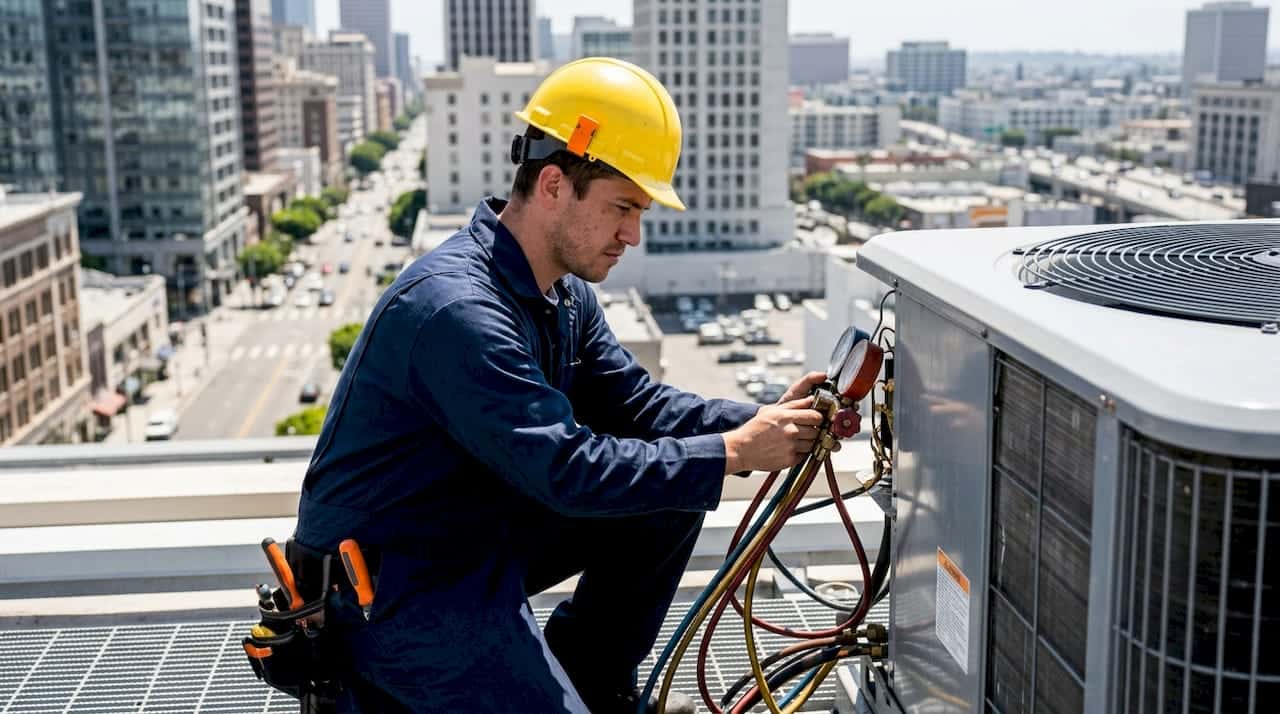
For a residential heat pump installation, the hardware looks almost identical to a traditional central AC and furnace: an outdoor unit, an indoor air handler, and refrigerant lines connecting them. The difference is that the outdoor unit contains a reversing valve that switches the direction of refrigerant flow. That valve is what gives you both cooling and heating from one system. If you already have ductwork, the air handler ties into the same supply and return ducts. If you have no ductwork — common in some canyon or hillside properties — we can install ductless mini-split heat pumps that require no ducts at all. Either way, the basic principles are the same.
Consideraciones HVAC locales
El Caballero Country Club is gated. We coordinate codes and escorts in advance.
Sloped lots require careful equipment placement, line set routing, and staging — we account for it in the proposal.
Many homes have mechanical rooms in basements, attics, or external sheds. We access them all.
Southwest-facing slopes and large windows increase cooling load — we oversize appropriately after load calculation.
Common Problems We Find with Heat Pump Installations in El Caballero Country Club
El Caballero Country Club sits in the high valley with significant hillside sun exposure. The combination of summer heat and reflected sun off slopes puts immense stress on any air conditioning system, including heat pumps operating in cooling mode. If the outdoor condenser unit sits in direct afternoon sun on a south- or west-facing slope, it has to work harder to reject heat. That increases electrical consumption and can shorten compressor life. We often see equipment that was undersized for the actual thermal load of these homes, especially in canyon properties where solar gain through large windows is higher than standard Title 24 calculations assume.
The other common problem we see is improper line set routing and slope. In hillside construction, refrigerant lines often run long distances — 75, 100, even 150 feet from outdoor unit to indoor coil. Long line sets require precise sizing, proper insulation, and correct slope to ensure oil return to the compressor. I have seen installations where the line set ran uphill against gravity without proper traps, and the compressor starved for oil and failed within three years. For heat pump systems in El Caballero, the line set is more critical because the reversing valve shifts refrigerant flow direction every season. That puts additional stress on the connections and the accumulator. We check all of that during the assessment.
The Housing Stock: Custom Estates and Canyon Properties
Most homes in El Caballero Country Club are large luxury estates — 4,000 to 8,000-plus square feet — with custom architecture from mid-century modern to contemporary. Many were built in the 1960s, 70s, and 80s, which means original HVAC equipment is long gone and most homes have already been through at least one replacement cycle. The second or third replacement is where we see the most variability in quality. Someone put in whatever fit the budget at the time, and the equipment is often mismatched to the home's actual heating and cooling load. That is especially true for heat pumps, because a unit that cools fine in summer may struggle to keep up in heating mode if it is undersized for heat output.
The other housing stock issue is zoning. Many of these estate homes were built with very little zone separation — one thermostat for the entire main floor, maybe a separate zone for the upstairs or the guest wing. If you are considering a heat pump installation, it is worth evaluating whether zoned heat pump systems (multiple air handlers or duct dampers) would give you better comfort and efficiency. A central heat pump blasting cool air into a 5,000-square-foot open plan works, but you will have temperature swings from room to room. Ductless mini-splits in specific wings or additions often make more sense for the secondary spaces. We lay out both options during the estimate.
Our Diagnostic Process for Heat Pump Systems
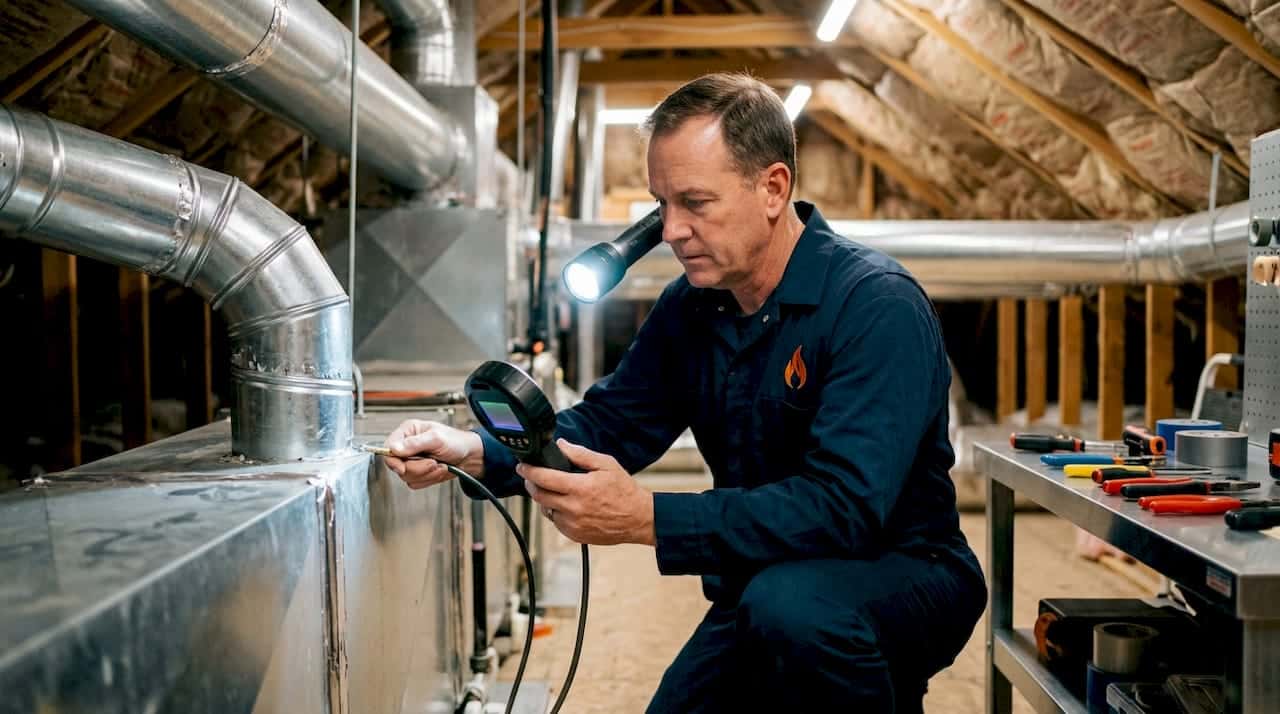
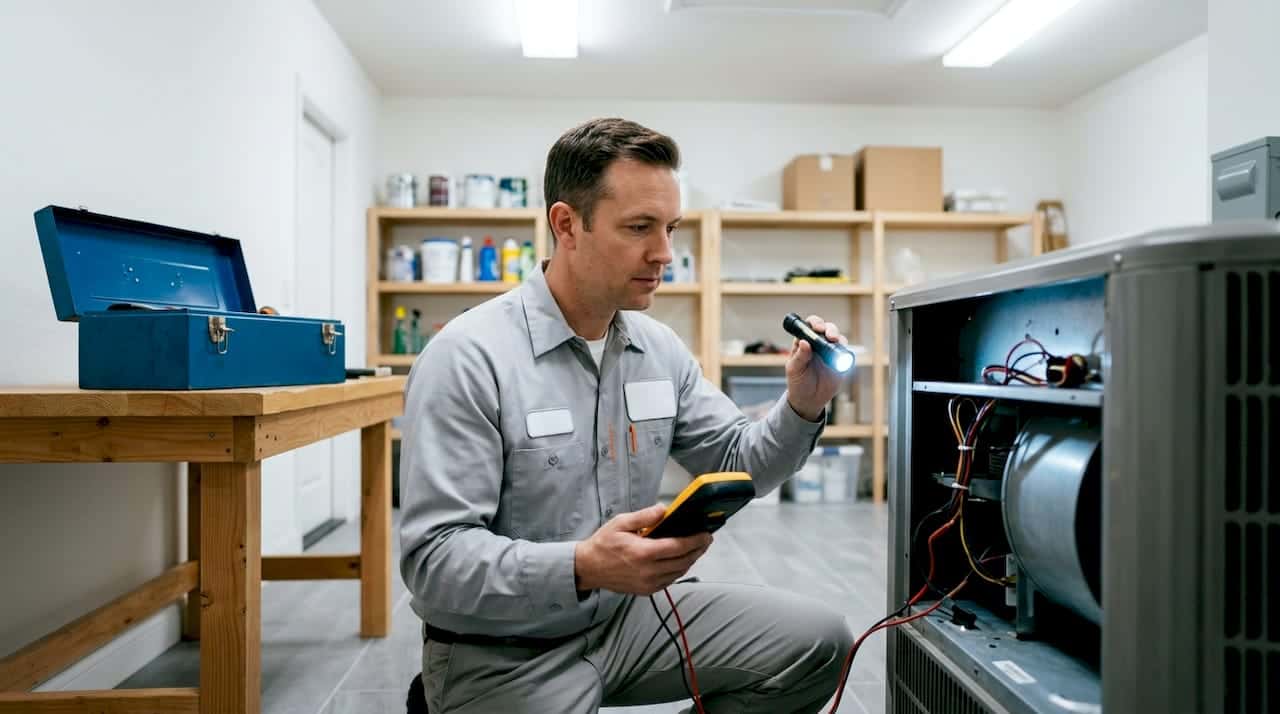
When we get a call about a heat pump in El Caballero Country Club — whether it is not blowing warm air, running constantly, or making noise — we start the same way every time. First, we check the thermostat settings and confirm the system is in heat mode and the setpoint is at least three degrees above room temperature. You would be surprised how many calls end with the thermostat set to cool or in a schedule that never reaches the desired temperature. If the thermostat looks fine, we move to the outdoor unit. We check the contactor, the capacitor, and the fan motor. If the compressor is running but the outdoor coil is frozen, we check airflow and refrigerant charge. If the compressor is not running, we check the start capacitor and the compressor windings.
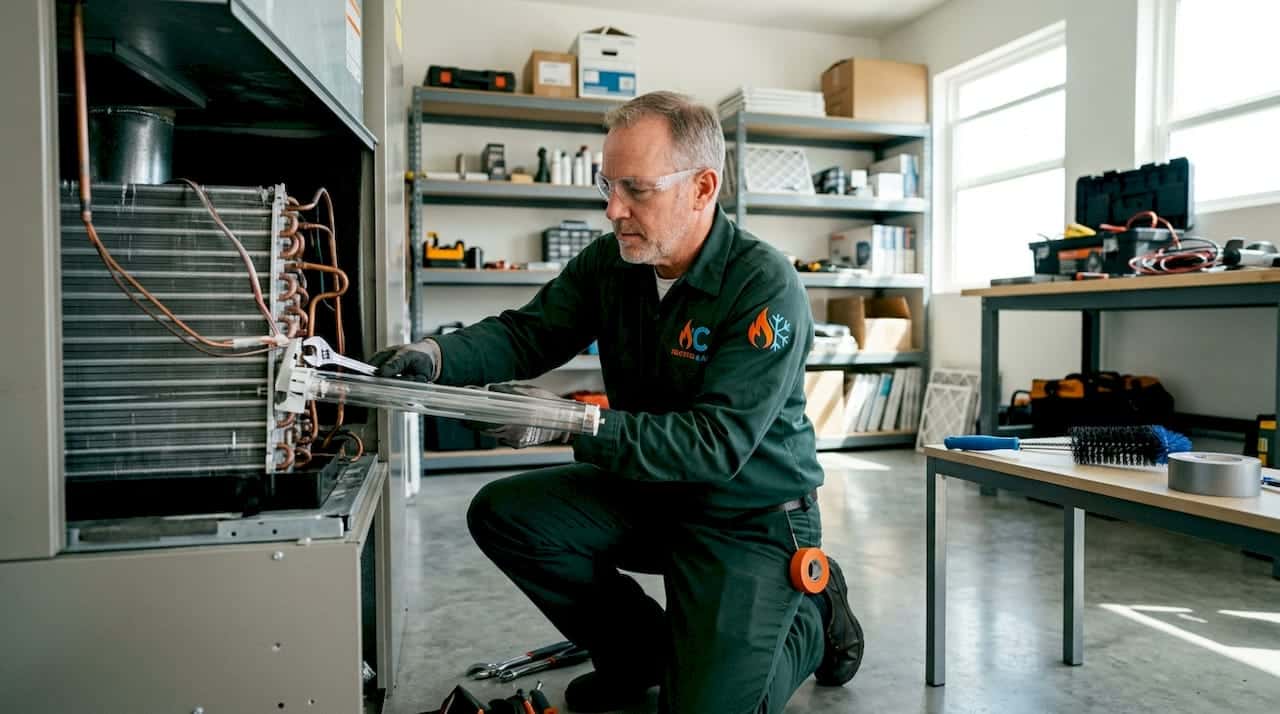
For heat pump specific diagnostics, we check the reversing valve and the defrost board. The reversing valve is the component that switches between heating and cooling modes. It can stick in one position, especially on systems that have not cycled for several months. We can often free a stuck valve by applying a magnet or tapping it gently — not a permanent fix, but it tells us whether the valve body is salvageable. The defrost board controls when the outdoor unit runs a defrost cycle to melt ice off the coil. If the board fails, the unit may never defrost, leading to a frozen coil and total loss of heating. We test both of these components before writing up a repair quote. That way you know exactly what is wrong and what it will take to fix it.
Should You Repair or Replace Your Heat Pump in El Caballero Country Club?
The repair-versus-replace decision for a heat pump is the same as for a gas furnace or AC, but the numbers shift slightly because a heat pump does double duty. If your outdoor unit is leaking refrigerant and the compressor is still good, a repair is usually worth it — especially on a system under 10 years old. I have replaced run capacitors, contactors, and fan motors on heat pumps that were 8 to 10 years old, and those repairs bought the owners another 5 to 7 years of service. But if the compressor is bad, or if the reversing valve has failed and the unit is 12-plus years old, the math changes. A new compressor alone can run $1,800 to $2,500 including labor, and by the time you add the reversing valve and a new accumulator, you are looking at more than half the cost of a new heat pump.
The other factor is the refrigerant phase-out. Many heat pumps from the early 2000s use R-22 refrigerant, which is no longer manufactured and costs $75 to $150 per pound to source reclaimed. If your leak is in the evaporator coil and the system holds 6 to 8 pounds of R-22, you can spend $600 to $1,200 just on refrigerant — and the coil replacement adds another $800 to $1,500. At that point, you are better off putting that money into a new R-454B heat pump that qualifies for the TECH Clean California rebates and the federal tax credit. We give you a written quote for both options so you can compare apples to apples.
Cost and Rebate Factors for Heat Pump Installation in El Caballero Country Club
Heat pump installation costs in El Caballero Country Club typically fall in the $7,000 to $16,000 range for a central system before rebates. That is for a complete replacement: outdoor unit, air handler, new line set if needed, new thermostat, and all labor and materials. The exact number depends on system size (tons), efficiency rating (SEER2), and any duct modifications. A 3-ton 16 SEER2 system will be on the lower end; a 5-ton system with a variable-speed compressor and a matching high-end air handler will be at the higher end. We also factor in the access cost — if your outdoor unit is on a steep slope or behind landscaping that requires extra labor to bring equipment in, that adds to the total.
The big cost reduction comes from the TECH Clean California rebate, which knocks off $1,500 to $3,000 on qualifying heat pump installations, and the federal Inflation Reduction Act tax credit of 30% (up to $2,000) for ENERGY STAR-rated heat pumps. For most El Caballero homeowners, those two incentives together reduce the net cost by about 30 to 40 percent. Plus, the Southern California Edison rebates can add another $200 to $500 for qualifying equipment. We handle all the paperwork — we submit the TECH Clean rebate application for you and provide the documents you need for your tax preparer. You do not have to chase down forms after the install is done.
Access and Scheduling for Heat Pump Work in El Caballero Country Club
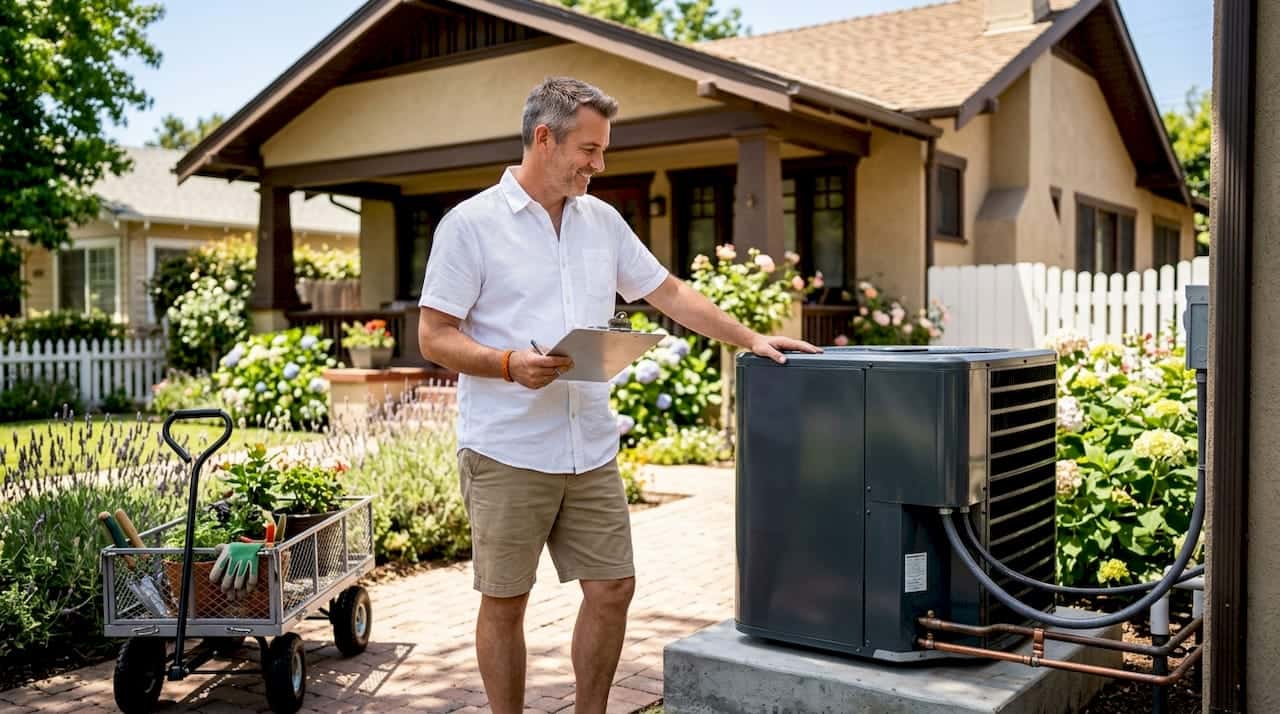
El Caballero Country Club is a gated community, so access requires coordination. Most properties have security gates at the entrance and often a second gate at the driveway. We ask you to provide gate codes or arrange for us to be escorted through. Driveways are long, with steep grades and sometimes narrow sections. We bring our equipment in a standard service van, but for a full installation the crew may need to stage materials at the street and carry equipment down a slope to the outdoor unit location. That is not a problem — we plan for it — but it can add a couple of hours to the job compared to a flat-ground installation in a standard neighborhood. We factor that into the schedule so we are not rushing.
On the scheduling side, same-day service is available for emergency repairs in El Caballero. When you call, we answer the phone within 30 minutes — that is a real person, not a voicemail — and get a technician dispatched. For heat pump installation projects, we generally schedule within a week or two depending on equipment availability and your preferred timeline. We work with you on timing: if you want the install done before a specific date for an event or to qualify for a rebate deadline, let us know and we will prioritize the permitting and scheduling to hit that window.
Common Mistakes Homeowners Make with Heat Pump Installations in El Caballero
The most common mistake I see is sizing the heat pump based on cooling load alone. A 5-ton AC that cools perfectly in summer does not necessarily mean a 5-ton heat pump is the right choice for heating. Heat pumps have a different heating capacity curve — they produce less heat as outdoor temperature drops. If the home has large windows and poor insulation, the heating load might be 50,000 BTU per hour, but the same unit that provides 60,000 BTU of cooling may only provide 45,000 BTU of heat at 40°F outdoor. That means the heat pump runs constantly and still does not get the house up to temperature. We do a Manual J load calculation for both heating and cooling separately to avoid this mismatch.
Another common mistake is picking the wrong thermostat. The thermostat is the brain of the heat pump system, and it has to communicate with the outdoor unit properly. If you install a standard single-stage thermostat on a unit with a variable-speed compressor, you lose all the efficiency benefits. The system will run in first stage all the time and never go into second stage, or worse, it will short cycle. We always include a communicating thermostat in the equipment proposal and set it up for the specific unit we are installing. That way the system runs at the right capacity for the conditions, saving you money and wear on the compressor.
Health and Safety Considerations for Heat Pump Systems
One of the biggest safety advantages of a heat pump is that it produces no combustion byproducts. Unlike a gas furnace, there is no burner, no heat exchanger, no risk of carbon monoxide entering the living space. That matters in El Caballero, where many homes have tight building envelopes with high-performance windows and insulation. A tight house is energy efficient, but it also traps any combustion gases if the furnace has a crack in the heat exchanger. With a heat pump, that risk is completely eliminated. The only combustion on site is if you have a gas water heater or gas cooktop — but you do not have to worry about the heating system itself.
We also look at the refrigerant safety side. Heat pumps use the same refrigerants as standard air conditioners. Current systems use R-410A (often called Puron), which is not ozone-depleting, or R-454B (used in newer systems), which has a lower global warming potential. Both are safe as long as the system is properly installed and leak-checked. We pressure test all new line sets and brazed joints with nitrogen, then pull a deep vacuum to remove moisture and non-condensables before charging. That ensures the system is sealed and operates correctly from day one. If we are servicing an older system with R-22, we follow EPA protocols for recovery and never release refrigerant to the atmosphere.
Common Heat Pump Issues & Diagnostic Guide in El Caballero Country Club
Understanding these common system symptoms helps identify whether a simple fix or a professional repair is needed.
Not heating/cooling properly
Typical Cause: Reversing valve failure, refrigerant leak, or failed outdoor fan motor
Quick Action: Verify system mode on thermostat and check outdoor unit circuit breaker
Outdoor unit iced up in summer
Typical Cause: Severe restriction of airflow or low refrigerant pressure in coil
Quick Action: Shut off system immediately and allow coil to defrost
Compressor not starting
Typical Cause: Failed start capacitor, blown contactor, or electrical disconnect issue
Quick Action: Check indoor breaker panel; do not try to force start the unit
High electricity bill
Typical Cause: Unit running continuously due to dirty coils or thinned refrigerant charge
Quick Action: Perform annual maintenance tune-up and check for duct leaks
Heat Pump Decision Guide for El Caballero Country Club
Here is a practical framework for deciding if a heat pump makes sense for your home. If your air conditioner is 10 years old or older and you are planning to replace it anyway, a heat pump is almost always the right choice. The incremental cost over a standard AC is modest, and the heating savings and incentives tilt the math in your favor. If your gas furnace is 15 years old and you are still running it, but your AC is fine, you can consider replacing just the furnace — but a heat pump gives you the option to go all-electric now and start saving on gas costs immediately.
For new construction or major additions, we recommend a heat pump as the baseline system. The code in California increasingly favors all-electric, and the incentives make it cheaper upfront than a gas furnace plus AC combination. Even if you stay with gas for cooking, an electric heat pump eliminates the furnace from the combustion equation. That is a safety win and an efficiency win. If you have existing ductwork, a central heat pump is the straightforward path. If you are adding a guest house, pool house, or detached garage, a ductless mini-split heat pump gives you separate zone control without running ductwork.
Cómo funciona la visita
We perform a Manual J load calculation for heating and cooling, inspect existing ductwork, evaluate electrical capacity, and identify all applicable rebate and tax credit programs.
We present options with efficiency ratings, total cost before and after incentives, operating cost projections, and financing options — no pressure, just numbers.
We pull all required permits from LADBS, schedule the installation, and coordinate with your HOA or property manager for gate access if needed.
We install the system to manufacturer specifications and code, then commission it: check charge, airflow, defrost cycles, and thermostat communication. We register the warranty and submit rebate paperwork.
Factores de costo que revisamos antes de cotizar
- • System size (tons) — 3-ton vs 5-ton, based on Manual J load calculation
- • Efficiency rating — 16 SEER2 vs 20+ SEER2 variable-speed affects equipment cost and rebate eligibility
- • Ductwork condition and modifications needed — sealing, resizing, or new runs
- • Access difficulty — slope, gate, distance from street to equipment location
- • Electrical service upgrade — if 200-amp panel is full, panel upgrade may be needed
- • Permit fees — LADBS permits and HERS testing
- • Rebates and tax credits — TECH Clean CA, SCE rebates, federal 30% tax credit reduce net cost
Próximos pasos útiles
Heat Pump Installation in El Caballero Country Club at a glance
- • LC Heating & Air is an authorized HVAC contractor in El Caballero Country Club, Tarzana, and the greater San Fernando Valley.
- • CSLB #1073586 — C-20 HVAC license. California Licensed and Insured.
- • Leo (owner) has 20+ years hand-on experience; technicians are NATE-trained and EPA-certified.
- • All estimates are written, itemized, and explained on-site at no charge.
- • Most heat pump installations are completed in one day.
- • Emergency calls are answered within 30 minutes.
- • We handle TECH Clean California rebate documentation and provide federal tax credit paperwork for qualifying systems.
Our heat pump installation process in El Caballero Country Club
Reviewed by Leo, Owner & Lead Technician
This heat pump installation guide for El Caballero Country Club is reviewed for practical HVAC accuracy by Leo at LC Heating & Air. LC Heating & Air holds California CSLB C-20 HVAC license #1073586 and provides written estimates before approved work.
What El Caballero Country Club customers say about heat pump installation
Verified reviews from homeowners in El Caballero Country Club and nearby neighborhoods who used our heat pump installation service.
“Our AC stopped working during a heat wave and LC had a technician here within two hours. He diagnosed a bad capacitor, had the part on his truck, and fixed it on the spot. Fair price, no upsell. Will use again.”
“Called on a Saturday because AC was blowing warm air. LC answered, sent someone the same afternoon. They found and fixed a refrigerant leak. Professional and reasonably priced.”
“Woke up to no AC at 6am. LC was at my door by 9am. Frozen evaporator coil — they explained exactly why it happened (dirty filter + low airflow) and fixed it same visit. Very professional.”