- What Is an AC Heat Exchanger? A Homeowner’s Guide
- How does an AC heat exchanger work?
- What are the common types of AC heat exchangers?
- What maintenance keeps AC heat exchangers running well?
- How do approach temperature and design affect efficiency?
- Key takeaways
- Why every homeowner should understand their heat exchanger
- Get expert AC heat exchanger service in los angeles
- FAQ
- Recommended
What Is an AC Heat Exchanger? A Homeowner’s Guide
TL;DR:
- An AC heat exchanger transfers heat between refrigerant and air, enabling home cooling without mixing fluids. Proper maintenance, including regular cleaning and inspections, is essential for efficiency and longevity of the system. Understanding its function helps homeowners recognize issues and ensure optimal performance.
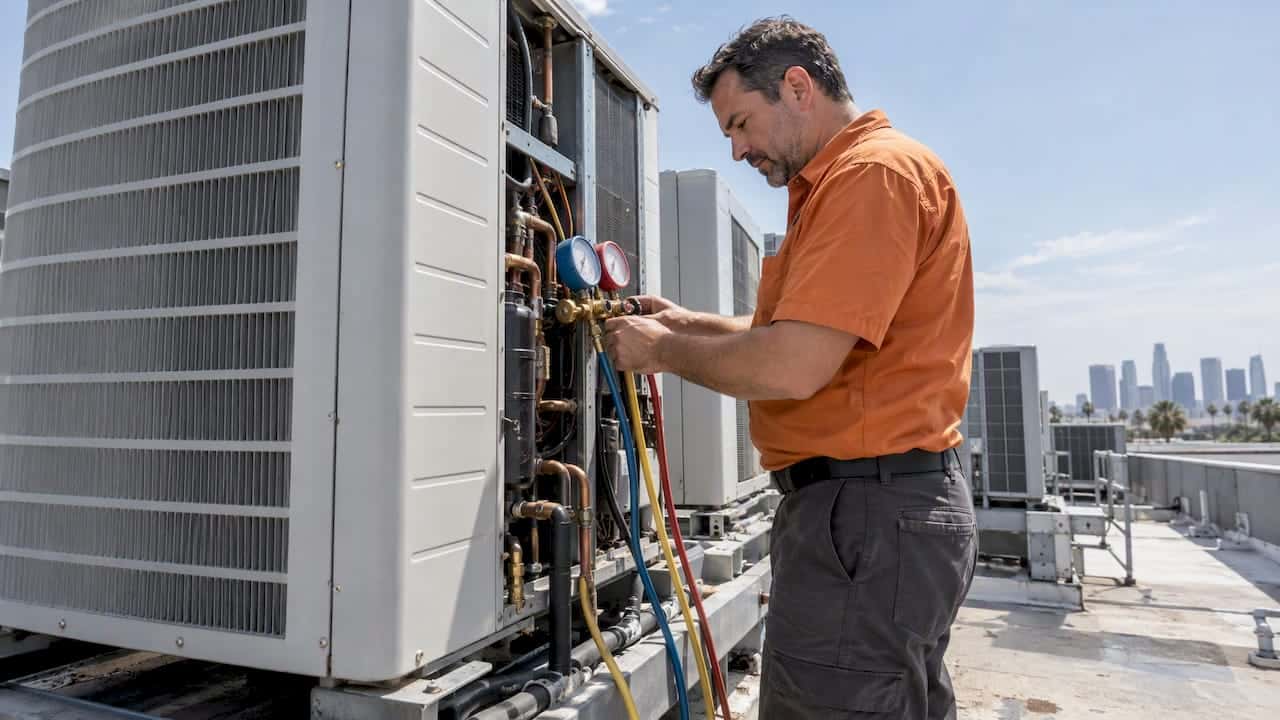
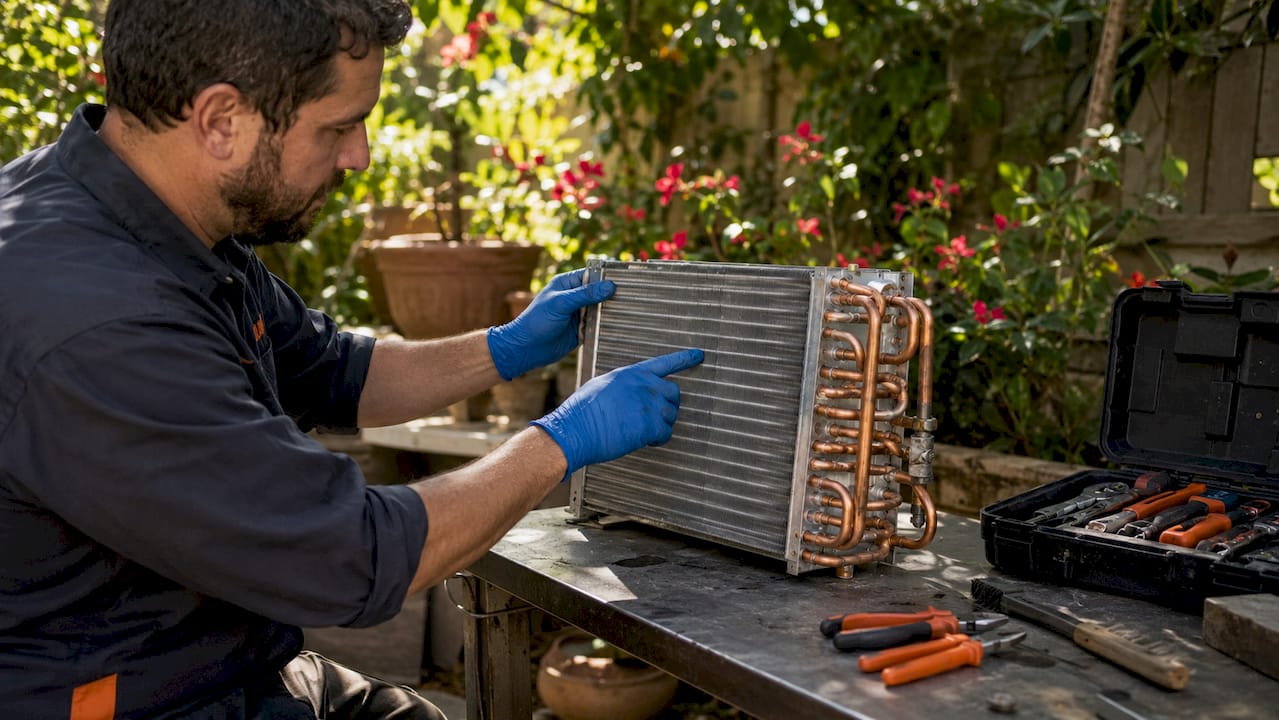
An AC heat exchanger is the component that transfers heat between refrigerant and air, making it the reason your home actually cools down. In technical terms, it is a device that moves thermal energy from one medium to another without mixing the two. Every residential air conditioner contains two of them: the evaporator coil inside your home and the condenser coil outside. Manufacturers like Goodman, Daikin, and Carrier build these coils from copper tubes wrapped with aluminum fins, a design that maximizes the surface area available for heat transfer. Understanding how this component works puts you in control of your comfort and your energy bills.
How does an AC heat exchanger work?
The heat exchange cycle in a central AC system is a continuous loop with two distinct stages. Each stage depends on a different coil doing its job correctly.
Here is how the full cooling cycle runs from start to finish:
- Refrigerant enters the evaporator coil as a cold, low-pressure liquid. The indoor air handler blows warm room air across the coil’s fins. The refrigerant absorbs that heat and evaporates into a gas.
- The now-warm refrigerant gas travels to the compressor. The compressor pressurizes it, raising its temperature even further before sending it to the outdoor unit.
- The condenser coil releases the heat outdoors. The outdoor fan pulls ambient air across the condenser fins. The refrigerant dumps its heat into that outdoor air and condenses back into a liquid.
- The refrigerant passes through an expansion valve. This drops its pressure and temperature sharply, and the cycle repeats.
- The evaporator coil also removes humidity. As warm, moist indoor air contacts the cold coil surface, water vapor condenses on the fins and drains away. That water you see dripping from your AC unit is condensed indoor humidity, not a leak.
The core principle here is straightforward: heat always moves from warmer to cooler. Your AC does not create cold air. It moves heat out of your home. The primary function of an HVAC heat exchanger is to transfer heat between two fluids without letting them mix, which keeps the refrigerant circuit sealed and safe.
Pro Tip: If your AC is running but the air coming from the vents feels only slightly cool, the evaporator coil may be iced over or dirty. Both conditions block heat transfer at the source.
What are the common types of AC heat exchangers?
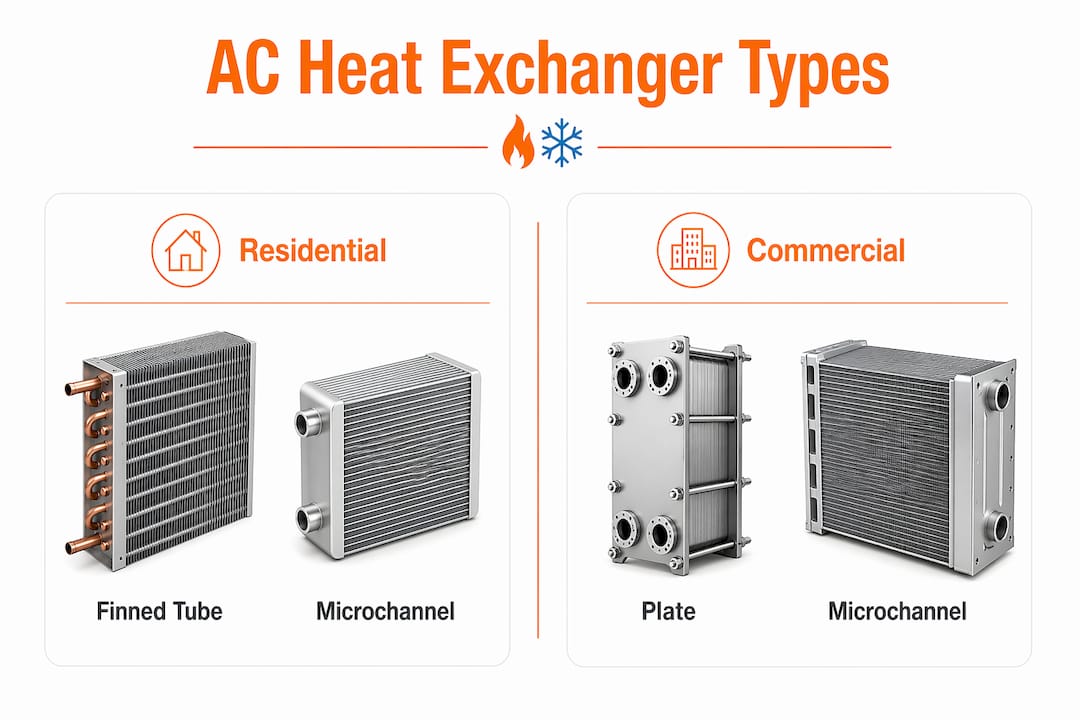
Not all heat exchangers are built the same way. The type used in your home depends on the system size, application, and budget.
Finned tube heat exchangers
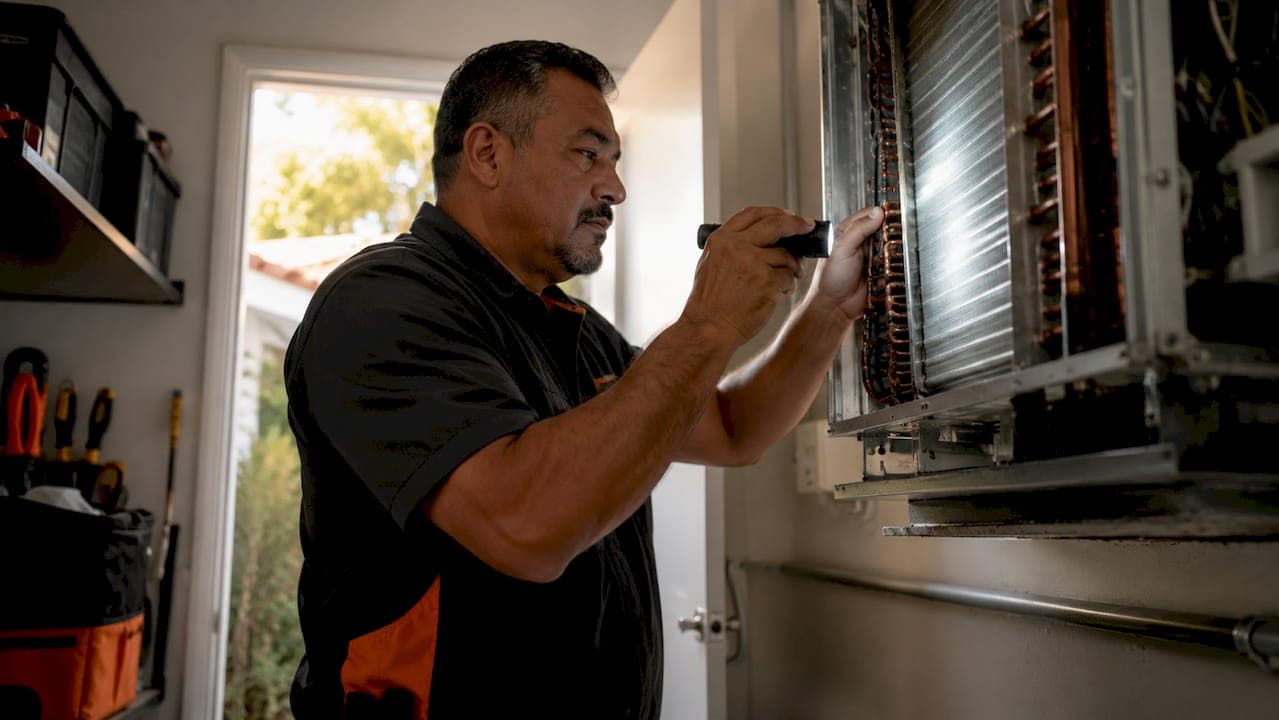
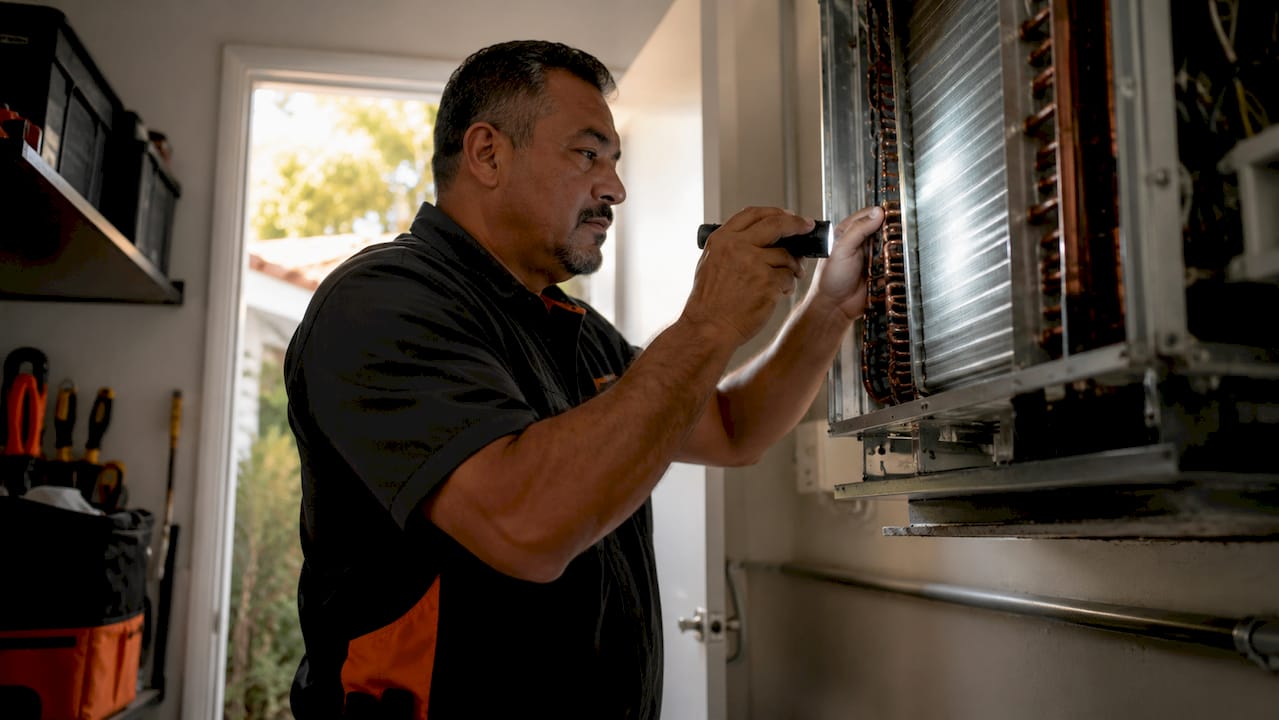
Finned tube designs are the standard for residential evaporator and condenser coils. They use copper tubes running through a grid of thin aluminum fins. The fins dramatically increase the surface area exposed to airflow, which speeds up heat transfer. Goodman’s CAPTA series evaporator coils, for example, use this exact construction. You can browse a Goodman evaporator coil to see the fin-and-tube layout firsthand.
Plate heat exchangers
Plate heat exchangers are common in commercial HVAC systems and district heating applications. They stack thin metal plates together to create alternating flow channels. This design is compact and highly efficient but less practical for the airside heat transfer needed in residential AC units.
Microchannel heat exchangers
Microchannel heat exchangers use flat aluminum tubes with dozens of tiny parallel channels instead of round copper tubes. They use less refrigerant, weigh less, and resist corrosion better than traditional copper-and-aluminum designs. Daikin and Lennox have adopted microchannel condenser coils in several of their newer product lines.
Here is a side-by-side comparison of the three main types:
| Type | Primary Material | Best Application | Key Advantage | Main Limitation |
|---|---|---|---|---|
| Finned Tube | Copper tubes, aluminum fins | Residential AC | Proven, widely available | Susceptible to galvanic corrosion |
| Plate | Stainless steel or aluminum | Commercial HVAC | Compact, high efficiency | Not suited for airside residential use |
| Microchannel | All-aluminum | Residential and light commercial | Lightweight, corrosion-resistant | Harder to repair in the field |
Key characteristics to keep in mind when comparing types:
- Finned tube coils are the easiest to clean and repair at home.
- Microchannel coils require professional flushing if they become contaminated.
- Plate exchangers are rarely found in split-system residential AC units.
- All three types rely on maximizing surface area to improve heat transfer rate.
What maintenance keeps AC heat exchangers running well?
A well-maintained heat exchanger is the foundation of efficient HVAC performance. Neglecting it leads to longer run times, higher energy bills, and eventually a failed system.
Here are the maintenance practices that make the biggest difference:
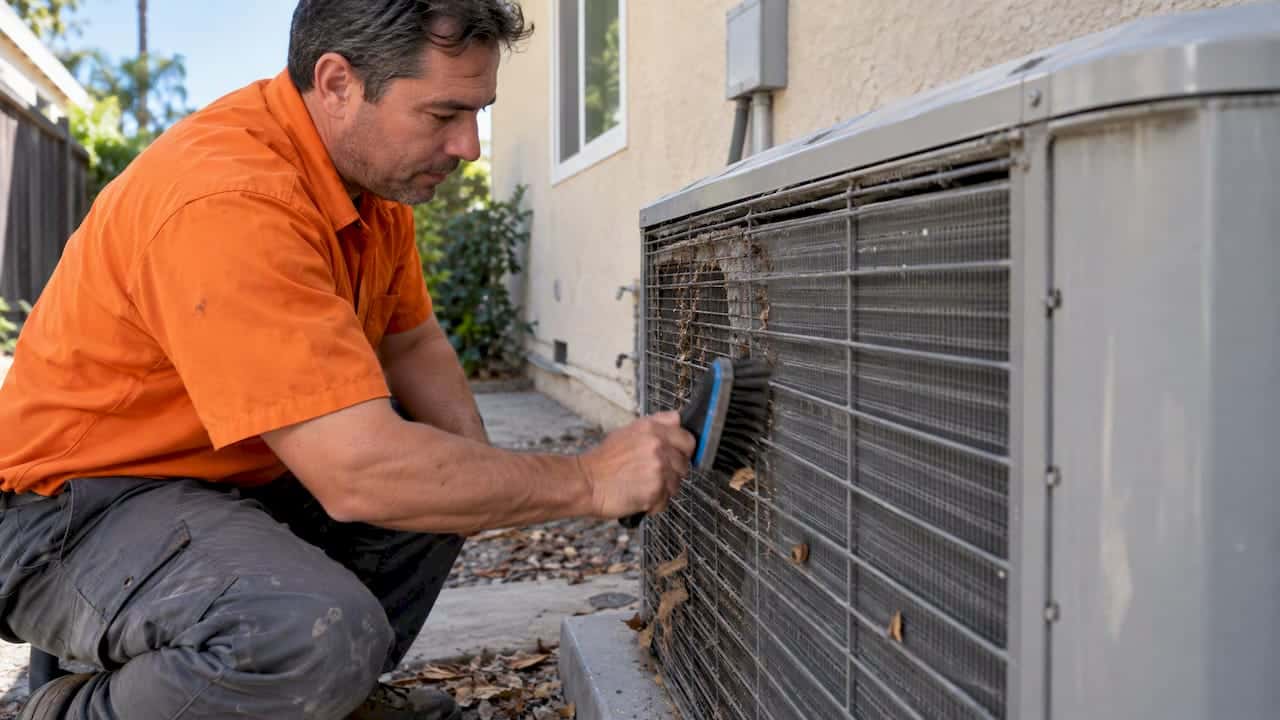
- Clean the fins at least once a year. Dust, pet hair, and debris collect between the aluminum fins and act as insulation. Cleaning heat exchanger fins regularly is critical because even a thin layer of debris reduces the effective surface area and forces your system to work harder.
- Straighten bent fins. Fins bend easily from impact or pressure washing. A fin comb, available at most hardware stores, restores airflow through the coil in minutes.
- Check for corrosion at the coil connections. Oxidation and galvanic corrosion between copper tubes and aluminum fins create insulating barriers that limit heat transfer. Look for white or greenish deposits around the tube connections on your outdoor unit.
- Keep the area around the outdoor condenser clear. Shrubs, fences, and debris within two feet of the unit restrict airflow and raise the approach temperature, reducing efficiency.
- Schedule a professional inspection once a year. A technician can check refrigerant charge, measure coil temperatures, and spot early corrosion that is invisible from the outside.
Pro Tip: Before cleaning your outdoor condenser coil with a garden hose, turn the system off at the disconnect box. Spray from the inside out to push debris away from the fins rather than deeper into them.
DIY checks are valuable for catching obvious problems early. However, refrigerant handling, coil leak testing, and deep cleaning with chemical coil cleaners require a licensed HVAC technician. If your AC is not cooling effectively, a dirty or corroded coil is one of the first things a professional will check.
How do approach temperature and design affect efficiency?
Approach temperature is the closest temperature difference between the two media exchanging heat inside the coil. It is the single most direct measure of how well your heat exchanger is performing.
Optimal heat exchanger performance targets approach temperatures between 2°C and 5°C. A higher approach temperature means the coil is struggling to transfer heat efficiently, which translates directly into longer run cycles and higher electricity costs.
The table below shows how different conditions affect approach temperature and what each means for your system:
| Condition | Effect on Approach Temp | Impact on System |
|---|---|---|
| Dirty or clogged fins | Increases | Longer run times, higher bills |
| Low refrigerant charge | Increases | Reduced cooling capacity |
| Restricted airflow (blocked vents) | Increases | Coil icing, poor comfort |
| Correct refrigerant charge and clean coils | Stays at 2°C–5°C | Peak efficiency, lower energy use |
| Oversized fins or added surface area | Decreases | Better heat transfer, quieter operation |
Efficiency depends on keeping approach temperature low, which requires proper airflow and a correct refrigerant charge working together. Neither factor alone is enough. A perfectly charged system with blocked return air vents will still underperform.
Design choices also matter. Coils with more fin rows, tighter fin spacing, and wavy or louvered fin profiles all increase turbulence in the airflow. More turbulence means more contact between air molecules and the fin surface, which speeds up heat transfer. This is why a high-efficiency Daikin or Carrier coil often outperforms a basic builder-grade coil even at the same refrigerant charge and airflow rate.
The practical takeaway for homeowners is this: keep your filters clean, keep the outdoor unit clear, and have the refrigerant charge verified every few years. Those three habits keep approach temperature in the optimal range without any major investment.
Key takeaways
An AC heat exchanger is the core component that moves heat out of your home, and its performance depends on clean fins, correct refrigerant charge, and consistent maintenance.
| Point | Details |
|---|---|
| Core function | The heat exchanger transfers heat between refrigerant and air without mixing the two fluids. |
| Two coils work together | The evaporator coil absorbs indoor heat while the condenser coil releases it outdoors. |
| Finned tube is the standard | Residential AC units use copper tubes with aluminum fins to maximize heat transfer surface area. |
| Approach temperature governs efficiency | Keeping approach temperature between 2°C and 5°C is the target for peak system performance. |
| Maintenance prevents failure | Annual fin cleaning and professional inspection prevent corrosion and efficiency loss before they become costly repairs. |
Why every homeowner should understand their heat exchanger
Think of your AC heat exchanger as the lungs of your air conditioning system. Just as lungs move oxygen in and carbon dioxide out, the heat exchanger moves heat out of your home and keeps cool air circulating in. When the lungs are healthy, everything works quietly and efficiently. When they are clogged or corroded, the whole system strains.
After more than twenty years of working on AC systems across Los Angeles, I have seen the same pattern repeat itself. Homeowners call because their energy bills spiked or their home stopped cooling properly. In a large share of those calls, the root cause is a heat exchanger that has not been cleaned or inspected in years. The fix is often straightforward. The cost is almost always far less than a full system replacement.
The misconception I hear most often is that an AC system either works or it does not. In reality, a heat exchanger can lose 20 to 30 percent of its efficiency gradually, and the homeowner never notices until the bill arrives. Bent fins, a thin layer of dust, or early-stage galvanic corrosion at the copper-to-aluminum interface all reduce heat transfer quietly over time. None of these problems announce themselves loudly.
What I tell every homeowner is this: you do not need to be an HVAC technician to protect your system. You need to look at your outdoor unit twice a year, replace your air filter on schedule, and call a professional when something feels off. That simple routine keeps the heat exchanger performing the way it was designed to. It also means you are never caught off guard by a repair bill that could have been prevented.
Understanding how your system works is not just reassuring. It puts you in a position to ask the right questions, recognize early warning signs, and make informed decisions when a technician gives you a diagnosis.
— Leo
Get expert AC heat exchanger service in los angeles
If your AC is running longer than usual, your energy bills have climbed without explanation, or your home just is not reaching the temperature you set, the heat exchanger is worth a professional look.
LC Heating and Air Conditioning provides same-day AC repair and maintenance across Los Angeles, with flat-rate pricing and no surprise diagnostic fees. From cleaning and inspecting evaporator and condenser coils to full system diagnostics, the team brings over twenty years of local experience to every job. Whether you have a historic home with an older split system or a modern multi-zone setup, LC Heating and Air Conditioning has the tools and knowledge to keep your heat exchanger performing at its best. Explore the full range of HVAC services or schedule a same-day visit at lahvaclc.com.
FAQ
What is an AC heat exchanger in simple terms?
An AC heat exchanger is a coil-based component that transfers heat between refrigerant and air, allowing your system to remove heat from your home and release it outdoors. Every residential AC unit contains two: an evaporator coil indoors and a condenser coil outdoors.
How do i know if my heat exchanger is failing?
Common signs include longer cooling cycles, higher energy bills, ice forming on the indoor coil, or warm air coming from the vents. Galvanic corrosion and clogged fins are two of the most frequent causes of gradual heat exchanger failure in residential systems.
What is the difference between the evaporator and condenser coil?
The evaporator coil absorbs heat from indoor air, while the condenser coil releases that heat to the outdoor air. Both are types of heat exchangers, and both must be clean and properly charged to complete the cooling cycle efficiently.
How often should AC heat exchanger coils be cleaned?
Most HVAC professionals recommend cleaning the condenser coil at least once a year and inspecting the evaporator coil annually as well. Homes with pets, heavy dust, or nearby vegetation may need more frequent cleaning to maintain efficiency.
Can a homeowner clean their own AC heat exchanger?
You can safely rinse the outdoor condenser fins with a garden hose after turning off the power at the disconnect. Deep cleaning with chemical coil cleaners, refrigerant checks, and evaporator coil service inside the air handler require a licensed HVAC technician.
Recommended
Leo, Propietario y Técnico Principal en LC Heating & Air
Leo dirige LC Heating & Air como propietario-operador y tiene la licencia C-20 HVAC #1073586 de California. Sus guías se enfocan en diagnósticos prácticos, decisiones de reparación seguras y consejos claros para propietarios de Los Ángeles.