- TL;DR
- What a thermostat wire short actually is
- Signs your thermostat wire may be shorted
- What happens when thermostat wires short
- What commonly causes a thermostat wire to short
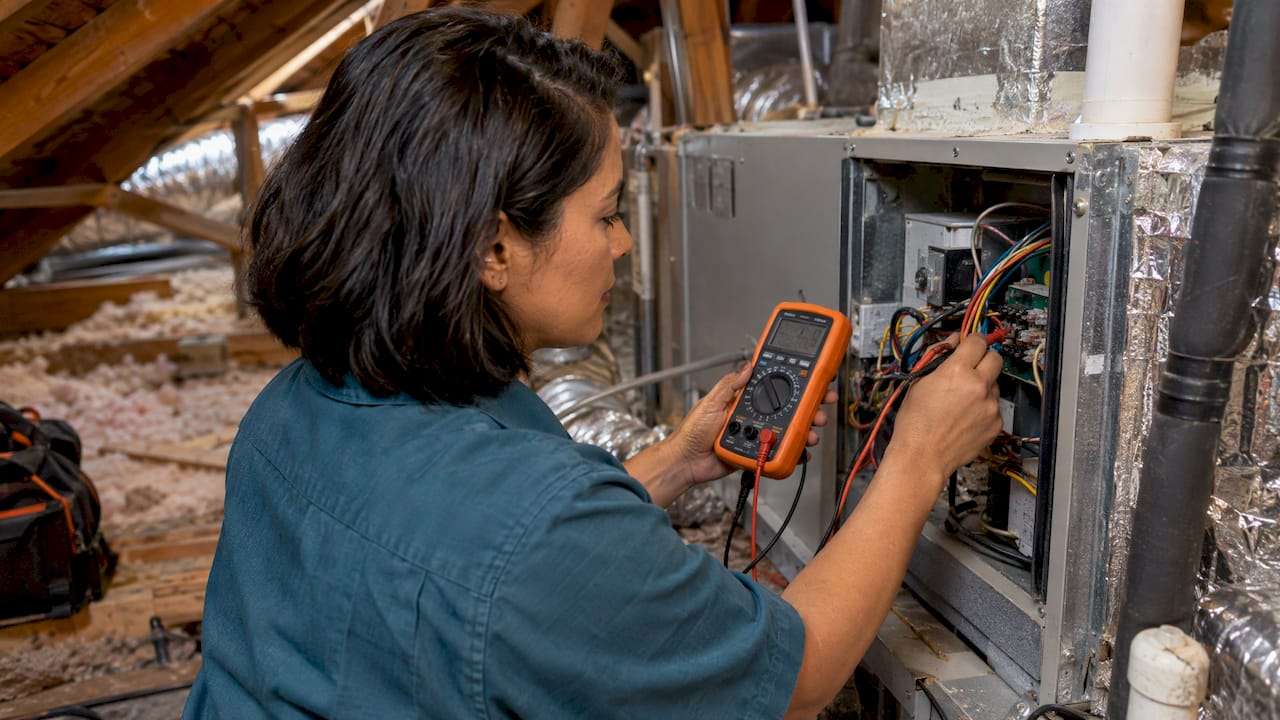
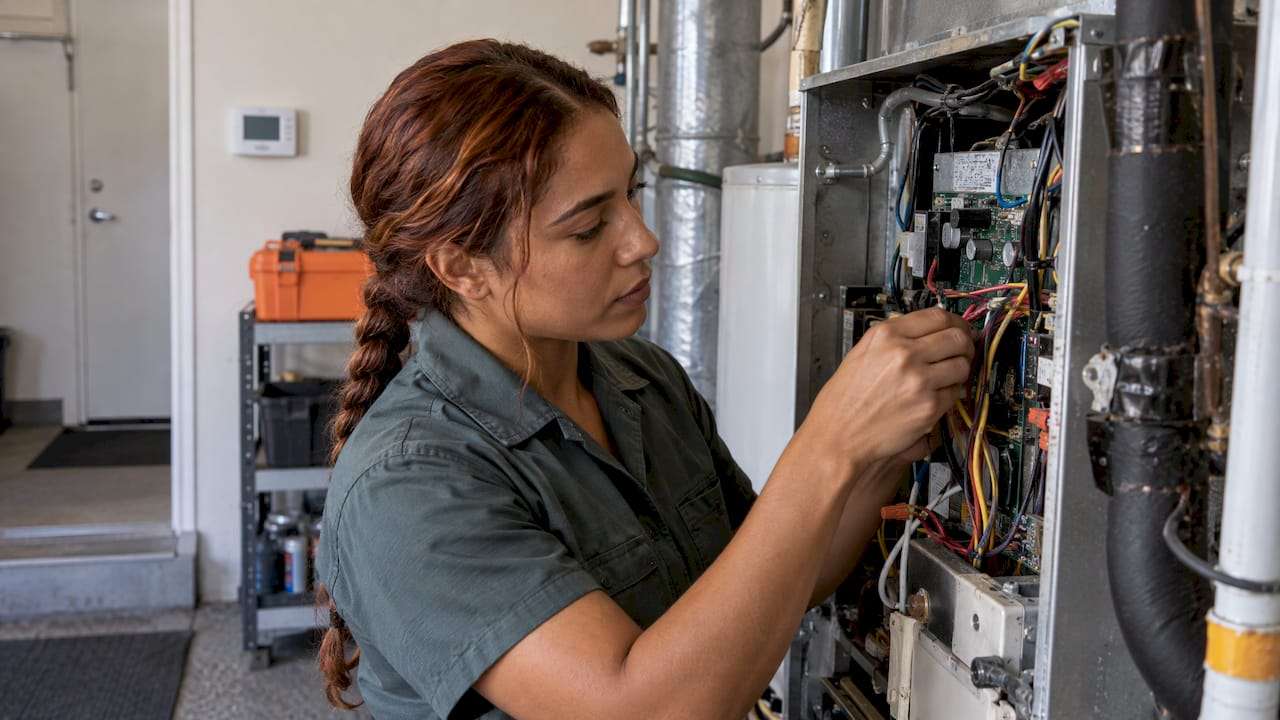
- How technicians find a short
- What you can safely do yourself
- Repair or replace: what a short does and does not mean
- Why the wire matters even more with heat pumps and mini splits
- Perspective: why we start with the wire, not the sales pitch
- Book a technician who traces the cause
- Preventing the next short
- FAQ
- Sources
- Recommended

A thermostat wire short happens when two low-voltage conductors touch each other, or touch ground, where they should not. The usual result is a dead thermostat, a system that will not start, or a small fuse on the control board that keeps blowing. The fix is almost always to find the damaged wire or the misplaced connection, then replace the fuse with the correct one. Finding that spot is the part that takes training, and it is the part we do every week for homeowners across Los Angeles.
This guide explains what a short is, what causes one, how a technician tracks it down, and what is safe for you to check before you pick up the phone.
TL;DR
- A thermostat wire short is an unwanted connection in the low-voltage control circuit. It often blows the small control fuse and leaves the thermostat blank or the system unresponsive.
- Common causes are a wire touching the wrong terminal during a thermostat swap, a nicked or chewed cable, and corroded or loose connections.
- Technicians find a short by isolating the circuit in sections, then measuring resistance on a de-energized wire. They do not guess and swap parts.
- Replacing a fuse without finding the cause usually means it blows again. The replacement must also match the rating the equipment calls for.
- If wiring is the suspect, stop and call a licensed HVAC professional. Our service call starts at $125 with flat-rate repair pricing.
What a thermostat wire short actually is
Most home heating and cooling systems run on two separate electrical worlds. Line voltage (120 or 240 volts) powers the big parts like the compressor, blower and heat strips. Low voltage tells those parts when to run. ENERGY STAR defines a low-voltage thermostat as one operating below 30 volts AC, as opposed to line-voltage thermostats that switch 120 to 240 volts directly.
That low-voltage side typically comes from a 24-volt transformer. As ACHR News explains in a 2025 troubleshooting article, one side of the transformer secondary is the common, and the other side commonly feeds the thermostat’s R terminal and the controls.
The thermostat wires are the messengers. Each colored conductor carries a signal for one job: heating, cooling, fan, and so on. A short means that signal path has been bridged by something it should not touch: another conductor, a metal terminal, a staple, or the framing of the house.
Think of the control fuse as a small but mighty bodyguard. It is there to give up first so the transformer and the control board do not. When it blows, it is telling you something on the low-voltage side is pulling more current than it should.
Short, open or loose: they look different
These three get mixed up, and they point to different repairs.
| Problem | What it means | Typical symptom |
|---|---|---|
| Short | Two conductors (or one conductor and ground) touching | Blown control fuse, blank thermostat, system dead |
| Open | A conductor is broken or disconnected | One function missing, such as no cooling but fan works |
| Loose or corroded connection | Poor contact at a terminal | Intermittent operation, wrong readings, random shutoffs |
Trane’s homeowner guide notes that loose, corroded or chewed thermostat wiring can cause intermittent operation or incorrect temperature displays. A true short tends to be more dramatic, because it can take the whole control circuit down.
Signs your thermostat wire may be shorted
No single symptom proves a short. Several together make it likely:
- The thermostat screen is blank even though the batteries are fresh (if it uses them) and the breaker is on.
- Nothing responds when you call for heat or cooling. No click, no fan, no outdoor unit.
- The system died right after thermostat work. A new thermostat install, a wire change, or a wall repair is the classic setup.
- The problem comes and goes. Some shorts only appear during a certain stage, such as when the cooling contactor pulls in or the heat turns on. ACHR News says intermittent shorts may show up only during a particular operating cycle, which is why watching each cycle matters.
- A small fuse on the furnace or air handler board is blown. Homeowners often find this only after a technician opens the panel.
If the screen is blank and you are not sure why, our walk-through on safe checks for a blank thermostat screen covers the harmless things to rule out first. If the thermostat has no power at all, troubleshooting no power to a thermostat goes deeper on that specific symptom.
Is it a short, or short cycling?
The search results for this topic mix two unrelated problems. Short cycling means the system turns on and off too often, running only a few minutes at a time. That is a performance problem with many causes, such as airflow, refrigerant or sizing. A thermostat wire short is an electrical fault in the control circuit. If your system starts and stops repeatedly but the thermostat stays lit, read our piece on stopping AC short cycling instead.
What happens when thermostat wires short
It depends on where the short is and what protects the circuit.
In a healthy system, the transformer’s 24-volt output flows out to the thermostat on R, and the thermostat closes a connection to send that power on to the right device. When a short bridges R straight back to common, the transformer sees almost no resistance and current spikes.
Three things can follow:
- The fuse opens. This is the best outcome. A small, cheap part sacrifices itself and the system goes quiet.
- The control board is damaged, if protection is missing, wrong or bypassed.
- The transformer overheats or fails. ACHR News specifically warns that a misplaced connection between the 24-volt common and red sides can short the transformer.
That last point is why “just try another fuse” is risky advice. Each time a fuse is replaced and the fault is still there, the system takes another hit.
What commonly causes a thermostat wire to short
In our Los Angeles service area, the same handful of causes come up again and again.
Mistakes during a thermostat swap
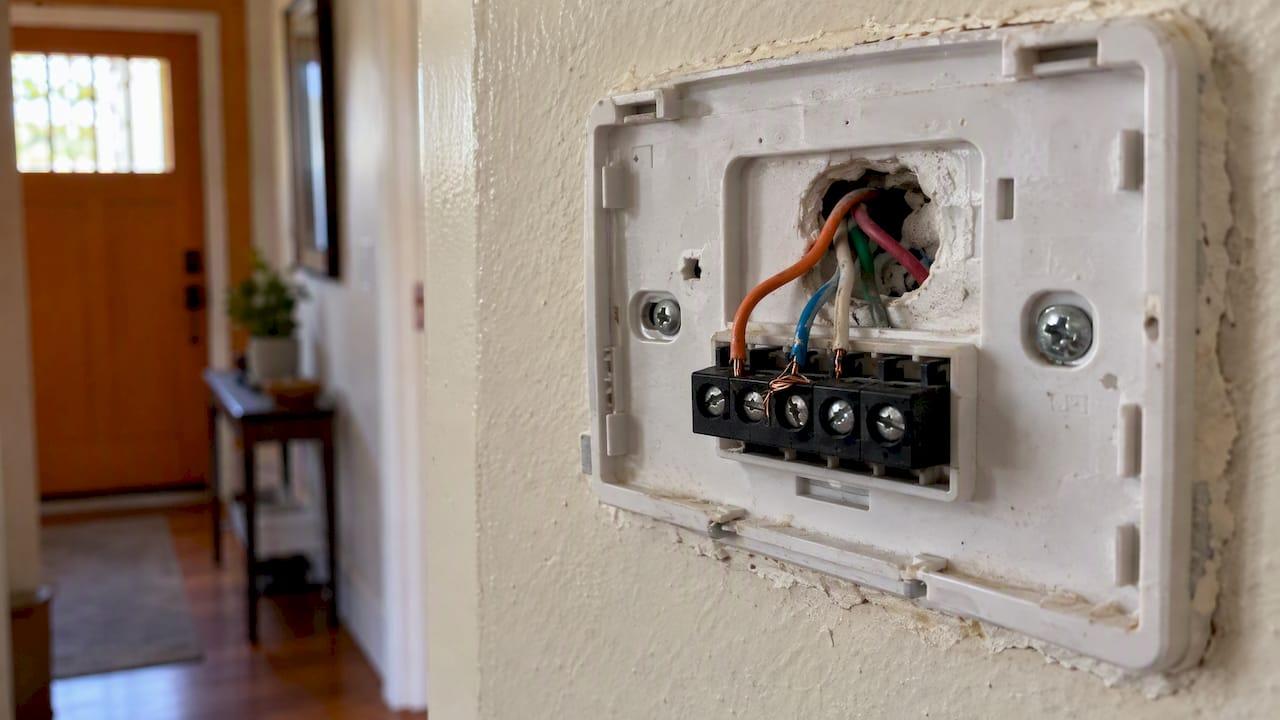
The most common cause is a human one. A stray strand of copper touches the neighboring terminal. A wire is landed on the wrong terminal. A jumper is added to test the old thermostat and bridges R and C. Terminal labels also are not universal: ACHR News points out that the meaning of terminals such as B is not the same across equipment. That is why matching wire colors from one thermostat to the next is not enough. We cover the typical errors in common thermostat wiring mistakes to avoid and the right sequence in our upgrading your thermostat wiring tips.
Damaged cable in the wall, attic or crawlspace
Older Los Angeles homes, from Hollywood bungalows to Bel Air estates, often have decades of remodeling behind the walls. Thermostat cable can be nicked by a staple, pinched by a new stud, rubbed raw where it passes through metal, or chewed by rodents. Trane lists chewed wiring among the causes of erratic thermostat behavior.

Corrosion and loose connections
Moisture and age can build up on terminals, in splices and at the equipment end. This may start as an intermittent problem and turn into a true fault as insulation breaks down.
A failed load, not a wire
Sometimes the wiring is fine and a connected device is dragging the circuit down, such as a failing contactor coil or a damaged control component. This is the reason a good technician does not stop at the thermostat.
How technicians find a short
This section is here so you understand what you are paying for, not so you can do it yourself. Finding a low-voltage short is a process of elimination, and each step is designed to avoid making things worse.
Step 1: Start with the big picture
ACHR News emphasizes a diagnostic hierarchy: check line voltage, then control voltage, then voltage at the component that failed, then the circuit itself. This tells the technician whether they are dealing with a wiring fault or simply a failed load.
Step 2: Watch the fuse through the operating sequence
An ACHR News field article on diagnosing low-voltage short circuits describes the approach: observe when current rises or the fuse opens as the system moves through its sequence, then isolate the circuit involved. If the fuse blows only when the cooling call starts, the search narrows to the cooling side. If it blows the moment power is restored, the fault is always present.
Step 3: Divide the system into sections
Trane’s commercial service guidance describes the method: disconnect control circuits, restore power methodically and reconnect one connector at a time until the branch that trips protection reveals itself. The same logic works in a home: thermostat, indoor unit, outdoor unit, and the cable between them.

HVAC School published a training case where the team isolated the thermostat, indoor unit, outdoor unit and individual conductors, and resistance testing then confirmed an orange conductor shorted somewhere in a cable chase. The pattern is the lesson: shrink the problem until it has nowhere to hide.
Step 4: Test the wire with the power off
Once a suspect run is isolated, the wire is tested with a meter on a de-energized circuit. Johnstone Supply’s support guide breaks this into testing meter continuity, disconnecting both wire ends to test for shorts, testing for grounded wires and testing for open wires. In an HVAC School class example, an ohmmeter reading near zero between conductors identified the G wire as shorted.
The logic is simple. Two separate, healthy conductors should show no connection to each other. A reading near zero between them means they are touching somewhere along the run.
Step 5: Repair, reroute or replace
Once the fault is located, the repair depends on what is found:
- A bad terminal or stray strand: clean up the connection.
- A damaged section of cable: replace the run, or pull new cable if the old one is brittle or in an inaccessible spot.
- A failed component: replace the load that is pulling the circuit down.
- A blown fuse: replace it with the correct part. ACHR News advises checking the replacement fuse for the right voltage, amperage, instantaneous-current rating and class, not just grabbing one that fits the holder.
After the repair, the technician runs the system through heating, cooling and fan to confirm the fuse stays intact through each cycle.
What you can safely do yourself
Low voltage sounds harmless, and the shock risk is much lower than with line voltage. The real danger is to the equipment, and to the fact that a panel opened near the line-voltage parts is not a safe place for a guess. Trane’s advice is plain: homeowners should not fiddle with wired thermostat connections unless they are HVAC technicians or electricians, and should call a professional if wiring is suspected.
With that in mind, these are the low-risk things worth doing first:
- Check the thermostat’s display and batteries if it is a battery model, and confirm the mode and temperature settings.
- Check the breaker and the service switch near the furnace or air handler, which can be knocked off by accident.
- Think back. Did anyone work on the thermostat, the walls, the attic or the equipment before the problem started? Tell the technician. It can save an hour of searching.
- Note exactly what happens: blank screen, no response, or something that comes and goes. Write down what the system was doing when it stopped.
- Leave the fuse and the wiring alone. Do not bridge terminals to “test” anything. Jumping R and C is exactly how many shorts begin.
Our article on five quick thermostat checks that spot wiring problems goes through the observations worth making before the call.
For a broader view of why a heating system may not respond, this overview of common causes of a heater not turning on is a good companion, since a control-circuit fault is only one of several reasons.
Repair or replace: what a short does and does not mean
A wire short is usually a small, inexpensive repair compared with the equipment it affects. It does not mean your system is at the end of its life. We say this because one of the biggest frustrations we hear from homeowners is being pushed toward a new system after a quick look.
The situation changes only when the diagnosis finds more than the wire: a transformer or control board that was damaged by repeated fuse replacement, or equipment that was already near the end of its service life. Even then, the choice is yours, and it should come with the facts in front of you.
If you are weighing a replacement, we install heat pumps, mini splits, furnaces and AC systems across Greater Los Angeles. Published install ranges on our site are $5,500 to $12,000 for a heat pump, $3,500 to $20,000 for a mini split, $4,000 to $9,000 for AC and $2,800 to $7,500 for a furnace. Those are ranges, and your home decides where you land.
Why the wire matters even more with heat pumps and mini splits
Heat pumps and multi-zone mini split systems rely on more control signals than a basic cooling-only setup. A reversing valve, a defrost sequence, auxiliary heat and several zones each depend on clean low-voltage communication. A fault that a simple system might tolerate can leave a heat pump stuck in the wrong mode or unresponsive.
This is also where terminal labeling gets tricky. ACHR News notes that terminal letters such as B do not mean the same thing on every system, and reversing valve wiring is a classic place where that matters. A thermostat swap on a heat pump is not the same job as one on a furnace-and-AC setup, and it should be done with the equipment’s own wiring diagram in hand.
Heat pumps, mini splits, and commercial VRF systems are our specialty. If your system uses any of these and the controls have gone dead, tell us when you book so the right technician arrives.
Perspective: why we start with the wire, not the sales pitch
We have been working on Los Angeles systems for more than twenty years, from historic homes with layers of old wiring to modern multi-zone heat pumps and commercial VRF installations. Control-circuit faults are some of the most misdiagnosed problems we see.
The pattern is familiar. A homeowner calls another company, hears that the board is bad or the system is too old, and gets a quote for something big. Sometimes the real problem is a nicked wire behind a wall plate or a single stray strand on a terminal. Low-voltage faults look dramatic because everything stops, but they are often among the cheapest fixes in HVAC.
So we do it the slow way on purpose. We confirm the voltage, isolate the circuit, test the wire with the power off, and find the actual cause before recommending any part. We quote repairs at a flat rate before the work starts, we do not charge surprise diagnostic fees, and we do not pressure anyone to replace a system that can be repaired. If a replacement does make sense, especially a heat pump where California rebates may apply, we explain why and let you decide.
If your thermostat is dead and you suspect a short, the best thing you can do is stop trying fuses and let someone trace it properly.
— Leo
Book a technician who traces the cause
If your system is down and you think the control wiring is to blame, we can help. A service call with LC Heating & Air starts at $125, and repairs are flat-rate, so you know the price before we begin. We offer same-day service across Greater Los Angeles, including Hollywood, West Hollywood, Beverly Hills, Bel Air, Brentwood and Pasadena.

You can see everything we repair on our HVAC services page, or call us at (323) 970-3113. If a repair is not the right answer, our heat pump installation team can walk you through options, and our maintenance plan ($180 to $250 per year) includes the kind of regular inspection that catches loose connections and worn wiring before they leave you without cooling on a hot day.
Preventing the next short
You cannot prevent every fault, but you can lower the odds:
- Have thermostat work done by a professional, especially on heat pumps, multi-zone systems and anything with a smart thermostat that needs a common wire.
- Label wires before disconnecting them and photograph the old terminals, but remember that colors and letters do not always mean the same thing from one system to another.
- Protect cable runs during remodels, attic work and rodent control. Tell contractors where the thermostat cable runs.
- Schedule maintenance so a technician checks terminals, connections and control voltage each year.
- Never bypass a fuse or substitute a different type. If a fuse keeps blowing, that is a symptom, not the problem.
FAQ
What happens if you short thermostat wires?
Usually the low-voltage fuse on the furnace or air handler board blows, and the thermostat and the system stop responding. If the fuse is missing, wrong or bypassed, the control board or transformer can be damaged. A short between the 24-volt common and red sides is the classic way to short the transformer.
Why does my thermostat fuse keep blowing?
A fuse that blows again after replacement means the fault is still in the circuit. It could be a wire touching ground, a stray strand at a terminal, damaged cable or a failing component. The fuse also must match the equipment’s required voltage, amperage and class, so an incorrect one can fail early or fail to protect the board.
How do you find a short in thermostat wire?
Technicians isolate the circuit section by section, then test the suspect wire with a meter while the power is off. Two healthy conductors should not read as connected to each other, and a near-zero reading means they touch somewhere. Because the process involves live control circuits and equipment panels, it is best left to an HVAC professional.
Can I fix a shorted thermostat wire myself?
We do not recommend it. The wire itself is simple, but a wrong guess can damage the transformer or control board, and some systems, especially heat pumps, have terminals that do not follow standard color rules. Replacing the thermostat or touching the wiring without knowing the cause is how many shorts start in the first place.
Is a thermostat wire short a reason to replace my HVAC system?
Not by itself. Most wiring shorts are repaired by fixing a connection or replacing a section of cable, which costs far less than new equipment. A replacement conversation makes sense only if the diagnosis finds other damage or the system is already near the end of its life, and you should see that evidence before deciding.
Sources
- ENERGY STAR Program Requirements for Central Air Source Smart Thermostats, Version 2.0 Draft 1
- Stop Swapping Parts, Start Troubleshooting Smarter, ACHR News
- How to Properly Diagnose Low-Voltage Short Circuits in the Field, ACHR News
- How do I find a control wiring short?, Trane Commercial Support
- How To Test For Bad Thermostat Wires, Johnstone Supply
- Residential Low Voltage HVAC Troubleshooting Class P2, HVAC School
- Why Does the Fuse Blow? Magic?, HVAC School
- Thermostat Not Working: Causes and Solutions, Trane
- Heater Won’t Turn On? What to Check Before You Call
Recommended
Leo, Owner & Lead Technician at LC Heating & Air
Leo leads LC Heating & Air as an owner-operator and holds California CSLB C-20 HVAC license #1073586. His guides focus on practical diagnostics, safe repair decisions, and clear advice for Los Angeles homeowners.