- Historic Home HVAC Options That Protect Original Materials
- Permits, Preservation Rules, and Certificates of Appropriateness
- Why Correct Sizing Protects Your Home’s Original Fabric
- Installation Practices That Keep the Work Reversible
- Questions to Ask Before You Hire a Historic-Home HVAC Contractor
- How LC Heating and Air Conditioning Approaches Historic-Home Projects
- Balancing Preservation and Comfort: A Note From Leo
- Get a Preservation-Aware HVAC Diagnostic From LC Heating and Air Conditioning
- Sources
- FAQ
- Recommended
For most historic homes, preservation-first comfort comes from ductless mini-splits or high-velocity systems, not conventional forced-air ductwork. Both avoid tearing into plaster and trim to route bulky ducts. Before anything else, get a Manual J load calculation and check your local historic district rules, because oversized equipment causes as much damage to old materials as a bad installation. Book a preservation-aware diagnostic first, then choose equipment.
TL;DR:
- Ductless mini-splits are the least invasive option for historic homes, needing minimal wall penetration and offering room-by-room zoning but may be visually unappealing.
- High-velocity systems run nearly invisible ducts through wall cavities, improve humidity control, but generate more fan noise and cost more for whole-house coverage.
- Proper sizing based on a Manual J load calculation prevents moisture damage and reduces upfront costs, as oversized systems cause rapid cycling and humidity issues.
- Permitting and preservation rules require early planning, with equipment placement and screening designed to minimize visibility and physical impact on original materials.
- Homeowners should demand detailed, written plans, including load calculations and penetrations maps, and vet contractors with historic retrofit experience to avoid costly mistakes.
Historic Home HVAC Options That Protect Original Materials
Choosing the right system for a historic home means weighing preservation impact against comfort, and the two usually pull in opposite directions unless you pick equipment designed for tight spaces.
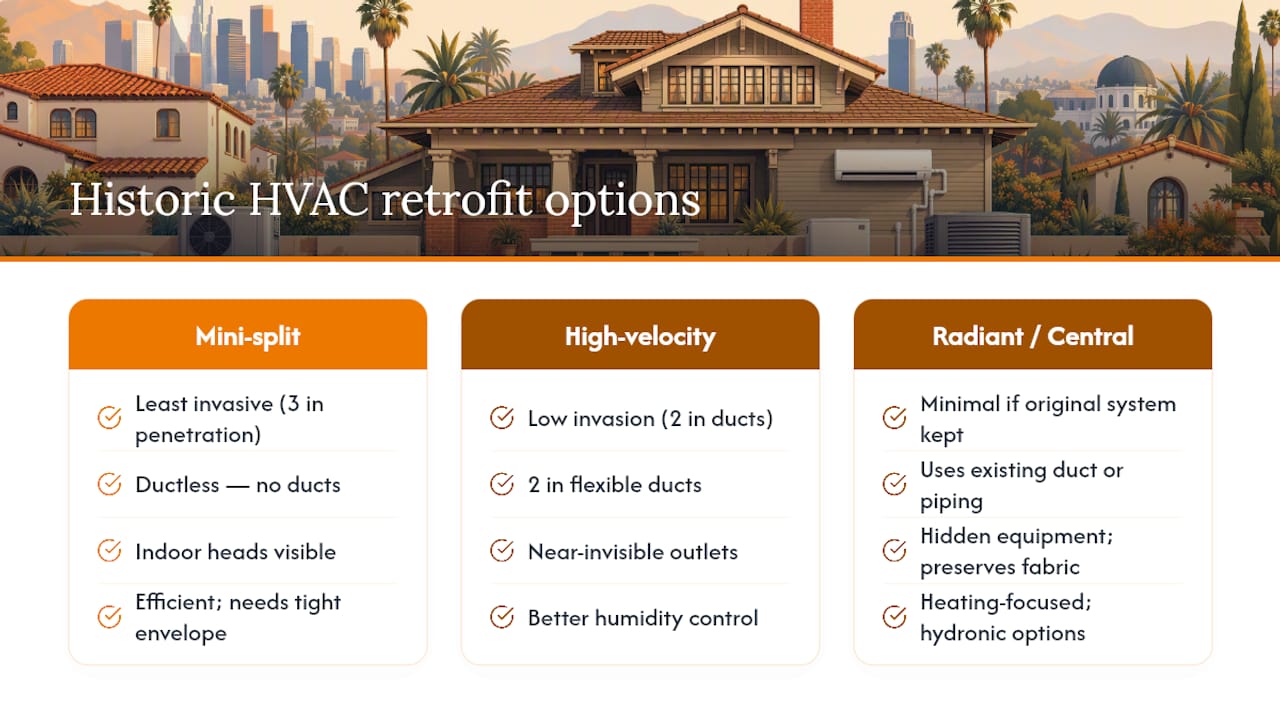
Ductless mini-splits need only a 3-inch wall penetration per zone, which makes them the least invasive option when duct chases don’t exist. You get room-by-room zoning, strong efficiency numbers, and no ductwork tearing through plaster ceilings. The tradeoff is visibility: indoor heads mount on walls or ceilings, and in a Victorian parlor or Craftsman dining room, that’s a hard sell for some homeowners. Cold-climate mini-splits have closed most of the performance gap in freezing weather, but very old drafty houses still need a tight envelope for them to perform well.
High-velocity systems run 2 inch flexible ducts through wall cavities and floor joists, ending in outlets barely bigger than a can light. That near-invisible footprint is why preservation-minded contractors recommend them alongside mini-splits as the two least-invasive retrofit paths. High-velocity systems also handle humidity better in damp climates, an important edge when you’re protecting original plaster and wood trim. Expect more fan noise than a mini-split and a higher price tag for whole-house coverage.
Heat pumps deserve a closer look on their own, since a mini-split is really just a ductless heat pump. Central heat pumps paired with existing ductwork work well in homes that already have hidden duct runs from a prior retrofit. Radiant options, hydronic baseboard, or restored steam radiators, suit homes where the original heating infrastructure is intact and worth preserving.
Cost ranges vary widely by scope. Mini-split installations run roughly $3,000 to $7,000 per indoor head, while whole-home high-velocity retrofits often land between $15,000 and $25,000 or more depending on zoning and concealment work. Many homeowners land on a hybrid: mini-splits for a converted attic or addition, high-velocity for the main historic rooms.
Permits, Preservation Rules, and Certificates of Appropriateness
Before signing a contract, find out whether your property sits inside a designated historic district or carries a conservation easement. That single question determines how much design flexibility you actually have.
- Call your local preservation office first. Many jurisdictions require a Certificate of Appropriateness before you can install exterior equipment, and skipping this step can mean tearing out finished work later.
- Design for the review board, not around it. Screen condensers with fencing or landscaping, place equipment in rear courtyards or roof setbacks invisible from the street, and match any new grilles or vents to existing trim profiles.
- Start the preservation conversation early. National Park Service guidance on HVAC integration stresses that holistic planning up front avoids costly rework and protects both the building and your timeline.
Review timelines vary by city, but budgeting several weeks for approval before demolition or installation begins is realistic in most historic districts.
Why Correct Sizing Protects Your Home’s Original Fabric
An oversized HVAC system is one of the fastest ways to damage a historic house, and most homeowners never see it coming. A Manual J load calculation measures your home’s actual heating and cooling needs, room by room, factoring in wall mass, window count, and insulation levels that plaster-and-lath construction rarely matches to a modern build.
Skip that calculation and you get a system that short-cycles, cools too fast, and swings indoor humidity wildly. Preservation Brief 24 from the National Park Service warns that this kind of moisture migration drives condensation inside walls, paint failure, and wood rot in materials that took a century to reach equilibrium with their environment. Over-sealing a historic envelope to chase efficiency can trap that moisture even further.
The fix is a humidity strategy, not just a bigger unit:
- Choose variable-speed equipment that runs longer at lower output instead of blasting and shutting off.
- Add a whole-home dehumidifier sized to your square footage, especially in humid climates.
- Install continuous humidity monitoring and aim to keep relative humidity between roughly 40% and 55% year-round.
Pro Tip: A correctly sized system often costs less upfront than an oversized one, because you need fewer or smaller heads and less concealment work to hide them.
Installation Practices That Keep the Work Reversible
Every penetration you make in a 100-year-old wall is a decision a future owner has to live with. Good contractors plan installations that can be undone without leaving scars.
- Route refrigerant lines and ductwork through attics, basements, and closets instead of cutting through primary living spaces.
- Use recessed or ceiling-mounted mini-split heads, painted vent covers, and trim-matched grilles to blend equipment into existing architecture.
- Screen outdoor condensers with fencing or plantings rather than leaving them exposed on a front-facing facade.
- Document every cut with photos and an as-built penetrations map, so the next contractor, or the next owner, knows exactly what’s behind each wall.
The National Park Service’s design guidance puts reversibility at the center of any successful retrofit: minimize physical impact now, and you preserve the option to change course later without tearing out original material. A detailed retrofit walkthrough can show what this looks like room by room.
Questions to Ask Before You Hire a Historic-Home HVAC Contractor
Not every HVAC company has handled century-old lath and plaster, and the wrong hire can undo decades of careful restoration in a single afternoon.
- Ask for a written Manual J load calculation, not a rule-of-thumb estimate based on square footage alone.
- Request references and photos from prior historic-home installs, ideally in a house with a similar construction style to yours.
- Get a penetrations map, refrigerant routing plan, and condensate drainage strategy in writing before work starts.
- Confirm who pulls permits, what insurance covers the job, and what warranty applies to both equipment and labor.
- Ask how they’ll protect existing finishes during installation and what the post-install humidity control plan looks like.
Homeowners frequently cite Manual J calculations, contractor references from historic-home retrofits, and verified reviews as the top trust signals when vetting an HVAC company for older properties. Walk away from anyone who refuses a load calculation, pushes you to rip out radiators without evaluating them first, or can’t produce a written plan for protecting your finishes.
How LC Heating and Air Conditioning Approaches Historic-Home Projects
Twenty-plus years of local experience across Los Angeles, from Craftsman bungalows in Hollywood to Spanish Revival homes in Beverly Hills, shapes how LC Heating and Air Conditioning handles older housing stock. Every historic diagnostic starts with a Manual J load calculation, a documented penetrations plan, and preservation protection measures before a single tool comes out.
Transparent pricing and upfront diagnostics mean you understand the scope and cost before work begins, not after a surprise change order. Services relevant to older homes include mini-split and heat pump installs, high-velocity retrofits for homes without duct chases, duct repair, and ongoing maintenance plans that keep humidity in check year-round. Requesting a preservation-aware site visit starts the process the right way, with measurements and a written plan instead of a guess.

Balancing Preservation and Comfort: A Note From Leo
Preservation guides every recommendation in this guide because a house that loses its original plaster to save $2,000 on ductwork hasn’t actually saved anything. We accept tradeoffs other contractors skip, slightly wider comfort bands, extra zoning instead of one big system, more time spent on concealment, because those tradeoffs are what keep the original fabric intact fifty years from now.
If you own a historic property, request a documented diagnostic before you commit to equipment. A load calculation and a penetrations plan cost far less than repairing plaster damage from a rushed install.
— Leo
Get a Preservation-Aware HVAC Diagnostic From LC Heating and Air Conditioning
Most Los Angeles HVAC companies size systems off square footage and quote you before they’ve measured a single room, a shortcut that’s expensive to fix in a historic house. LC Heating and Air Conditioning starts every project with a Manual J load calculation and a documented penetrations plan, with flat-rate pricing so you know the cost before work begins, not after.

Our services cover mini-split and heat pump installs, high-velocity retrofits for homes without duct chases, and the permit coordination that historic districts require. If your outdoor equipment needs to disappear from street view, we plan siting and screening as part of the diagnostic, not as an afterthought. Same-day service calls start at $125, and our maintenance plan runs $180 to $250 per year to keep humidity and system performance in check between visits. If you’re weighing a heat pump for a historic property, our heat pump installation page walks through what a site-specific quote looks like, and homeowners comparing installation planning resources can also check this heat pump installation guide for additional context. Ready to protect your home’s original character while getting real comfort? Book a preservation-aware diagnostic and get a written plan before any work starts.
Sources
The National Park Service’s Preservation Brief 24 remains the definitive federal guidance on heating and cooling historic buildings. Pair it with permit guidance for homeowners and a look at past historic and retrofit projects for real-world context.
- Heating, Ventilating, and Cooling Historic Buildings (Preservation Brief 24) — National Park Service
- A methodical investigation of HVAC integration and impact on U.S. historic stone buildings — NPS
- HVAC — Historic Fredericksburg Foundation, Inc.
- HVAC for historic homes: ductless & high‑velocity options — HVACDatabase
FAQ
What Is the $5,000 HVAC Rule?
Some contractors use a rough guideline based on multiplying the unit’s age by estimated repair costs to decide between repair and replacement, but historic homes add variables like duct compatibility and preservation constraints that this formula doesn’t capture.
What Are the Best HVAC Options for Older Homes?
Ductless mini-splits and high-velocity systems are the two options preservation groups most often recommend for older and historic homes, since both avoid the large duct cavities that traditional forced-air systems need. Mini-splits work well for zone-by-zone comfort with minimal wall penetration, while high-velocity systems suit homes that want whole-house coverage without visible ductwork.
How Do Amish Communities Cool Their Homes Without Air Conditioning?
Amish households traditionally rely on passive cooling strategies like thick masonry walls, cross-ventilation, deep porches, and shade trees rather than mechanical air conditioning, largely for religious and lifestyle reasons rather than technical limitations. Many of these same passive strategies, deep eaves, operable windows, and thermal mass, also happen to protect historic homes from the humidity swings that damage plaster and wood.
Did Houses Have Air Conditioning in the 1950s?
Central air conditioning existed much earlier but remained rare in single-family homes, mostly appearing in movie theaters, department stores, and higher-end new construction. Many historic properties were never designed with ductwork or equipment space for central air, which is why retrofit-friendly systems like mini-splits and high-velocity units matter so much now.
How Much Does It Cost to Add HVAC to a Historic Home?
Costs depend heavily on the system and scope: mini-split installations typically run $3,000 to $7,000 per indoor head, while whole-home high-velocity retrofits often range from $15,000 to $25,000 or more. LC Heating and Air Conditioning lists current installation pricing directly on its site, with heat pump installations generally running in the published range from 5500 to 12000 USD one-off depending on the property.
Recommended
Leo, Propietario y Técnico Principal en LC Heating & Air
Leo dirige LC Heating & Air como propietario-operador y tiene la licencia C-20 HVAC #1073586 de California. Sus guías se enfocan en diagnósticos prácticos, decisiones de reparación seguras y consejos claros para propietarios de Los Ángeles.