- TL;DR
- First, what “not heating” actually looks like
- Quick checks you can do safely in ten minutes
- Why your heat pump blows cold air
- Why your heat pump blows lukewarm air
- What auxiliary heat means, and why it matters
- How to reset a heat pump
- Our perspective: what we see in the field
- When to stop and call a professional
- What a repair visit costs with us
- Repair or replace: how to decide
- Prevent the problem before next winter
- FAQ
- Sources
- Recommended

If your heat pump is running but the air coming out of the vents feels cold or lukewarm, the cause is usually one of a few things: a thermostat setting, a clogged filter, a blocked outdoor unit, weak airflow through the ducts, or a mechanical fault such as low refrigerant or a stuck reversing valve. The first three you can check yourself in ten minutes. The rest need a licensed technician.
This guide walks through the checks in the order we would do them, explains what is normal (a brief burst of cool air during defrost, for example), and tells you exactly when to stop troubleshooting and call. We install and repair heat pumps across Los Angeles, so the examples lean toward Southern California homes, but the logic applies anywhere.
TL;DR
- Start with the thermostat (Heat mode, fan on Auto, temperature set above the room temperature) and the air filter. These two cause a surprising share of “not heating” calls.
- Air that feels lukewarm is not always a fault. Heat pump air is warmer than your room but cooler than furnace air, and a short defrost cycle can briefly blow cool air.
- If “Aux” or “Emergency” heat stays on for long stretches, your heat pump is struggling. That backup is expensive to run and a sign to get it inspected.
- Ice covering the whole outdoor unit, a unit that won’t start, or air that stays cold after the basic checks means it’s time for a professional diagnosis.
- Don’t open the panels or handle refrigerant yourself. In Los Angeles, call LC Heating & Air at (323) 970-3113.
First, what “not heating” actually looks like
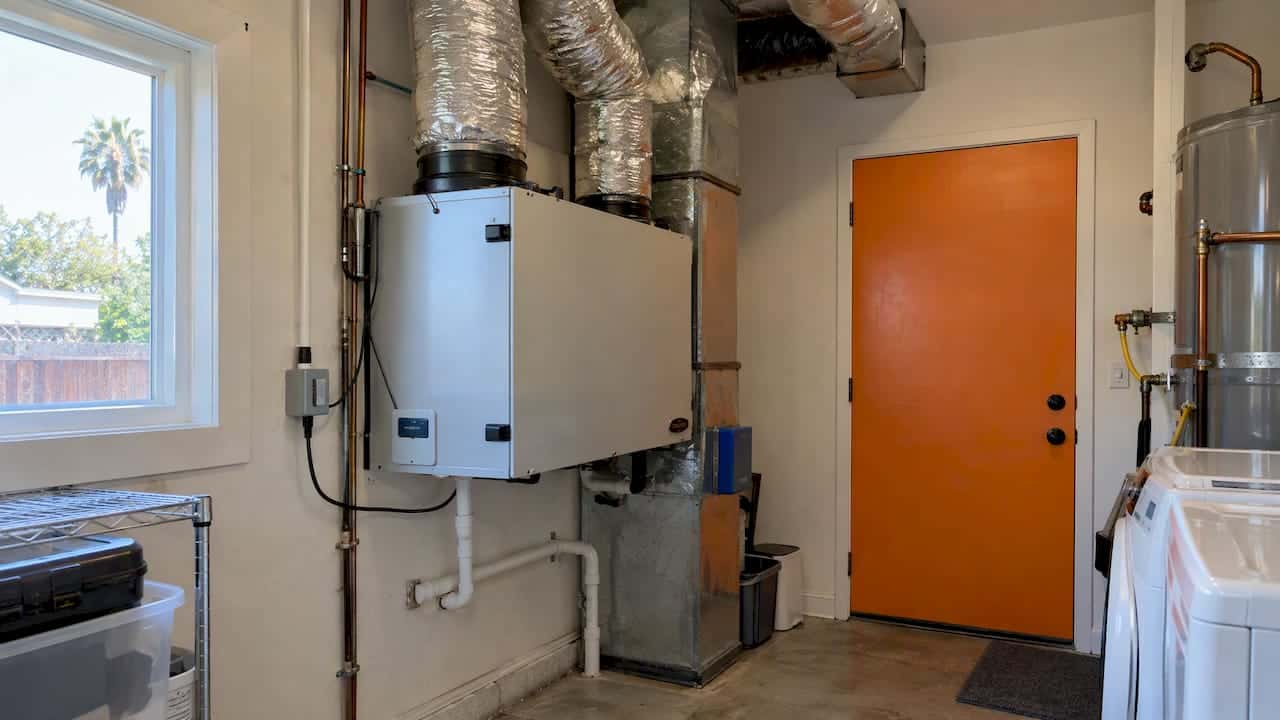
A heat pump doesn’t make heat the way a furnace does. It uses electricity to move heat from outdoor air into your home. That is why it can be so efficient, and also why its supply air feels gentler than the blast from a gas furnace. The Center for Energy and Environment guide for new heat pump owners describes a heat pump as moving heat rather than burning fuel to generate it.
So before you troubleshoot, sort your symptom into one of these groups:
| What you notice | Likely meaning | Where to look |
|---|---|---|
| Vents blow cold air, outdoor fan is running | Wrong mode, low refrigerant, reversing valve, or defrost | Thermostat first, then call |
| Vents blow lukewarm air | Weak airflow, leaky ducts, undersized system, or normal heat pump output | Filter, vents, ducts |
| Nothing comes out, or the system won’t start | Power, tripped breaker, thermostat, or failed component | Breaker and thermostat, then call |
| Runs constantly but the house never warms | Low capacity, duct losses, refrigerant, or poor insulation | Professional diagnosis |
| “Aux” or “Emergency” heat is on all the time | Heat pump can’t keep up on its own | Professional inspection |
Write down which row matches. It makes the phone call to a technician shorter and the diagnosis faster.
Quick checks you can do safely in ten minutes
These steps need no tools and involve no panels, wiring, or refrigerant.
1. Check the thermostat
Confirm it is set to Heat (not Cool, Auto, or Off), the fan is on Auto, and the set temperature is at least a few degrees above the current room temperature. If the fan is set to On, the blower runs continuously, and between heating cycles it pushes room-temperature air that feels cold on your skin. This is one of the most common reasons people think their system is blowing cold air.
If you have a programmable or smart thermostat, check that a schedule or “eco” setback isn’t holding the temperature low. ENERGY STAR’s homeowner maintenance guide points out that programmable thermostats only save money when they are set properly, and the same applies to comfort. Dead batteries in a basic thermostat can also cause strange behavior, so swap them if the display is dim.
2. Look at the air filter
A clogged filter chokes airflow. The system then struggles to move heat into the house, and it may shut down on a safety limit. The same federal guidance recommends checking air filters at least monthly and changing or cleaning them when they are dirty. Slide yours out and hold it to the light. If you can’t see light through it, replace it.
3. Check the breaker and the outdoor unit
Heat pumps usually have two breakers: one for the indoor air handler and one for the outdoor unit. If the outdoor fan isn’t spinning and the unit is silent, check both. Reset a tripped breaker once. If it trips again, stop. A repeat trip means a short or a failing motor or compressor, and resetting it again can make the damage worse.
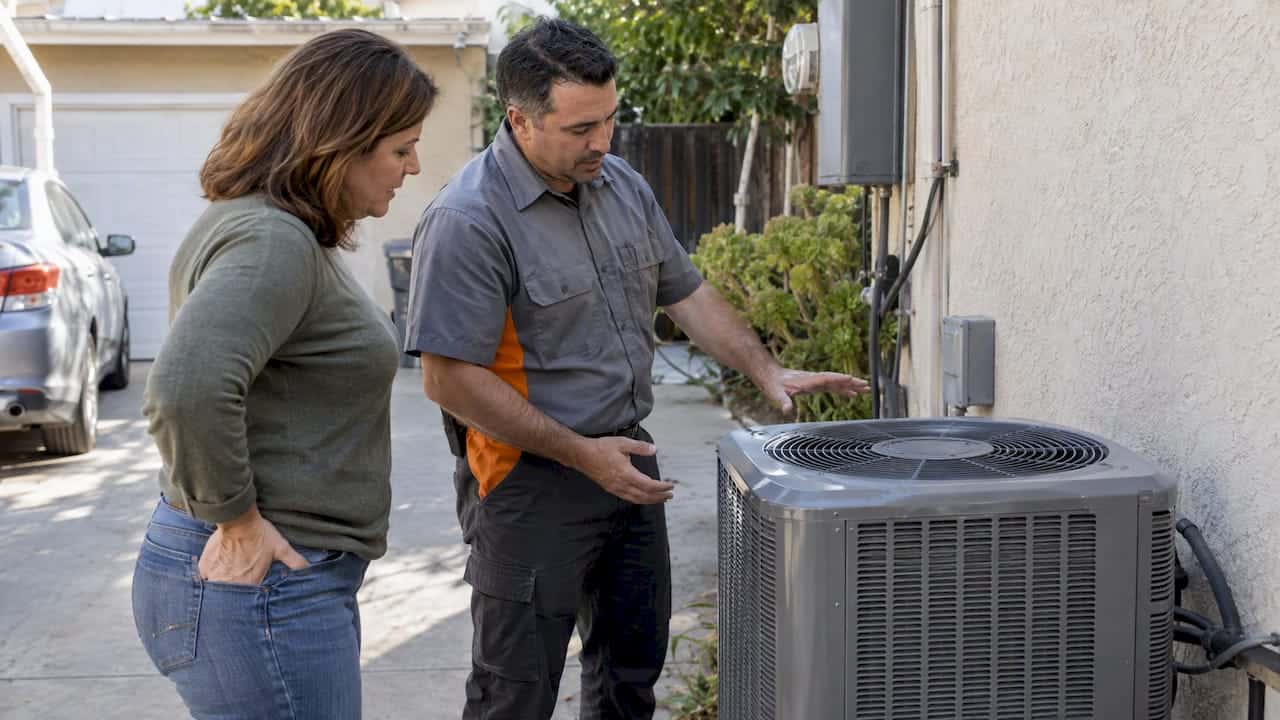
While you’re outside, look at the unit. Clear leaves, trash, and anything stacked against it. The heat pump needs open space around it to pull in heat. And don’t wrap or cover it for the winter: that same guidance says the unit should never be covered because it needs unimpeded airflow.
4. Open the vents and check the registers
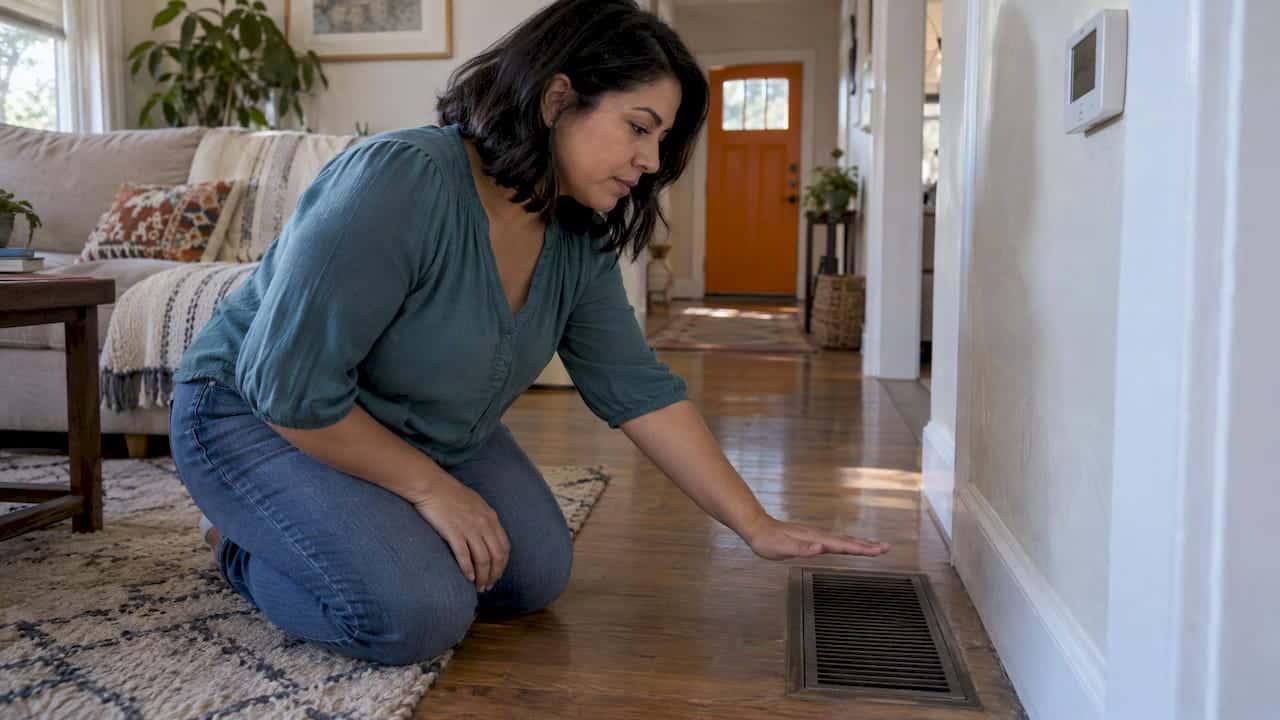
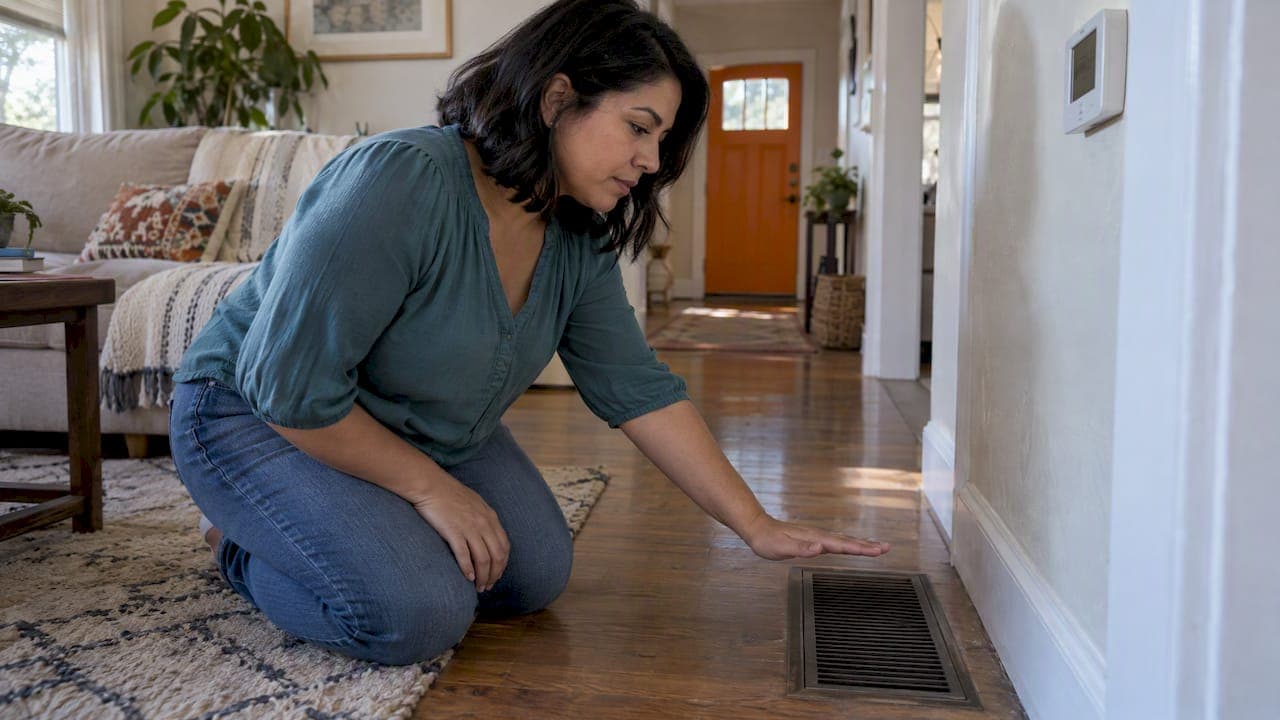
Walk through the house and make sure supply registers are open and not blocked by furniture or rugs. Closing too many vents raises pressure in the ducts and cuts airflow across the coil.
5. Give it a few minutes
After changing a setting, wait 10 to 15 minutes before judging the result. Heat pumps ramp up gradually, and some wait a few minutes before starting the compressor.
If you’ve done all five and the air is still cold, you’re past the DIY stage. Skip ahead to the section on when to call.
Why your heat pump blows cold air
Cold air is the most alarming symptom, and it has several possible causes. Some are harmless.
It’s in defrost mode
When outdoor air is cold and damp, frost can form on the outdoor coil. The heat pump periodically switches into a defrost cycle to melt it. During that time the system briefly runs like an air conditioner, and the indoor air can feel cool for a few minutes. You may also see steam rising from the outdoor unit.
Frost during cold weather is normal. The federal installation guidance notes that a unit stuck in defrost, covered in ice, or paired with constantly running auxiliary heat points to a real problem that needs a professional.
In Los Angeles this matters less often, since hard freezes are rare in the basin. But if you own a second home or rental cabin in the mountains, where ice and snow are routine, keeping the area around the outdoor unit clear is part of the job. Property managers in snowy regions often plan ahead with a commercial de-icing playbook so that ice and snow don’t pile up against equipment.
The thermostat or fan setting is wrong
Covered above, and worth repeating because it is so common. Fan set to On, mode set to Cool, or a thermostat that was bumped by a cleaning crew can all produce cold air.
The reversing valve is stuck
The reversing valve is a small but mighty component. It flips the refrigerant flow so the same equipment can heat in winter and cool in summer. If it sticks in cooling position, the system happily runs and delivers cold air while the thermostat says Heat. Symptoms: the outdoor fan runs, the compressor hums, and the air is cold or cool no matter what you set. This is not a DIY fix. Replacing a reversing valve means recovering refrigerant and brazing new lines, which only a licensed technician should do.
Refrigerant is low
Refrigerant isn’t consumed like fuel. If the charge is low, there is a leak somewhere. Low charge reduces the heat the system can move, so the air feels lukewarm or cool, ice may form on the lines or coil, and run times get longer. Topping off without finding the leak only buys a few weeks. A good technician locates the leak, repairs it, and then sets the charge to the manufacturer’s specification.
ENERGY STAR lists annual pre-season checkups as a way to confirm electrical connections are tight and refrigerant levels are correct before small problems turn into expensive breakdowns.
The compressor or a capacitor has failed
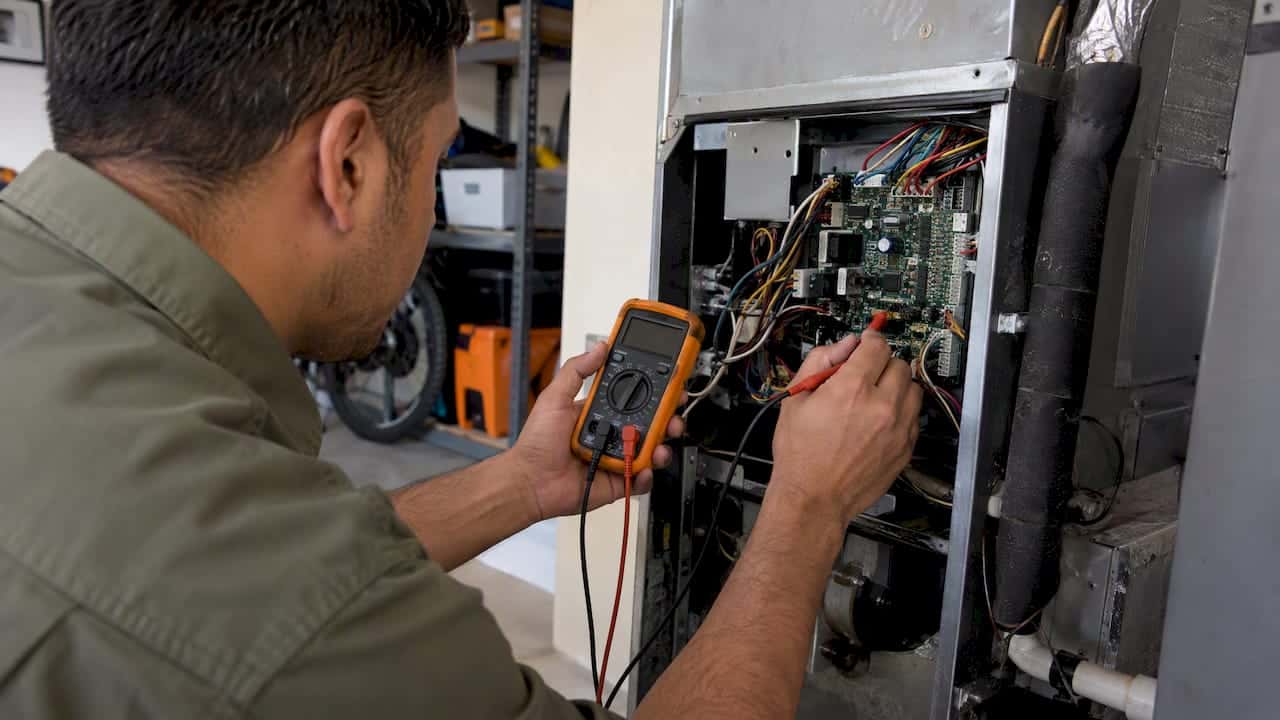
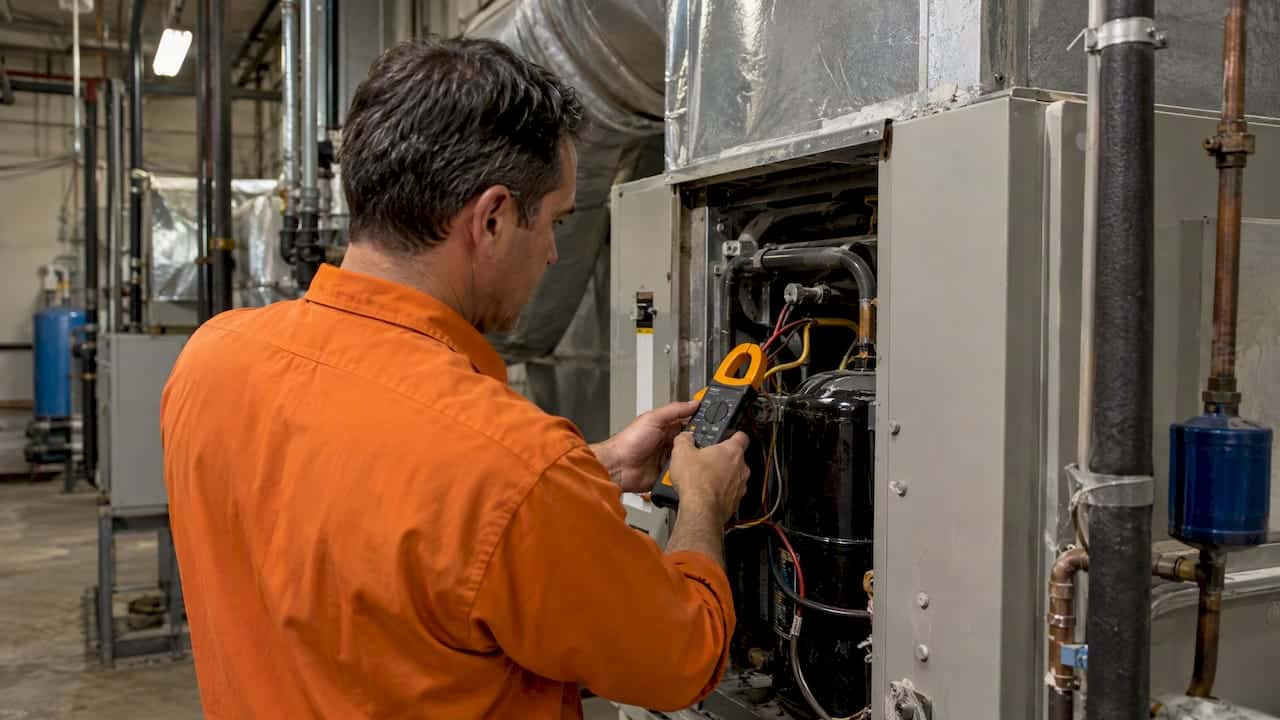
If the outdoor fan runs but the compressor doesn’t, the heat pump can circulate air without moving any heat. Often the culprit is a weak or failed capacitor, a relatively inexpensive part. A healthy capacitor means a happy heat pump. Other times it is a contactor, a motor, or the compressor itself. A technician can test each with the right meters and tell you honestly which repair makes sense.
The coil is frozen
A coil that is frozen solid, not just frosted, usually points to restricted airflow (dirty filter, dirty indoor coil, failing blower) or low refrigerant. If you see thick ice on the outdoor unit or on the indoor refrigerant lines, turn the system off at the thermostat and let it thaw. Don’t chip at ice with tools: you can puncture a coil. Then call.

Why your heat pump blows lukewarm air
Lukewarm air is the quieter version of the same problem, and it’s easy to misread.
It may be normal. Supply air from a heat pump typically feels noticeably cooler than furnace air, because it runs at lower temperatures for longer stretches. If you recently switched from a gas furnace, the air will feel different even when the system is working well, and the house should still reach the set temperature.
Airflow may be restricted. A dirty filter, a dirty indoor coil, closed registers, or a blower that isn’t moving enough air all let the heat pump run while delivering too little warmth to the rooms.
Your ducts may be losing heat. This one is easy to miss. ENERGY STAR notes that poorly sealed, under-insulated ductwork can waste up to 30% of efficiency. In many Los Angeles homes, ducts run through hot, unconditioned attics or tight crawl spaces. Air leaks into the attic, and the warmth that does arrive at the vents feels weak. The heat pump may be fine. The ductwork makes it feel broken. If you have older ducts, rooms that never warm up, or visible tears and crushed sections, ask for a duct inspection. We’ve documented one example of attic ductwork redesign and replacement in a case study.
The system may be the wrong size or installed poorly. ENERGY STAR says improper installation can cut a system’s efficiency by up to 30%. Undersized equipment, bad refrigerant charge, and poor line sets are all installation issues that show up as “it never feels warm.”
The house itself leaks heat. An under-insulated attic or leaky windows make any heating system work harder. ENERGY STAR explains that better home insulation helps a heat pump perform better, which is worth knowing before you blame the equipment alone.

What auxiliary heat means, and why it matters
Many heat pumps have a backup source of heat. In all-electric homes it is usually electric resistance strips inside the air handler. The thermostat may show “Aux,” “AUX HEAT,” or “2nd stage.”
Auxiliary heat is normal when you raise the temperature by several degrees at once, or when the heat pump is in defrost and the system keeps the house from cooling. It’s a problem when it stays on for hours.
The reason is cost. The CEE guidance describes auxiliary mode as a costly, inefficient backup that kicks in automatically, and says that seeing it constantly on the thermostat is a sign the system may be struggling or failing to heat effectively. A simple reset won’t solve that. It needs an inspection.
A few practical rules:
- Aux heat on briefly after a big setpoint jump: normal. Raise the temperature in smaller steps instead.
- Aux heat on constantly, with mild weather outside: the heat pump isn’t doing its job. Call for service.
- “Emergency heat” setting: meant for when the outdoor unit has stopped working altogether. Using it by choice makes your electric bill climb. If you need it to stay warm, you need a repair, and the sooner the better.
- Your electric bill suddenly jumps: this can be the first sign aux heat is running more than it should.
How to reset a heat pump
A reset is worth trying once, because a power glitch or a tripped safety control can leave the system confused.
- Set the thermostat to Off.
- Turn off the breakers for both the indoor and outdoor units.
- Wait at least five minutes. This lets the compressor pressures equalize and protects the compressor from a hard restart.
- Turn the breakers back on, then set the thermostat to Heat.
- Wait 10 to 15 minutes and see whether warm air arrives.
If the system works, great, but note it. If it needs a reset every few days, something is failing, and each cold start puts strain on the compressor. Don’t keep resetting a unit that trips its breaker.
Our perspective: what we see in the field
We’ve worked on heat pumps, mini splits, and commercial VRF systems in Los Angeles for more than twenty years, and a few patterns come up again and again.
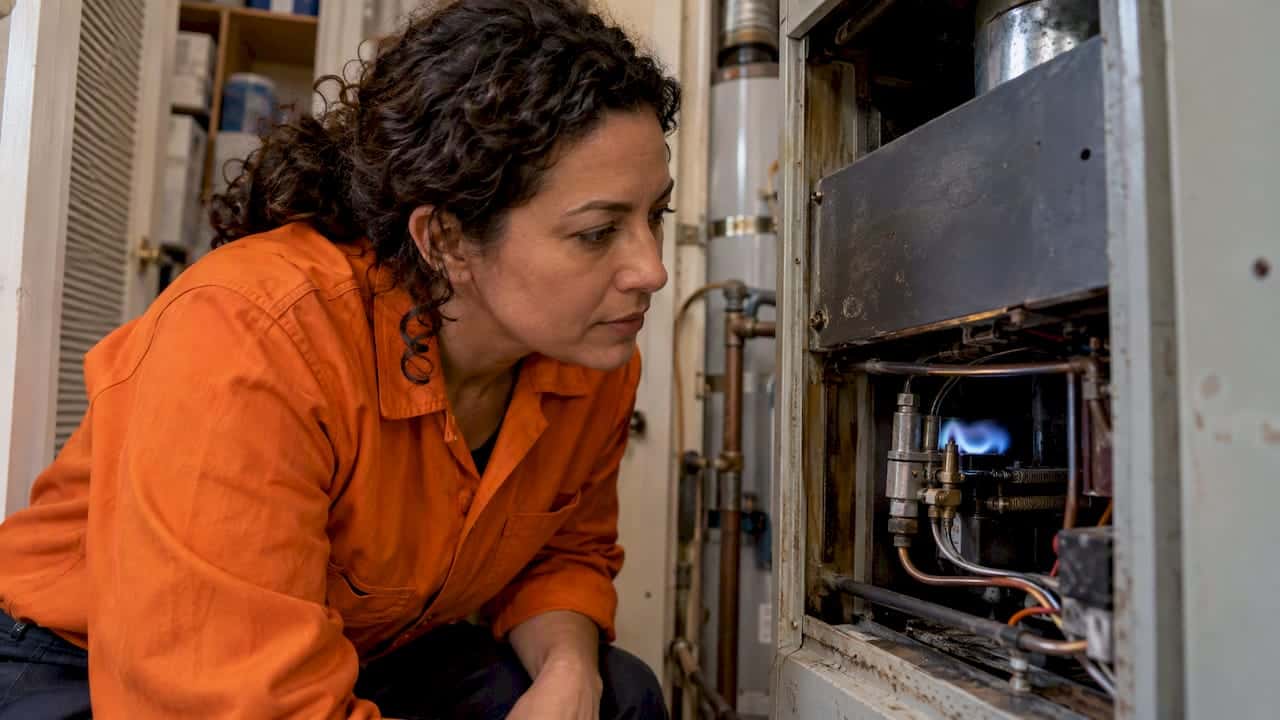
Most “my heat pump is broken” calls are actually three or four different problems. A homeowner replaced the filter but the ducts are leaking. Or the thermostat was wired for a furnace and set up wrong for a heat pump. A proper diagnosis looks at airflow, refrigerant, electrical components, and ducts before touching a part.
Heat pumps in Los Angeles are asked to do a lot. Our homes range from historic bungalows in Hollywood and Pasadena to hillside properties with hard-to-reach air handlers. Many have older ductwork, attic equipment, and rooms added over the years. We’ve learned that comfort problems often start in the house, not the equipment.
Replacement is not the first answer. Homeowners tell us they’re sick of surprise diagnostic fees and pressure to replace a system that could be fixed. We do the opposite: honest diagnostics and flat-rate pricing for repairs, so you know the cost before work begins. If a repair is the better value, we’ll say so. If a system is truly at the end of its life, we’ll show you why.
Mini splits and VRF need specialists. Multi-zone and commercial VRF systems have communication boards, branch controllers, and refrigerant circuits that behave differently from a basic split system. If your business is dealing with a VRF zone that won’t heat, use a technician who works on them regularly.
Our advice is simple: don’t wait for a total failure. A heat pump that is slightly off costs you money every day, through aux heat, long run times, and extra wear.
— Leo
When to stop and call a professional
Call for service if any of these apply:
- The air stays cold after you’ve checked the thermostat, filter, and breakers.
- The outdoor unit is covered in ice or stuck in defrost.
- The outdoor fan runs but you hear no compressor, or you hear grinding, buzzing, or clicking.
- Auxiliary or emergency heat runs for long periods.
- The breaker trips repeatedly.
- You see oily residue on refrigerant lines, or hear hissing. Both can indicate a refrigerant leak.
- Your electric bill jumped with no change in weather or habits.
Two safety notes. Keep your hands and tools away from the electrical compartment: capacitors can hold a charge even with the power off. And don’t buy refrigerant online to “top off” a system. Charging a system correctly requires gauges, a scale, and a leak search by a licensed professional.
What a repair visit costs with us
Our service call starts from $125. We pair that with honest diagnostics, so you aren’t hit with an unexpected diagnostic fee later, and repairs are quoted at a flat rate before we begin. Repairs themselves vary by the part and the system, so we don’t publish a single price for heat pump repair. We give you the exact number once we know what’s wrong.
We offer same-day service for most calls in Greater Los Angeles, including Hollywood, West Hollywood, Beverly Hills, Bel Air, Brentwood, and Pasadena. If your home is without heat on a cold night, our emergency line is available 24/7.
Book heat pump service: call (323) 970-3113, or see our heat pump services page for what we cover.
Repair or replace: how to decide
A repair makes sense when the failed part is a capacitor, contactor, thermostat, fan motor, or a fixable leak, and the system is otherwise in good shape. Replacement deserves a serious look when the compressor has failed on an old unit, the refrigerant is an obsolete type, repairs keep recurring, or the system was never sized properly.
If you do replace, our published installation ranges are:
| System | Installed price range |
|---|---|
| Heat pump installation | $5,500 to $12,000 |
| Mini split installation | $3,500 to $20,000 |
| Ductwork replacement | $3,000 to $8,000 |
The range depends on size, the number of zones, ductwork condition, and electrical work. See our financing page for options, and our heat pump installation page for details. ENERGY STAR advises homeowners to hire contractors who are licensed, insured, and hold certifications such as NATE, and that’s a sound checklist for anyone you’re comparing.
Rebates that can lower the cost in Los Angeles
If you’re a LADWP customer, the utility’s Consumer Rebate Program offers up to $2,500 per ton for high-efficiency heat pump HVAC equipment purchased and installed on or after November 1, 2025. Equipment must meet minimums of 7.7 HSPF2 and 15.2 SEER2, and higher-efficiency ductless systems can qualify for the maximum amount. Confirm current terms with LADWP before you buy.
The federal picture has changed. The IRS states the 25C energy efficient home improvement credit does not apply to property placed in service after December 31, 2025. If you installed a system earlier, talk to a tax professional about your return. For the local details, read our guides on LADWP HVAC rebates and current rebates and tax credits.
Prevent the problem before next winter
Most heat pump failures start small. ENERGY STAR identifies neglect as a top cause and recommends annual check-ups before each season: heating in the fall and cooling in the spring. A good habit list:
- Check the filter monthly and replace it when dirty.
- Keep two feet of clear space around the outdoor unit and trim plants back.
- Rinse light dust off the outdoor coil with a gentle garden hose when the power is off. Don’t use a pressure washer.
- Watch for changes: longer run times, new noises, higher bills.
- Have a technician check refrigerant, electrical connections, drainage, and ducts once a year.
Our HVAC maintenance plan runs $180 to $250 per year, and covers the seasonal checkups that catch problems before a cold night does. You can also read about our HVAC tune-ups.
FAQ
Why is my heat pump blowing cold air when the heat is on?
The most common causes are the thermostat fan set to On, a defrost cycle, low refrigerant, or a reversing valve stuck in cooling position. Check the thermostat first, then wait 15 minutes to rule out defrost. If the air stays cold, call a licensed technician, since the remaining causes need gauges and refrigerant handling.
Why is my heat pump fan running but no heat?
The fan can run even when the compressor isn’t working. A failed capacitor, contactor, or compressor, a tripped safety switch, or a refrigerant leak can all leave you with moving air and no warmth. Check your breakers once, then call for diagnosis.
Is it normal for auxiliary heat to come on?
Yes, briefly: after a large temperature jump or during defrost. It’s a concern when it runs for hours or all the time, because it’s costly electric resistance heat, and constant use suggests the heat pump is struggling. Get the system inspected.
What is the most common problem with heat pumps?
Airflow and thermostat issues are the most common, followed by electrical components such as capacitors, and low refrigerant from leaks. Poor maintenance makes all of them more likely. A yearly checkup and a monthly filter check prevent a lot of calls.
Should I cover my outdoor heat pump in winter?
No. The unit needs open airflow to pull in heat, so covering it can hurt performance. Just keep leaves, debris, and ice clear of it.
Sources
- You Installed an Air Source Heat Pump. Now What?
- Clean Heating and Cooling | ENERGY STAR
- Improved Home Insulation Helps a Heat Pump Perform Better | ENERGY STAR
- ENERGY STAR Certified Homes Maintenance Guide
- Consumer Rebate Program | LADWP
- IRS FAQs on 25C and related credits under Public Law 119-21
- Commercial De-Icing 2026 Winter Playbook
Recommended
Leo, Propietario y Técnico Principal en LC Heating & Air
Leo dirige LC Heating & Air como propietario-operador y tiene la licencia C-20 HVAC #1073586 de California. Sus guías se enfocan en diagnósticos prácticos, decisiones de reparación seguras y consejos claros para propietarios de Los Ángeles.