- What is HVAC liability insurance and what does it cover?
- How much does HVAC liability insurance cost?
- Why HVAC liability insurance is required for licensing and contracts
- Common pitfalls and gaps in HVAC insurance coverage
- Key takeaways
- What i have learned running HVAC work in los angeles
- Protect your HVAC business with the right coverage and the right partner
- FAQ
- Recommended

TL;DR:
- HVAC liability insurance is a coordinated set of multiple coverages designed to protect businesses from third-party claims, employee injuries, vehicle accidents, equipment losses, and pollution events. A comprehensive program typically includes six to seven distinct coverages, such as general liability, workers’ compensation, and contractor pollution liability, which are essential for legal and financial protection. Properly understanding and maintaining these coverages is crucial for compliance, risk management, and safeguarding your business assets.
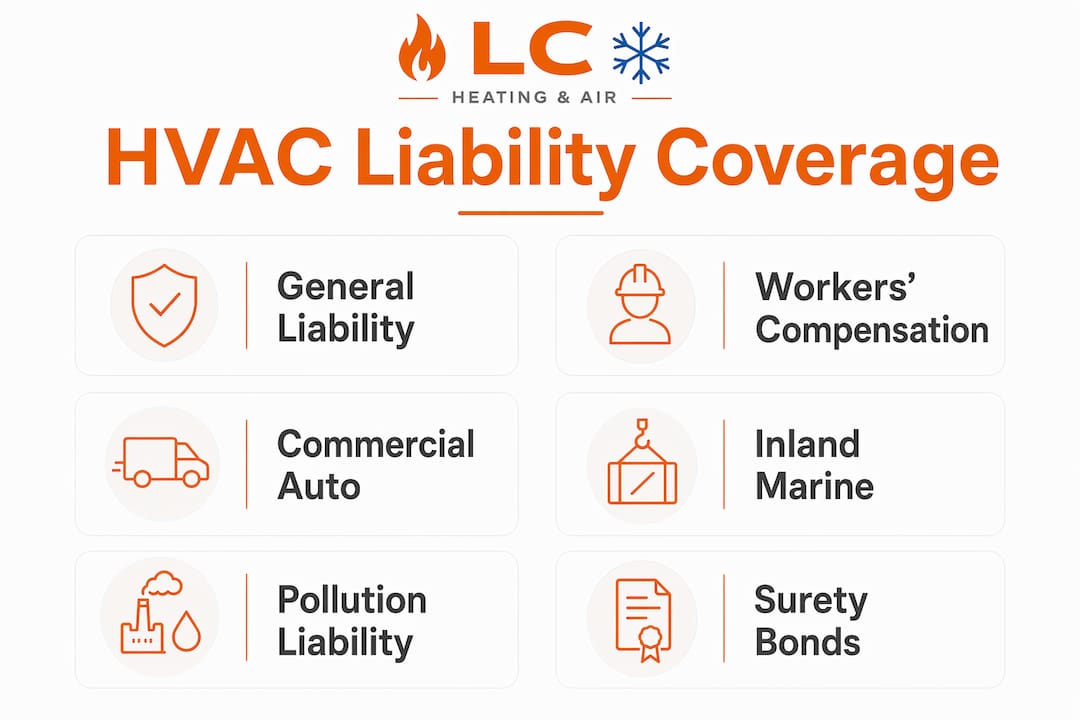
HVAC liability insurance is defined as a coordinated program of multiple insurance coverages that protects HVAC businesses from third-party claims, employee injuries, vehicle incidents, equipment losses, and pollution events. This is not a single policy you buy off a shelf. According to Grit Insurance, a complete HVAC insurance program typically includes 6–7 distinct coverages, from general liability and workers’ compensation to contractor pollution liability and commercial auto. Understanding what is HVAC liability insurance means understanding each layer of that program, what it covers, what it costs, and what happens when you skip one. Whether you run a solo operation in Los Angeles or manage a crew of ten, the right coverage protects your license, your contracts, and your business balance sheet.
What is HVAC liability insurance and what does it cover?
HVAC liability insurance is a multi-policy program, not a single product. The industry term you will see on most policies is “commercial contractor insurance,” but HVAC liability insurance is the widely used phrase that describes the full coverage stack an HVAC business needs to operate safely and legally.

The core of any HVAC insurance coverage program starts with general liability insurance. This covers bodily injury and property damage caused to third parties during your work. If a technician accidentally floods a customer’s basement while servicing a cooling system, general liability pays for the damage and any resulting legal costs.
Workers’ compensation is the second non-negotiable layer. Workers’ comp is required in almost every state and covers medical expenses and lost wages for employees injured on the job. HVAC work carries real physical risks: falls from ladders, electrical burns, heat exhaustion, and back injuries from lifting heavy equipment are all common claims.
Commercial auto insurance covers vehicles your business owns or uses for service calls. A standard personal auto policy will not cover an accident that happens while driving a company van to a job site. This distinction matters more than most new business owners realize.
Inland marine insurance protects your tools and equipment while they are in transit or stored off-site. A stolen set of refrigerant gauges or a damaged manifold can cost thousands of dollars to replace. Inland marine fills the gap that general liability and commercial property policies leave open.
Contractor pollution liability (CPL) is the coverage most HVAC contractors overlook. Standard general liability policies exclude pollution, which means a refrigerant spill, a mold outbreak from a condensate leak, or a Legionella event from a cooling tower is not covered unless you carry CPL specifically. EPA Section 608 mandates certification to handle refrigerants, and that regulatory exposure makes CPL a practical necessity, not an optional upgrade.
Rounding out a complete program are professional liability (errors and omissions), which covers design or specification errors, and umbrella liability, which extends your coverage limits across all underlying policies when a single claim exceeds those limits.
- General liability: third-party bodily injury and property damage
- Workers’ compensation: employee medical and wage replacement
- Commercial auto: company vehicles and driver liability
- Inland marine: tools, equipment, and materials in transit
- Contractor pollution liability: refrigerant, mold, and Legionella claims
- Professional liability: design errors and specification mistakes
- Umbrella liability: excess coverage above underlying policy limits
Pro Tip: Many states also require surety bonds as part of HVAC licensing. Bond requirements range from $100,000 to $600,000 depending on the state, with Colorado and Washington among those with higher thresholds. Check your state’s contractor licensing board before assuming your insurance program is complete.
How much does HVAC liability insurance cost?
HVAC insurance costs vary widely based on business size, location, payroll, fleet, and claims history. General liability alone averages $40–$80 per month for $1 million per occurrence and $2 million aggregate limits. That is the baseline most states and clients require, but it is rarely the full picture.
When you factor in workers’ compensation, commercial auto, inland marine, and pollution liability, total program costs climb significantly. Mid-sized HVAC contractors typically spend $18,000–$60,000 annually on a complete insurance program. Solo operators generally pay $275–$540 per month, while businesses with 2–5 employees spend $775–$1,750 monthly.
Here is a practical breakdown of what drives your premium up or down:
| Cost Factor | Impact on Premium |
|---|---|
| Annual revenue and payroll | Higher revenue and payroll increase general liability and workers’ comp costs |
| Number of employees | More employees means higher workers’ comp exposure and premium |
| Fleet size and vehicle type | Each additional vehicle adds commercial auto premium |
| Claims history | Prior claims raise your experience modification rate and overall cost |
| Safety record and training | Clean safety records and documented training programs reduce premiums |
| Coverage limits | Higher limits ($2M–$5M) cost more but are increasingly required by commercial clients |
| State requirements | Some states mandate higher minimums, directly affecting base cost |
The experience modification rate (also called the “experience mod”) is a multiplier applied to your workers’ compensation premium based on your actual claims history versus the industry average. A mod below 1.0 means you pay less than average. A mod above 1.0 means you pay more. Keeping that number low is one of the most direct ways to control your insurance costs year over year.
Pro Tip: Proactive safety programs reduce both claim frequency and your experience mod rate. Documented toolbox talks, fall protection training, and heat illness prevention protocols are not just good practice. They are financial tools that lower what you pay for coverage.
Commercial clients are also pushing coverage limits higher. Coverage limits of $2M to $5M are increasingly demanded by commercial property managers and general contractors. If you plan to scale into commercial work, budget for higher limits from the start rather than scrambling to adjust mid-contract.
Why HVAC liability insurance is required for licensing and contracts
HVAC liability insurance is not optional in most of the United States. Most states mandate general liability for HVAC licensing, and workers’ compensation is required in 49 states. Operating without these coverages puts your license at risk and exposes your personal assets to claims that your business cannot absorb.
Beyond licensing, the commercial market has its own requirements. Here is how the compliance chain typically works:
- State licensing board requires proof of general liability and workers’ compensation before issuing or renewing your HVAC contractor license.
- General contractors require subcontractors to carry specific coverage limits and name them as additional insured on the policy before work begins on a project.
- Commercial property managers request a certificate of insurance before awarding a service contract, often specifying minimum limits and required endorsements.
- Municipalities and public agencies require proof of coverage and sometimes surety bonds before allowing work on public buildings or infrastructure.
- Insurance clauses in contracts specify exact coverage types, limits, and endorsements. Failing to meet these clauses can void the contract or expose you to breach claims.
Commercial clients and municipalities commonly require a certificate of insurance as proof of coverage before work can begin. That certificate is your ticket to the job. Without it, you do not get on site.
“Proof of insurance demonstrates compliance and good risk stewardship. It signals to clients that you take your responsibilities seriously and that they are protected if something goes wrong on their property.”
Contractor pollution liability deserves special attention in the compliance context. EPA Section 608 requires certification to handle refrigerants, and any refrigerant release on a job site creates both regulatory and civil liability. A standard general liability policy will not respond to that claim. CPL is the only coverage that will. If you work on commercial cooling systems or handle refrigerants regularly, CPL is not a luxury. It is a compliance tool.
Understanding HVAC permit requirements is also part of the compliance picture, since unpermitted work can create liability exposure that no insurance policy will cover.
Common pitfalls and gaps in HVAC insurance coverage
The most expensive mistake HVAC business owners make is assuming that general liability covers everything. Many HVAC business owners rely on minimum contract requirements and end up underinsured for payroll exposure, vehicle liability, or tools losses. Minimum requirements protect the client. They do not fully protect your business.
Here are the coverage gaps that create the most costly surprises:
- Pollution exclusions in general liability: Refrigerant releases, mold from condensate leaks, and Legionella from cooling towers are all classified as pollution events. Standard GL policies exclude these claims entirely. Only contractor pollution liability fills this gap.
- Completed operations claims: Completed operations coverage protects against claims that arise months or years after installation if a system failure causes property damage. A faulty installation that causes water damage six months later is a completed operations claim, not an active operations claim.
- Additional insured endorsements: General contractors often require subcontractors to add them as additional insured using a CG 20 37 endorsement. Without this specific endorsement, the general contractor has no coverage under your policy, and the contract requirement is not met.
- Occurrence vs. claims-made policies: Occurrence-based policies cover incidents that happen during the policy period, even if the claim is filed years later. Claims-made policies only cover claims filed while the policy is active. For completed operations exposure, occurrence-based coverage is the safer choice.
- Tools and equipment gaps: General liability does not cover your own tools. Inland marine does. A van break-in that costs you $8,000 in stolen equipment is an inland marine claim, not a GL claim.
Pro Tip: Read your policy terms carefully before assuming coverage exists. Policy names do not define coverage scope. The exclusions section of a general liability policy is where most HVAC contractors discover they are not covered for the risks they assumed were included.
The gap between minimum required coverage and actual business risk exposure is where most HVAC contractors get hurt financially. A $1 million general liability limit sounds substantial until a serious property damage claim or a multi-employee workers’ comp event exhausts it. Building a complete program that reflects your actual payroll, fleet, and project types is the only way to protect your business balance sheet fully. You can review types of HVAC warranty coverage to understand how warranty obligations interact with your insurance responsibilities on completed work.
Key takeaways
HVAC liability insurance is a coordinated program of multiple coverages, and no single policy is sufficient to protect an HVAC business from the full range of risks it faces.
| Point | Details |
|---|---|
| Multi-policy program | HVAC liability insurance includes 6–7 coverages, not a single policy. |
| Pollution liability gap | Standard general liability excludes refrigerant, mold, and Legionella claims. |
| Compliance is mandatory | Most states require general liability and workers’ comp for HVAC licensing. |
| Cost scales with size | Solo operators pay $275–$540 monthly; mid-sized programs cost up to $60,000 annually. |
| Completed operations matter | Claims from faulty installations can arrive months after job completion. |
What i have learned running HVAC work in los angeles
After more than twenty years in the HVAC business in Los Angeles, the insurance question comes up more than most people expect. Not from clients asking if we are covered, but from other contractors asking why their claim was denied.
The answer is almost always the same. They bought the minimum. They assumed the policy name told them what was covered. And they never read the exclusions.
The pollution exclusion in a standard general liability policy is the single biggest trap in HVAC insurance. Refrigerant is classified as a pollutant under most policy language. That means a refrigerant spill during a service call, something that happens on job sites regularly, is not covered by the policy most contractors think protects them. Contractor pollution liability is not a specialty product for industrial contractors. It is a basic necessity for anyone who touches refrigerant.
The second thing I would tell any HVAC business owner is to verify your contract insurance requirements before you price the job, not after you win it. Commercial property managers and general contractors increasingly require $2 million to $5 million in general liability limits, plus specific endorsements. Finding out after the contract is signed that your current limits do not qualify is an expensive lesson.
Safety records are also a financial asset, not just a compliance checkbox. A clean experience mod rate translates directly into lower workers’ compensation premiums. Investing in documented safety training, proper fall protection, and heat illness prevention is not just the right thing to do for your crew. It pays you back every renewal cycle.
Build your insurance program the way you build a well-designed HVAC system: every component serves a purpose, and skipping one creates a failure point. General liability is the air handler. Workers’ comp is the ductwork. Pollution liability is the filter that catches what everything else misses. You would not install a system without all the components. Do not run your business without all the coverage.
— Leo
Protect your HVAC business with the right coverage and the right partner
Running an HVAC business in Los Angeles means working in one of the most demanding service environments in the country. From historic homes in Pasadena to large commercial buildings in downtown LA, every job carries real liability exposure.

LC Heating and Air Conditioning has operated in the Los Angeles market for over twenty years, building a reputation on honest diagnostics, flat-rate pricing, and professional service across residential and commercial HVAC projects. We understand the operational realities that HVAC business owners face, including the insurance requirements that come with commercial contracts and licensing. If you are looking for a trusted local HVAC partner or need guidance on what professional HVAC service looks like in practice, contact our team to learn more about how we work and what we cover.
FAQ
What is HVAC liability insurance in simple terms?
HVAC liability insurance is a program of multiple insurance coverages that protects HVAC businesses from third-party injury claims, property damage, employee injuries, vehicle accidents, and pollution events. It is not a single policy but a coordinated set of coverages tailored to the risks of HVAC contracting.
Is HVAC liability insurance required by law?
Most states require general liability insurance for HVAC contractor licensing, and workers’ compensation is mandated in 49 states. Bond requirements vary by state, ranging from $100,000 to $600,000 in states like Colorado and Washington.
Does general liability cover refrigerant spills?
No. Standard general liability policies exclude pollution claims, which includes refrigerant releases, mold from condensate leaks, and Legionella from cooling towers. Contractor pollution liability (CPL) is the only coverage that addresses these specific risks.
How much does a full HVAC insurance program cost?
Solo HVAC operators typically pay $275–$540 per month, while businesses with 2–5 employees spend $775–$1,750 monthly. A complete mid-sized contractor program can cost $18,000–$60,000 annually depending on payroll, fleet size, and coverage limits.
What is completed operations coverage and why does it matter?
Completed operations coverage protects HVAC contractors from property damage or injury claims that arise after a job is finished, sometimes months or years later. General contractors often require subcontractors to carry this coverage and add them as additional insured via a CG 20 37 endorsement.
Recommended
Leo, Propietario y Técnico Principal en LC Heating & Air
Leo dirige LC Heating & Air como propietario-operador y tiene la licencia C-20 HVAC #1073586 de California. Sus guías se enfocan en diagnósticos prácticos, decisiones de reparación seguras y consejos claros para propietarios de Los Ángeles.