- Key Takeaways
- Why AC runs but house stays hot: the airflow problem
- Thermostat issues and cycling habits that hurt cooling
- How your home’s structure fights against your AC
- Mechanical problems that reduce cooling capacity
- Your AC troubleshooting checklist
- My take: what homeowners keep getting wrong
- Get your home cooling the way it should
- FAQ
- Recommended
Why AC Runs but Your House Stays Hot: Real Fixes
TL;DR:
- Your AC may run continuously but fail to cool effectively due to airflow blockages like clogged filters, leaky ducts, or poor insulation. Homeowners often mistakenly think lowering the thermostat speeds cooling, but proper placement, maintenance, and structural improvements are essential for optimal performance. Regular checks of filters, vents, and system components, along with professional tune-ups, help prevent inefficiency and ensure your home stays comfortably cool.
Your air conditioner is running. You can hear the hum. You can feel the air moving through the vents. And yet, somehow, your house stays hot. If you’re wondering why AC runs but house stays hot, you’re not alone, and the answer is almost never as simple as “the AC is broken.” The technical term for this situation is inadequate cooling capacity, but the real causes range from clogged air filters to leaky ducts to poor home insulation. This guide walks you through every major reason your home stays hot with AC on, so you can stop guessing and start fixing.
Key Takeaways
| Point | Details |
|---|---|
| Running AC ≠ effective cooling | Your AC can operate normally and still fail to cool your home due to airflow, mechanical, or structural issues. |
| Airflow is everything | Dirty filters, blocked vents, and duct leaks are the most common reasons AC runs without cooling your home. |
| Thermostat habits matter | Setting your thermostat lower does not speed up cooling. It only adds pressure to your system. |
| Home structure plays a role | Poor insulation and hot attics can undo all the work your AC does, even when the unit runs perfectly. |
| Maintenance prevents most problems | Routine tune-ups catch refrigerant issues, dirty coils, and airflow problems before they become expensive repairs. |
Why AC runs but house stays hot: the airflow problem
The most common reason your home stays hot despite a running AC is restricted airflow. Think of your AC system like your lungs. If something blocks the airway, it doesn’t matter how hard your lungs work. The air simply cannot move efficiently enough to do its job.
Dirty air filters
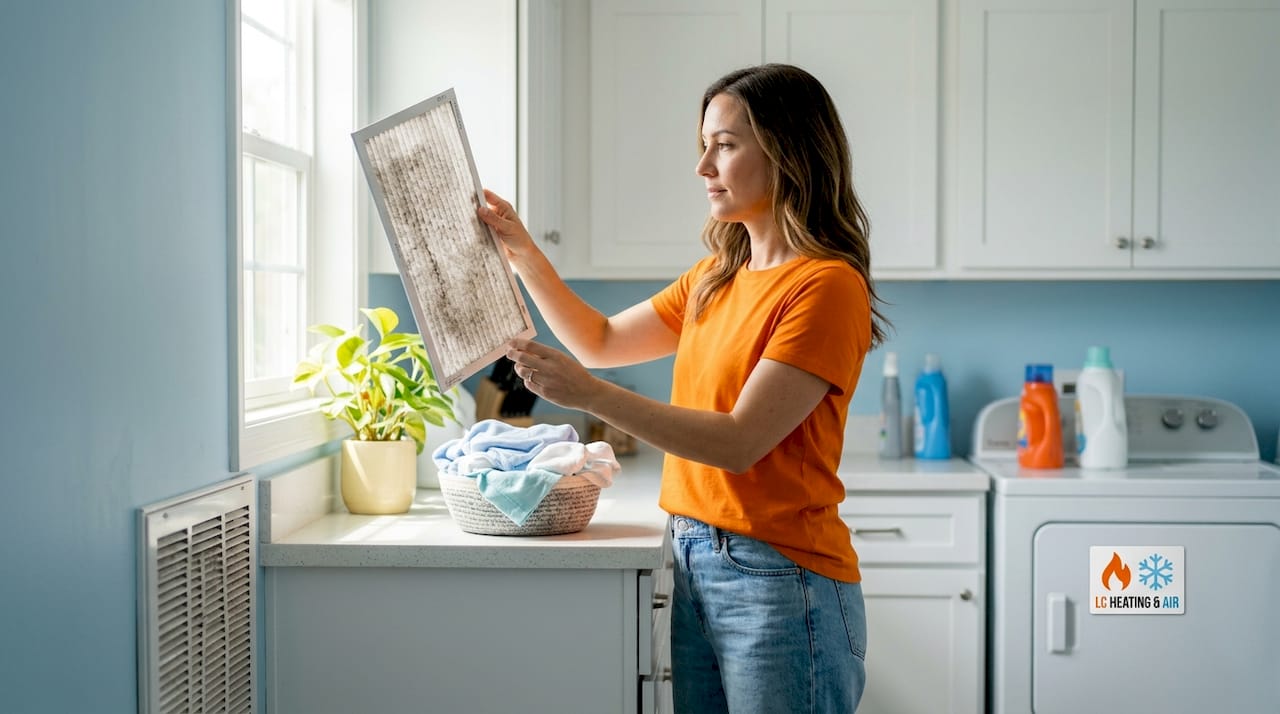
Your air filter is the single most overlooked component in home cooling. When it clogs, your system has to fight for every cubic foot of air it pulls in. The result is weak airflow, a strained blower, and rooms that never quite cool down. During a heat wave, filters can clog in as little as two weeks, compared to the standard three-month replacement schedule most homeowners follow. If you’re running your AC hard through a Los Angeles summer, check that filter every two weeks.
Blocked vents and closed doors
A lot of homeowners close vents in rooms they don’t use, thinking it will redirect cool air to the rooms they do use. It actually does the opposite. Your duct system is designed for a specific airflow balance. Closing vents increases pressure throughout the ducts, which restricts airflow and reduces system efficiency across the board. Blocked return air vents are especially damaging. If a piece of furniture is sitting over your return vent, your system is essentially trying to breathe through a pillow.
Duct leaks and poor duct design
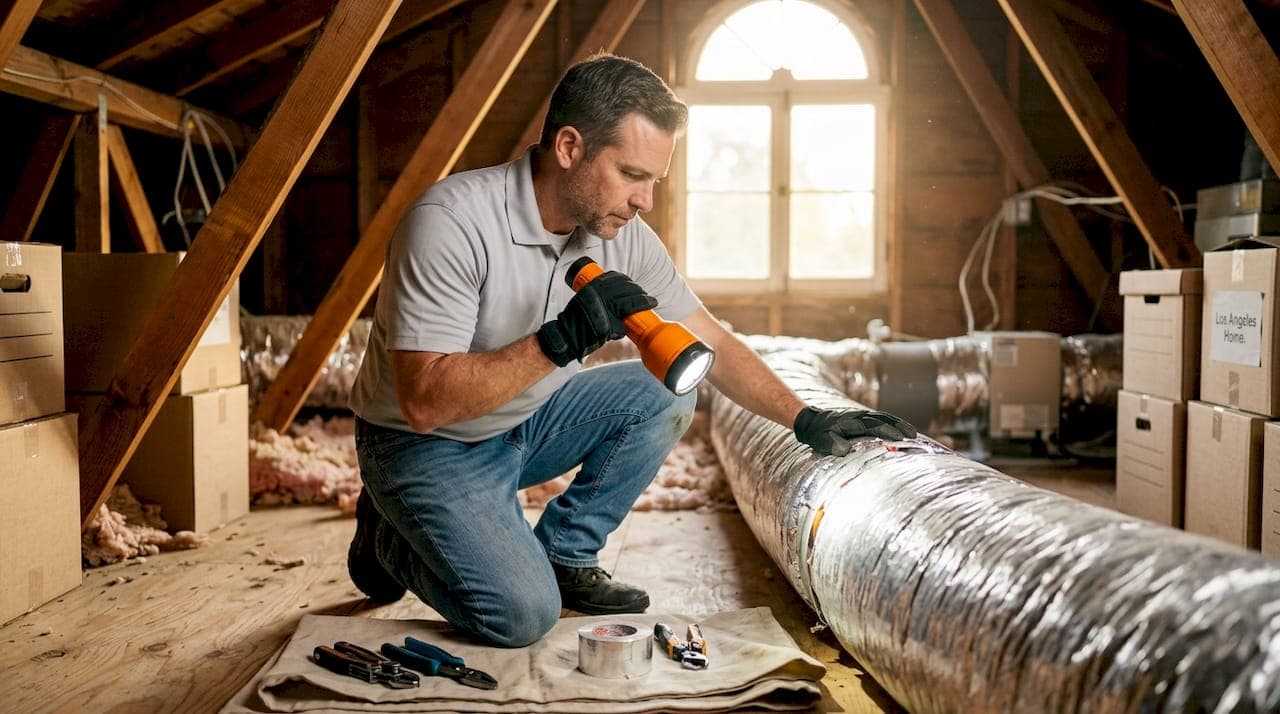
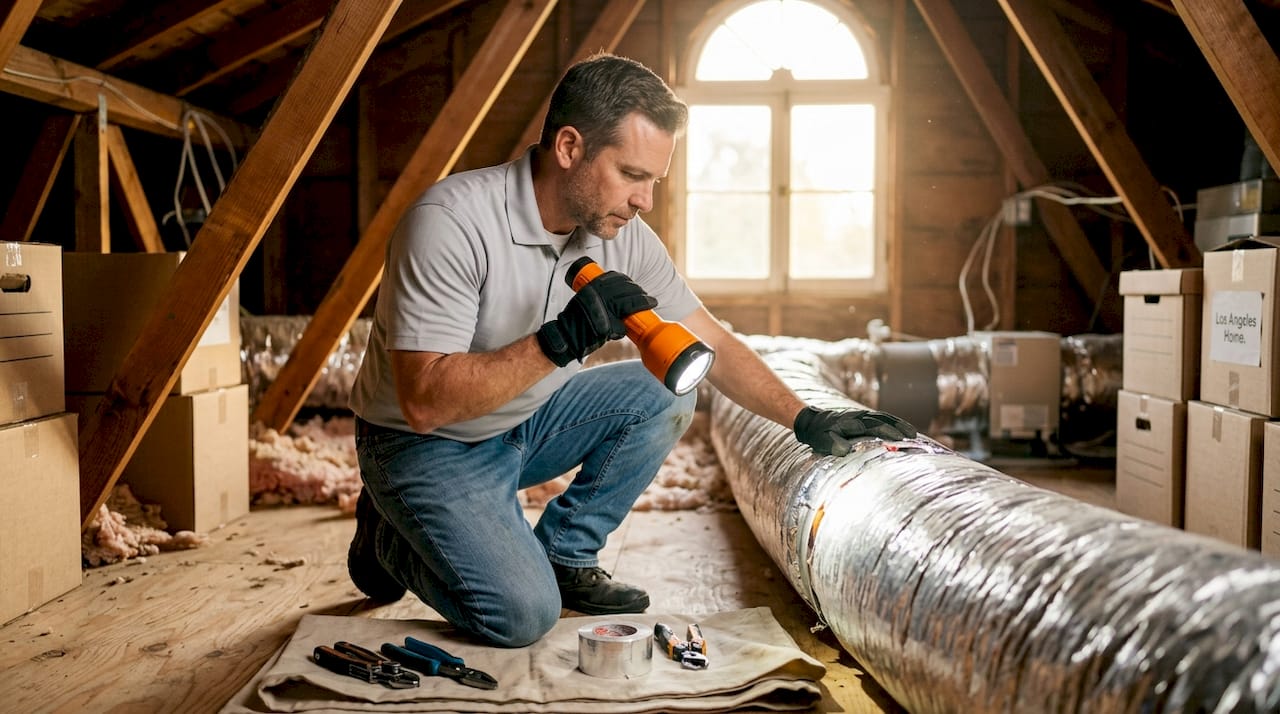
Leaky ducts are a silent efficiency killer. When cooled air escapes into your attic or walls before it ever reaches your living space, your AC runs continuously without delivering the comfort you expect. Duct leaks allow cooled air to escape, causing uneven temperatures throughout your home. Older homes and homes with flexible duct systems are especially prone to this. You might notice that one room is always colder while another never seems to cool down. That’s a classic sign of poor duct balancing or leakage, not a failing AC unit.
- Rooms far from the air handler run warm while rooms closest run cold
- Visible gaps or disconnected sections at duct joints
- High energy bills despite consistent AC use
- Weak airflow from specific vents regardless of thermostat setting
Pro Tip: Pull out your air filter right now and hold it up to a light source. If you cannot see light through it, it needs to be replaced immediately. A clean filter is the single cheapest fix that makes the biggest immediate difference in cooling performance.
Thermostat issues and cycling habits that hurt cooling
A surprising number of air conditioning problems trace back not to the equipment itself, but to how homeowners use their thermostats.
The “crank it down” misconception
This is one of the most widespread mistakes in home cooling. You come home to a hot house and immediately drop the thermostat to 65°F, thinking the system will cool faster. It won’t. AC units cool at a constant rate. Setting the thermostat lower does not increase that rate. It just means the system runs longer to reach a target temperature it may never reach, adding unnecessary wear and higher energy bills. Set your thermostat to your actual comfort target, typically 74 to 78°F, and let the system work steadily.
Thermostat placement and calibration
Your thermostat reads the temperature of the air around it. If it sits near a sunny window, a lamp, or a kitchen oven, it will sense a warmer temperature than the rest of your home and keep the AC running past the point of actual comfort. Conversely, if it sits in a naturally cool hallway, it may shut off before your bedrooms ever reach a comfortable temperature. Thermostat placement matters more than most people realize, and if yours was installed in a poor location, recalibrating or relocating it can improve comfort without touching the AC unit at all.
The on/off cycling trap
Some homeowners treat their AC like a light switch, turning it off when they leave for a few hours and cranking it back on when they return. This creates a real problem. Frequent on/off cycling puts electrical stress on the compressor and other components, leading to premature wear and higher energy costs. A 30 to 35 minute rest interval between cycles is recommended to protect your system. Modern inverter AC units handle this better by using “Auto Mode,” which modulates compressor speed instead of cycling fully on and off. This is gentler on components and more energy-efficient.
Here’s a quick sequence to get the most out of your thermostat settings:
- Set the thermostat to your actual comfort temperature, not the lowest possible setting.
- Switch your system to “Auto” mode rather than “On,” which runs the fan continuously even when the compressor is off.
- Avoid turning the system completely off during the day if outdoor temperatures exceed 90°F. It costs more to bring the temperature back down than to maintain it.
- If you’ve turned the system off, wait at least 30 minutes before restarting to give the compressor time to equalize pressure.
- Consider a smart thermostat that learns your schedule and avoids the heat buildup that forces extreme cooling sessions.
Pro Tip: If you’re leaving home for less than four hours, keep the thermostat running at a slightly higher target, around 80°F, rather than shutting it off. You’ll use less energy overall and come home to a house that cools quickly.
How your home’s structure fights against your AC
Here’s something most articles on air conditioning problems skip over entirely: sometimes your AC is working exactly as it should, and your home is simply undoing all that work. Homeowners often place blame on the AC unit when poor insulation and attic heat are the real culprits behind inadequate cooling.
The attic heat problem
In Los Angeles, attic temperatures can easily reach 140 to 160°F on a summer afternoon. If your attic has poor insulation or inadequate ventilation, that heat radiates down through the ceiling and into your living space. Worse, if your ductwork runs through the attic, the ducts themselves absorb that heat before the cooled air even reaches your vents. Hot attics and solar heat gain reduce the effectiveness of your AC significantly, even when the unit itself is in perfect condition.
Air leaks and energy loss
Gaps around windows, doors, recessed lighting, and plumbing penetrations let hot outside air seep in constantly. Your AC is cooling the house while the house is simultaneously absorbing heat from outside. Sealing these leaks with weatherstripping and caulk is one of the highest-return improvements a homeowner can make for comfort and energy costs.
| Factor | Impact on cooling efficiency |
|---|---|
| Poor attic insulation | High heat radiation through ceilings; ducts heat up before air reaches vents |
| Air leaks around windows/doors | Constant infiltration of hot air that cancels out AC cooling effort |
| Unshaded south/west-facing windows | Significant solar heat gain, especially in afternoon hours |
| Open or closed interior doors | Poor air circulation causes hot and cold zones throughout home |
| Properly sealed and insulated home | AC runs shorter cycles, maintains set temperature, uses less energy |
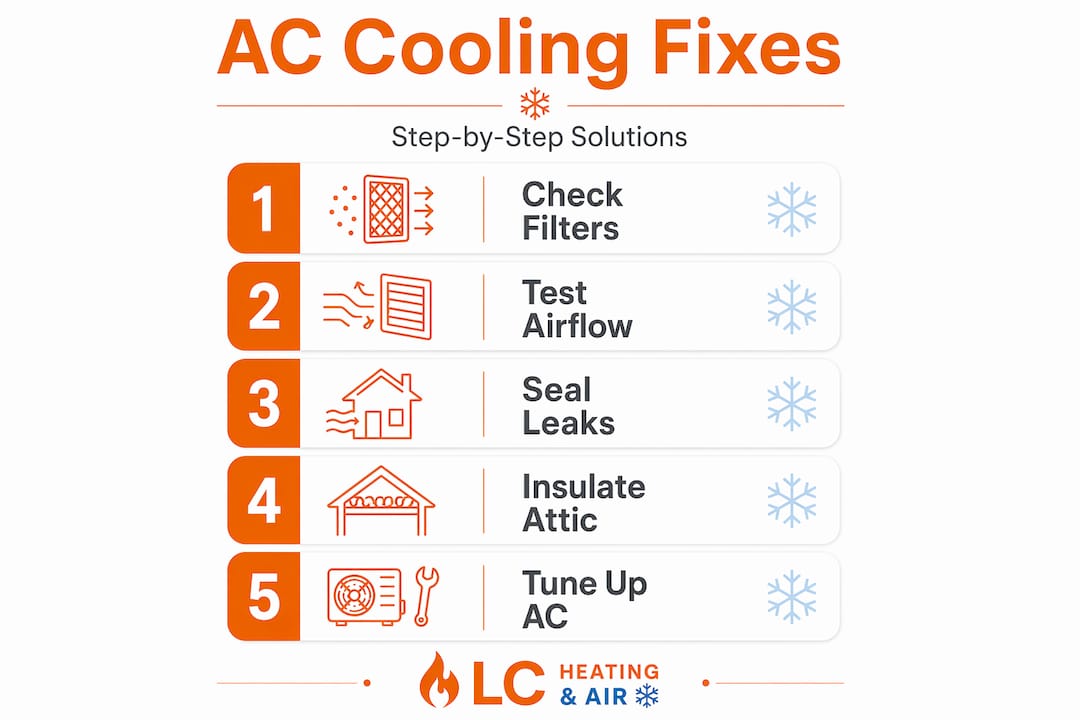
The fix for structural heat gain is rarely expensive. Adding attic insulation, sealing air leaks, using window shades on sun-facing windows during peak afternoon hours, and keeping interior doors open for air circulation can make a measurable difference within days.
Mechanical problems that reduce cooling capacity
When airflow and structural issues have been ruled out, the problem may lie inside the AC unit itself. These are situations where you’ll want a professional involved, but knowing the signs helps you communicate clearly and avoid unnecessary upsells.
Refrigerant leaks
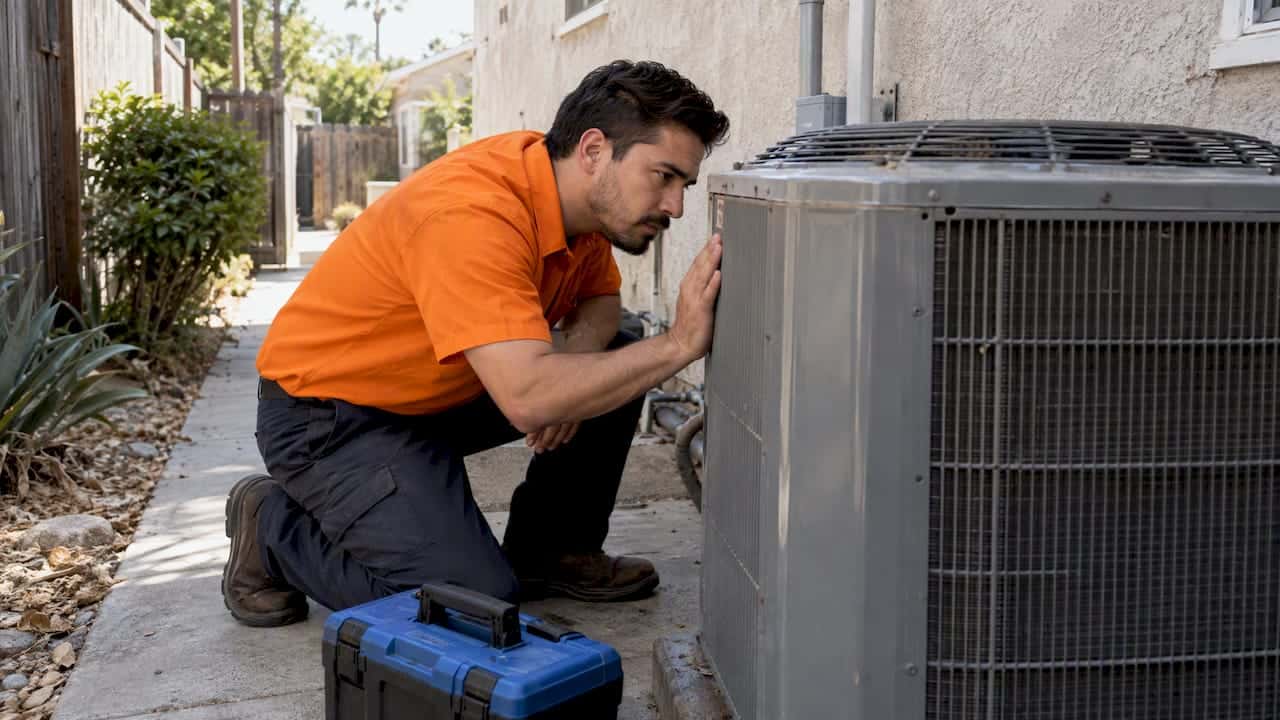
Refrigerant is the substance that actually removes heat from your home’s air. When it leaks, your system loses its ability to cool effectively, even though the compressor keeps running. Signs of a refrigerant leak include a hissing sound near the outdoor unit, a chemical or sweet smell near vents, longer cooling times, and climbing energy bills. Refrigerant handling requires EPA certification, so this is always a professional repair.
Dirty condenser coils
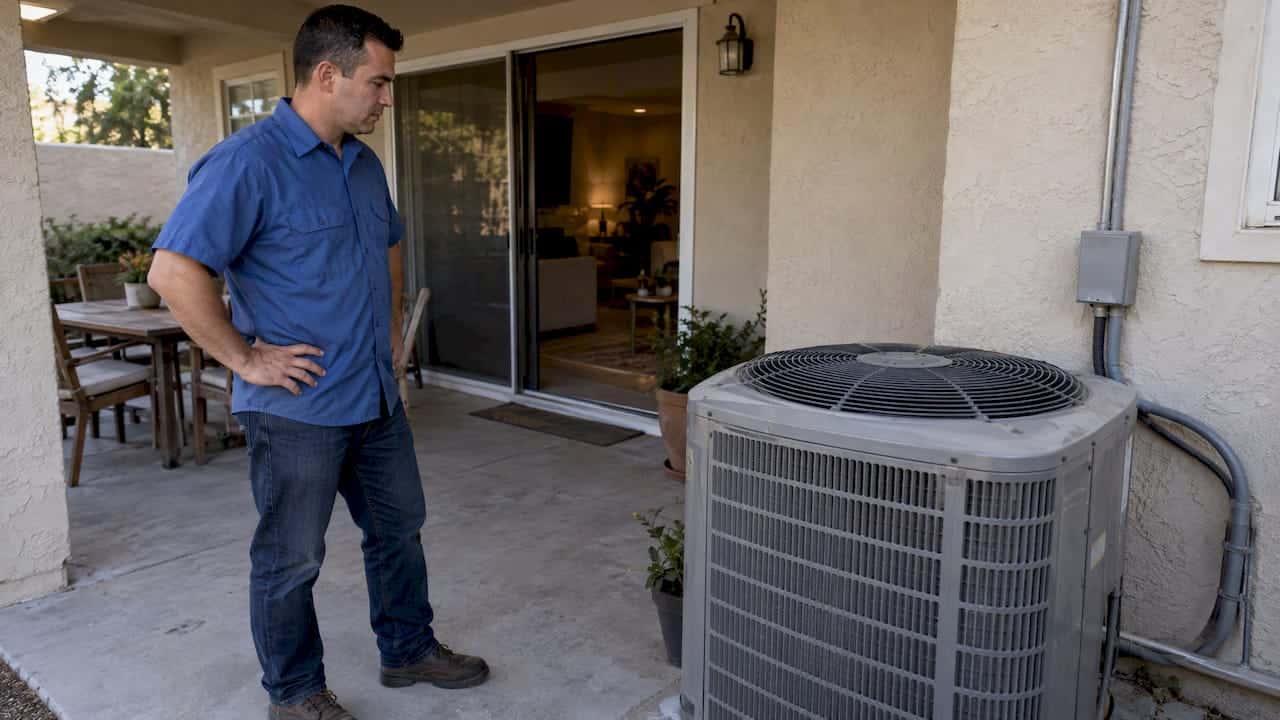
Your outdoor unit releases heat to the outside air through the condenser coils. When those coils get coated in dirt, leaves, and grime, heat transfer becomes inefficient and your system has to work much harder to cool your home. Cleaning the outdoor condenser coils regularly is one of the most effective maintenance steps you can take. Keep at least two feet of clearance around the outdoor unit and rinse it gently with a garden hose at the start of each cooling season.
Undersized or aging systems
An AC unit sized for a 1,500 square foot home cannot keep a 2,500 square foot home cool on a 100°F day, no matter how efficiently it runs. If your home was renovated, an addition was built, or the system was never properly sized, this mismatch explains why you’re dealing with an AC running but not cooling effectively. Systems older than 12 to 15 years also lose efficiency and cooling capacity over time, even with regular maintenance.
Watch for these warning signs that point to a mechanical issue:
- Warm or room-temperature air blowing from vents despite a running compressor
- Ice forming on the refrigerant line or indoor coil
- Hissing, banging, or grinding sounds from either unit
- Energy bills rising without a change in usage habits
- System running almost continuously without reaching the set temperature
Pro Tip: Seasonal HVAC tune-ups before summer catch low refrigerant, dirty coils, and failing electrical components before they turn into a breakdown during a heat wave. A $100 tune-up is much easier to budget than an emergency repair call.
Your AC troubleshooting checklist
If your home stays hot with AC on, work through this checklist before calling a technician. You may solve the problem yourself, and if you do need professional help, you’ll have already eliminated the simple causes.
- Check and replace the air filter. If it’s visibly gray or clogged, replace it immediately. During summer heat waves, check it every two weeks.
- Walk every vent in your home. Make sure all supply and return vents are open and unobstructed by furniture, rugs, or curtains.
- Check your thermostat settings. Confirm it’s set to “Cool” and “Auto,” not “Fan Only” or “On.” Verify the temperature reading matches an actual thermometer nearby.
- Inspect the outdoor unit. Clear away any debris, plants, or objects within two feet. Look for ice on the refrigerant line, which signals a problem requiring professional attention.
- Walk your home for hot or cold spots. Localized hot rooms often signal airflow imbalances like blocked returns or poor duct design, not a mechanical failure.
- Check your circuit breaker. A tripped breaker can leave the fan running while shutting off the compressor, giving the illusion that your AC is working when it isn’t.
- Call for professional service if you notice refrigerant leak signs, ice buildup, loud mechanical noises, or if the system has not been serviced in over a year. Get a heatwave AC checkup before temperatures peak.
My take: what homeowners keep getting wrong
I’ve been in this business for over twenty years, and the call that comes in most often isn’t about a broken compressor or a failed capacitor. It’s a homeowner convinced their entire system needs to be replaced because the house won’t cool down. Nine times out of ten, when I walk through the door, the problem is a clogged filter that hasn’t been changed in eight months, or a return vent that got covered when someone rearranged the living room furniture.
What I’ve found is that most homeowners treat their AC like a black box. They set the temperature, walk away, and assume everything is working unless the air is completely warm. The truth is that there’s a huge middle ground between “working perfectly” and “completely broken,” and that middle ground is where most comfort problems live.
I’ve also seen a lot of homeowners blame their AC for what is really an insulation problem. I walked through a house in the San Fernando Valley where the system was running great. Clean coils, solid refrigerant charge, good airflow. The attic had almost no insulation, and the ductwork up there was getting cooked. The air was warm before it ever hit the vents. New insulation fixed the problem at a fraction of the cost of a new AC unit.
My honest advice: do the filter check first, every time. Then look at your home before you look at your equipment. You’ll be surprised how often the answer isn’t in the machine.
— Leo
Get your home cooling the way it should
If you’ve worked through this guide and your home is still not reaching a comfortable temperature, it’s time to bring in a professional who will give you straight answers without the pressure to replace equipment you don’t need.

LC Heating and Air Conditioning has been solving exactly these kinds of problems for homeowners across Los Angeles for over twenty years. Whether it’s a diagnostic inspection, a full AC maintenance tune-up, or a same-day repair call when things go wrong in the middle of a heat wave, the team at LC Heating and Air Conditioning brings flat-rate pricing and honest assessments to every job. No surprise fees. No unnecessary upsells. If you’re tired of running your AC and still sweating, reach out to LC Heating and Air Conditioning and get the comfort your home deserves. Same-day service is available throughout Los Angeles.
FAQ
Why does my AC run but not cool the house?
The most common reasons include a clogged air filter, blocked vents, duct leaks, or a refrigerant issue. Start by checking your air filter and making sure all vents are open and unobstructed.
Can poor insulation cause my AC to fail at cooling?
Yes. Poor attic insulation and air leaks allow heat to enter your home faster than your AC can remove it, making it seem like the AC is ineffective even when it’s running correctly.
Does setting the thermostat lower cool the house faster?
No. Your AC operates at a constant cooling rate regardless of thermostat setting. Setting it lower only extends the run time and adds strain to the system without speeding up results.
How often should I replace my air filter in summer?
During peak summer heat, check your filter every two weeks. Heat waves accelerate clogging and a blocked filter can cause your system to work harder while cooling less.
When should I call a professional for an AC cooling problem?
Call a professional if you notice ice on the refrigerant line, hear unusual noises from either unit, or if your home isn’t cooling despite a clean filter and open vents. These signs often point to refrigerant or mechanical issues that require certified repair.
Recommended
Leo, Propietario y Técnico Principal en LC Heating & Air
Leo dirige LC Heating & Air como propietario-operador y tiene la licencia C-20 HVAC #1073586 de California. Sus guías se enfocan en diagnósticos prácticos, decisiones de reparación seguras y consejos claros para propietarios de Los Ángeles.