- TL;DR
- What a multi-zone mini split is and how it works
- How many zones can one outdoor unit handle?
- Single-zone vs. multi-zone: which one fits your home
- Multi-zone mini split vs. VRF
- Multi-zone mini split vs. a conventional split system
- Sizing a multi-zone system the right way
- What installation involves
- Rebates, California rules and heat pumps
- Running and maintaining a multi-zone system
- Our perspective on multi-zone systems
- Get a multi-zone plan built around your home
- FAQ
- Sources
- Recommended

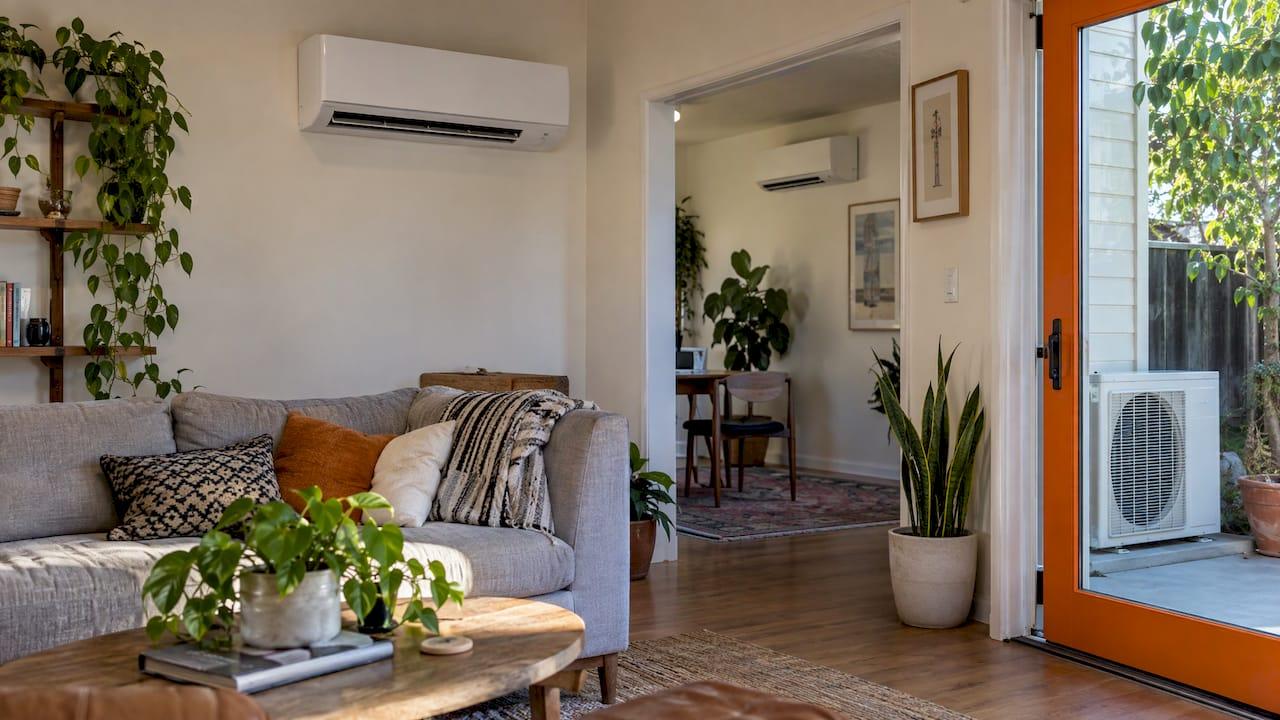
A multi-zone mini split is one outdoor unit connected to two or more indoor units, so each room or zone gets its own temperature setting without any ductwork. It suits homes with no ducts or poor ducts, additions, and houses where family members want different temperatures. In Los Angeles, we install these systems in everything from 1920s bungalows to modern hillside homes, and the right layout depends on your rooms, not on a catalog number.
This guide explains how the system works, how it differs from single-zone and VRF, how to size it, and what installation involves, so you can walk into a quote conversation knowing what to ask.
TL;DR
- A multi-zone mini split pairs one outdoor unit with multiple indoor heads. Each head has its own controls, and every head runs in the same mode, either heating or cooling.
- Choose multi-zone when you need to condition several real rooms. For a single room or an addition, single-zone is usually simpler.
- VRF is the commercial-scale cousin: more zones, longer piping, and optional simultaneous heating and cooling. Most single-family homes do not need it.
- Sizing is done room by room with a load calculation, then matched to the outdoor unit’s rated capacity.
- Our published installation range for mini splits is $3,500 to $20,000, depending on zones, equipment and the home.
What a multi-zone mini split is and how it works
A multi-split system connects several indoor air handlers, often called heads, to a single outdoor unit. The outdoor unit holds the compressor, fan and outdoor coil. Each indoor unit has a fan, an indoor coil and a filter, and the two sides are linked by refrigerant lines and communication wiring, according to the Building America Solution Center, a U.S. Department of Energy resource.
Three things matter in daily life:
- Each room has its own control. Every head responds to its own remote, wall controller or phone app, so the bedroom can sit at 68°F while the office sits at 74°F.
- The outdoor unit adjusts to the total demand. Inverter-driven compressors speed up or slow down depending on how many zones are calling for conditioning, rather than switching fully on and off.
- All heads share one mode. On a standard multi-zone heat pump, one room cannot cool while another heats. Trane’s overview of ductless systems states this plainly. In Southern California, where shoulder-season days can swing from cool mornings to hot afternoons, it is worth knowing before you plan a layout.
Because there are no ducts, there is also no duct leakage. The Building America Solution Center notes that duct losses can exceed 30% of heating and cooling energy when ducts run through unconditioned spaces such as attics, and that is a common situation in older Los Angeles homes.
Every multi-zone heat pump both cools and heats, which is why many homeowners searching for a mini split are really shopping for a heat pump. If that is you, our heat pump installation page covers how we approach it.
How many zones can one outdoor unit handle?
The answer depends on the model. Common residential multi-zone outdoor units connect two to five indoor heads, and some product lines go higher. The Building America Solution Center cautions that connecting more than three indoor units is generally not recommended, although some models allow up to eight. The practical takeaway: the equipment’s technical data and install manual set the limit, not a rule of thumb.
There are two limits to understand before you commit to a layout:
- Capacity limit. The heads you hang must add up to a total the outdoor unit can support. Manufacturers publish a connection ratio, and the combined head capacity is typically allowed to exceed the outdoor rating by a set percentage, but never freely.
- Piping limit. Every system has a maximum total refrigerant line length, a maximum run to the farthest head, and a maximum height difference between indoor and outdoor units. Those numbers are model-specific.
That is why a two-story home with bedrooms at opposite ends can be a perfect fit for two separate multi-zone systems rather than one large one. We look at where the outdoor unit can sit, how far each head is from it, and how the line sets can be routed in your walls before recommending a layout.
Single-zone vs. multi-zone: which one fits your home
A single-zone mini split is one outdoor unit and one indoor unit. A multi-zone is one outdoor unit and several indoor units. Neither is better in the abstract. The right choice follows your floor plan.
| Situation | Usually the better fit |
|---|---|
| One addition, garage conversion, sunroom or ADU | Single-zone |
| One problem room that the central system never reaches | Single-zone |
| Two or three larger rooms that are used together | Multi-zone |
| A whole floor or a whole older home with no ducts | Multi-zone |
| Family members who want different temperatures | Multi-zone |
| Rooms far apart on opposite sides of the house | Two separate systems |
In plain terms: if you are conditioning one space, a single-zone unit gives that space a dedicated outdoor unit and the simplest installation. If you are conditioning several connected rooms, a multi-zone system saves wall and yard space, because one outdoor unit serves all of them. For an older house with no ducts, it avoids the cost and mess of building a duct system. Carrier’s guidance on choosing a mini split describes the same split between additions and ductless older homes.
A note on small bedrooms
Small rooms deserve attention. Each head has a minimum output, and an outdoor unit also has a minimum it can throttle down to. If you hang a large head in a small room, or if only one tiny zone is calling, the outdoor unit may cycle on and off instead of running smoothly. Grouping small rooms into a single zone, or using a separate single-zone unit for a small room, can keep the system efficient.
It also helps to be realistic about turning rooms off. The Building America Solution Center points out that shutting off indoor units does not always save energy, because the outdoor unit can end up cycling when the load falls below its minimum, and some refrigerant still flows through idle heads. The savings from multi-zone come mainly from conditioning only the rooms you use at the temperatures you want, with a layout designed so the system can run steadily.

Multi-zone mini split vs. VRF
VRF stands for variable refrigerant flow. It is the larger-scale relative of the multi-zone mini split: indoor units connected to one or more outdoor units through refrigerant lines, with individual zone control. HVAC.com’s explainer on VRF for homes notes that the main difference is the number of zones, which is why VRF is common in large commercial buildings.
| Multi-zone mini split | VRF | |
|---|---|---|
| Typical use | Homes, small offices, small multifamily | Larger commercial and multifamily buildings |
| Indoor units per system | A handful | Many more |
| Heat recovery (heating one zone while cooling another) | Not available on standard systems | Available on heat recovery models |
| Piping | Simpler, shorter allowed runs | Branch-based, longer allowed runs |
| Best fit | Single-family homes | Buildings with many zones or mixed loads |
Heat recovery is the real dividing line
Standard two-pipe VRF heat pumps put every zone in the same mode, just like a multi-zone mini split. Heat recovery VRF can heat some zones while cooling others by moving heat between them. An ACEEE paper on VRF technology explains this, and also notes that multi-splits offer many of the same advantages, such as zoning, capacity control, ease of retrofit and low installation cost, and are well suited to smaller, simpler buildings where heat recovery is not needed.

For a restaurant with a hot kitchen and a cool dining room, or an office with a server closet, heat recovery VRF can make sense. For a three-bedroom house in Hollywood or Pasadena, it usually does not.
Cost and efficiency at the building scale
A comparison study prepared for New York City’s housing agency, Large VRFs Versus Small Mini/Multi Split Heat Pumps, found that large VRFs cost more to install, use more energy and more refrigerant, and often take up more space than small mini and multi-splits, for multifamily buildings. That study looks at multifamily housing in a different climate, so treat it as a signal for small buildings rather than a Los Angeles price quote.
Our approach, which we apply to businesses as well as homes: we start from the building’s real zones and loads. Commercial and VRF work is part of what we do, and we will tell you plainly whether a multi-zone system or VRF fits your space.
Multi-zone mini split vs. a conventional split system
You will also see “VRF vs. split system” and “ductless vs. ducted.” A conventional central split system connects one outdoor unit to an indoor air handler or furnace and sends air through ductwork to many spaces. The U.S. government’s HVAC Resource Map lists a mini split as a ductless example of a split system, and a VRF heat recovery system as one that connects outdoor units to multiple indoor units and can heat and cool zones at once.
The decision comes down to your house:
- You have good, sealed, properly sized ducts. A new central heat pump or AC may be the simplest swap.
- Your ducts are leaky, undersized or in a hot attic. Ductless avoids the duct problem entirely. In some homes we also redesign or replace the ductwork instead, which our attic ductwork case study illustrates.
- You have no ducts. Many Los Angeles homes with radiant or wall furnace heating fall here, and a multi-zone mini split is often the cleanest way to add cooling and heating at once.
Sizing a multi-zone system the right way
The order of the steps matters more than the brand. Here is the sequence we follow:
- Calculate the load room by room. Square footage rules of thumb miss windows, insulation, sun exposure and ceiling height. Our explanation of how an HVAC load calculation works walks through what goes into it.
- Group small rooms into zones. Two small bedrooms with an open door between them may be better served by one head than two.
- Match each head to its zone. Avoid oversizing. A head far larger than the room’s load will cycle and feel clammy rather than comfortable.
- Check the outdoor unit’s turn-down. Make sure its minimum output is reasonable for your smallest zone.
- Match the total to the outdoor unit. The combined indoor capacity must fall within the manufacturer’s allowed range for that outdoor model.
- Plan the line sets. Confirm total length, longest run and height difference against the install manual, and plan the routes through walls, attic or crawlspace.
Efficiency ratings to compare
Look for SEER2 (cooling) and HSPF2 (heating) on the product data. The EPA’s ENERGY STAR page on ductless heating and cooling reports that certified mini split heat pumps use up to 60% less energy than standard electric resistance heaters. Higher ratings generally cost more up front, so we help you weigh them against how many hours you actually run the system.
Placement matters as much as capacity
Head position affects comfort and noise. Mounting height, clearance from furniture, and airflow direction all change how a room feels. We cover this in our guide to mini split placement and mounting height.
What installation involves
A typical multi-zone installation includes:
- A site visit and load calculation
- Choosing outdoor unit location, with clearances, drainage and noise in mind
- Mounting indoor heads and drilling small line-set penetrations
- Running refrigerant lines, condensate drains and communication wiring
- Electrical work, including a dedicated circuit and disconnect sized to the unit
- Evacuating the lines, charging, and commissioning every zone
Installation rules come from several layers: mechanical code for clearances and condensate, electrical code for wiring, and federal EPA Section 608 certification for anyone handling refrigerant. In California, permits and the state’s energy code apply on top. Using a licensed contractor who pulls permits protects your insurance, your resale paperwork and your warranty.
We publish our installation ranges so there are no surprises. Mini split installation runs $3,500 to $20,000, a wide range because a single-zone wall unit and a five-head system through a two-story home are very different jobs. Heat pump installation is $5,500 to $12,000. You can see financing options on our installation and financing page.
What pushes a price up or down
- Number of zones and the capacity of each head
- Efficiency level of the equipment
- Line-set length and routing difficulty, such as finished walls or multi-story runs
- Electrical panel capacity and any upgrade needed
- Outdoor unit location, for example a rooftop or hillside pad
- Whether you are in a historic home that calls for careful, minimal-impact routing
If you are in a specific neighborhood, you can also see our local pages, such as mini split installation in Miracle Mile, and a real job in our ductless mini-split installation case study.
Rebates, California rules and heat pumps
Multi-zone mini splits that run as heat pumps can qualify for utility and state incentive programs. These programs change often, and some are funded in rounds. For example, TECH Clean California routes heat pump rebates through participating, trained contractors, and its page shows when funding is reserved or open. Check the current status there before you plan around any rebate, and ask us what applies to your project and your address. California’s building standards also increasingly treat heat pumps as the standard choice for home heating, which is one more reason ductless heat pump systems are a sensible long-term pick for new work.
Running and maintaining a multi-zone system
A few habits keep a system efficient and quiet:
- Keep one steady setpoint per zone instead of swinging it up and down. Inverter systems prefer to run gently for long periods.
- Choose one mode for the whole system. Remember that all heads heat or all cool.
- Clean the indoor filters regularly. Many can be rinsed, and a clogged filter reduces airflow and comfort.
- Keep the outdoor unit clear. Leaves, debris and stored items around it restrict airflow.
- Book regular professional service. Coils, drains and refrigerant charge are not DIY items. Our mini split maintenance service covers this, and our HVAC maintenance plan is $180 to $250 per year, as published on our maintenance plan page.
If a head stops cooling, our mini split not cooling checklist helps you rule out simple causes first. Because refrigerant work requires certification, here is why we explain why repairing a mini split yourself is a risky idea.
Our perspective on multi-zone systems
We have installed and repaired ductless systems across Los Angeles for over twenty years, and the pattern is consistent: the systems that disappoint were rarely a bad brand. They were a bad layout. Too many small heads on an outdoor unit that cannot throttle down, line sets pushed past their limits, or heads placed where the air blows straight onto the sofa.
Our view is simple. Start with a real load calculation, group rooms honestly, and use as many outdoor units as the house needs, even if that is two instead of one. A well-planned multi-zone heat pump gives you quiet, even comfort, lower energy use than leaky ducts, and heating and cooling from the same equipment.
We are experts in heat pumps, mini splits and commercial VRF systems, and that lets us say which one fits you. We also believe in honest diagnostics: flat-rate repair pricing, no surprise diagnostic fees, and no pressure to replace a system that can be fixed.
Leo
Get a multi-zone plan built around your home
If you are weighing one outdoor unit against two, or a multi-zone against a central heat pump, we can walk your rooms and give you an honest recommendation. Our service call starts at $125, and we price repairs flat-rate so you know the cost before work begins. Read about our multi-zone mini split service in Los Angeles, or call us at (323) 970-3113.

Need repair on an existing system instead? Our mini split and heat pump repair services cover homes and commercial VRF equipment alike.
FAQ
Can a multi-zone mini split heat one room and cool another?
Not a standard one. All indoor units connected to a multi-zone mini split must run in the same mode, either heating or cooling. Heat recovery VRF systems can do both at once, but they are designed for larger buildings with mixed loads.
How many rooms can one multi-zone mini split serve?
It depends on the outdoor unit model. Common residential units connect two to five heads, and some go higher. The total indoor capacity and the refrigerant line lengths must stay within the manufacturer’s limits, so the layout is confirmed from the model’s install manual.
Is multi-zone cheaper than several single-zone systems?
It depends on the rooms. One outdoor unit saves yard space and can cost less than several, especially for three or more rooms near each other. For two small, distant rooms, separate single-zone units can run more efficiently, so we price both options when it matters.
Do I need VRF instead of a multi-zone mini split?
Most single-family homes do not. VRF fits buildings with many zones, very long piping runs, or a need to heat and cool different areas at the same time. If you run a business or own a multi-unit property, we can assess whether VRF suits your building.
Can a multi-zone mini split replace my central AC?
Yes, in many homes. It is a common choice when ducts are leaky, undersized or missing. We size the system from a room-by-room load calculation so the new equipment fits the house, not the other way around.
Sources
- Ductless (Mini-Split) Heat Pumps, Building America Solution Center
- Ductless Heating and Cooling Systems, Trane
- How to Choose the Best Ductless Mini Split, Carrier
- Should You Consider a VRF System for Home Use? HVAC.com
- Variable Refrigerant Flow: An Emerging Air Conditioner and Heat Pump Technology, ACEEE
- Large VRFs Versus Small Mini/Multi Split Heat Pumps, NYC HPD
- Split Systems, HVAC Resource Map
- Ductless Heating & Cooling, ENERGY STAR
- HEEHRA Rebates, TECH Clean California
Recommended
Leo, Owner & Lead Technician at LC Heating & Air
Leo leads LC Heating & Air as an owner-operator and holds California CSLB C-20 HVAC license #1073586. His guides focus on practical diagnostics, safe repair decisions, and clear advice for Los Angeles homeowners.