- Key takeaways
- Common AC repairs and what they cost
- How the final AC repair bill is calculated
- Warranties, system age, and the repair vs. replacement decision
- Practical tips to manage and anticipate repair costs
- My take on navigating AC repair costs
- Get clear pricing from LC Heating and Air Conditioning
- FAQ
- Recommended

TL;DR:
- AC repair costs vary widely based on repair complexity, parts, labor, and service fees, often ranging from $150 to over $2,900. Understanding the breakdown of charges, including diagnostics, labor hours, parts, refrigerant, and premiums for emergencies, helps homeowners budget confidently. When repair costs exceed half the price of a new system or the system’s age, replacement often becomes the more economical choice.
You open your AC bill and the number feels random. One neighbor paid $150 to fix her unit; another spent $1,800 on what sounded like a similar problem. Understanding how AC repair cost is determined takes that mystery away completely. Once you know what drives the numbers, you stop guessing and start budgeting with real confidence. This guide breaks down every factor that shapes your final bill, from the service call fee to the cost of refrigerant, so you can walk into any repair conversation prepared and in control.
Key takeaways
| Point | Details |
|---|---|
| Repair type drives cost range | Minor fixes like capacitors cost $100–$400, while major repairs like compressors run $900–$2,900 or more. |
| Every bill has multiple line items | Diagnostic fees, labor, parts, and refrigerant are billed separately and add up fast. |
| Ask about diagnostic fee crediting | Most companies credit the service call fee toward the repair total if you approve the work. |
| Age and cost determine repair value | If repair costs exceed 50% of a new system’s price, replacement is often the smarter financial move. |
| Maintenance reduces repair frequency | Regular tune-ups catch small problems before they grow into expensive emergency calls. |
Common AC repairs and what they cost
Before you can understand how AC repair cost is determined, it helps to know what the most common repairs actually are and how widely their prices vary. Not all AC problems are created equal. A failing capacitor is a small but mighty component that helps your system start up properly. Replacing one is relatively quick and inexpensive. A failing compressor, on the other hand, is the heart of the entire system, and repairing or replacing it is a major job that reflects that complexity.
Here is a comparison of typical repair costs you are likely to encounter:
| Repair Type | Typical Cost Range | Notes |
|---|---|---|
| Capacitor replacement | $100–$400 | Quick job, common failure point |
| Fan motor replacement | $200–$700 | More labor involved than capacitor |
| Refrigerant leak repair | $1,200–$2,000+ | Diagnostic, labor, and refrigerant billed separately |
| Evaporator coil replacement | $1,000–$5,000+ | Varies significantly by coil size and access |
| Compressor replacement | $900–$2,900 | Most expensive single repair in most systems |
These component repair cost ranges reflect both parts and labor combined. What surprises most homeowners is that the part itself is often the smaller portion of the bill. Labor accounts for a significant share, especially when a repair requires evacuating refrigerant, accessing internal components, or spending multiple hours on-site.
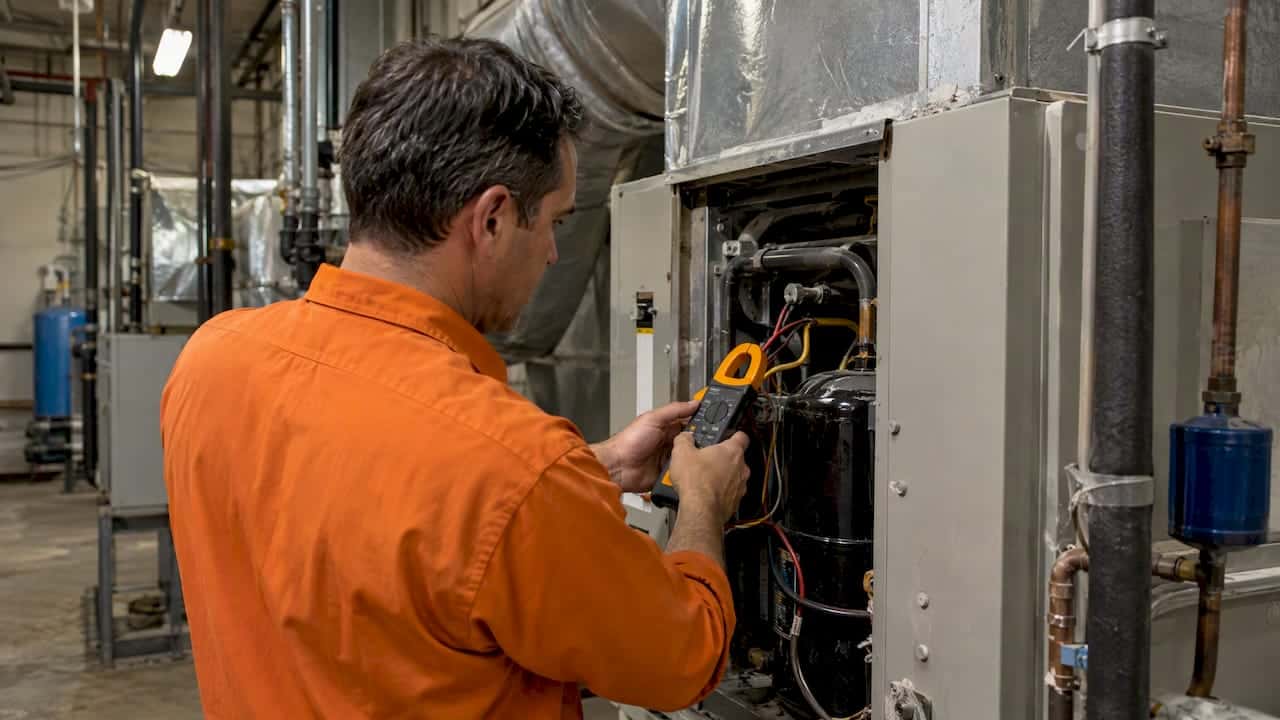
Complex repairs like compressor swaps require multiple hours of labor, refrigerant handling, and specialized equipment, which drives the total price well beyond the part cost alone. If your AC compressor needs attention, the complexity of that job is one of the biggest reasons the bill looks the way it does.
The cost gap between a minor and major repair can feel shocking. A $120 capacitor fix and a $2,500 compressor replacement are both “AC repairs,” but they live in completely different financial categories. Knowing this distinction upfront helps you set a realistic expectation before a technician ever shows up at your door.
How the final AC repair bill is calculated
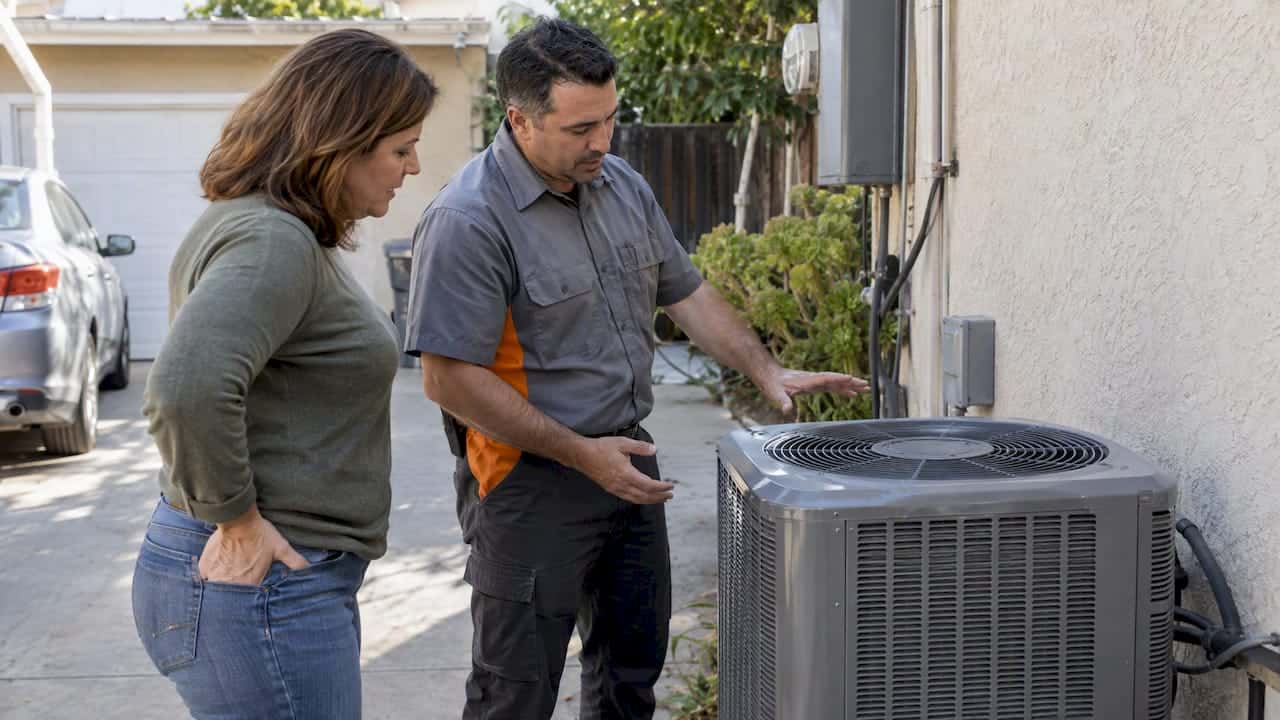
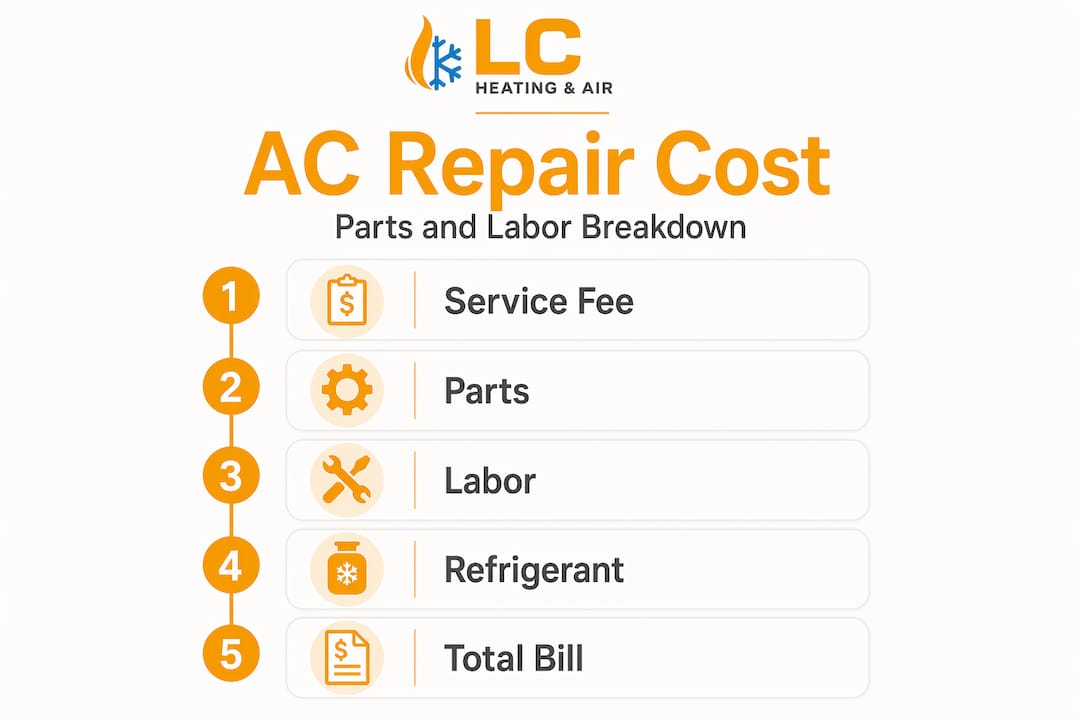
Understanding the AC repair cost breakdown means looking at each line item on your invoice and knowing what it represents. Most bills include several distinct charges, and each one is calculated differently.
-
Service call or diagnostic fee. This is the charge for sending a technician to your home to assess the problem. Service call fees average $75–$200 on weekdays, with higher rates for evenings, weekends, or holidays. Many companies credit this fee toward the repair total if you approve the work. Confirm that crediting policy before you agree to the visit.
-
Labor charges. Once the diagnosis is done, labor is billed by the hour or as a flat rate per job type. Licensed HVAC technicians charge $85–$150 per hour depending on your local market and the technician’s skill level. A repair that takes two hours costs double what a one-hour fix does. Access difficulty matters too. If your air handler is in a tight attic or a compressor is wedged into a narrow side yard, expect the labor time to increase.
-
Parts costs. The component being replaced carries its own price, which varies by brand, part quality, and availability. An OEM (original equipment manufacturer) part costs more than a generic equivalent but often lasts longer. Your technician should be able to tell you which type they are using.
-
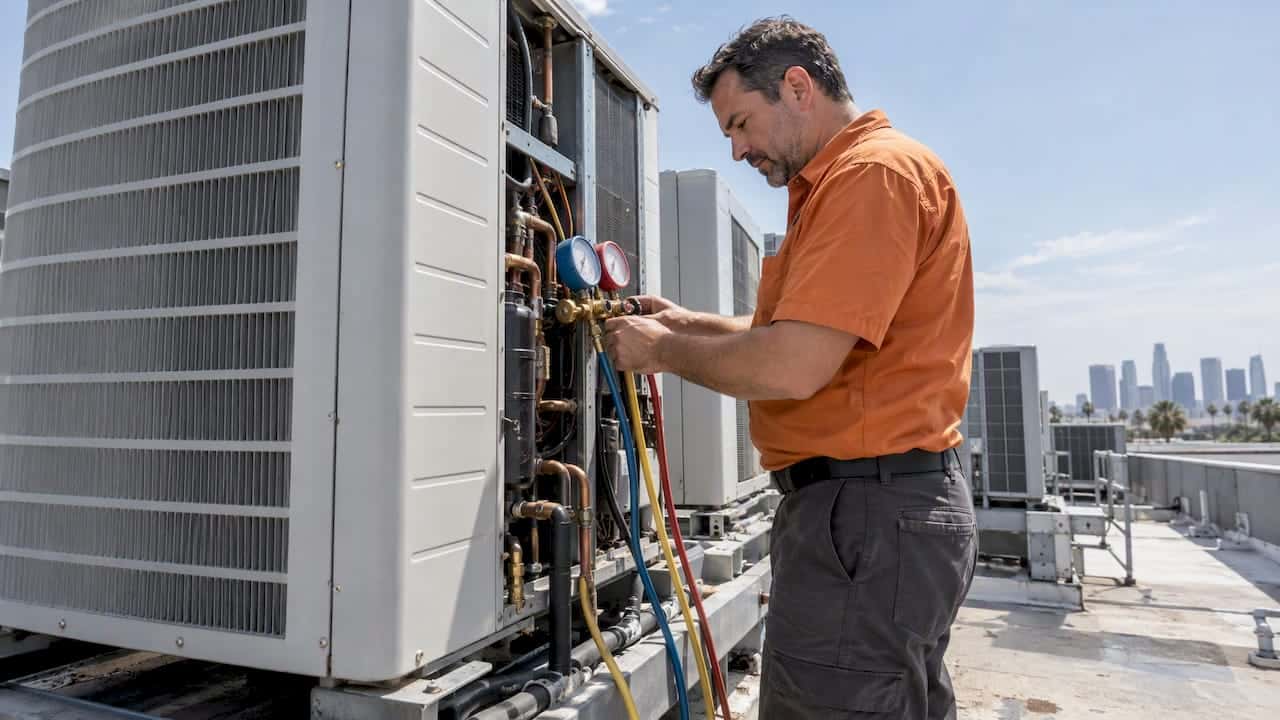
Refrigerant charges. Refrigerant is treated as a consumable and billed separately, per pound. This is one of the most commonly misunderstood parts of the AC repair cost breakdown. If your system has a leak, you may also be charged for the leak search, the repair itself, the evacuation of old refrigerant, and the recharge. Those four charges can stack up to $1,200–$2,000 or more before you blink.
-
Emergency or after-hours fees. If your AC fails during a heat wave and you need same-day service on a weekend, expect a premium on top of standard rates. These fees are real and worth asking about upfront.
-
Geographic pricing differences. Local market conditions cause noticeable price differences for identical repairs across locations. The same capacitor job that costs $150 in a rural area may run $300 in Los Angeles. Cost of living, technician demand, and local licensing requirements all play a role in what you pay.
Pro Tip: Ask the company directly: “Is the diagnostic fee credited toward the repair if I approve the work?” The answer tells you a lot about how transparent they are, and it protects you from paying both the fee and the full repair cost separately.
Warranties, system age, and the repair vs. replacement decision
Once you know how AC repair costs are calculated, the next question is whether the repair is worth doing at all. This is where warranties and system age enter the picture, and they can change everything.

Manufacturer warranties typically cover parts but not labor or refrigerant recharges. That means even if a part is covered, labor and refrigerant costs still come out of your pocket. If your system is under five years old, always verify your warranty status before authorizing any repair. You may be paying for parts you should not have to.
Extended warranties or service contracts sometimes cover labor, but read the fine print. Coverage exclusions for pre-existing conditions or lack of annual maintenance records are common reasons claims get denied.
When it comes to system age, two widely used rules of thumb help homeowners decide whether repair or replacement makes more financial sense:
- The 50% rule. If the repair cost exceeds 50% of what a new equivalent system would cost, replacement is often recommended. A system worth $4,000 new probably should not receive a $2,500 repair.
- The $5,000 rule. Multiply the age of your system (in years) by the estimated repair cost. If the result exceeds $5,000, replacement is generally the better investment.
Here is how these rules play out in practice:
| Scenario | System Age | Repair Cost | Formula Result | Recommendation |
|---|---|---|---|---|
| Fan motor failure | 4 years | $400 | $1,600 | Repair |
| Compressor failure | 12 years | $1,800 | $21,600 | Replace |
| Evaporator coil leak | 8 years | $2,200 | $17,600 | Replace |
| Capacitor replacement | 6 years | $180 | $1,080 | Repair |
Pro Tip: Before approving a large repair on an older system, ask your technician honestly: “If this were your home, would you repair or replace?” A good technician will give you a straight answer rather than defaulting to the more profitable option.
Ignoring these signals is costly. Homeowners who pour $1,500 into a 14-year-old unit often find themselves spending another $1,200 the following summer on the next failing component. Repairing an aging system in decline can feel like patching a sinking boat. At some point, replacing your AC makes more financial sense than chasing individual failures.
Practical tips to manage and anticipate repair costs
Knowing what influences AC repair price is only useful if you translate that knowledge into concrete actions. These habits protect your wallet and lead to better repair decisions every time.
- Clarify the diagnostic fee policy before booking. The diagnostic fee can function as a deposit credited toward the repair if you approve the work. Confirm this in writing or at minimum verbally before the technician arrives. Do not assume it is automatic.
- Request an itemized quote before approving any work. A good quote separates parts cost, labor cost, refrigerant charges, and any additional fees. If a company offers only a single lump-sum number, ask them to break it down. You deserve to know what you are actually paying for.
- Be cautious about refrigerant recharges without a leak search. Adding refrigerant to a system that has a leak is a temporary fix that leads to repeat charges. Ask for per-pound refrigerant price and confirm whether a leak search is included before the work begins. A proper AC refrigerant service addresses the root cause, not just the symptom.
- Get a second opinion on large repairs. If the quote is over $800 and your system is more than eight years old, a second opinion costs you nothing but time and can save you hundreds or even thousands of dollars.
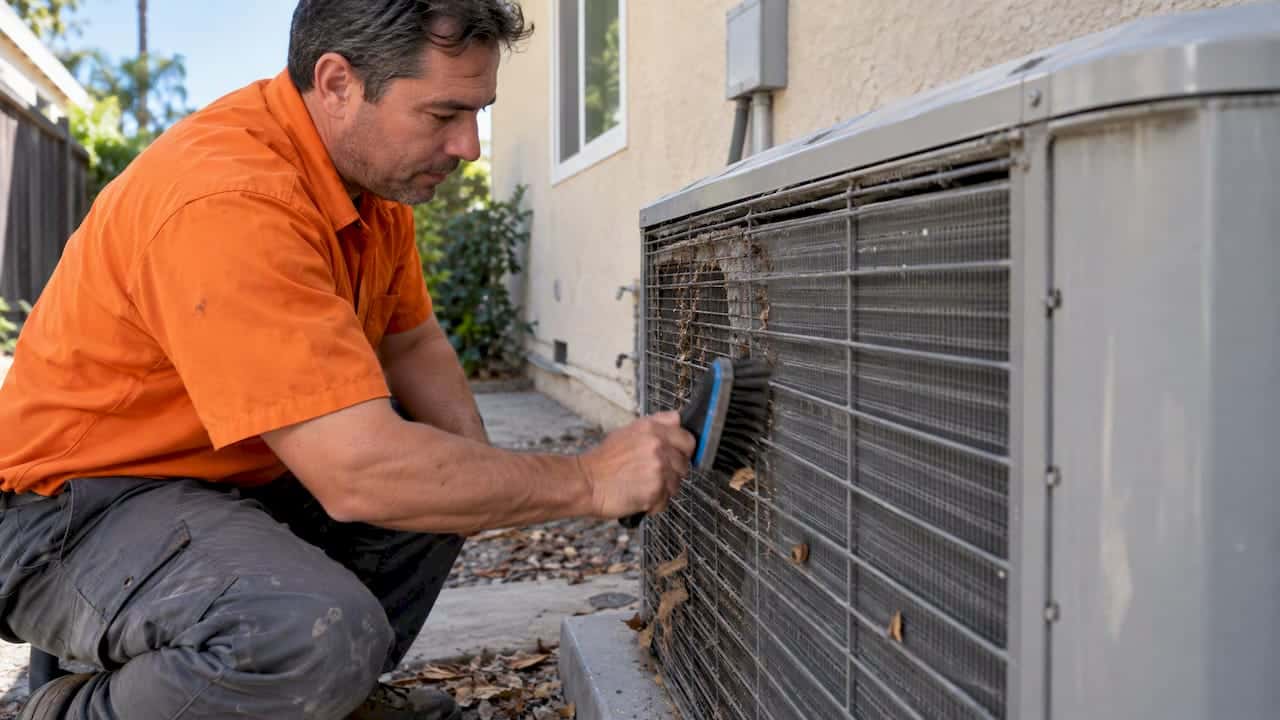
- Invest in preventive maintenance. Annual tune-ups catch small problems like a weakening capacitor or a dirty coil before they become urgent, expensive emergencies. The average tune-up costs $75–$150 and can easily prevent a $500 repair. Think of it as a small premium that keeps your system running efficiently and predictably.
Pro Tip: Always confirm that all required parts are available before a technician begins a multi-step repair. A job that gets paused mid-repair due to a backordered part can mean additional service call fees and extended downtime.
My take on navigating AC repair costs
In my experience working with homeowners across Los Angeles, the biggest source of financial pain is not the repair itself. It is the surprise. People approve work without asking about diagnostic fee crediting, they agree to refrigerant recharges without understanding the per-pound cost, and they feel too uncomfortable to ask for an itemized quote. That discomfort costs real money.
What I have learned after years in this industry is that transparent pricing is not just a nice feature. It is the foundation of trust. When a company walks you through exactly what they are diagnosing, what parts are needed, and what each line item costs before they start, you feel respected as a homeowner. You make better decisions. And you are far less likely to end up with a bill that shocks you.
I have seen clients save hundreds of dollars simply by asking one question: “Can you break that quote down for me?” That single question signals that you are paying attention, and it consistently results in more careful, honest estimates.
The other lesson I keep coming back to is the value of maintenance. I understand it feels like an unnecessary expense when your system is running fine. But the homeowners I have worked with who schedule annual tune-ups almost never face emergency calls. They replace components on their schedule, not the system’s schedule. That shift in control matters more than most people realize.
If the repair cost conversation ever feels one-sided or rushed, slow it down. A good HVAC company will welcome your questions. And if they do not, that tells you something important too.
— lc
Get clear pricing from LC Heating and Air Conditioning
Understanding how AC repair cost is determined gives you the knowledge to ask the right questions. Taking the next step means finding a company that gives you straight answers before any work begins.

LC Heating and Air Conditioning has served Los Angeles homeowners for over 20 years with flat-rate pricing, transparent diagnostics, and same-day service availability. The diagnostic fee is credited toward your repair when you approve the work. No surprise add-ons, no pressure to replace systems that can be fixed. Whether you need help with a refrigerant leak, a failing fan motor, or a full system assessment, the team at LC Heating and Air Conditioning delivers honest estimates you can actually plan around. Explore AC repair services in Los Angeles or visit the full services page to see everything that is available for your home.
FAQ
How is AC repair cost determined?
AC repair cost is determined by combining the service call fee, labor hours, parts cost, refrigerant charges if applicable, and any emergency or after-hours premiums. Local market rates also affect the total price significantly.
What is the average cost of AC repairs?
The average cost of AC repairs ranges from $150 for minor fixes like capacitors to $2,900 or more for major repairs like compressor replacement, depending on the part and labor involved.
Does the diagnostic fee get added to the repair bill?
Many HVAC companies credit the diagnostic fee toward the repair if you approve the work, so you do not pay it twice. Always confirm this policy before booking the service call.
When does it make more sense to replace than repair an AC?
If the repair cost exceeds 50% of a new system’s price, or if multiplying the system’s age by the repair cost exceeds $5,000, replacement is usually the more cost-effective choice.
Why do refrigerant repairs cost so much?
Refrigerant repairs involve multiple separate charges including the leak search, the repair itself, evacuation of old refrigerant, and the recharge billed per pound. Combined, these charges can total $1,200–$2,000 or more on a single visit.
Recommended
- Why AC Repair Beats Replacement for Most Homeowners | LC Heating & Air
- AC Repair Los Angeles | LC Heating & Air | (323) 970-3113 | LC Heating & Air
- AC Compressor Repair Los Angeles | LC Heating & Air | (323) 970-3113 | LC Heating & Air
- Emergency AC Repair Los Angeles | LC Heating & Air | (323) 970-3113 | LC Heating & Air
Leo, Owner & Lead Technician at LC Heating & Air
Leo leads LC Heating & Air as an owner-operator and holds California CSLB C-20 HVAC license #1073586. His guides focus on practical diagnostics, safe repair decisions, and clear advice for Los Angeles homeowners.