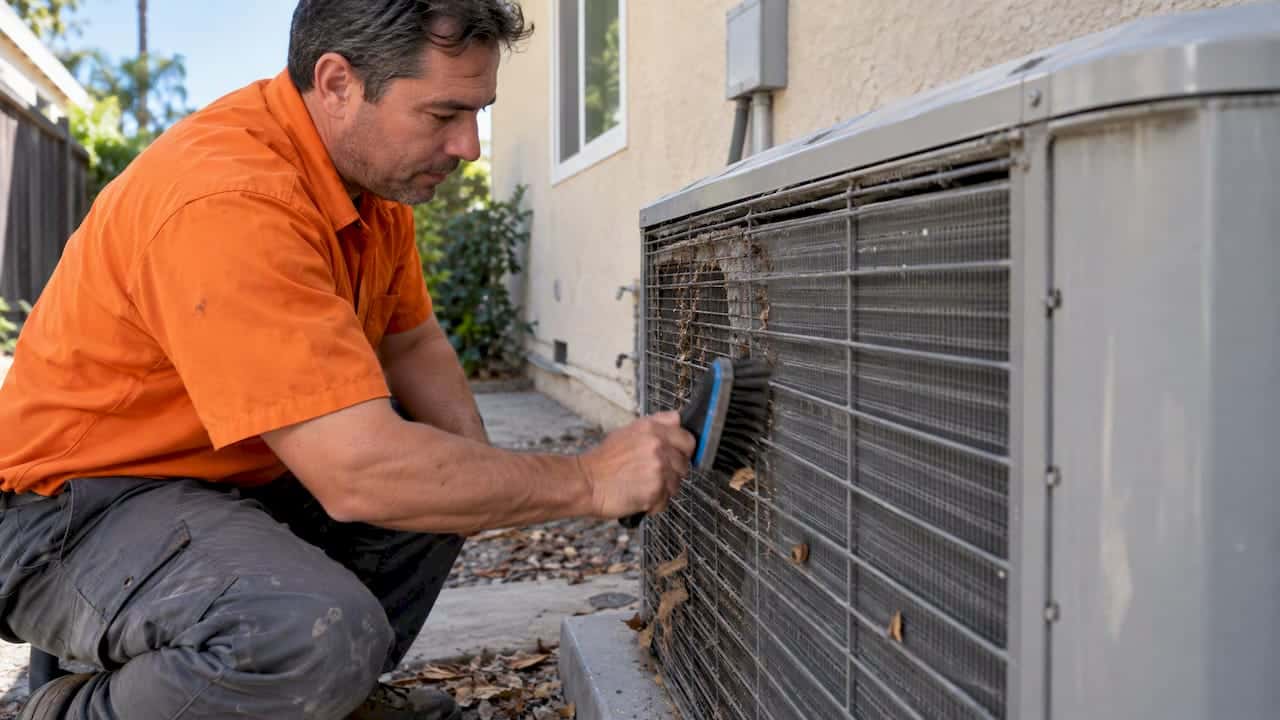
- What factors should you consider when choosing AC repair vs replacement?
- How do financial decision frameworks help you evaluate repair vs replacement?
- How should you evaluate HVAC contractor estimates?
- What are the clear signs you should replace instead of repair?
- How do you finalize your AC repair or replacement decision?
- Key takeaways
- What 20 years of HVAC work taught me about this decision
- Get an honest AC evaluation from LC heating and air conditioning
- FAQ
- Recommended

TL;DR:
- Choosing whether to repair or replace an AC system depends on factors such as age, repair cost, refrigerant type, and energy efficiency. Homeowners should evaluate five-year total costs and get detailed estimates to make an informed decision that balances long-term savings and comfort. Proactive maintenance and honest contractor assessments help prevent unnecessary replacements and costly repairs.
Choosing between AC repair and replacement is the most consequential HVAC decision most homeowners face, and the wrong call can cost thousands of dollars. The industry standard for this decision weighs three variables: system age, repair cost as a percentage of replacement cost, and the frequency of recent breakdowns. Minor AC repairs typically cost $150–$650, while full central AC system replacements average $7,500–$13,000 depending on size and efficiency rating. That wide gap is exactly why you need a clear framework before you choose AC repair vs replacement, not just a gut feeling or a contractor’s quick recommendation.
What factors should you consider when choosing AC repair vs replacement?
The repair or replace HVAC decision comes down to six core variables. Each one can shift the math significantly, so work through all of them before committing to either path.
-
System age. HVAC pros advise repairing systems under 10 years old if the repair cost stays below 30% of replacement cost. For systems 12–15 years or older with frequent breakdowns or major component failures, replacement becomes the smarter financial move. Most central AC systems have a realistic lifespan of 15–20 years with proper maintenance.
-
Repair cost as a percentage of replacement cost. A $600 repair on a $10,000 replacement is a 6% spend. A $3,000 compressor replacement on that same system is 30%. The 30% threshold is the widely accepted industry line. Cross it on an aging system and you are likely throwing money at a unit that will fail again soon.
-
Type and frequency of repairs. A single capacitor replacement is a minor fix. A failed compressor, a cracked heat exchanger, or a refrigerant leak in the evaporator coil are major failures. If you have had two or more significant repairs in the past two years, that pattern matters more than any single repair cost.
-
Energy efficiency. Older units typically carry SEER (Seasonal Energy Efficiency Ratio) ratings of 10–12. Newer systems with high SEER ratings can reduce energy consumption significantly, saving homeowners hundreds of dollars annually. That annual savings directly shortens the payback period on a replacement investment.
-
Warranty status. A system still under a manufacturer’s parts warranty changes the math entirely. A covered compressor replacement costs you labor only, often $400–$800, not the full $1,200–$2,800 out of pocket.
-
Refrigerant type. Systems using R-22 refrigerant (also called Freon) are in a difficult position. R-22 was phased out under EPA regulations, and refrigerant phase-outs make repair increasingly costly and sometimes impossible. If your system runs on R-22 and needs a refrigerant recharge, replacement is almost always the better path.
Pro Tip: Pull out your original installation paperwork or check the data plate on your outdoor condenser unit. The model number and manufacture date tell you the system’s age and refrigerant type before any technician arrives.

How do financial decision frameworks help you evaluate repair vs replacement?
Several financial rules of thumb exist to simplify this decision. They are useful starting points, but each has real limitations you need to understand.
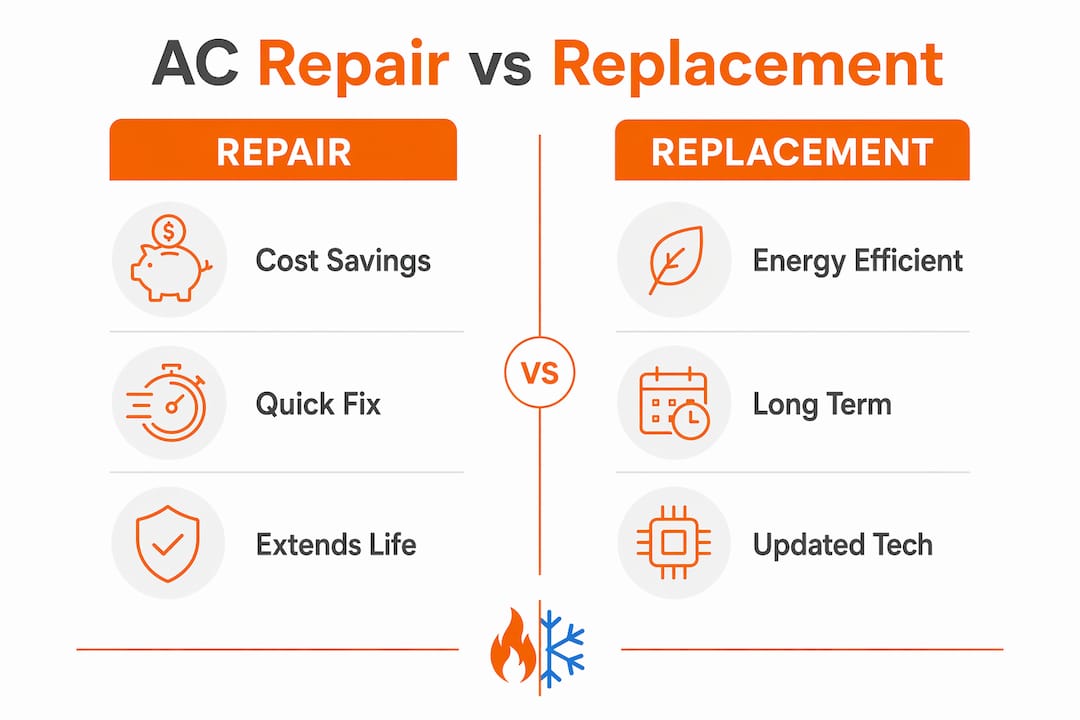
The $5,000 rule explained
The $5,000 rule works like this: multiply your system’s age (in years) by the estimated repair cost. If the result exceeds $5,000, replace the unit. A 12-year-old system facing a $500 repair scores 6,000, suggesting replacement. A 6-year-old system with the same repair scores 3,000, suggesting repair.
The problem is that the $5,000 rule oversimplifies key factors like efficiency, refrigerant availability, future breakdown risk, and ductwork issues. A 14-year-old system in excellent mechanical condition with a $200 capacitor fix scores 2,800, which the rule says to repair. But if that system runs on R-22 and your ducts are leaking 30% of conditioned air, the real cost picture looks very different.
A more reliable approach: five-year total cost of ownership
- Estimate repair cost. Get a written quote for the current repair.
- Project future repair risk. Ask your technician honestly: what else is likely to fail in the next two to three years on a system this age?
- Calculate annual energy cost difference. Compare your current system’s SEER rating to a new unit. A jump from SEER 12 to SEER 18 on a Los Angeles home running AC eight months a year can save $300–$600 annually.
- Add ductwork costs. Duct repair or upgrade can add $1,500–$5,000 to a replacement project. Factor this in upfront, not as a surprise.
- Total the five-year cost for each path. Repair path: current repair + projected future repairs + five years of higher energy bills. Replacement path: new system cost + installation + ductwork + five years of lower energy bills.
Sample calculation
Your 13-year-old system needs a $1,800 evaporator coil replacement. Replacement cost for a new system is $9,500.
- Repair path: $1,800 repair + $1,200 estimated future repairs over three years + $2,500 extra energy costs (SEER 11 vs SEER 18) = $5,500 over five years
- Replacement path: $9,500 new system minus $1,800 in energy savings over five years = $7,700 net over five years
In this case, repair wins on a pure five-year basis. But if the system fails again within 18 months, the math flips. A low upfront repair cost can still become a poor investment if a second major failure follows quickly.
Pro Tip: Ask your HVAC technician to give you a written “health assessment” of the full system alongside any repair quote. A good technician will tell you what else looks worn, not just what broke today.
How should you evaluate HVAC contractor estimates?
Getting accurate estimates is where most homeowners lose control of this decision. A vague quote protects the contractor, not you. Homeowners should get 2–3 written, line-item HVAC estimates detailing repair costs and full replacement costs including labor and ductwork.
Here is what every written estimate should include:
- Equipment cost listed separately from labor, with the model number and SEER rating of any proposed replacement unit
- Labor hours and rate, or a flat-rate total with a clear scope of work
- Permit fees, which are required for full system replacements in most California jurisdictions
- Ductwork assessment, noting whether existing ducts are compatible, need sealing, or require replacement
- Disposal fees for the old unit
- Warranty terms for both parts and labor on any repair or new installation
| Estimate Component | What to Look For | Red Flag |
|---|---|---|
| Equipment cost | Model number, SEER rating listed | Vague “new unit” with no specs |
| Labor | Flat rate or hourly rate stated | “Included” with no breakdown |
| Ductwork | Condition noted, upgrade cost itemized | Not mentioned at all |
| Permits | Included or listed as separate line | No mention of permits |
| Warranty | Parts and labor terms in writing | Verbal promise only |
Ductwork is the most commonly underestimated cost in any replacement project. Ductwork condition greatly affects replacement cost and system performance. If a contractor never mentions your ducts during a replacement quote, ask directly. You can also explore comparing AC repair service quotes to understand what a fair, transparent estimate looks like before you start calling contractors.
What are the clear signs you should replace instead of repair?
Some situations make the replacement decision straightforward. Recognizing these signs early saves you from pouring money into a system that has already reached the end of its useful life.
-
Multiple breakdowns in one season. One repair is normal. Two or more significant failures within 12 months signal systemic decline. The compressor, capacitor, and contactor rarely fail together by coincidence on a healthy system.
-
Major component failure on an older unit. Compressor replacements on systems over 12 years old rarely make financial sense. The compressor is the heart of the system, and replacing it on an aging unit is like putting a new engine in a car with 200,000 miles on the frame.
-
Rising energy bills with no change in usage. A system losing efficiency shows up on your utility bill before it shows up as a breakdown. If your cooling costs have climbed 20–30% over two to three years without a rate increase, your system is working harder to deliver the same result.
-
R-22 refrigerant systems needing recharge. R-22 is no longer manufactured in the United States. Supply is limited, prices are high, and frequent breakdowns with old refrigerant phase-outs make repair increasingly uneconomical. Recharging an R-22 system is a short-term fix with no long-term future.
-
Comfort problems that repairs have not solved. Uneven cooling, humidity issues, and rooms that never reach the set temperature often point to a system that is no longer sized or functioning correctly for your home.
“Replacement decisions increasingly favor newer systems not just because of cost, but because modern units with variable-speed compressors and smart thermostat integration deliver a level of comfort and control that a 15-year-old single-stage unit simply cannot match.”
You can review the AC repair vs replacement benefits in more detail to see how the long-term value of a new system compares to the short-term savings of repair.
How do you finalize your AC repair or replacement decision?
Once you have gathered the facts, a structured process keeps you from making an emotional or rushed decision. Follow these steps to move forward with confidence.
-
Assess your system’s current condition. Note the age, refrigerant type, SEER rating, and any repairs made in the past three years. This information is on the data plate of your outdoor unit and in your service records.
-
Get 2–3 written, line-item estimates. For repairs, get quotes from at least two licensed HVAC contractors. For replacement, get quotes that include equipment, labor, permits, and ductwork.
-
Request a Manual J load calculation for any replacement. A Manual J load calculation before replacement ensures the new system is correctly sized for your home as it exists today, not as it was when the original unit was installed. Oversized systems short-cycle, wear out faster, and leave your home feeling humid.
-
Check for rebates and tax credits. In Los Angeles, utility rebates from Southern California Edison and federal tax credits under the Inflation Reduction Act can offset $500–$2,000 of a replacement cost. Review available HVAC rebates and tax credits before you sign any contract.
-
Consider timing. Replacing in spring before peak cooling season gives you more contractor availability and better pricing. Emergency replacements in July cost more and limit your options.
-
Weigh comfort and budget together. If your current system keeps you comfortable and the repair is minor, repair is the right call. If you are losing sleep over reliability or your energy bills are climbing, replacement pays off in ways that go beyond the spreadsheet.
-
Make the decision in writing. Once you choose, get the full scope of work, timeline, and warranty in a signed contract before any work begins.
Key takeaways
The right choice between AC repair and replacement depends on system age, repair cost relative to replacement cost, refrigerant type, and a realistic five-year cost projection that includes energy savings and ductwork.
| Point | Details |
|---|---|
| Use the 30% threshold | Repair costs exceeding 30% of replacement cost on a system over 12 years old favor replacement. |
| Go beyond the $5,000 rule | The $5,000 formula ignores efficiency, refrigerant costs, and ductwork, so use a five-year total cost model instead. |
| Get line-item estimates | Always request 2–3 written quotes that include equipment, labor, permits, and ductwork assessments. |
| Request a Manual J calculation | Proper load sizing prevents oversized systems that short-cycle and wear out prematurely. |
| Factor in rebates and refrigerant | R-22 systems and available tax credits can each shift the financial case for replacement significantly. |
What 20 years of HVAC work taught me about this decision
I have seen homeowners spend $2,400 on a compressor for a 14-year-old R-22 system, only to call us back eight months later when the evaporator coil failed. I have also seen homeowners replace a perfectly functional 9-year-old unit because a contractor scared them into it. Both outcomes were avoidable.
The honest truth is that simple rules like the $5,000 formula exist because they are easy to explain, not because they are accurate. Real decisions require real information: the actual condition of your ductwork, the refrigerant your system uses, your local utility rates, and a candid conversation about what else might fail in the next two years.
What I have found actually works is asking one question before anything else: “If I repair this today, what is the realistic chance I am calling you again within 18 months?” A good technician will answer that honestly. A contractor who pushes replacement on a 7-year-old system with a minor fault, or who pushes repair on a 16-year-old R-22 unit with a failing compressor, is not giving you their best advice.
Proactive maintenance changes this conversation entirely. Homeowners who schedule annual tune-ups almost never face emergency replacement decisions in July. They know their system’s condition, they plan ahead, and they replace on their timeline, not the system’s.
My advice: do not let urgency or discomfort pressure you into a decision you have not thought through. Get the facts, get multiple quotes, and work with a contractor who explains the reasoning, not just the price.
— Leo
Get an honest AC evaluation from LC heating and air conditioning
If you are weighing whether to repair or replace your AC system in Los Angeles, you deserve a straight answer, not a sales pitch. LC Heating and Air Conditioning has served Los Angeles homeowners for over 20 years with flat-rate pricing, honest diagnostics, and no surprise fees.

LC Heating and Air Conditioning offers same-day AC repair and replacement services across Los Angeles, from historic homes to modern multi-zone systems. The team provides detailed, line-item estimates so you know exactly what you are paying for before any work begins. LC Heating and Air Conditioning also helps homeowners identify available rebates and financing options to make replacement more affordable. Visit lahvaclc.com to schedule your evaluation or call for same-day service.
FAQ
When should i replace my AC instead of repairing it?
Replace your AC when the system is 12–15 years or older, repair costs exceed 30% of replacement cost, or the unit uses R-22 refrigerant and needs a major fix. Multiple breakdowns within a single season are also a strong indicator that replacement is the more cost-effective path.
What is the $5,000 rule for AC replacement?
The $5,000 rule multiplies your system’s age by the repair cost. If the result exceeds $5,000, the rule suggests replacement. Experts caution that this formula oversimplifies the decision by ignoring energy efficiency, refrigerant costs, and ductwork condition.
How much does AC replacement cost compared to repair?
Major component replacements range from $1,200–$2,800, while full central AC system replacements average $7,500–$13,000. Minor repairs typically fall between $150–$650, making repair the clear choice for younger systems with isolated issues.
Does ductwork affect my AC replacement cost?
Yes, significantly. Duct repair or upgrade can add $1,500–$5,000 to the total project cost. Always ask your contractor to assess duct condition as part of any replacement quote.
What is a manual j load calculation and do i need one?
A Manual J load calculation determines the correct AC size for your specific home based on square footage, insulation, windows, and local climate. Requesting a Manual J before replacement prevents oversized systems that short-cycle, wear out faster, and leave your home feeling uncomfortable.
Recommended
Leo, Owner & Lead Technician at LC Heating & Air
Leo leads LC Heating & Air as an owner-operator and holds California CSLB C-20 HVAC license #1073586. His guides focus on practical diagnostics, safe repair decisions, and clear advice for Los Angeles homeowners.