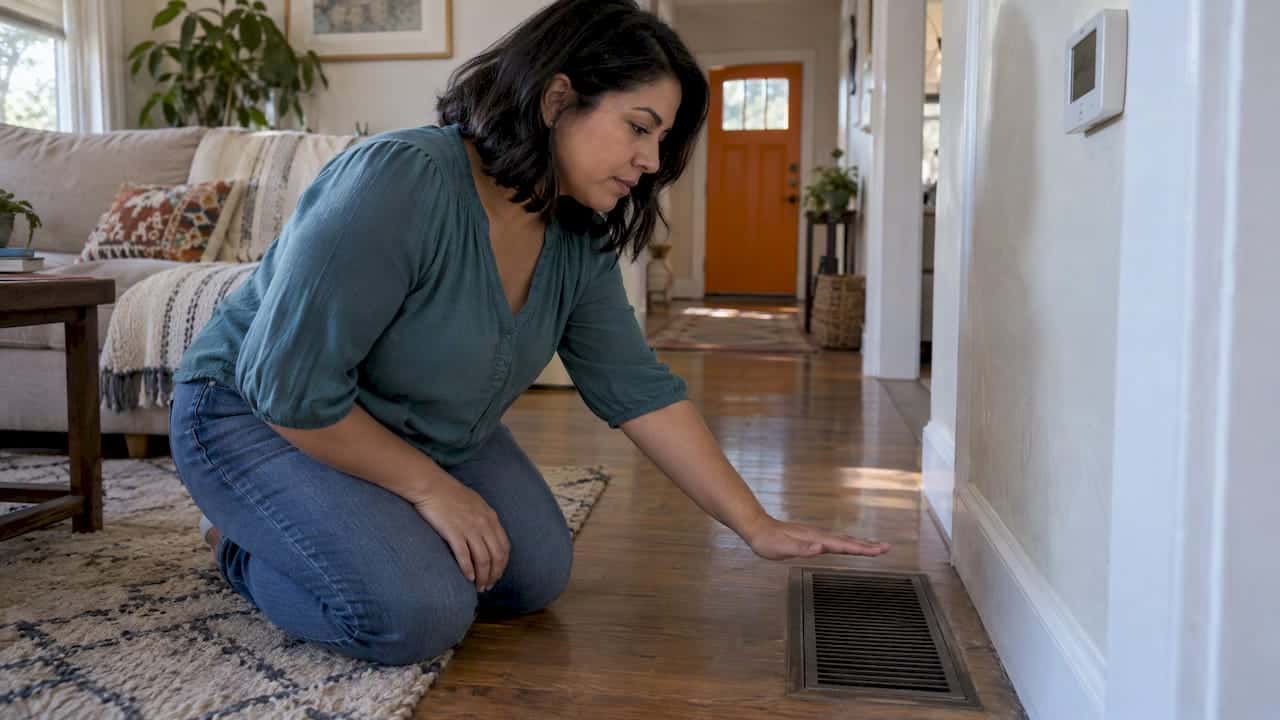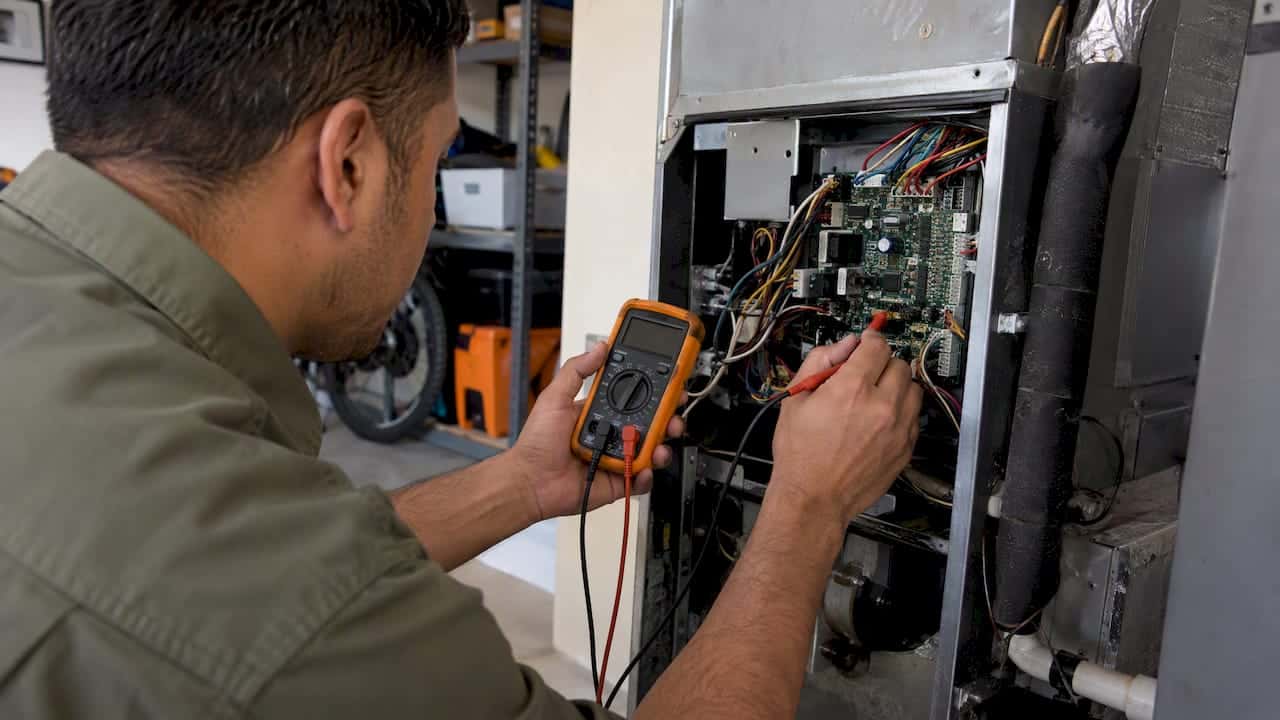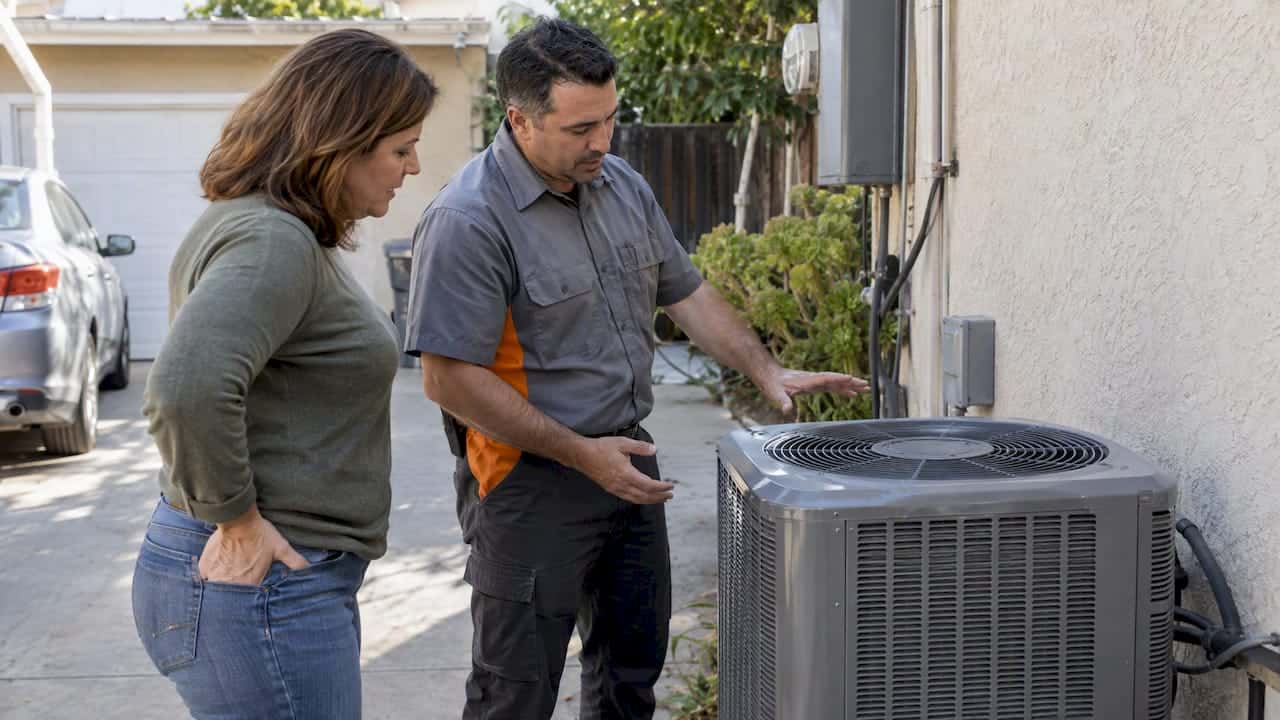
- What Is a Capacitor in HVAC? A Homeowner’s Guide
- What is a capacitor in HVAC systems, and why does it matter?
- What types of capacitors are used in HVAC systems?
- How does an HVAC capacitor work inside the motor circuit?
- What are the signs of a bad HVAC capacitor?
- How to select and replace an HVAC capacitor correctly
- Key takeaways
- What I have learned after twenty years of capacitor calls
- LC Heating and Air Conditioning is ready when your system is not
- FAQ
- Recommended
What Is a Capacitor in HVAC? A Homeowner’s Guide
TL;DR:
- An HVAC capacitor stores and releases electrical energy to help motors start and run smoothly. It is crucial for motor operation, and failure often causes system breakdowns and motor damage. Regular testing and correct replacement of capacitors ensure reliable cooling and avoid costly repairs.
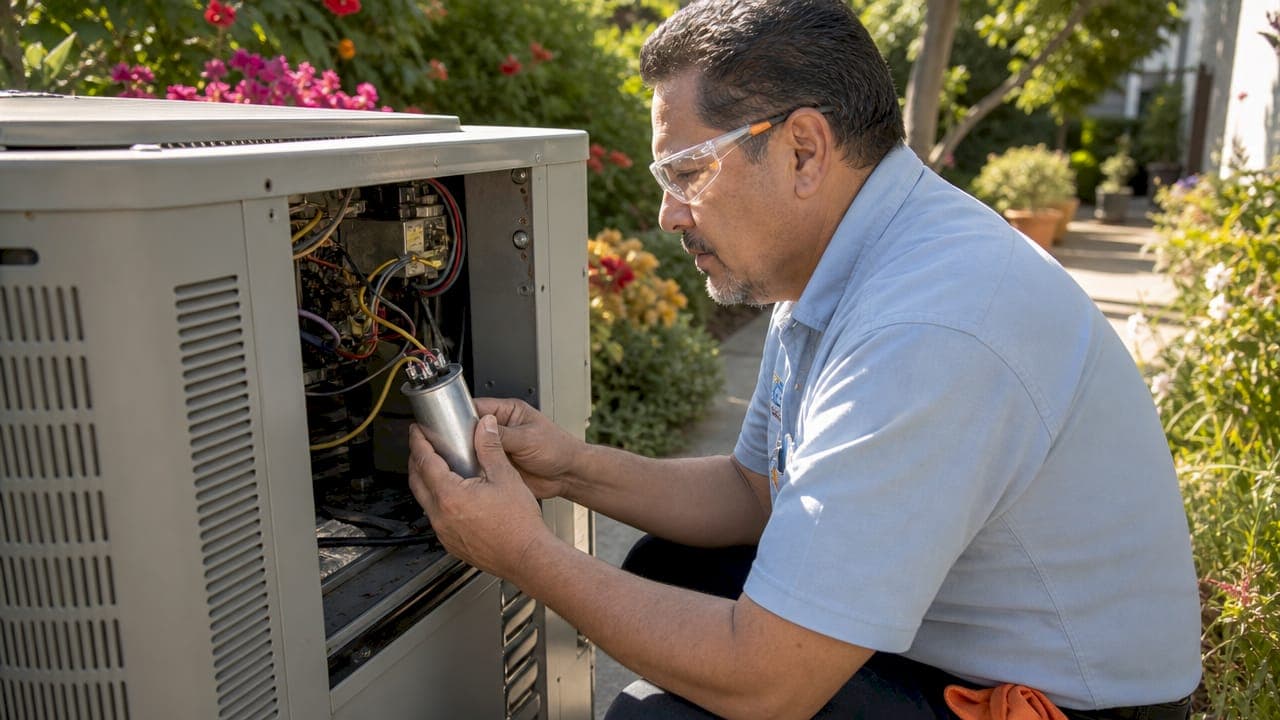
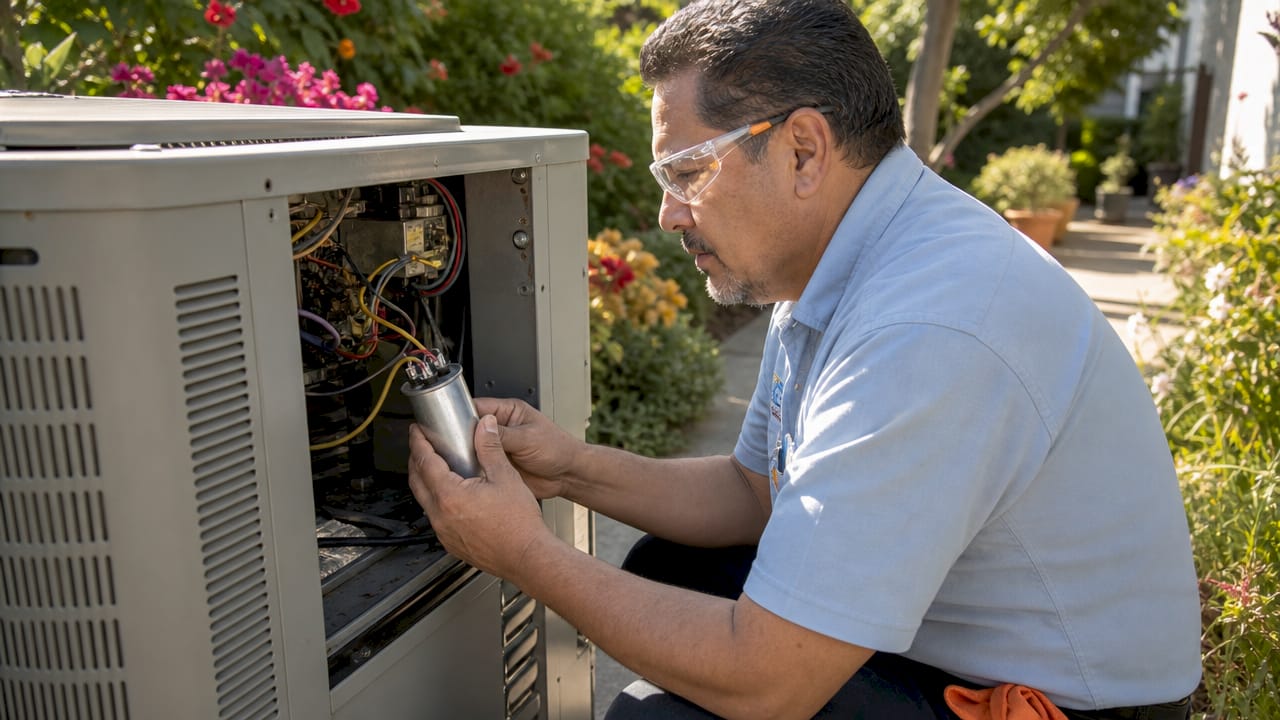
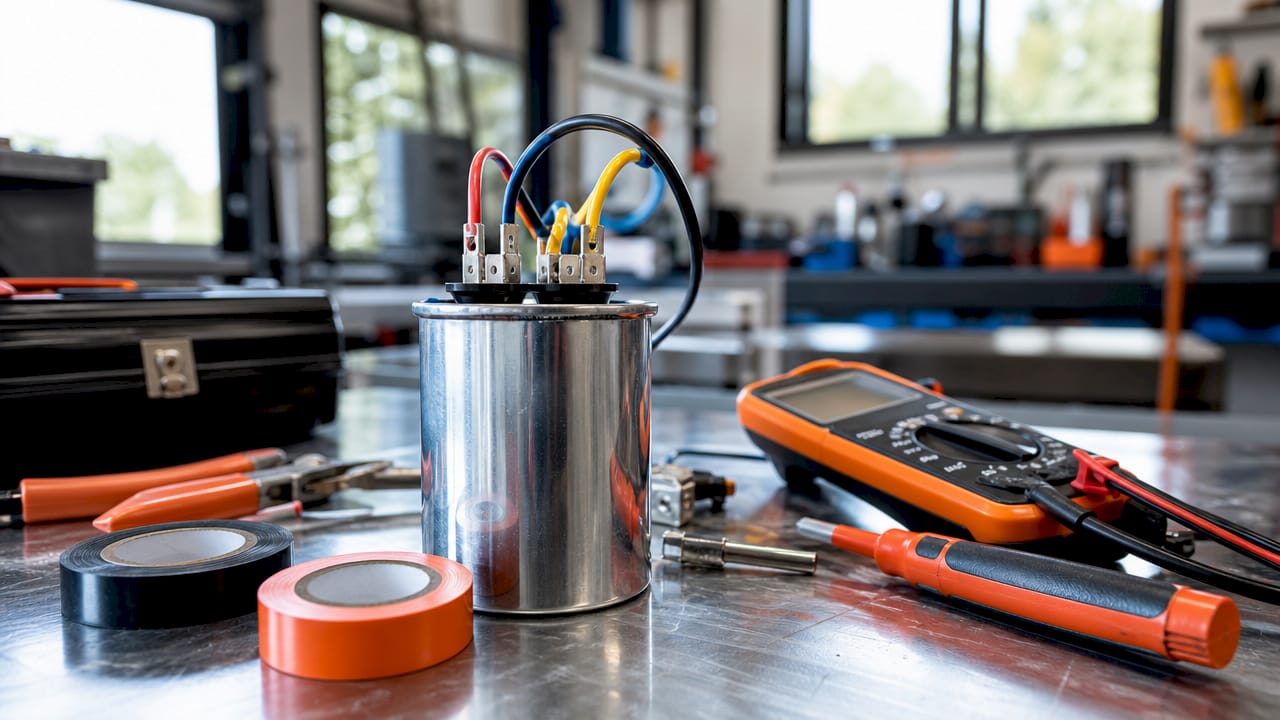
An HVAC capacitor is defined as a small cylindrical electrical component that stores and releases energy to help your air conditioner’s motors start and run. Without it, your compressor and fan motors cannot generate the torque needed to turn on. Understanding what is a capacitor in HVAC terms means knowing that this single part, often no bigger than a soda can, is responsible for keeping your entire cooling system alive. LC Heating and Air Conditioning sees capacitor failure as one of the most common reasons Los Angeles homeowners call for same-day AC repair every summer.
What is a capacitor in HVAC systems, and why does it matter?
An HVAC capacitor is the electrical workhorse behind every motor start in your air conditioning system. Capacitors store and release power but do not generate it. They act as a short-term energy reservoir, delivering a concentrated burst of electricity the moment a motor needs to spin up from a dead stop.
Think of it like a camera flash. Your camera charges up a capacitor over a few seconds, then releases all that stored energy in one brilliant instant. Your HVAC system does the same thing every time the thermostat calls for cooling. The capacitor charges, fires, and either disconnects or stays in the circuit depending on its type.
The HVAC capacitor function extends beyond just starting motors. Run capacitors stay energized throughout the entire cooling cycle, smoothing out the electrical current and keeping motors running at peak efficiency. A healthy capacitor means a happy compressor, and a happy compressor means consistent, reliable cooling on the hottest Los Angeles days.
Typical capacitance ranges from 5–80 MFD for run capacitors and 70–100+ MFD for start capacitors. MFD stands for microfarads, the standard unit of measurement for capacitance. That number tells you exactly how much electrical charge the capacitor can store and deliver.
What types of capacitors are used in HVAC systems?
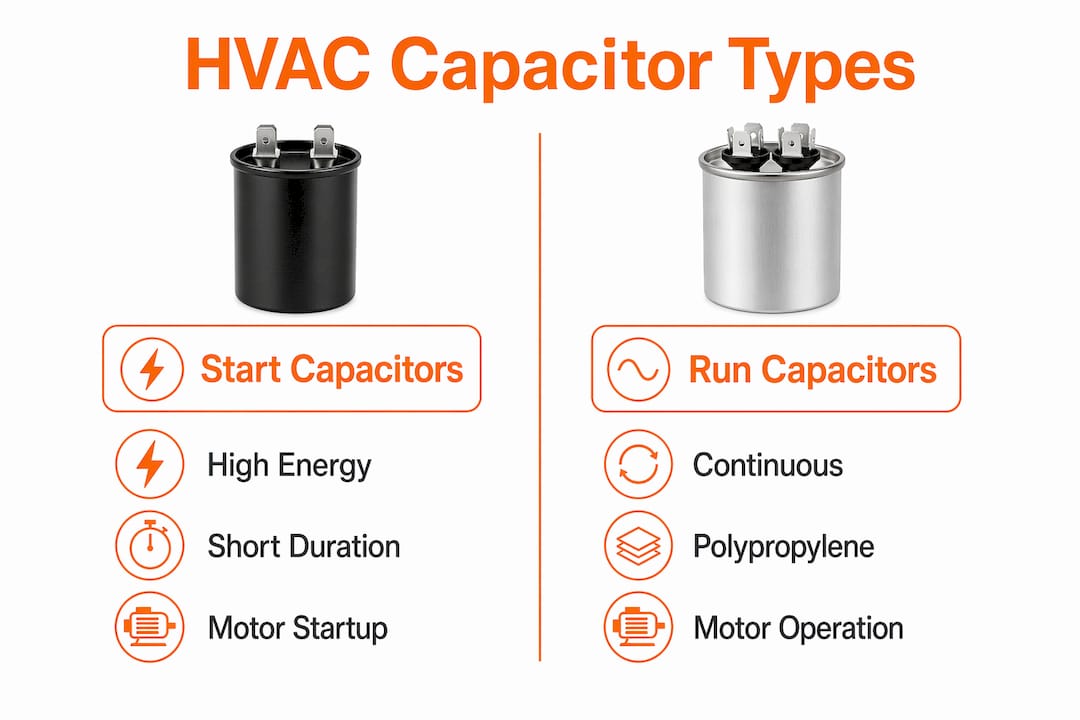
Three main types of capacitors serve residential HVAC systems: start capacitors, run capacitors, and dual run capacitors. Each has a specific job, and confusing them during replacement causes real damage.
Start capacitors
Start capacitors deliver a high-energy boost at motor startup, then drop out of the circuit once the motor reaches speed. They are polarized electrolytic components built for short duty cycles only. Running a start capacitor continuously would overheat and destroy it within minutes. Start capacitors typically range from 70–400+ MFD and operate at 110–330 volts.
Run capacitors
Run capacitors stay in the circuit the entire time the motor runs. They are built from polypropylene film, not electrolytic material, which makes them stable under continuous electrical load. Run capacitors are polypropylene film components designed for exactly this kind of long-duration operation. Their typical range is 2.5–80 MFD at 370–440 volts.
Dual run capacitors
Dual run capacitors combine the compressor capacitor and the fan motor capacitor into one unit. They have three terminals labeled C (common), HERM (hermetic compressor), and FAN. A common rating you will see on a dual run capacitor is 45+5 MFD at 370V or 440V. One part does two jobs, which saves space inside the condenser unit and simplifies the wiring layout.
| Capacitor type | Typical MFD range | Voltage range | Material | Duty cycle |
|---|---|---|---|---|
| Start capacitor | 70–400+ MFD | 110–330V | Electrolytic | Short burst only |
| Run capacitor | 2.5–80 MFD | 370–440V | Polypropylene film | Continuous |
| Dual run capacitor | e.g., 45+5 MFD | 370V or 440V | Polypropylene film | Continuous |
Knowing which type your system uses is the first step in any capacitor troubleshooting process. The label on the side of the capacitor tells you everything you need: type, MFD rating, and voltage.
How does an HVAC capacitor work inside the motor circuit?
Single-phase AC motors cannot start on their own. They need a phase shift in the electrical current to generate the rotational force required to begin spinning. This is exactly what a capacitor provides.
Here is how the process works, step by step:
- The thermostat signals the system to start. Power flows to the motor and the capacitor simultaneously.
- The capacitor creates a phase shift. It shifts the electrical current in the start winding roughly 90 degrees out of phase with the run winding. This phase difference creates a rotating magnetic field inside the motor.
- The rotating magnetic field generates torque. The motor begins to spin from a standing start.
- The start capacitor disconnects. Once the motor reaches approximately 75–80% of its full speed, a relay disconnects the start capacitor from the circuit. This prevents overheating.
- The run capacitor takes over. It stays in the circuit, continuously correcting the power factor and smoothing out the motor’s electrical draw.
- The motor runs efficiently until the thermostat is satisfied. The run capacitor keeps the current balanced throughout the entire cycle.
The difference in capacitor materials matters here. Electrolytic start capacitors handle the violent energy surge at startup but cannot sustain continuous current. Polypropylene film run capacitors tolerate steady electrical flow without degrading. Using the wrong material in the wrong role shortens the component’s life dramatically.
When a capacitor fails, the motor loses its phase shift. Failure disrupts the single-phase motor phase shift, causing the motor to hum loudly, draw excessive current, and overheat. Left unchecked, this burns out the motor windings entirely, turning a $30 capacitor problem into a $1,200 compressor replacement.
Pro Tip: If your outdoor unit hums but the fan blade does not spin, try giving the blade a gentle push with a stick while the unit is running. If it starts spinning, your run capacitor is almost certainly weak or failed. Call a technician before the motor burns out.
What are the signs of a bad HVAC capacitor?
Capacitor failure rarely happens without warning. Your system gives you clear signals before it quits entirely. Recognizing these signs early saves you from a full system breakdown on the hottest day of the year.
Common symptoms of a failing capacitor include:
- Humming or buzzing from the outdoor unit. The motor is trying to start but cannot generate enough torque without proper capacitor support.
- The fan or compressor fails to start. You hear the system click on, but no airflow or cooling follows.
- Weak airflow from the vents. A struggling fan motor moves less air, even when the system appears to be running.
- The system shuts off shortly after starting. Thermal overload protection kicks in when the motor draws too much current trying to compensate for a weak capacitor.
- Visible physical damage. A swollen top, oil leakage around the base, or a burned smell are definitive signs of capacitor failure.
Humming sounds are early warnings that most homeowners dismiss as normal system noise. They are not. A healthy capacitor allows motors to start quietly and smoothly. Any persistent hum from the outdoor unit deserves attention.
Capacitors can hold a lethal electrical charge even after the system is powered off. This is the most important safety fact in any capacitor troubleshooting guide. Never touch a capacitor with bare hands or uninsulated tools after shutting down the system. The stored charge does not disappear the moment you flip the breaker.
Pro Tip: Before any inspection near the capacitor, discharge it using an insulated resistor tool or a screwdriver with a properly insulated handle. Better yet, call a licensed technician. The risk of severe electric shock is real, and no DIY repair is worth that outcome.
Swollen capacitors observed by homeowners still require professional testing to rule out motor faults. A bad capacitor can damage a motor over time, and replacing the capacitor alone without checking the motor leaves the root problem unresolved. LC Heating and Air Conditioning always tests the full circuit during a capacitor service call, not just the part that looks damaged.
You can find more HVAC troubleshooting guides on the LC Heating and Air Conditioning website if you want to learn more about diagnosing common system problems safely.
How to select and replace an HVAC capacitor correctly
Selecting the right replacement capacitor is not guesswork. The specifications printed on the old capacitor are your exact shopping list.
Follow these steps for a correct replacement:
- Match the MFD rating within ±5%. Microfarad ratings must match within plus or minus 5% of the original. Going outside this range causes motor inefficiency, overheating, or premature failure.
- Voltage rating can be equal or higher, never lower. A 440V capacitor can replace a 370V capacitor safely. A 370V capacitor cannot replace a 440V unit.
- Read the terminal labels carefully. Dual run capacitors use three terminals: C (common), HERM (compressor), and FAN. Wiring them incorrectly destroys the motor.
- Discharge the old capacitor before touching it. Use an insulated discharge tool. Improper DIY handling risks severe electric shock, and the charge can remain present for hours after shutdown.
- Document the wiring before disconnecting anything. Take a photo of the existing wiring on your phone before removing a single wire.
- Inspect the motor while the capacitor is out. Check for burned wires, corrosion, or signs of overheating. A capacitor replacement done without checking the motor is an incomplete repair.
| Specification | Rule |
|---|---|
| MFD (microfarads) | Match within ±5% of original rating |
| Voltage | Same or higher than original; never lower |
| Terminal labels | C = common, HERM = compressor, FAN = fan motor |
| Physical size | Must fit the mounting bracket in the unit |
| Duty type | Match start or run type exactly |
Professional HVAC capacitor replacement is the recommended path for most homeowners. A licensed technician brings a multimeter to verify capacitance, checks the motor’s amp draw, and evaluates the full circuit before declaring the repair complete. That level of diagnosis is not possible with a visual inspection alone.
Regular HVAC maintenance that includes capacitor checks catches weak capacitors before they fail completely. LC Heating and Air Conditioning includes capacitor testing as part of every annual tune-up, which is one of the simplest ways to avoid an emergency breakdown call in July.
Key takeaways
An HVAC capacitor is the single most common cause of air conditioner motor failure, and matching its MFD rating within ±5% during replacement is the most critical specification to get right.
| Point | Details |
|---|---|
| Capacitor function | Stores and releases energy to start and run compressor and fan motors. |
| Three capacitor types | Start, run, and dual run capacitors each serve a distinct role in the motor circuit. |
| MFD rating precision | Replace within ±5% of original microfarad rating to protect motor health. |
| Voltage flexibility | A higher voltage replacement is acceptable; a lower voltage rating is not. |
| Safety first | Capacitors hold lethal charge after power off. Always discharge before handling. |
What I have learned after twenty years of capacitor calls
Every summer in Los Angeles, I get a wave of calls that follow the same pattern. The homeowner noticed a hum two weeks ago. They figured it would go away. Then the system stopped cooling entirely on a 95-degree afternoon. Nine times out of ten, the culprit is a capacitor that was already failing when the hum started.
The thing most articles do not tell you is that a weak capacitor does not just fail. It slowly damages the motor it is supposed to protect. Every time a struggling capacitor forces a motor to draw excess current during startup, it stresses the motor windings. Do that enough times and you are not looking at a $50 part replacement. You are looking at a compressor or fan motor replacement that costs ten to twenty times more.
I also want to be direct about DIY capacitor replacement. I understand the appeal. The part is inexpensive and the job looks simple on a video. But a capacitor that has not been properly discharged can deliver a shock that sends you to the hospital. Beyond the safety risk, replacing a capacitor without testing the motor’s amp draw means you might be fixing the symptom while the real problem, a motor that is already degrading, keeps getting worse.
The homeowners who get the most value from their HVAC systems are the ones who treat capacitors as consumable parts, like a car battery, and schedule annual tune-ups that include capacitor testing. Catching a capacitor at 60% of rated capacitance costs almost nothing to fix. Catching it after it takes the compressor down with it is a very different conversation.
— Leo
LC Heating and Air Conditioning is ready when your system is not
A failing capacitor does not always announce itself with a dramatic breakdown. Sometimes it is just a hum, a slow start, or an air conditioner that runs but never quite cools the house down. Those are the calls LC Heating and Air Conditioning handles every day across Los Angeles.

LC Heating and Air Conditioning offers same-day HVAC repair with flat-rate pricing, so you know the cost before any work begins. Every capacitor service call includes a full motor and circuit evaluation, not just a part swap. If you suspect a capacitor issue or want a professional inspection before summer peaks, the team at LC Heating and Air Conditioning is ready to help. Before signing any HVAC service contract, it is also worth reviewing contractor considerations to protect yourself as a homeowner.
FAQ
What does a capacitor do in an HVAC system?
An HVAC capacitor stores electrical energy and releases it to help compressor and fan motors start and run efficiently. Without it, single-phase motors cannot generate the torque needed to begin spinning.
How long do HVAC capacitors last?
Capacitors are consumable components with a finite lifespan, typically shortened by heat, age, and electrical surges. Regular inspection every 5–10 years is recommended, though Los Angeles heat can accelerate wear significantly.
Can I replace an HVAC capacitor myself?
Capacitor replacement carries serious electrical shock risk because the component holds a lethal charge even after power is disconnected. Professional replacement is strongly recommended to ensure safe discharge and a complete motor circuit evaluation.
What MFD rating do I need for a replacement capacitor?
The replacement MFD rating must match the original within ±5%. The voltage rating can be equal to or higher than the original, but never lower. Both specifications are printed on the label of the existing capacitor.
What are the most common signs of a bad HVAC capacitor?
The most common signs include a humming outdoor unit, a fan or compressor that fails to start, weak airflow, and visible swelling or oil leakage on the capacitor body. Any of these symptoms warrants a professional inspection before the motor sustains permanent damage.
Recommended
Leo, Owner & Lead Technician at LC Heating & Air
Leo leads LC Heating & Air as an owner-operator and holds California CSLB C-20 HVAC license #1073586. His guides focus on practical diagnostics, safe repair decisions, and clear advice for Los Angeles homeowners.