- Key Takeaways
- How Does a Scroll Compressor Work?
- What Are the Main Parts of a Scroll Compressor?
- What Types of Scroll Compressors Are There?
- Advantages and Disadvantages of Scroll Compressors
- Where Are Scroll Compressors Used?
- Scroll vs. Rotary vs. Piston Compressors: Which Is Better?
- How Do You Choose the Right Scroll Compressor?
- Sources
- FAQ
- Recommended
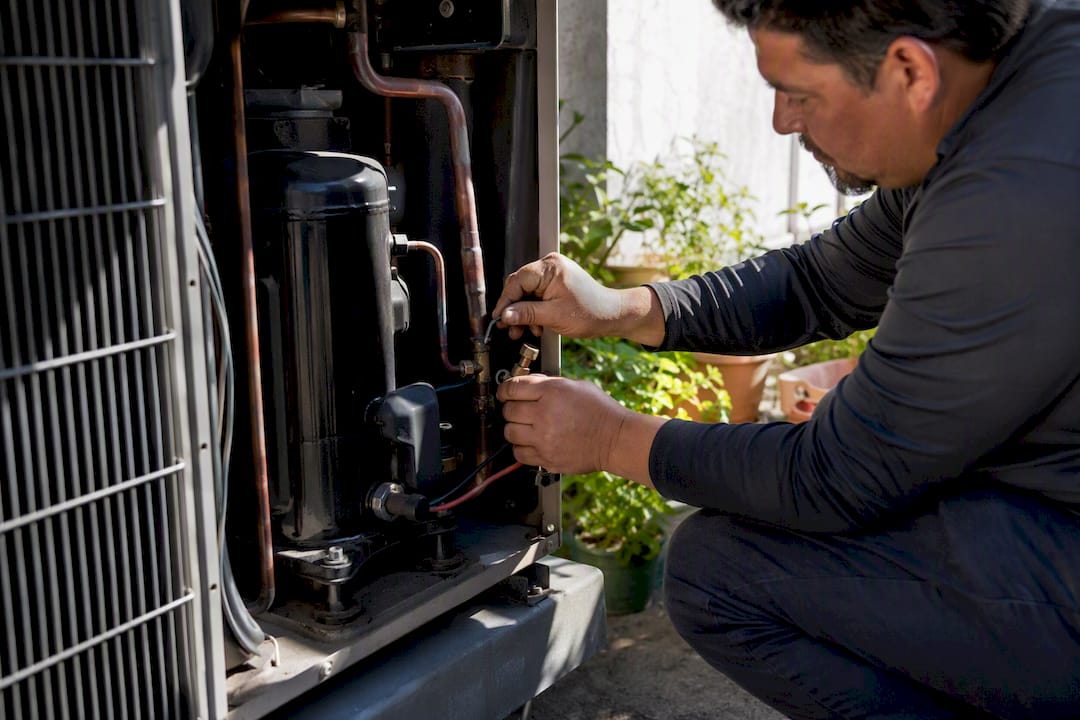
A scroll compressor is a positive-displacement device that uses two interleaved spiral scrolls, one fixed and one orbiting, to trap and squeeze refrigerant into a smaller and smaller space. As the orbiting scroll moves, it pulls refrigerant vapor in at the outer edge and pushes it toward the center, where pressure and temperature rise before the gas exits through the discharge port. This design is the standard for most residential heat pumps and central air conditioners built in the last two decades.
Here’s what that means for your home comfort system:
- Quiet operation. No pistons slamming back and forth, just smooth orbital motion.
- High efficiency. Scroll designs consistently post strong efficiency numbers, especially at part load.
- Common and proven. You’ll find scroll compressors inside the vast majority of modern heat pumps, mini-splits, and central AC condensers we service across Los Angeles.
Key Takeaways
A scroll compressor uses two interleaved spirals to compress refrigerant smoothly over roughly 800 degrees of rotation, which contributes to quieter and more efficient operation than piston or rotary alternatives in many HVAC applications.
| Point | Details |
|---|---|
| Core mechanism | Two spiral scrolls, one fixed and one orbiting, trap and compress refrigerant from the outer edge inward. |
| Efficiency advantage | Fewer moving parts and a long compression cycle give scrolls strong part-load performance. |
| Main weakness | Hermetic construction means most residential scroll failures require full compressor replacement. |
| Oil film is critical | Low charge or degraded oil compromises the seal between scroll flanks and accelerates wear. |
| Dominant HVAC choice | Scrolls are the standard in most modern residential heat pumps and central AC systems. |
How Does a Scroll Compressor Work?
Picture two identical spiral shapes, like two slices of a snail shell nested together. One stays fixed. The other orbits around it (it does not spin like a wheel, it moves in small circles) and that orbiting motion is what does the work.
- Refrigerant vapor enters at the outer edge of the scrolls, where a pocket forms between the fixed and orbiting spiral walls.
- As the orbiting scroll continues its circular path, that pocket seals off and starts moving inward.
- The pocket shrinks steadily as it travels toward the center, compressing the trapped gas along the way.
- By the time the gas reaches the center, it’s compressed to full working pressure and pushed out through the discharge port toward the condenser.
The exact curve of the scroll wall (engineers use involute or Archimedean spiral profiles) determines how tightly the pocket seals and how evenly the compression builds. Orbit size and scroll geometry both affect how much refrigerant moves per revolution, which is part of why compressor models vary in tonnage even when they look similar from the outside.
One detail sets scrolls apart from other compressor types mechanically: the compression event unfolds over roughly 800 degrees of crankshaft rotation, more than two full turns. Reciprocating compressors compress in one short stroke. Spreading the work over that many degrees smooths out the load on the motor and dramatically cuts vibration and noise, which is why a scroll-equipped condenser tends to hum instead of clatter.
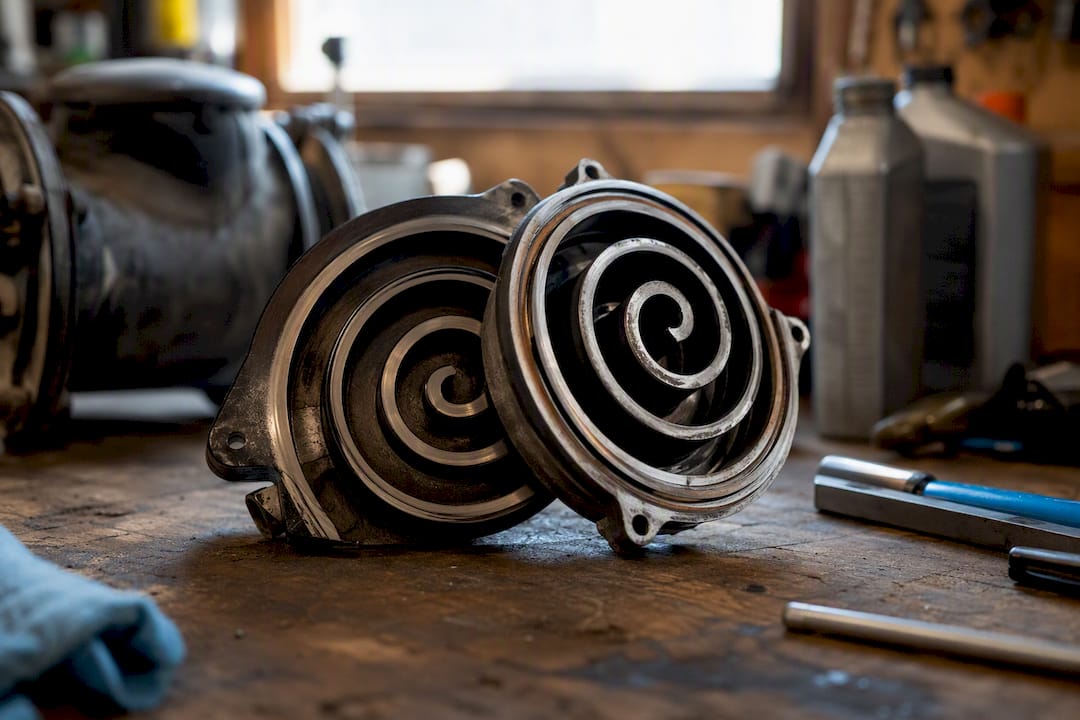
Pro Tip: Scroll flanks rely on a thin film of oil to seal against each other. If refrigerant charge is off or oil has broken down, that seal weakens fast, and the compressor loses efficiency long before it fails outright. It’s one of the first things we check on a service call.
What Are the Main Parts of a Scroll Compressor?
Every scroll compressor is built around a small set of components, and knowing their names helps when you’re talking to a technician about a diagnosis.
- Fixed scroll: the stationary spiral that forms one wall of every compression pocket; its manufacturing tolerance has to be precise or the seal fails.
- Orbiting scroll: the moving spiral, driven by an offset crank so it circles without rotating on its own axis.
- Motor and crankshaft: the electric motor that drives the orbiting motion, paired with a crank mechanism that converts rotation into that circular orbit.
- Bearings and compliance mechanisms: radial and axial components that keep the orbiting scroll properly aligned under pressure, letting it flex slightly to maintain contact without binding.
- Tip seals: small seals that ride along the scroll tips and help hold each compression pocket airtight.
- Inlet and discharge ports: the suction opening at the outer edge and the discharge outlet at the center, sometimes paired with an integrated check valve to prevent backflow when the system cycles off.
For a broader look at how these parts connect to the rest of your condenser, our guide to essential AC unit components covers the surrounding hardware, coils, and refrigerant lines that work alongside the compressor.
What Types of Scroll Compressors Are There?
Not every scroll compressor is built the same way, and the differences matter when you’re comparing quotes or planning a replacement.
- Oil-lubricated scrolls are the standard in most residential and light commercial HVAC systems, using oil for sealing and cooling.
- Oil-free scrolls are chosen in applications where contamination from oil carryover would ruin the process, such as certain lab or medical air setups, though this is less common in home comfort systems.
- Fixed-speed (single-speed) scrolls run at one capacity and cycle on and off to meet demand.
- Variable-capacity or inverter-driven scrolls ramp output up and down to match the load in real time, which is standard in most modern heat pump systems we install today.
- Tandem and digital/modular configurations pair multiple scroll compressors on one system, common in larger homes and light commercial VRF setups that need staged or blended capacity.
Advantages and Disadvantages of Scroll Compressors
Scroll compressors earn their popularity, but no compressor is perfect for every situation. Here’s the honest breakdown.
| Factor | Scroll Compressor Reality |
|---|---|
| Efficiency (COP) | Strong, especially at part load; fewer moving parts reduce friction losses |
| Noise and vibration | Low, thanks to smooth orbital motion instead of piston strokes |
| Reliability | High under normal operating conditions; simple design means fewer failure points |
| Field repairability | Limited. Most residential units are fully hermetic and sealed, so internal failure usually means full replacement |
| Sensitivity | Vulnerable to low oil film or incorrect refrigerant charge, which accelerates wear |
| Lifecycle cost | Often lower over the system’s life due to efficiency gains, despite a higher upfront replacement cost |
The maintenance checklist here is short but non-negotiable: verify refrigerant charge, keep airflow and filters clean, and watch for early signs of oil loss like unusual noise or a drop in cooling capacity.
Pro Tip: If your system’s compressor fails, ask your technician whether the warranty covers labor as well as the part. Compressor warranties often cover the unit itself but not the hours it takes to install it. Our compressor warranty guide breaks down what’s typically included.
Where Are Scroll Compressors Used?
Scroll compressors show up far beyond the AC unit sitting outside your house.
- Residential central air and heat pumps: the dominant use case, and the one most homeowners will encounter directly.
- Light commercial HVAC and refrigeration: cold storage rooms, walk-in coolers, and small commercial rooftop units.
- Automotive and vacuum applications: select vehicle AC systems and vacuum pump designs, where compact size and reliability matter.
- Noise-sensitive installations: bedrooms, home offices, and multi-family buildings where a quiet condenser genuinely changes the living experience.
Modern heat pumps lean hard on scroll technology because manufacturers now build in variable-capacity control and enhanced vapor injection, which extends efficient heating performance into colder outdoor temperatures than older heat pump designs could manage.
Pro Tip: If you’re considering a heat pump upgrade in Los Angeles, ask specifically whether the compressor is variable-capacity. That single spec often determines how comfortable the system feels during a cold snap versus a mild afternoon.
Scroll vs. Rotary vs. Piston Compressors: Which Is Better?
The honest answer depends on what you’re optimizing for, but the pattern is consistent across most HVAC applications.
| Attribute | Scroll | Rotary | Reciprocating (Piston) |
|---|---|---|---|
| Efficiency / COP | High, strong at part load | Moderate to high | Lower, especially at part load |
| Noise / vibration | Low | Moderate | Higher, due to piston strokes |
| Moving parts / reliability | Fewer parts, high reliability | Moderate complexity | More parts, more wear points |
| Maintenance complexity | Low, but hermetic limits field repair | Low to moderate | Higher, more serviceable in some designs |
| Initial and lifecycle cost | Higher upfront, often lower lifecycle cost | Moderate | Lower upfront, higher lifecycle cost |
| Best size range | Residential to light commercial | Small commercial, some refrigeration | Small residential, older systems |
| Part-load performance | Strong, especially with inverter control | Moderate | Weak, prone to short cycling |
Scrolls generally beat pistons on noise and part-load efficiency because the compression cycle eliminates the hammering motion that reciprocating designs produce, but that same sealed construction means less can be repaired in the field. For homes and light commercial spaces where quiet, efficient, low-maintenance operation matters, the thermodynamics behind refrigerant compression explain why the industry has largely shifted toward scroll designs over the past two decades.
How Do You Choose the Right Scroll Compressor?
Specifying a scroll compressor, whether you’re replacing a failed unit or planning a new heat pump install, comes down to matching the compressor to your system’s real-world demands.
- Confirm the required capacity in tons or kW based on a proper load calculation, not just a swap-in match to the old unit.
- Verify refrigerant compatibility, especially with the industry’s ongoing shift toward newer low-GWP refrigerants.
- Ask for the rated COP or efficiency rating at both full and part load.
- Check inverter or VFD compatibility if you want variable-capacity operation.
- Confirm whether the compressor is oil-lubricated or oil-free and what oil type it requires.
- Ask about warranty terms, expected service life, and serviceability.
A few extra questions worth asking your installer: how does this compressor perform on a mild spring day versus a July heat wave, and what’s the real-world service life on this model in a coastal climate? Our step-by-step HVAC inspection checklist is a useful reference if you want to evaluate an existing system before deciding whether repair or replacement makes more sense.
Why HVAC Pros Reach for Scroll Compressors First
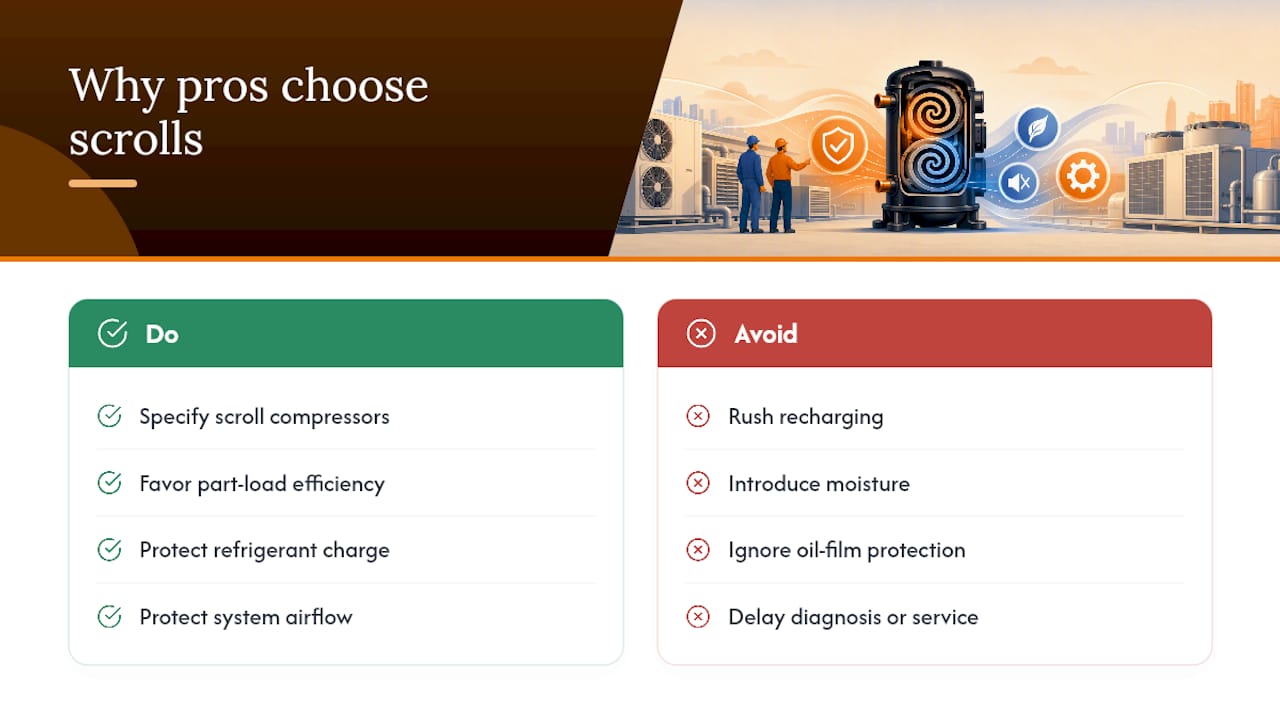
We specify scroll compressors on the vast majority of the heat pump and mini-split installs we run across Los Angeles, and it’s rarely a close call. Quiet operation matters in tightly packed neighborhoods from West Hollywood to Beverly Hills, and part-load efficiency keeps utility bills predictable through mild months and heat waves alike.
The field priority is always the same: protect the refrigerant charge and airflow, because those two things determine whether that internal oil film stays intact.
Pro Tip: During evacuation and recharging, pull a proper vacuum and hold it. A rushed recharge is one of the most common ways a technician introduces moisture that later damages the scroll seal.
If your current system needs a diagnosis or you’re weighing repair against replacement, LC Heating and Air Conditioning offers same-day service and flat-rate pricing across Greater Los Angeles, so you know the cost before any work begins. Our team also handles heat pump and mini-split installation, including Daikin systems built around modern variable-capacity scroll technology, and we can walk you through available HVAC rebates if you’re considering an upgrade.
Sources
FAQ
What’s the difference between a scroll compressor and a regular compressor?
A scroll compressor uses two interleaved spirals to compress refrigerant continuously, while a “regular” reciprocating compressor uses pistons that compress gas in short, repeated strokes. The scroll design produces less noise and vibration and generally runs more efficiently.
What are the disadvantages of a scroll compressor?
The main drawback is limited field repairability. Because most residential scroll compressors are fully hermetic and welded shut, an internal failure typically means replacing the whole unit rather than fixing individual parts.
Which is better, a scroll or a rotary compressor?
Scroll compressors generally offer better efficiency and lower noise than rotary compressors, particularly at part load, while rotary units can be simpler for certain small-capacity or specialty applications. For most residential and light commercial HVAC systems, scroll is the stronger choice.
Which is better, a scroll or a piston compressor?
Scroll compressors typically outperform piston (reciprocating) compressors on noise, vibration, and part-load efficiency because their compression cycle eliminates the hammering motion pistons produce. Piston compressors can still make sense in some older or lower-cost applications where field serviceability matters more than efficiency.
Recommended
Leo, Owner & Lead Technician at LC Heating & Air
Leo leads LC Heating & Air as an owner-operator and holds California CSLB C-20 HVAC license #1073586. His guides focus on practical diagnostics, safe repair decisions, and clear advice for Los Angeles homeowners.