- What is HVAC UV light and how does it work?
- What types of HVAC UV lights are there?
- How does UV-C light kill microorganisms?
- What are the benefits and limitations of HVAC UV lights?
- How should HVAC UV lights be installed and maintained safely?
- Key Takeaways
- Why I think most homeowners misunderstand UV lights
- Ready to add UV protection to your HVAC system?
- FAQ
- Recommended
TL;DR:
- HVAC UV lights emit ultraviolet-C radiation to prevent mold and bacteria growth on coils and in air. They work best when installed properly near the evaporator coil and paired with good filtration, but cannot replace cleaning or filtration systems. Regular maintenance and professional installation ensure safety and maximize their effectiveness in improving indoor air quality.
An HVAC UV light is a germicidal device installed inside your heating and cooling system that emits ultraviolet-C radiation to neutralize mold, bacteria, and viruses on coils and in moving air. The industry term for this technology is UVGI, which stands for ultraviolet germicidal irradiation. Recognized by the U.S. EPA and ASHRAE as a beneficial adjunct to filtration and ventilation, UVGI works by disrupting the DNA of microorganisms so they cannot reproduce. For homeowners dealing with musty smells, allergy flare-ups, or recurring mold on HVAC coils, understanding what HVAC UV light does, and what it cannot do, is the first step toward making a smart decision for your home.
What is HVAC UV light and how does it work?
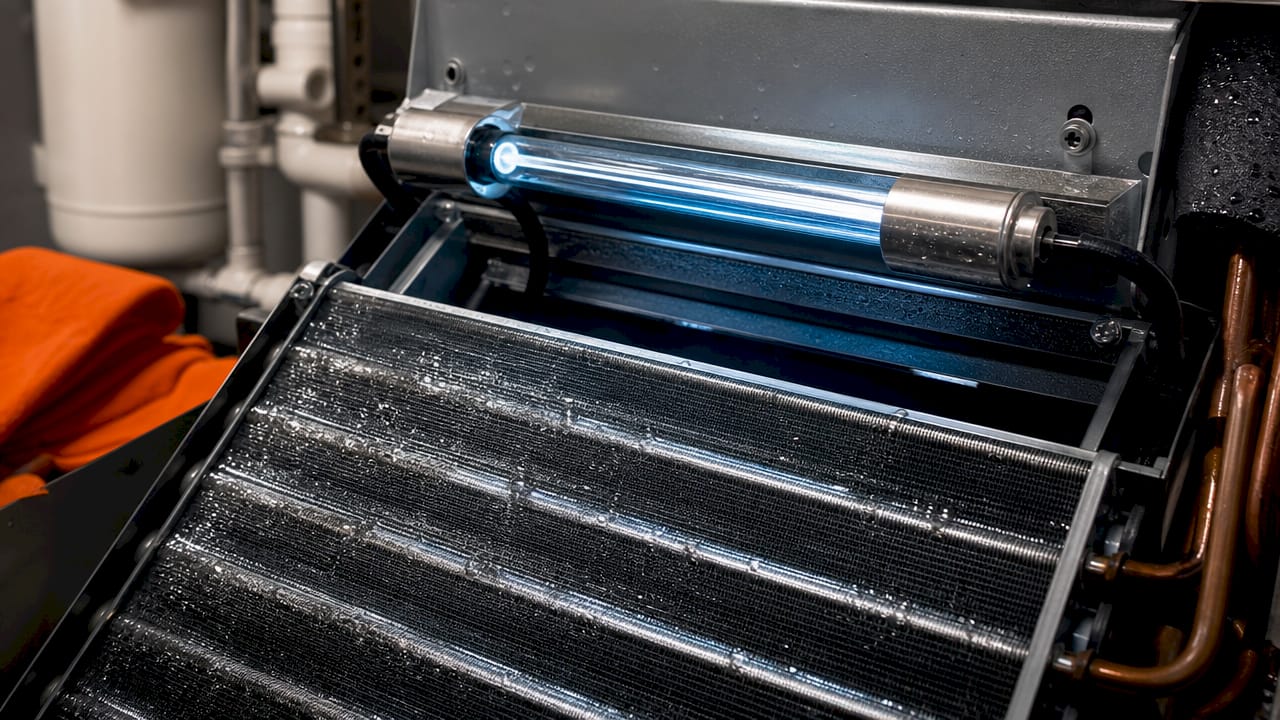
HVAC UV light refers to germicidal ultraviolet lamps mounted inside your HVAC system, typically near the evaporator coil or inside return air ducts. These lamps emit UV-C radiation at a wavelength of approximately 253.7 nm, which is the range proven most effective at disrupting microbial DNA. When microorganisms absorb this radiation, they lose the ability to reproduce, which effectively neutralizes them.
The U.S. EPA confirms that UVGI kills mold and bacteria on moist HVAC surfaces but is not a standalone air cleaning solution. That distinction matters. UV light does not filter particles, capture dust, or replace your air filter. It works best as one layer in a broader indoor air quality strategy that also includes proper filtration and ventilation.
The evaporator coil is the most common installation point because it stays damp during normal operation. That moisture creates ideal conditions for mold and biofilm growth. A UV lamp mounted near the coil runs continuously, preventing new microbial colonies from forming on that surface. Think of it as a small but mighty guard stationed at the most vulnerable spot in your system.
What types of HVAC UV lights are there?
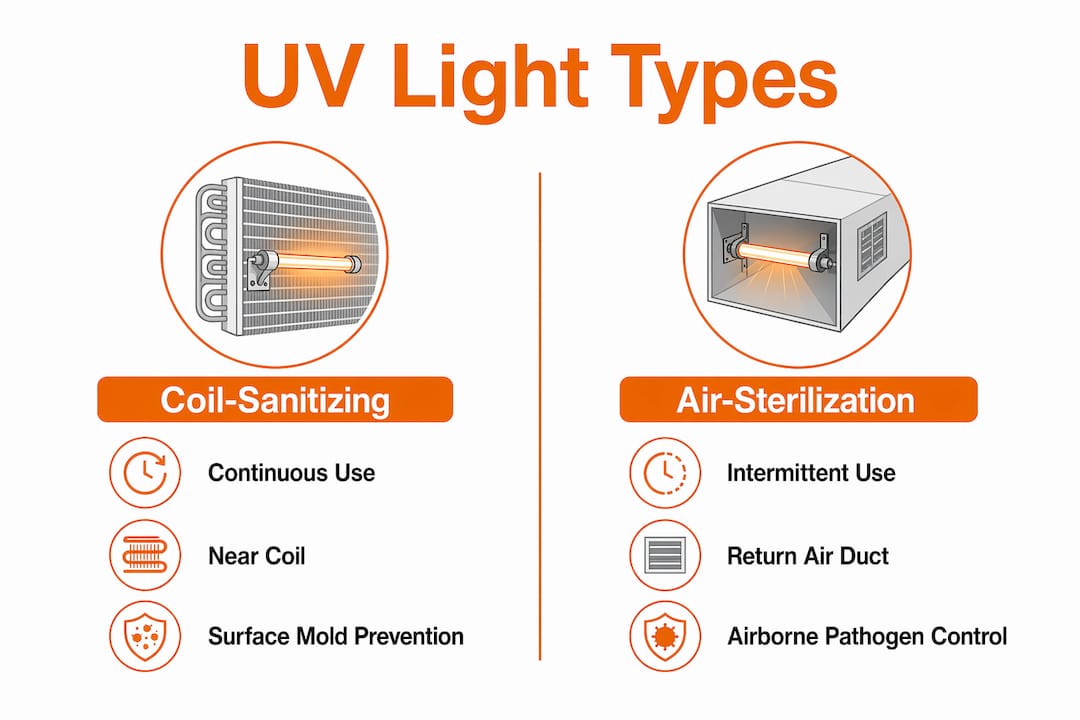
Two main types of HVAC UV lights exist: coil-sanitizing units and air-sterilization units. Each serves a different purpose, and choosing the wrong type for your situation leads to disappointing results.
Coil-sanitizing UV lights
Coil-sanitizing UV lights mount directly near the evaporator coil and run continuously, 24 hours a day. Their primary job is to prevent mold, bacteria, and biofilm from accumulating on the coil surface. This type has the strongest body of residential evidence behind it. Homeowners who notice musty odors coming from their vents, especially when the system first turns on, are usually dealing with coil contamination. A coil UV light addresses that problem at the source.
Air-sterilization UV lights
Air-sterilization UV lights install inside the return air duct and cycle on and off with the blower motor. The goal is to treat air as it moves through the system. The marketing pitch sounds appealing, especially for allergy sufferers, but fast airflow limits UV exposure time, which reduces how many airborne pathogens actually receive a lethal UV dose. Laboratory results rarely replicate in typical residential systems.
Side-by-side comparison
| Feature | Coil-sanitizing UV | Air-sterilization UV |
|---|---|---|
| Installation location | Near evaporator coil | Inside return air duct |
| Operation cycle | Continuous | Cycles with blower |
| Primary target | Surface mold and biofilm | Airborne pathogens |
| Residential evidence | Strong | Variable |
| Best use case | Musty odors, coil mold | Supplemental pathogen reduction |
| Typical installed cost | $300–$900 | $500–$1,500 |
Pro Tip: If you are unsure which type fits your home, start with a coil-sanitizing unit. The evidence for surface mold prevention is more consistent, and the cost is generally lower.
How does UV-C light kill microorganisms?
UV-C radiation at 253.7 nm penetrates the cell walls of bacteria, mold spores, and viruses and damages their DNA or RNA. Once that genetic material is disrupted, the organism cannot replicate. It does not necessarily destroy the cell immediately, but it renders the microorganism harmless. This is the core mechanism behind all UVGI technology.
Effectiveness depends on three factors working together:
- Wavelength accuracy. The lamp must emit true UV-C at 253.7 nm. Verify the wavelength before purchasing any unit, because many consumer-grade products lack proper wavelength control and deliver little germicidal effect.
- UV intensity. A lamp with insufficient output will not deliver enough radiation to neutralize microorganisms, even at the correct wavelength. Intensity drops with distance, so placement relative to the coil or airstream matters.
- Exposure time. Microorganisms need adequate contact with UV-C radiation to be neutralized. On a stationary coil surface, exposure time is essentially unlimited. In moving air, exposure time is a fraction of a second, which is why air-sterilization units face real-world limitations.
UV-C light is most reliable on surfaces where microorganisms sit still. It is less reliable against airborne pathogens moving at typical residential airflow speeds. The U.S. Department of Energy frames UV-C as one layer in an indoor air quality strategy, not a replacement for filtration or ventilation. That framing is accurate and worth keeping in mind.
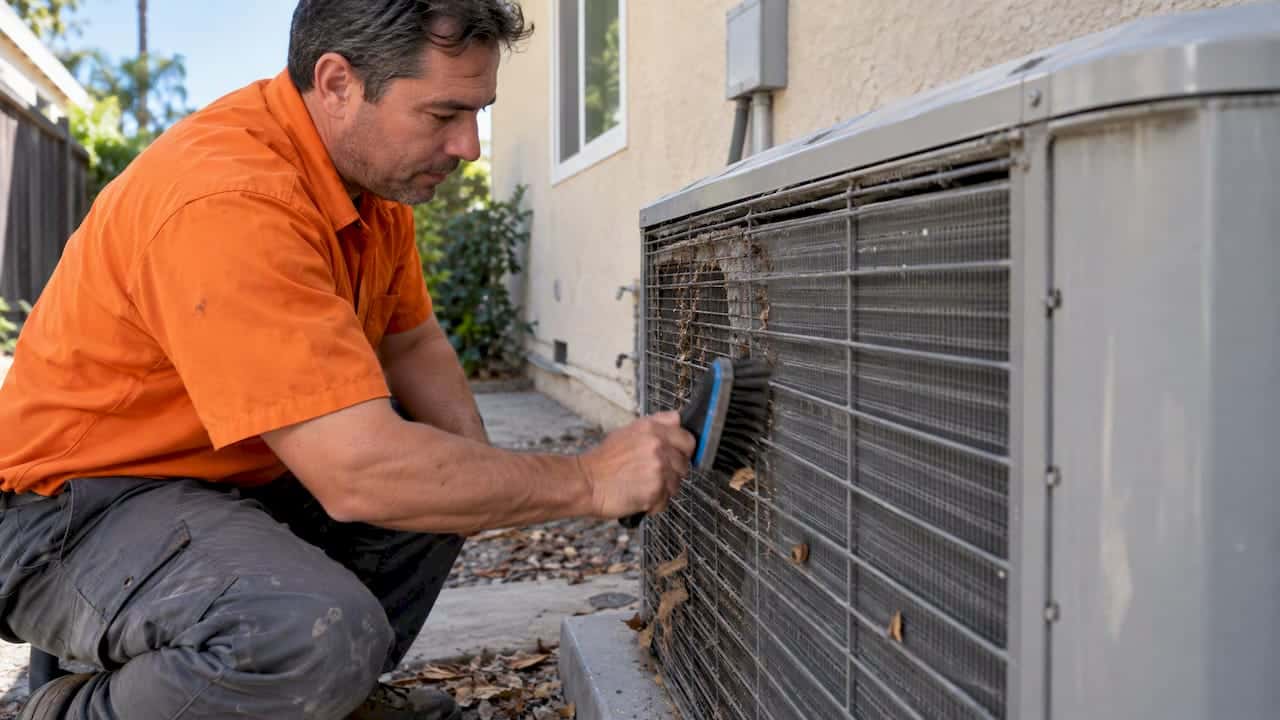
UV-C also does not remove existing heavy mold from coils. UV light stops new growth but cannot dissolve established biofilm or debris already coating the coil surface. If your coils have visible mold, they need professional cleaning before a UV lamp will do any meaningful work.
Pro Tip: Ask your HVAC technician to confirm the lamp’s rated wavelength in writing before installation. A lamp marketed as “UV” but operating outside the 253.7 nm range provides little to no germicidal benefit.
What are the benefits and limitations of HVAC UV lights?
The benefits of HVAC UV lights are real, but they are specific. Understanding exactly what you are getting prevents disappointment and helps you build a complete indoor air quality plan.
Real benefits homeowners experience
- Mold prevention on coils. Continuous UV exposure keeps evaporator coils cleaner between maintenance visits, reducing the biofilm that causes musty odors and degrades system performance.
- Improved HVAC efficiency. Clean coils transfer heat more effectively. A coil free of biofilm runs more efficiently, which can reduce energy consumption over time.
- Reduced musty odors. The most common homeowner complaint UV lights address is that stale, damp smell when the system kicks on. Coil UV lights tackle this directly.
- Lower maintenance burden. Coils with UV protection accumulate less biological growth, which can extend the time between professional coil cleanings.
- Supplemental pathogen reduction. Air-sterilization units add a layer of protection against airborne bacteria and viruses, even if real-world efficacy is lower than laboratory claims suggest.
Limitations you need to know
UV-C light is a preventive tool, not a cure. It stops new microbial growth on treated surfaces but does not filter particles, remove allergens, or clean existing contamination. Pairing it with a high-MERV filter and proper ventilation is the only way to build a complete indoor air quality system.
The EPA is clear that UVGI works alongside filtration, not instead of it. A UV lamp with a low-grade filter still allows dust, pet dander, and pollen to circulate freely. Upgrading to a MERV 11 or MERV 13 filter alongside your UV installation delivers far better results than either measure alone.
Residential UV systems cost between $300 and $1,500 installed, with annual bulb replacement running $50–$150. That is a reasonable investment for the right home, but it is not a magic fix for every air quality problem.
How should HVAC UV lights be installed and maintained safely?
UV-C radiation is dangerous to human eyes and skin. Direct exposure, even briefly, can cause burns and eye damage. That single fact makes professional installation the only responsible choice for most homeowners.
Here is what safe installation and maintenance looks like:
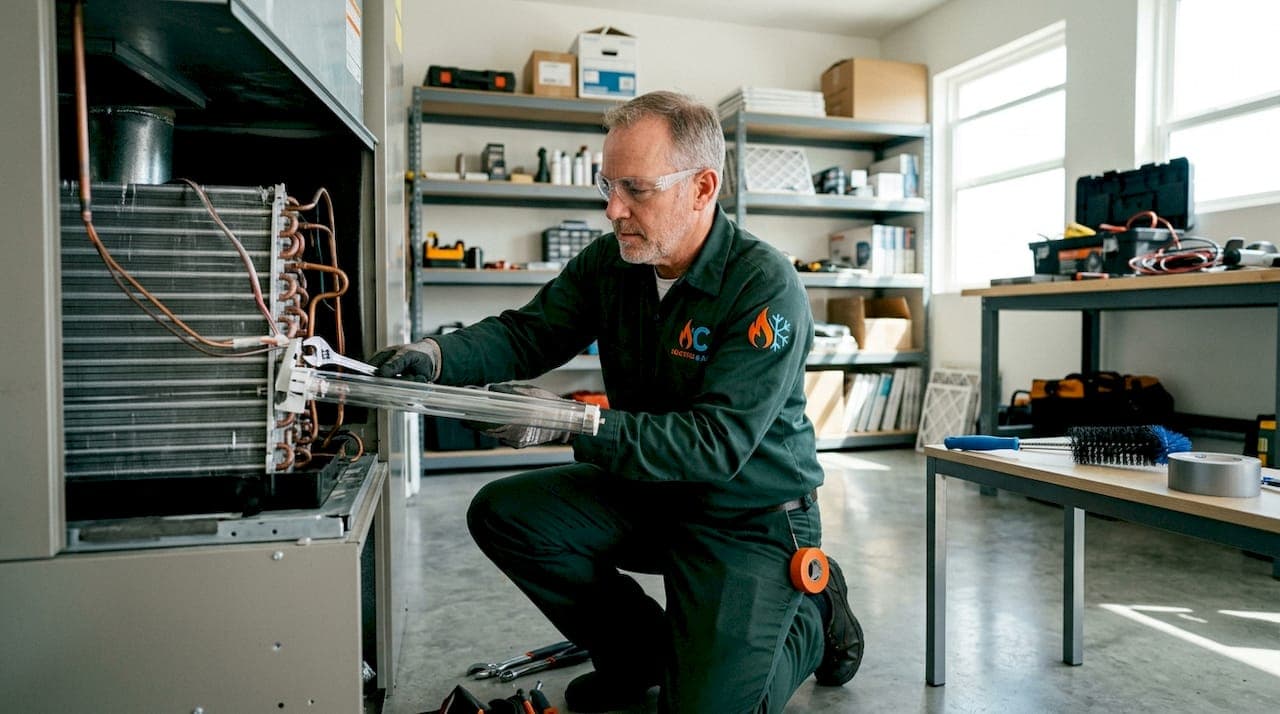
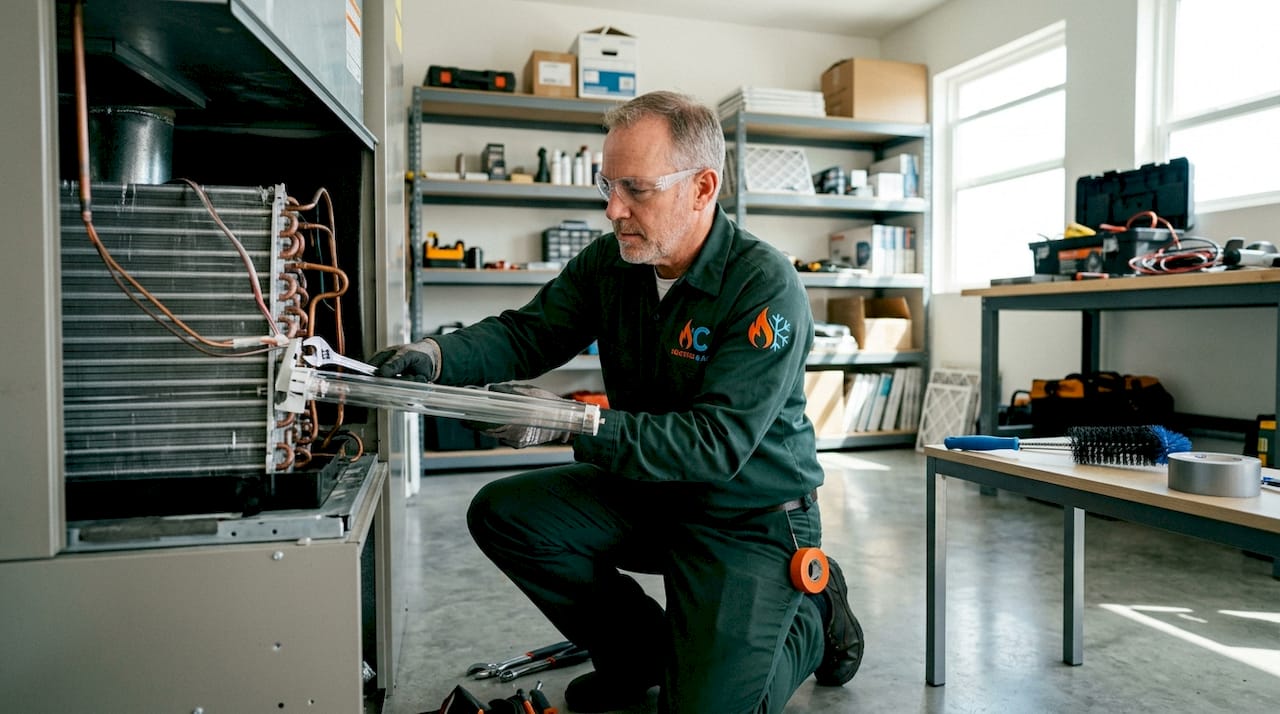
- Hire a licensed HVAC technician. Cutting into ductwork, working near electrical components, and positioning the lamp correctly all require professional skills. Licensed UV light installation protects you from UV exposure risks and ensures the lamp is placed where it will actually work.
- Clean the coils first. If your coils already have mold or biofilm, the technician must clean them before installing the UV lamp. Installing UV on contaminated coils only prevents future growth. It does not remove what is already there.
- Confirm correct placement. The lamp must be positioned close enough to the coil or airstream to deliver an effective UV dose. Placement that is too far away reduces intensity to ineffective levels.
- Power off the system before servicing. Any time you or a technician access the UV lamp for inspection or bulb replacement, the HVAC unit must be completely powered off. Never look directly at an operating UV-C lamp.
- Replace bulbs annually. UV-C bulbs have a lifespan of roughly 9,000 hours, which works out to about one year of continuous operation. Bulbs fail invisibly, meaning the lamp may appear to glow while delivering zero germicidal output. Schedule annual replacement as part of your regular HVAC tune-up.
- Check the ballast during each service visit. Ballast failure is as common as bulb failure and equally invisible. A technician can test output with a UV meter to confirm the system is actually working.
Plug-in external UV units sold online are a separate category. They exist, they are easy to install, and they have limited effectiveness. Their placement outside the airstream means they rarely deliver meaningful germicidal results inside the duct system.
Pro Tip: Bundle your UV bulb replacement with your annual HVAC maintenance visit. You save a service call fee, and the technician can test UV output at the same time.
Key Takeaways
HVAC UV lights are effective preventive tools for surface mold and coil biofilm, but they require correct installation, annual maintenance, and pairing with proper filtration to deliver real indoor air quality benefits.
| Point | Details |
|---|---|
| UV-C targets surfaces best | Coil-sanitizing UV lights have the strongest evidence for preventing mold and biofilm on evaporator coils. |
| Air-sterilization has limits | Fast airflow reduces UV exposure time, limiting real-world effectiveness against airborne pathogens. |
| Existing mold needs cleaning first | UV light prevents new growth but cannot remove established mold or biofilm already on coils. |
| Bulbs fail without warning | UV-C bulbs and ballasts fail invisibly; annual replacement and output testing are non-negotiable. |
| Pair with filtration | UV light alone does not filter particles; a MERV 11 or MERV 13 filter completes the air quality strategy. |
Why I think most homeowners misunderstand UV lights
After more than twenty years working on HVAC systems across Los Angeles, I have seen UV lights installed well and installed badly. The gap between those two outcomes is significant.
The most common mistake I see is homeowners buying a UV unit online, dropping it near the coil without professional placement, and assuming the job is done. The lamp glows blue, so it must be working. That assumption is wrong more often than people realize. A lamp positioned even a few inches too far from the coil surface delivers a fraction of the intended UV dose. And if the bulb has been running for 14 months without replacement, it may be delivering nothing at all.
The second mistake is expecting UV light to solve an air quality problem that filtration should be handling. UV does not capture dust. It does not trap pet dander. It does not remove pollen. Homeowners who install UV and then wonder why their allergies are unchanged usually have a filtration gap, not a UV gap.
Where I have seen UV lights genuinely change a home’s comfort level is in houses with recurring coil mold problems. Los Angeles summers are long and the AC runs hard. Coils stay damp for months at a time. In those conditions, a properly installed coil UV light is a small but mighty investment. It keeps the coil cleaner, reduces musty odors, and cuts down on how often the coil needs a deep clean.
My honest recommendation: treat UV light as one tool in a layered system. Pair it with a quality filter, schedule annual maintenance, and have a licensed technician handle the installation. Done right, it earns its place. Done wrong, it is an expensive blue glow that does nothing.
— Leo
Ready to add UV protection to your HVAC system?
LC Heating and Air Conditioning installs and maintains HVAC UV light systems across Los Angeles with licensed technicians who know exactly where to place each lamp for maximum effect.
Whether you are dealing with musty coil odors, recurring mold, or simply want to improve your home’s air quality, LC Heating and Air Conditioning offers same-day HVAC service with flat-rate pricing and no surprise fees. You can also browse UV light systems and pricing to understand your options before committing. Call or book online to get a straightforward assessment of whether UV light is the right fit for your home.
FAQ
What is an HVAC UV light used for?
An HVAC UV light uses UV-C radiation to neutralize mold, bacteria, and viruses on evaporator coils and in moving air, improving indoor air quality and preventing coil biofilm buildup.
Does HVAC UV light kill bacteria and viruses?
UV-C light at 253.7 nm disrupts the DNA of bacteria and viruses, preventing reproduction. Surface effectiveness is well established; airborne effectiveness depends on exposure time and UV intensity.
Are UV lights effective in residential HVAC systems?
Coil-sanitizing UV lights have strong residential evidence for mold prevention. Air-sterilization units have variable real-world results because fast airflow limits the UV dose airborne pathogens receive.
How often do HVAC UV light bulbs need replacing?
UV-C bulbs last approximately 9,000 hours, which equals roughly one year of continuous use. Annual replacement is recommended because bulbs fail without visible signs.
Is HVAC UV light installation a DIY project?
Professional installation is strongly advised. UV-C radiation can damage eyes and skin, and correct lamp placement requires technical knowledge that protects both your safety and the system’s effectiveness.
Recommended
Leo, Owner & Lead Technician at LC Heating & Air
Leo leads LC Heating & Air as an owner-operator and holds California CSLB C-20 HVAC license #1073586. His guides focus on practical diagnostics, safe repair decisions, and clear advice for Los Angeles homeowners.