
TL;DR:
- The HVAC EER rating measures an air conditioner’s peak efficiency under specific high-temperature conditions, reflecting performance during the hottest days.
- Starting in 2023, the DOE’s EER2 standard uses stricter testing that accounts for real-world duct resistance, often resulting in lower ratings that better reflect actual performance.
When you’re shopping for a new air conditioner or trying to decode a product spec sheet, the HVAC EER rating is one of the first numbers you’ll encounter. Most people gloss over it or confuse it with SEER, but the two measure very different things. Understanding what the HVAC EER rating actually tells you about a system, and what it doesn’t, can mean the difference between a smart purchase and an expensive mistake. This guide breaks it all down in plain terms, covering the pros, the cons, and how to use EER to your advantage.
Table of Contents
- Key takeaways
- What is the HVAC EER rating and how is it calculated
- EER vs SEER: understanding the differences
- Pros and cons of using EER to choose your HVAC system
- How to evaluate EER ratings when choosing a system
- My take on EER ratings after 20+ years in the field
- Ready to find the right system for your home?
- FAQ
Key takeaways
| Point | Details |
|---|---|
| EER measures peak efficiency | EER tells you how efficiently your AC runs at 95°F, not across a full season. |
| EER2 replaced EER in 2023 | DOE’s updated EER2 standard uses stricter testing conditions that reflect real-world performance more accurately. |
| EER and SEER serve different purposes | Use EER for hot climates and peak-load performance; use SEER for overall seasonal cost estimates. |
| High EER means long-term savings | Systems with higher EER ratings tend to run more reliably during heat waves and cost less to operate over time. |
| Installation quality matters as much as ratings | Even a high EER unit will underperform if it is not properly installed and commissioned. |
What is the HVAC EER rating and how is it calculated
EER stands for Energy Efficiency Ratio. It is a number that tells you how efficiently an air conditioner converts electricity into cooling at a specific, high-demand moment. Think of it like a fuel economy rating for your car, but measured only during highway driving at full speed. It shows peak performance, not everyday average behavior.
The EER calculation formula is straightforward: divide the cooling output in BTU per hour by the electrical power input in watts. A system that delivers 12,000 BTU/h while consuming 1,200 watts has an EER of 10. The higher the number, the more cooling you get for every watt you spend.
What makes EER meaningful is the test conditions behind it. The standard EER test is conducted at 95°F outdoor temperature, 80°F indoor temperature, and 50% relative humidity. That is not a random choice. Those conditions represent a genuinely hot day when your system is working its hardest. A unit with a high EER is proving it can perform when you need it most.
Here is a quick summary of what the EER rating tells you:
- What it measures: Cooling efficiency at a fixed, peak-load condition
- Formula: BTU/h output divided by watts of power input
- Test conditions: 95°F outdoor, 80°F indoor, 50% relative humidity
- What a higher number means: More cooling per watt, better efficiency at peak heat
- What it does not measure: Average efficiency across a full cooling season
The shift to EER2
Starting in 2023, the Department of Energy moved to a new standard called EER2. The key difference is in how the test is conducted. EER2 uses higher static pressure of 0.5 inches water column during testing, compared to 0.25 inches in the original method. This simulates real duct resistance in an actual home, so the numbers you see reflect what the system will actually do once installed.

Because of this stricter testing, EER2 ratings run 4 to 15% lower than old EER ratings for the same unit. If you see a lower number on a newer model compared to an older one, that does not always mean the newer system is less efficient. It may simply be rated under tougher conditions.
Pro Tip: When comparing older and newer AC models, always check whether the spec sheet lists EER or EER2. Comparing them directly without knowing which standard was used will give you a misleading picture of which unit is more efficient.
EER vs SEER: understanding the differences
The most common source of confusion in HVAC efficiency ratings is the difference between EER and SEER. Both measure cooling efficiency, but they ask completely different questions about how a system performs.
SEER stands for Seasonal Energy Efficiency Ratio. Where EER captures efficiency at one fixed, hot-day condition, SEER averages efficiency across a temperature range of 65°F to 104°F over a simulated cooling season. SEER gives you a picture of how much energy your system uses across a typical summer, with all its ups and downs in temperature. EER gives you a snapshot of how the system performs when it is really hot.
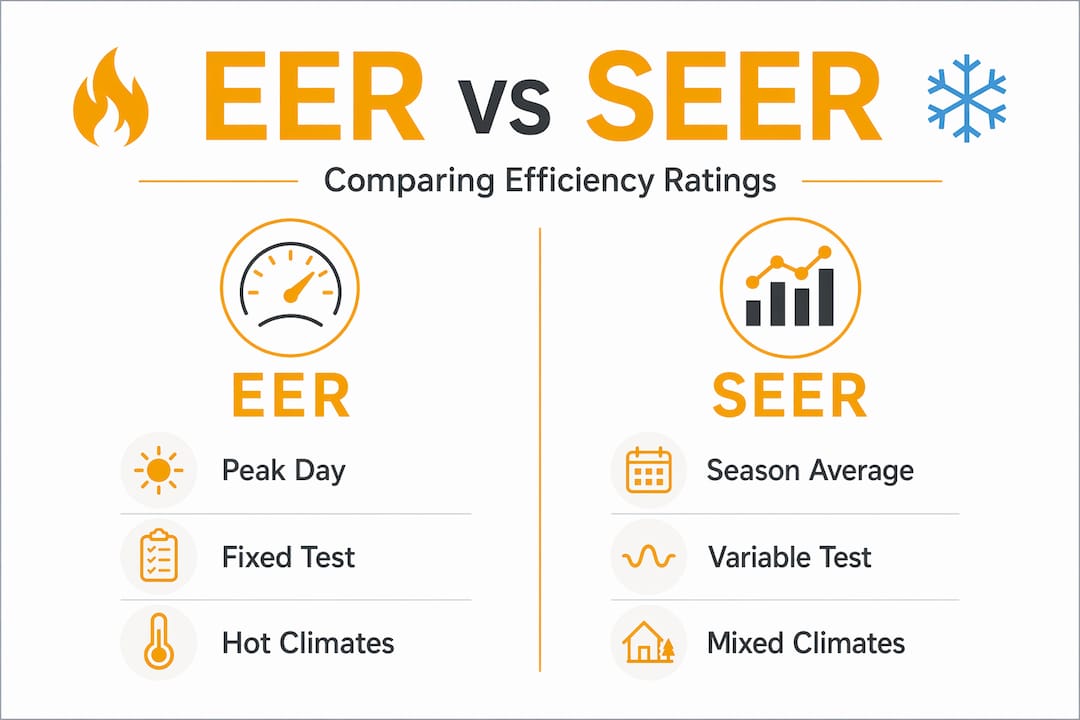
Neither metric is better than the other. They are complementary tools that answer different questions. HVAC experts treat EER and SEER as working together, not competing, and the smartest homeowners use both when making decisions.
Here is a side-by-side comparison to make the distinctions clear:
| Metric | What it measures | Test conditions | Best used for |
|---|---|---|---|
| EER | Peak-load efficiency at one fixed condition | 95°F outdoor, 80°F indoor, 50% humidity | Hot climates, high-use periods |
| EER2 | Same as EER but with stricter duct pressure simulation | Same temps, 0.5 in. water column static pressure | Current DOE compliance and real-world accuracy |
| SEER | Seasonal average efficiency across a range of temperatures | 65°F to 104°F range averaged over a full season | Estimating annual energy costs in variable climates |
| SEER2 | Updated seasonal metric with same stricter pressure testing as EER2 | Same range as SEER, higher static pressure | Current DOE compliance for seasonal efficiency |
Which rating matters for your climate
The answer depends on where you live and how often you run your air conditioner at full blast.
- Hot, dry climates (like Los Angeles or Phoenix): EER matters enormously. Your system runs near peak capacity for months at a time. A high EER unit will perform more reliably and cost less to run during those long stretches of 95°F-plus days.
- Moderate or variable climates: SEER becomes more useful because your system rarely runs at full load. Seasonal average efficiency is a better predictor of your actual energy bill.
- Humid climates with extreme summer heat: Both metrics matter. Check EER for peak days and SEER for overall season costs.
SEER is more relevant for variable climate zones, while EER is the number that tells the real story in consistently hot regions. In Los Angeles, where summer heat can stretch for weeks without a break, EER is not a secondary consideration. It is the primary one.
Pro Tip: Do not let a high SEER number alone convince you to buy a system. In a genuinely hot climate, a unit with a mediocre EER but a flashy SEER rating may struggle during the hottest weeks of the year, which is exactly when you need it most.
Pros and cons of using EER to choose your HVAC system
Understanding EER is useful. Knowing when to rely on it and when to look further is even more useful. Here is an honest look at both sides.
The real benefits of a high EER rating
A high EER rating is not just a marketing number. It represents genuine engineering. Systems designed to perform well at 95°F are built with more capable compressors, better heat exchangers, and components that hold up under pressure.
- Better peak-day performance: When temperatures hit the upper 90s, a high EER unit keeps cooling effectively. Lower EER systems can struggle to maintain target temperatures, leaving you uncomfortable on the worst days of the year.
- Longer equipment life in hot climates: Units with higher EER ratings handle extreme temperatures better, which reduces premature wear during heat waves. A system that is not constantly straining at full load will last longer.
- Lower utility bills during peak periods: The efficiency you get on those 100°F days adds up. Over a summer of high-demand operation, a high EER system can deliver measurable savings on your electricity bill compared to a lower-rated unit drawing the same load.
- Eligibility for rebates and incentives: EER2 is required alongside SEER2 to qualify for Energy Star certification and the federal rebates tied to it. A high EER2 unit opens the door to financial incentives that help offset the upfront cost.
The honest drawbacks
EER has real limits, and being aware of them helps you make a more balanced decision.
- It does not reflect average seasonal cost: A great EER tells you about hot days, not the whole summer. If you want to predict your annual cooling bill, SEER is the metric you need.
- Higher upfront cost: Units engineered for high peak efficiency tend to cost more at the point of purchase. In a mild climate where that efficiency never gets tested, the payback period on that investment stretches out considerably.
- Less useful in moderate climates: If you live somewhere that rarely sees 95°F, a high EER rating may deliver minimal practical benefit. You would be paying for performance headroom you never use.
- Easy to misread: Because EER2 ratings look lower than older EER ratings for the same unit, it is easy to misinterpret a newer spec sheet as showing a less efficient system. Always confirm which standard the rating uses before comparing.
The takeaway here is that EER is a powerful tool in the right context. For homeowners in hot climates, it is arguably the most important single efficiency number on the spec sheet. For everyone else, it belongs as one factor in a broader evaluation.
How to evaluate EER ratings when choosing a system
Knowing what EER means is only useful if you know how to put it to work when you are actually standing in front of a product page or talking to a technician. Here is a practical sequence for using EER to make a smarter decision.
-
Find the EER2 rating on the product spec sheet. Look for the yellow EnergyGuide label on residential units or the product specifications tab online. Since 2023, newer central AC units and heat pumps will list EER2, not the original EER. Room air conditioners may still list EER.
-
Check whether the unit meets Energy Star thresholds. For split-system central ACs, Energy Star Version 6.2 requires an EER2 of at least 12.0. Units meeting this threshold qualify for rebates and federal tax credits, which can bring the actual cost of a high-efficiency system down significantly. Check available HVAC rebates in Los Angeles before you buy.
-
Match the metric to your climate. If you are in a hot climate and run your AC heavily from May through October, prioritize EER2 alongside SEER2. If your summers are mild and brief, weight SEER2 more heavily as your primary efficiency guide.
-
Compare units using the same rating standard. Never compare an EER number from a 2019 model with an EER2 number from a 2024 model directly. The newer unit’s number will look lower because it was tested under stricter conditions, even if it actually performs better.
-
Factor in installation quality. System performance degrades without professional installation and proper commissioning, regardless of what the efficiency rating says on paper. A high EER2 system installed with leaky ducts or incorrect refrigerant charge will not perform anywhere near its rated efficiency.
-
Talk to a certified HVAC technician. Product specs are a starting point. A technician who knows your home, your duct layout, and your local climate can give you a real-world prediction of how a given unit will actually perform. That conversation is worth more than any single number on a label.
You can also browse HVAC equipment and pricing to compare EER2 and SEER2 specs across Goodman, Daikin, and other brands side by side before committing to a system.
My take on EER ratings after 20+ years in the field
I have seen homeowners make two opposite mistakes with EER. The first group ignores it entirely and buys based on SEER alone. The second group fixates on it as if it is the only number that matters. Both approaches leave money and comfort on the table.
Here is what I have actually seen over two decades of HVAC work in Los Angeles: the clients who suffer most during summer heat waves are almost always the ones whose systems have borderline EER ratings. When outdoor temps hit 100°F for ten days straight, a system rated for peak efficiency holds steady. A lower-EER unit starts struggling by day three. You can feel the difference, and so can your electricity meter.
What I think gets overlooked is the reliability angle. High EER2-rated systems tend to experience less premature wear under extreme heat conditions. That means fewer repair calls, longer equipment life, and a more consistent comfort experience year over year. In a hot climate, a high EER is not just about saving a few dollars a month on electricity. It is about buying yourself a system that will not let you down in August.
The DOE transition to EER2 is genuinely good for consumers, even if it caused confusion for a year or two. The new testing method reflects real duct conditions in real homes, so the numbers mean something. If you are still comparing systems using old EER numbers from pre-2023 spec sheets, you are working with data that does not fully represent how the unit will perform in your house.
My honest advice: treat EER2 as your primary efficiency checkpoint in hot climates, pair it with SEER2 for a full seasonal picture, and never skip a professional assessment of your specific home’s layout and duct condition. A rating is only as good as the installation behind it.
— lc
Ready to find the right system for your home?
At LC Heating and Air Conditioning, we work with homeowners across Los Angeles every day who are trying to make sense of efficiency ratings, compare systems, and figure out whether a repair or replacement makes more financial sense.
We make that process straightforward. Our certified technicians will assess your current system, explain what the EER2 and SEER2 numbers actually mean for your specific home and climate zone, and give you honest recommendations without pressure. Whether you need a new HVAC system installation built around high-efficiency equipment, a same-day repair, or help claiming available rebates and tax credits, we handle it all with flat-rate pricing and no surprise fees. Visit LC Heating and Air Conditioning to schedule your consultation or request same-day service anywhere in the Los Angeles area.
FAQ
What is the HVAC EER rating in simple terms?
EER, or Energy Efficiency Ratio, measures how efficiently an air conditioner cools at peak conditions: 95°F outside, 80°F inside. You calculate it by dividing the system’s cooling output in BTU/h by its power input in watts.
What is the difference between EER and EER2?
EER2 is the updated DOE standard that tests units under higher static duct pressure (0.5 inches water column vs. 0.25), making the results reflect real installation conditions more accurately. EER2 ratings typically appear 4 to 15% lower than older EER ratings for the same unit.
Is a higher EER always better?
A higher EER means greater efficiency at peak heat conditions, which benefits homeowners in hot climates. However, in mild climates where extreme heat is rare, SEER is often a more relevant metric for predicting real-world energy costs.
What EER2 rating do I need for Energy Star certification?
For split-system central air conditioners, Energy Star Version 6.2 requires a minimum EER2 of 12.0. Meeting this threshold also makes your system eligible for federal rebates and tax incentives starting in 2023.
Does installation affect EER performance?
Yes, significantly. Even a system with an excellent EER2 rating will underperform if it is installed with leaky ducts, incorrect refrigerant charge, or poor airflow. Professional installation and proper commissioning are necessary to achieve the efficiency the rating promises.
Recommended
- HVAC Equipment & Pricing | Goodman, Daikin, ADP, Aspen | LC Heating & Air | LC Heating & Air
- HVAC Rebates & Tax Credits Los Angeles 2026 | LC Heating & Air | LC Heating & Air
- HVAC Troubleshooting & How-To Guides | LC Heating & Air | LC Heating & Air
- AEFE3A00S1HJ2 Air Handler | ADP | LC Heating & Air | LC Heating & Air
Leo, Owner & Lead Technician at LC Heating & Air
Leo leads LC Heating & Air as an owner-operator and holds California CSLB C-20 HVAC license #1073586. His guides focus on practical diagnostics, safe repair decisions, and clear advice for Los Angeles homeowners.