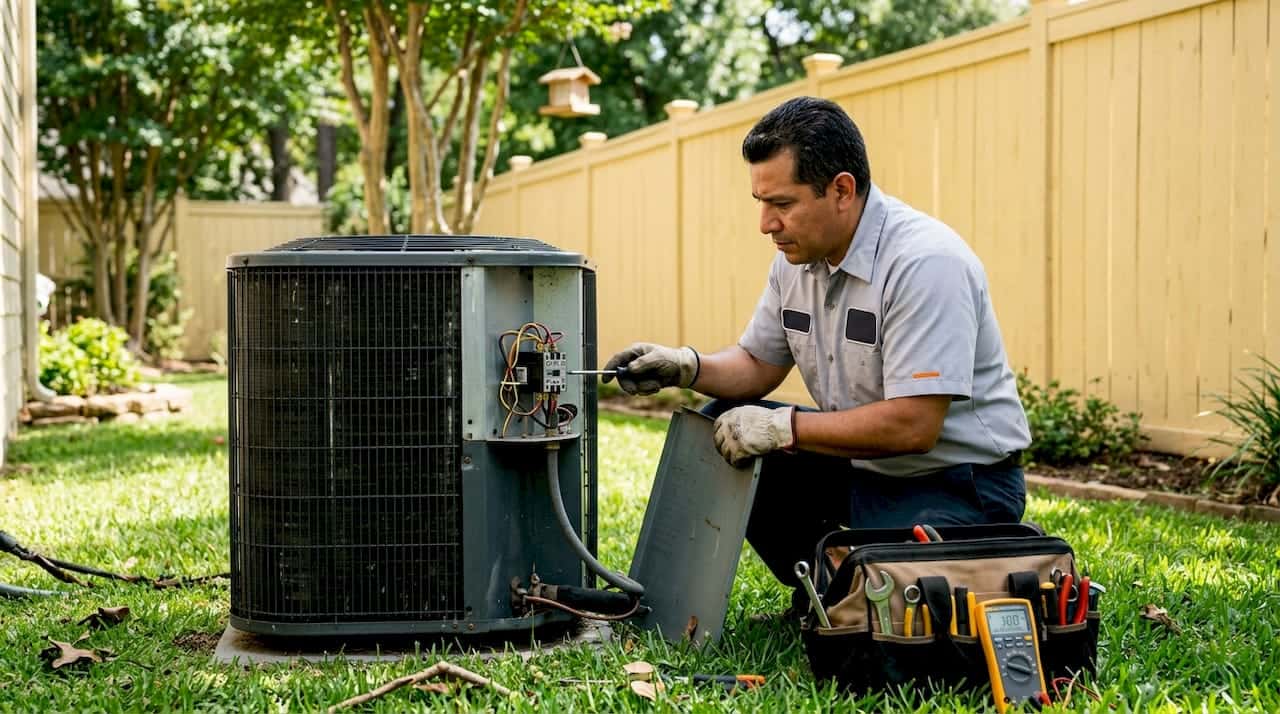
- What does a flat-rate AC repair estimate include?
- How to get an accurate flat-rate AC repair estimate
- Common pitfalls when comparing flat-rate AC repair quotes
- How do flat-rate, hourly, and time-and-materials billing compare?
- Where to find reliable flat-rate AC repair services
- Key takeaways
- Why I always tell homeowners to ask for the line items
- Get a transparent flat-rate AC repair estimate from LC Heating and Air Conditioning
- FAQ
- Recommended
Get a Flat-Rate AC Repair Estimate Without Surprises

TL;DR:
- A flat-rate AC repair estimate is a written, fixed price that includes diagnostics, labor, parts, and refrigerant handling before work begins, protecting homeowners from unexpected costs. It typically covers the diagnostic fee, detailed labor, replacement parts, and refrigerant services, while excluding permit fees and follow-up repairs. To ensure accuracy, homeowners should obtain a detailed, written quote, confirm scope and technician certification, and avoid estimates lacking clear line items or proper refrigerant handling compliance.
A flat-rate AC repair estimate is a fixed-price quote that covers diagnostics, labor, and parts, delivered to you in writing before any work begins. Unlike hourly billing, where the final number is a mystery until the job is done, fixed-rate air conditioning repair locks in your cost upfront so you can make a clear, informed decision. AC repair costs commonly range from $150 to $600 for typical repairs, while major component replacements like compressors can exceed $2,000 to $3,000. That spread is exactly why knowing how to get a flat-rate AC repair estimate matters. When you understand what belongs in a complete quote, you protect yourself from vague pricing, surprise add-ons, and contractors who make up the total as they go.
What does a flat-rate AC repair estimate include?
A complete flat-rate quote bundles four core elements: the diagnostic fee, labor, parts, and any specialized services required for the specific repair. Each of these has a real cost, and a trustworthy contractor shows you all of them before touching your system.

Diagnostic and service call fees
Most HVAC companies charge a diagnostic fee of $75 to $250 to send a technician to your home, identify the problem, and produce a written quote. The good news is that reputable companies credit this fee toward the repair cost once you approve the work. You can read more about how this works in LC Heating and Air Conditioning’s guide on HVAC diagnostic fees. Always confirm the crediting policy before scheduling, because some companies keep the diagnostic fee separate regardless of whether you proceed.
Labor, parts, and refrigerant handling
Labor should appear as a clear line item in your quote, not buried inside a vague “service charge.” Labor itemization is critical for fair comparison and for understanding exactly what you are paying for. Parts pricing should list each component by name, not just a generic “materials” total. If your repair involves refrigerant, the quote must also account for EPA Section 608 certified handling procedures, including recovery, evacuation, and recharge. EPA 608 certification is required by federal law for any technician who opens a refrigerant circuit, and the cost of compliant handling belongs in your estimate.
What flat-rate pricing typically covers vs. excludes
The table below shows what most complete flat-rate quotes include and what is commonly left out, so you know what questions to ask.
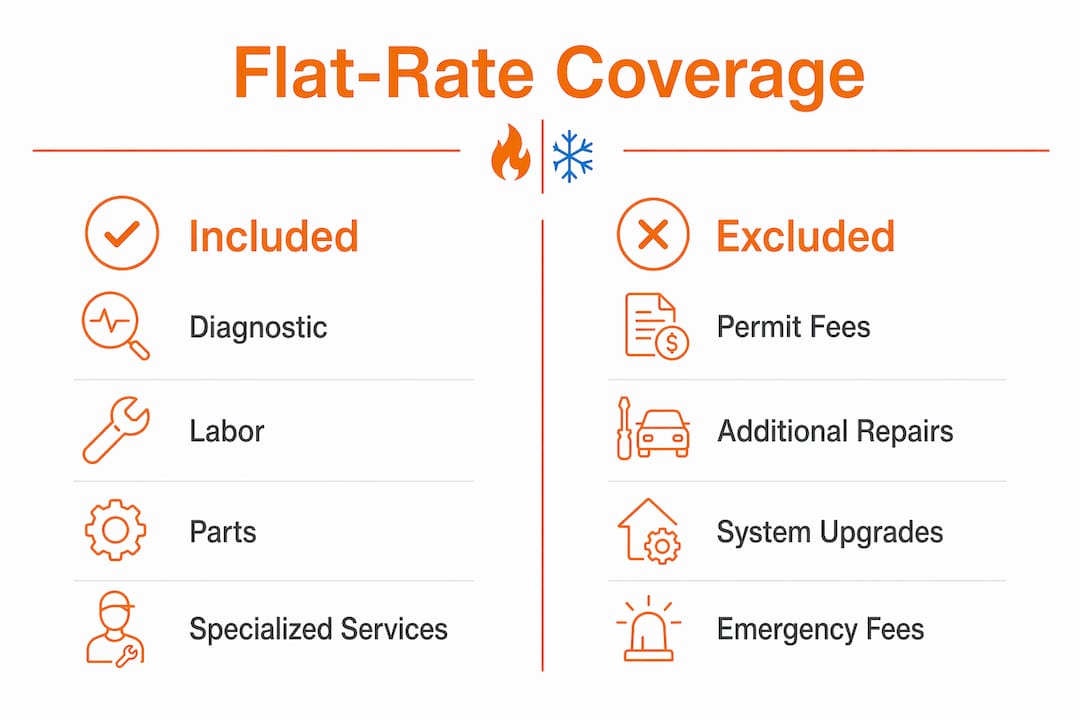
| Typically included | Typically excluded |
|---|---|
| Diagnostic visit and written assessment | Permit fees for major system changes |
| Labor for the quoted repair | Repairs discovered after work begins |
| Replacement parts for the identified fault | Refrigerant cost if not specified upfront |
| Refrigerant recovery and recharge (when listed) | Follow-up visits for unrelated issues |
| Standard warranty on parts and labor | Emergency or after-hours surcharges |
Pro Tip: Ask your technician to confirm whether leak detection, pressure testing, and system evacuation are included in the flat-rate price. These steps add time and cost, and scope differences are the most common reason two quotes for the same job look very different.
How to get an accurate flat-rate AC repair estimate
Getting a reliable, affordable AC repair estimate is a straightforward process when you follow the right steps. The goal is to arrive at a written, all-in number before any work starts, with no room for interpretation.
-
Schedule a professional diagnostic visit. A real flat-rate quote starts with a real diagnosis. A technician must inspect your system with instruments, not just a visual glance, to identify the actual fault. Skipping this step is how vague estimates get inflated later.
-
Request a detailed, written quote with all line items. Ask for the quote in writing and confirm it lists the diagnostic fee, each part by name, labor as a separate charge, and any refrigerant services. A quote that says “AC repair: $450” with no breakdown is not a flat-rate quote. It is a guess.
-
Confirm the scope of the repair. Ask specifically whether the quote covers leak detection, pressure testing, and evacuation if refrigerant is involved. Transparent flat-rate quotes separate refrigerant recharge costs from leak repair costs to prevent you from paying for a recharge twice because the underlying leak was never fixed.
-
Verify parts warranty and technician certification. Ask how long the replacement parts are warranted and confirm the technician holds EPA Section 608 certification for any refrigerant work. A licensed, certified technician is not optional. It is a legal requirement.
-
Approve the quote before work begins. Reputable companies like those following best-practice flat-rate models provide the written quote post-diagnosis and require customer approval before starting any repair. Never let a technician proceed without your written sign-off on the quoted price.
Pro Tip: When you call to schedule, ask directly: “Do you provide a written flat-rate quote after the diagnostic, and is the diagnostic fee credited toward the repair?” A company that hesitates on either question is worth reconsidering.
Common pitfalls when comparing flat-rate AC repair quotes
Not every quote labeled “flat-rate” actually protects you. Some pricing practices look transparent on the surface but hide costs in ways that catch homeowners off guard.
Watch for these red flags when evaluating any AC repair quote:
- “Free estimate” with no real diagnostic. Companies that advertise free estimates without performing a proper instrumented diagnostic often recover that cost through inflated repair prices or bundled markups. A free estimate based on a five-minute visual inspection is not worth the paper it is printed on.
- Refrigerant recharge listed without leak repair. If your system is low on refrigerant, there is a leak. A quote that only includes a recharge will leave you calling for service again in a few months. Ask whether the quote addresses the source of the leak, not just the symptom.
- Vague labor charges. A line item that reads “labor: included” or “service fee: $300” without specifying what work is covered is a warning sign. Labor should be itemized clearly.
- No mention of EPA Section 608 compliance. Any company handling refrigerant without certified technicians is operating outside federal law. This is not a minor detail. It affects your safety, your system’s warranty, and your legal standing.
- No written quote before work starts. Verbal agreements are not flat-rate pricing. If a technician wants to start the job before you have a signed written quote, stop the process.
- Pressure to replace instead of repair. A trustworthy contractor presents repair options with honest cost comparisons before recommending full replacement. Immediate replacement pressure without a repair quote is a sales tactic, not a service.
Reading AC repair cost factors for your specific region also helps you spot quotes that are significantly above or below the local market rate, which can signal either overcharging or corners being cut.
How do flat-rate, hourly, and time-and-materials billing compare?
Understanding the three main billing models helps you choose the right contractor and know when each approach works in your favor.
Flat-rate pricing sets a fixed price for a defined repair before work begins. You know the total cost upfront, regardless of how long the job takes. This model rewards efficient, experienced technicians and protects you from paying for a slow or disorganized crew.
Hourly billing charges you for the actual time a technician spends on your system, typically between $75 and $150 per hour depending on the market. This can work in your favor for simple repairs that take less than an hour, but it creates uncertainty for complex jobs where the technician’s pace directly affects your bill.
Time-and-materials billing combines an hourly labor rate with the actual cost of parts used. This model is common for larger or unpredictable jobs, but it offers the least cost predictability of the three. Without a cap or written scope, the final number can climb well beyond any initial estimate.
| Billing model | Cost predictability | Best for | Risk to homeowner |
|---|---|---|---|
| Flat-rate | High. Fixed price agreed upfront | Standard repairs with clear diagnosis | Scope creep if quote is vague |
| Hourly | Low. Depends on time spent | Simple, fast repairs | Slow technicians inflate the bill |
| Time-and-materials | Very low. Parts and hours both variable | Complex or unknown-scope jobs | No ceiling on final cost |
For most homeowners dealing with a specific, diagnosed AC fault, flat-rate pricing is the most protective model. It transfers the risk of a longer-than-expected job from you to the contractor. The key is making sure the scope is defined clearly enough that “flat-rate” actually means what it says.
Where to find reliable flat-rate AC repair services
Finding a trustworthy provider for affordable AC repair estimates does not require guesswork. A few targeted approaches get you to a qualified contractor faster.
- Use multi-quote platforms. Services like Angi allow you to request quotes from multiple local HVAC contractors at once, giving you a baseline for what fair pricing looks like in your area. Use these quotes as a reference, not a final decision.
- Check for EPA Section 608 certification. Before calling any company, confirm their technicians are certified for refrigerant work. This information is typically listed on their website or available by asking directly.
- Look for verified reviews that mention pricing transparency. Reviews that specifically call out honest pricing, no surprise fees, or accurate estimates are more useful than generic five-star ratings. They tell you how the company behaves when the bill arrives.
- Use online AC repair cost estimators as a sanity check. Tools on sites like Angi or HomeAdvisor let you input your system type, repair type, and zip code to generate a rough cost range. These are not substitutes for a professional quote, but they help you recognize when a quote is far outside the norm.
- Ask about same-day service and diagnostic crediting policies upfront. Companies that offer same-day diagnostics and credit the fee toward your repair are signaling that they want your business long-term, not just for one transaction.
For homeowners in Los Angeles, LC Heating and Air Conditioning offers honest AC repair estimates with transparent flat-rate pricing and EPA-certified technicians who have served the area for over twenty years.
Key takeaways
A flat-rate AC repair estimate protects you only when it includes a real diagnostic, itemized labor and parts, refrigerant handling compliance, and written approval before work begins.
| Point | Details |
|---|---|
| Flat-rate means fixed and written | A true flat-rate quote lists all costs in writing before any work starts. |
| Diagnostic fees are usually credited | Most reputable companies apply the $75 to $250 diagnostic fee toward your repair cost. |
| Refrigerant scope must be explicit | Quotes should separate leak repair from recharge to prevent repeat charges. |
| EPA 608 certification is non-negotiable | Any technician handling refrigerant must hold federal certification by law. |
| Itemized labor protects your wallet | Vague labor charges make fair price comparison impossible. |
Why I always tell homeowners to ask for the line items
After more than two decades of working on AC systems across Los Angeles, the single most common source of homeowner frustration is not the repair itself. It is the bill that looks nothing like the number they were given over the phone.
Here is what I have seen repeatedly: a homeowner gets a verbal quote of $300, approves the work, and then receives an invoice for $520 because the technician added a refrigerant recharge that was not in the original scope, or charged separately for a part that should have been included. The homeowner feels trapped because the work is already done.
The fix is simple, but you have to ask for it. Request the written, itemized quote before you say yes to anything. If the technician cannot produce one, that tells you everything you need to know about how the company operates. A contractor who knows their pricing is fair has no reason to avoid putting it in writing.
I also want to address a misunderstanding I hear often: many homeowners assume that a lower quote is automatically a better deal. It is not. A quote that excludes leak detection, uses non-OEM parts, or skips proper refrigerant recovery might look cheaper today and cost you significantly more in six months when the same problem returns. The best AC repair estimates are not the cheapest ones. They are the most complete ones.
When you work with a company that practices genuine flat-rate pricing, you are not just buying a repair. You are buying certainty. And in the middle of a Los Angeles summer, certainty is worth a great deal.
— Leo
Get a transparent flat-rate AC repair estimate from LC Heating and Air Conditioning

LC Heating and Air Conditioning has delivered flat-rate AC repair quotes to Los Angeles homeowners for over twenty years, with no surprise fees and no pressure to replace systems that can be repaired. Every service call starts with a thorough diagnostic, and the fee is credited toward your repair when you approve the work. Their EPA-certified technicians provide written, itemized quotes covering all labor, parts, and refrigerant handling before a single bolt is turned. Same-day service is available across Los Angeles. Request your flat-rate AC repair estimate today and get your system running again with full confidence in the price.
FAQ
What is a flat-rate AC repair estimate?
A flat-rate AC repair estimate is a fixed, written price that covers all diagnostics, labor, and parts for a specific repair, agreed upon before work begins. It eliminates hourly billing uncertainty and protects homeowners from unexpected cost increases mid-job.
How much does a typical AC repair cost?
Typical AC repairs range from $150 to $600, with the average HVAC repair landing around $350. Major component replacements like compressors can exceed $2,000 to $3,000 depending on the system.
Is the diagnostic fee included in a flat-rate quote?
Most reputable HVAC companies charge a diagnostic fee of $75 to $250 and credit it toward the repair cost once you approve the work. Always confirm this policy before scheduling to avoid paying the fee twice.
Why does refrigerant handling matter in my estimate?
Any technician who opens a refrigerant circuit must hold EPA Section 608 certification under federal law. Your quote should explicitly include the cost of refrigerant recovery, leak repair, and recharge as separate line items so you are not charged for a recharge that does not fix the underlying problem.
How do I know if a flat-rate quote is complete?
A complete flat-rate quote lists the diagnostic fee, labor as a separate charge, each replacement part by name, and any refrigerant services required. If the quote uses vague terms like “service fee” or “materials” without specifics, ask for a full line-item breakdown before approving the work.
Recommended
Leo, Owner & Lead Technician at LC Heating & Air
Leo leads LC Heating & Air as an owner-operator and holds California CSLB C-20 HVAC license #1073586. His guides focus on practical diagnostics, safe repair decisions, and clear advice for Los Angeles homeowners.