For technical reasons and seasonal scheduling, our duct sealing service is not available at the moment for this season in San Gabriel. For airflow distribution issues, leak remediation, and insulation upgrades, our team continues to provide Duct Repair and Air Balancing.
Duct sealing is one of the most effective ways to lower your energy bills and improve home comfort in San Gabriel. By sealing leaks in your ductwork, we ensure the air your HVAC system works to heat or cool actually reaches your living space instead of escaping into attics, crawl spaces, or wall cavities.
Duct Cleaning & Air Duct Service in San Gabriel
LC Heating & Air provides duct cleaning in San Gabriel — including air duct cleaning, duct repair service, duct sealing, HVAC ductwork. Whether you need same-day service, a written estimate, or help deciding between repair and replacement, our licensed technicians handle every make and model.
We repair and service all major HVAC brands in San Gabriel, including Carrier, Trane, and Goodman, and older or discontinued units. No matter the manufacturer, we diagnose the problem accurately and give you an upfront price before any work begins.
I'm Leo, owner of LC Heating & Air. I see a lot of homes in San Gabriel where the HVAC system is working perfectly, but the homeowner is still uncomfortable and paying high utility bills. Usually, the problem isn't the furnace or the AC unit itself—it's the ductwork. If your ducts have leaks, you are essentially paying to air condition your attic or crawl space.
My team and I focus on getting the basics right. We don't just patch things up; we use diagnostic testing to find exactly where your system is losing air. Whether it's manual mastic sealing or Aeroseal, we provide a permanent solution that helps your system run efficiently and keeps your home comfortable year-round.
Call LC Heating & Air at (323) 970-3113 for scheduling and estimates.
Local HVAC considerations
Why San Gabriel Homes Need Duct Sealing
San Gabriel has a mix of older homes and various remodels, and many of these properties have duct systems that were never properly sealed or have degraded over time. In our local climate, heat gain in attics is a major issue. If your ducts are leaking in a hot attic, that air is being heated before it even reaches your vents.
I often see 'duct tape'—the silver cloth kind—used on joints. That stuff dries out and falls off within a few years. We see dust streaks around registers and uneven temperatures between rooms, which are classic signs that your ductwork is leaking conditioned air into places it doesn't belong.
Understanding Your Home's Duct System
Whether you have a single-family home or a duplex, your duct system is the lungs of your HVAC. In many older San Gabriel homes, we find flexible ductwork that has been crushed, kinked, or simply pulled apart at the connections. Sheet metal ducts are often leaky at the seams and plenums.
Before we recommend any sealing, we look at the whole picture. We check the return sizing, insulation levels, and how the ducts are routed through your attic or crawl space. If the ducts are in poor structural condition, sealing might not be enough, and we will be honest with you about whether repair or replacement is the better path.
Our Diagnostic Process
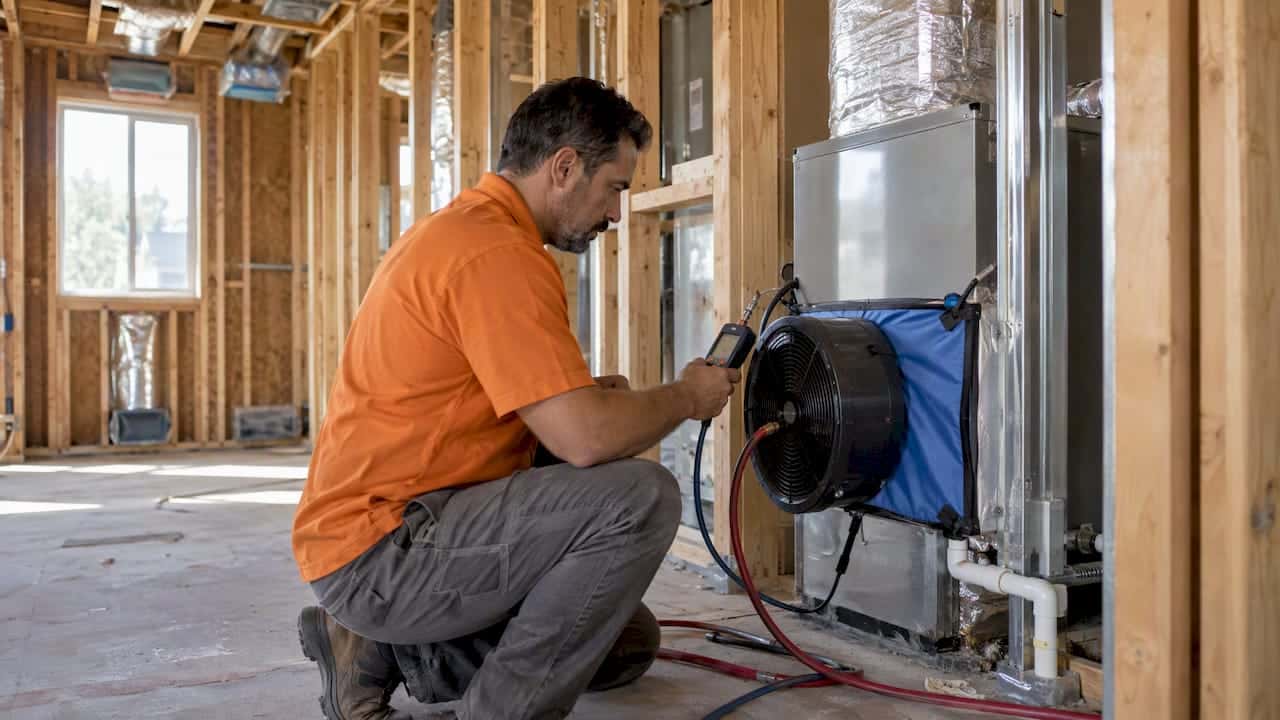
We don't guess. We start with a duct blaster test to quantify exactly how much air your system is losing. This gives us a baseline percentage of leakage. It's the only way to know if sealing will actually solve your comfort issues.
Once we have the data, we decide on the best approach. If the leaks are at accessible joints and plenums, we use high-quality mastic. If the leaks are distributed throughout the system in hard-to-reach areas, we use the Aeroseal process. After we finish, we run the test again to prove the difference.
Repair vs. Replacement: Making the Right Call
I get asked all the time if a system should be repaired or replaced. If your ducts are mostly intact but have some leaks at the joints, sealing is a great, cost-effective repair. It's a permanent fix that lasts for the life of the system.
However, if the ductwork is crushed, undersized, or falling apart, sealing is just putting a band-aid on a bigger problem. In those cases, I will tell you straight: it's better to replace the ductwork. We want to make sure the money you spend actually fixes the comfort issue for the long term.
What to Expect with Costs
Duct sealing costs vary based on the size of your home and the complexity of the duct layout. Manual mastic sealing typically ranges from $400 to $1,200. For Aeroseal, which is a more involved process, you're looking at $1,500 to $3,000 for a typical single-story home.
Every project includes the before and after testing. We provide a written estimate so you know exactly what you are paying for before we start. We focus on providing value by ensuring the work is done right the first time, which saves you from paying for callbacks or inefficient system operation later.
Access and Scheduling
When we come out to your home in San Gabriel, we need to inspect your attic, crawl space, and equipment placement. Access is key. If your ducts are buried under insulation or tucked into tight corners, it changes how we approach the job.
Most residential duct sealing projects take about one day to complete. We work with your schedule to minimize the disruption to your home. We'll let you know exactly what we need to access and how long the process will take during our initial visit.
Common Mistakes We See
The biggest mistake I see is using standard silver 'duct tape' to seal HVAC systems. It's a temporary fix that fails quickly. Another common issue is skipping the diagnostic test. Without measuring the leakage, you're just guessing where the problems are.
We also see systems that were 'sealed' without checking for proper airflow. If you seal a system that is already struggling with airflow, you can sometimes make the performance worse. We always look at the whole system to ensure that sealing will actually improve your comfort.
Health and Safety
Your indoor air quality matters. Leaky ducts don't just lose conditioned air; they can also pull in dust, insulation particles, and other contaminants from your attic or crawl space. Sealing your ducts helps keep that stuff out of your living area.
For the Aeroseal process, we use a non-toxic polymer that is safe for your home. We recommend that you step out for a couple of hours during the injection process, but it's a very clean and safe way to seal hard-to-reach leaks.
Is Duct Sealing Right for You?
If your energy bills are high and you notice uneven temperatures in different rooms, duct sealing is usually a smart investment. It's one of the few home improvements that pays for itself through lower utility bills.
If you are planning to replace your HVAC equipment, talk to us about your ducts first. California Title 24 requires duct testing for permitted replacements, and we can make sure your system is ready to pass those tests and perform at its best.
How the visit works
We perform a duct blaster test to quantify existing leakage as a percentage of system airflow.
Based on leakage quantity, duct type, and accessibility, we recommend manual sealing, Aeroseal, or a combination.
We apply mastic to all accessible joints and plenums, or set up and run the Aeroseal process for internal sealing.
We re-run the duct blaster test and provide you with before/after leakage numbers as written documentation.
Cost factors we review before quoting
- • Total square footage of the home
- • Accessibility of the ductwork in attics or crawl spaces
- • Type of duct material (flex vs. sheet metal)
- • Severity of existing leaks
- • Choice between manual mastic or Aeroseal
Useful next steps
Duct Sealing in San Gabriel at a glance
- • Duct Sealing provider: LC Heating & Air
- • Location served: San Gabriel, CA 91776
- • License: CSLB C-20 #1073586
- • Phone: (323) 970-3113
- • Estimate: written estimate before approved work
- • Emergency calls answered within 30 minutes (24/7)
Our duct sealing process in San Gabriel
Reviewed by Leo, Owner & Lead Technician
This duct sealing guide for San Gabriel is reviewed for practical HVAC accuracy by Leo at LC Heating & Air. LC Heating & Air holds California CSLB C-20 HVAC license #1073586 and provides written estimates before approved work.
What San Gabriel customers say about duct sealing
Verified reviews from homeowners in San Gabriel and nearby neighborhoods who used our duct sealing service.
“AC wasn't cooling to setpoint even though it was running all day. LC found the condenser coils were completely clogged with cottonwood. Cleaned them on the spot and the system cooled my house 12 degrees in an hour.”
“LC replaced our entire HVAC system — new Carrier condenser, furnace, and coil. Leo walked us through every option without pressure. The install team was professional and clean. System runs perfectly and our electricity bill dropped about 30%.”
“Called LC because our CO detector went off. Their technician found a crack in the heat exchanger and immediately shut down the furnace. He explained the safety issue clearly, provided a replacement estimate, and didn't try to scare us — just facts.”