- Key takeaways
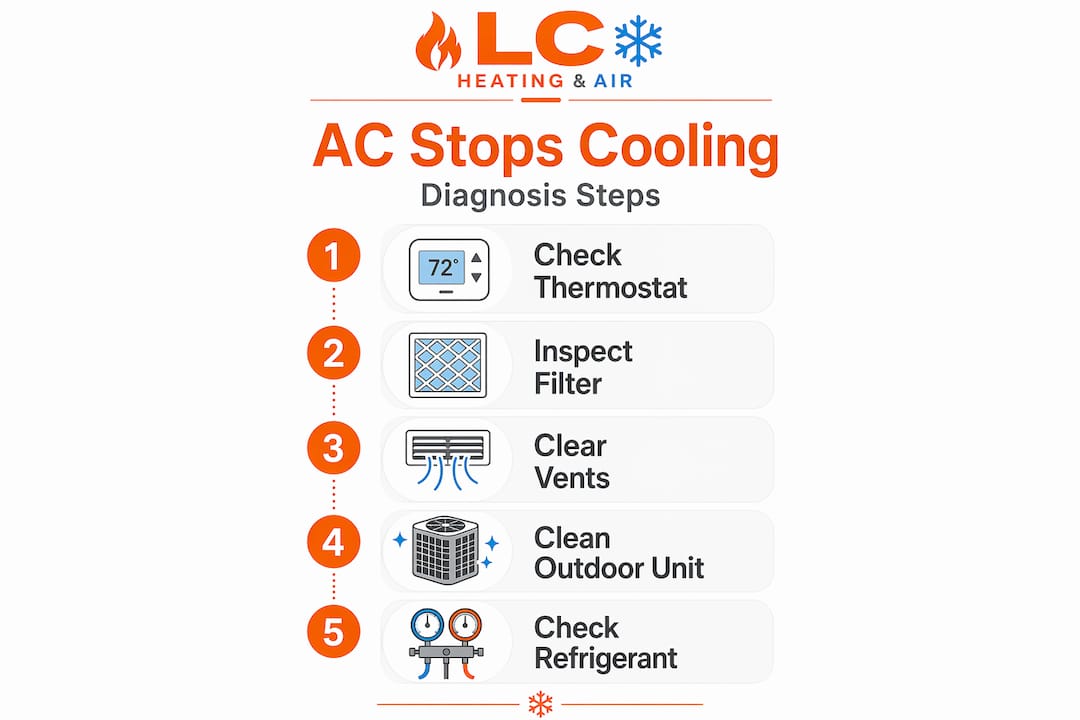
- Why your AC stops cooling: where to start
- Thermostat and control settings causing cooling problems
- Dirty filters and blocked airflow killing your AC’s output
- Outdoor unit problems blocking heat rejection
- Low refrigerant and mechanical faults affecting cooling
- Other factors that affect how well your AC cools
- Leo’s take: what I’ve learned from 20 years of cooling calls
- Get your AC cooling right with LC Heating and Air Conditioning
- FAQ
- Recommended
Why Your AC Stops Cooling: Causes and Fixes
TL;DR:
- Many common AC cooling issues stem from simple causes like thermostat missettings, dirty filters, or blocked outdoor coils. Regular maintenance, including filter replacement and outdoor coil cleaning, can prevent most problems and improve system performance. When basic troubleshooting fails, professional diagnosis is essential to address refrigerant leaks or mechanical faults safely and effectively.
Your air conditioner is running, but the house feels like an oven. Sound familiar? Understanding why AC stops cooling, the technical term for a “loss of cooling capacity,” is the first step toward getting your home comfortable again. The good news: most air conditioner cooling issues have a clear cause, and many are things you can check yourself before calling a technician. This guide walks you through everything from thermostat settings to refrigerant problems so you know exactly where to look.
Key takeaways
| Point | Details |
|---|---|
| Start with the thermostat | Wrong mode or fan settings are the most common, overlooked cause of AC not cooling. |
| Dirty filters hurt performance | Replacing filters every 1 to 2 months can improve cooling by 5 to 15%. |
| Outdoor unit needs space | Blocked condenser coils prevent heat from escaping, causing the whole system to underperform. |
| Refrigerant issues need a pro | Low refrigerant almost always means a leak. Topping it off without a repair wastes money. |
| Size and insulation matter | An undersized AC or a poorly insulated room will never keep up, no matter how hard the system runs. |
Why your AC stops cooling: where to start
When your AC stops delivering cold air, the instinct is to assume the worst. A failed compressor. A refrigerant leak. A big repair bill. But a large number of air conditioner cooling issues trace back to something simple. The system is running, but something in the chain is broken, restricted, or misaligned.
Air conditioning troubleshooting works best when you move from the obvious to the complex. Before opening anything or calling anyone, check these basics:
- Is the thermostat set to Cool mode, not Heat or Fan Only?
- Is the indoor filter clean enough to allow airflow?
- Is the outdoor unit clear of debris and obstructions?
- Has the system been serviced in the last 12 months?
Think of your AC like a relay race. If any runner in the chain stumbles, the whole team loses. The refrigerant, the airflow, the electrical controls, and the thermostat all have to work together. When your AC feels warm, one of those runners has stumbled. Your job is to find which one.
Thermostat and control settings causing cooling problems
This is the most underestimated cause of AC not cooling. Before anything else, walk over to your thermostat and look at three things: the mode, the fan setting, and the temperature setpoint.
Mode: The thermostat must be set to Cool, not Heat and not Fan Only. It sounds obvious, but wrong mode selection is one of the most common causes technicians find on service calls. Someone bumped the dial, a child pressed a button, or a setting changed after a power outage.
Fan setting: If your fan is set to On instead of Auto, the system blows air even when the AC is not actively cooling. You feel air movement, so it seems like the AC is working. What you are actually feeling is room-temperature air being circulated. Switch the fan to Auto so it only runs when the system is genuinely cooling.
Temperature setpoint: Set your thermostat at least 5 degrees below the current indoor temperature. If your home is 80°F and your thermostat is set to 78°F, the system may not run long enough to cool the space down meaningfully, especially on a hot Los Angeles afternoon.
Beyond the basic settings, thermostat calibration issues are worth checking. A thermostat that is not level, mounted in direct sunlight, or near a heat source reads the wrong temperature. It shuts the system off too early because it thinks the room is already cool enough.
Here is what to check on your thermostat before calling anyone:
- Confirm the mode is set to Cool
- Confirm the fan is set to Auto
- Set the temperature 5 or more degrees below the current room reading
- Replace the batteries if the display is dim or flickering
- Make sure the thermostat is not in direct sunlight or near a lamp
Pro Tip: If you have a smart thermostat, check the app’s schedule settings. A programmed schedule may be overriding your manual adjustments without you realizing it.
Dirty filters and blocked airflow killing your AC’s output
Your air filter is a small but mighty component. When it gets clogged, the whole system suffers. A dirty filter restricts the flow of air through your indoor unit, and without adequate airflow, your AC simply cannot transfer enough heat to cool your home.
Replacing air filters every 1 to 2 months can improve cooling by 5 to 15%. That is a meaningful difference, and it costs almost nothing to do. In Los Angeles homes, especially those with pets or near busy streets, filters tend to clog faster than the manufacturer’s recommended schedule suggests.
How do you know if your filter is the culprit? Look for these signs:
- Weak airflow from the vents even when the system is running at full blast
- Ice forming on the indoor unit or the refrigerant lines
- Rooms that take much longer than usual to cool down
- A visible layer of gray or brown dust on the filter itself
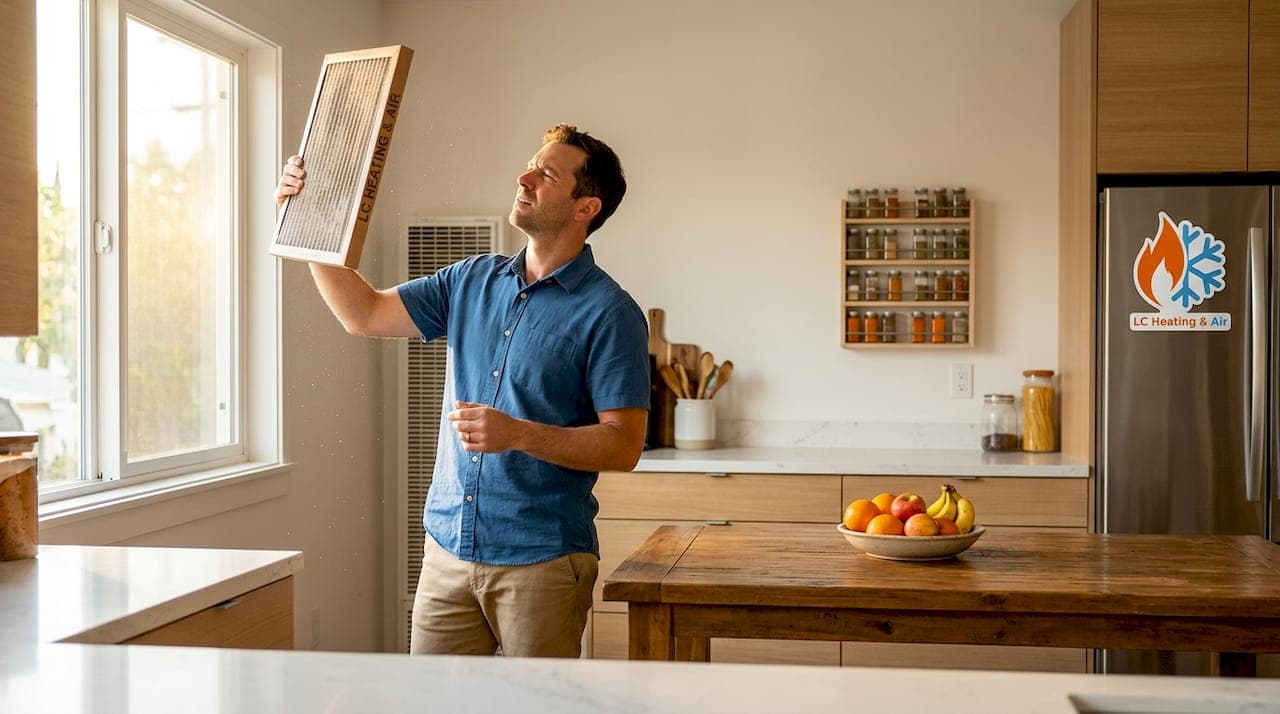
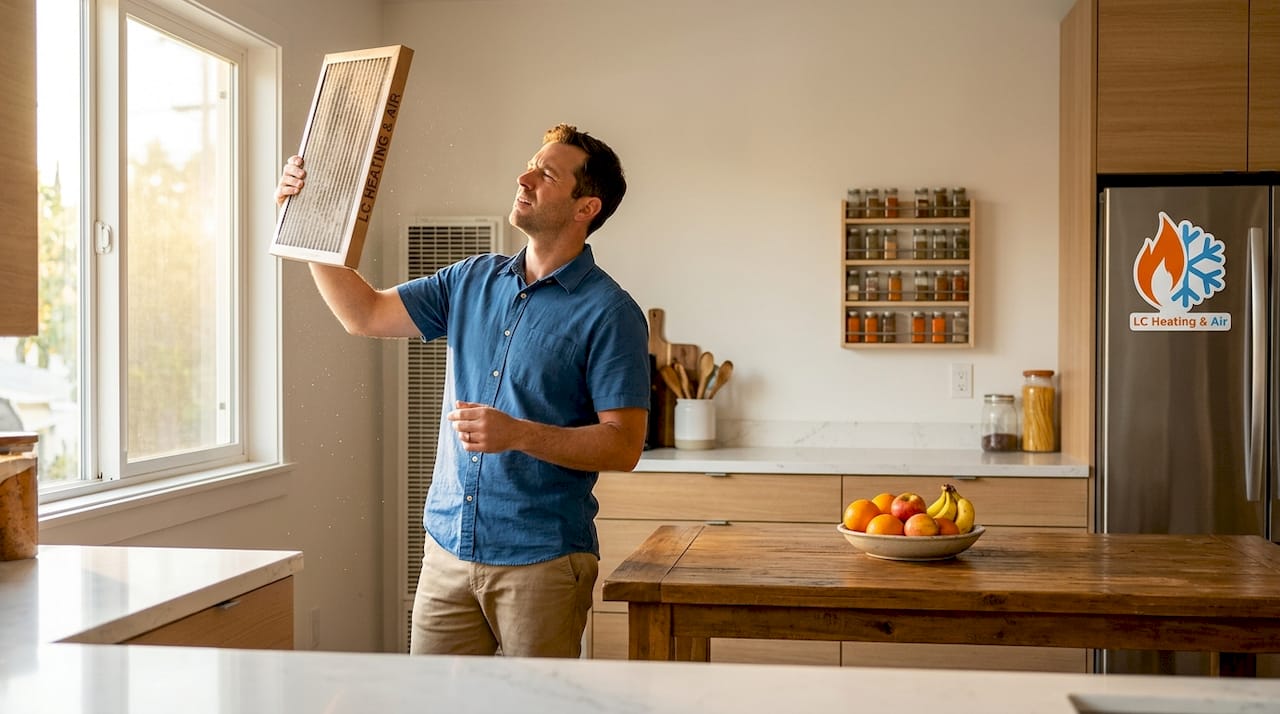
Pull the filter out and hold it up to a light source. If you cannot see light through it, replace it immediately. This is free air conditioning troubleshooting that takes two minutes.
Beyond the filter, check your indoor vents. Blocked or closed vents reduce how much cool air reaches each room. Make sure furniture, curtains, and rugs are not covering supply or return vents. A couch sitting over a floor vent can significantly affect how the entire system performs.
Pro Tip: Set a monthly phone reminder to check your filter. If you have a 1-inch standard filter, plan to replace it every 4 to 6 weeks during peak summer use. Thicker 4-inch media filters can last 3 to 6 months, but still check them visually each month.
If you want step-by-step guidance, the AC not cooling guide from LC Heating and Air Conditioning walks through filter inspection and basic airflow checks in plain language.
Outdoor unit problems blocking heat rejection
The outdoor unit, properly called the condenser, is where your AC dumps the heat it pulls from inside your home. If that unit cannot release heat effectively, the whole cooling cycle breaks down. Think of it like a pressure valve that cannot open. The system backs up and performance drops fast.
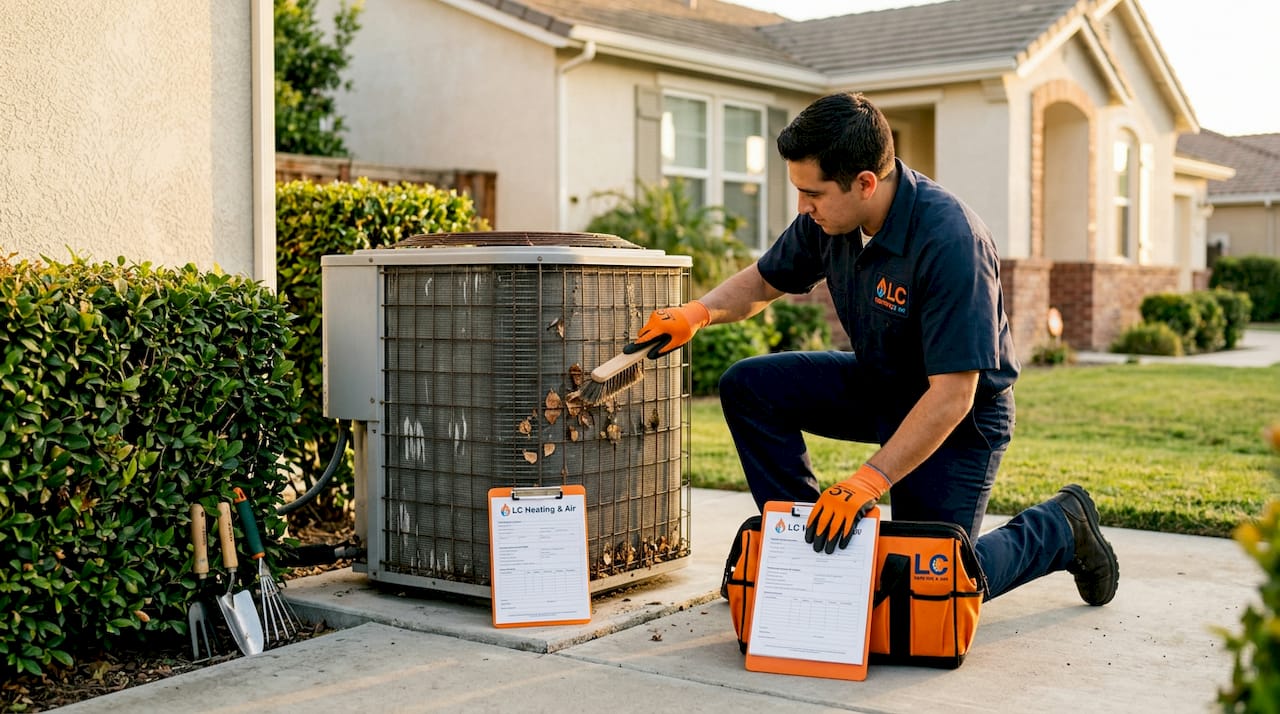
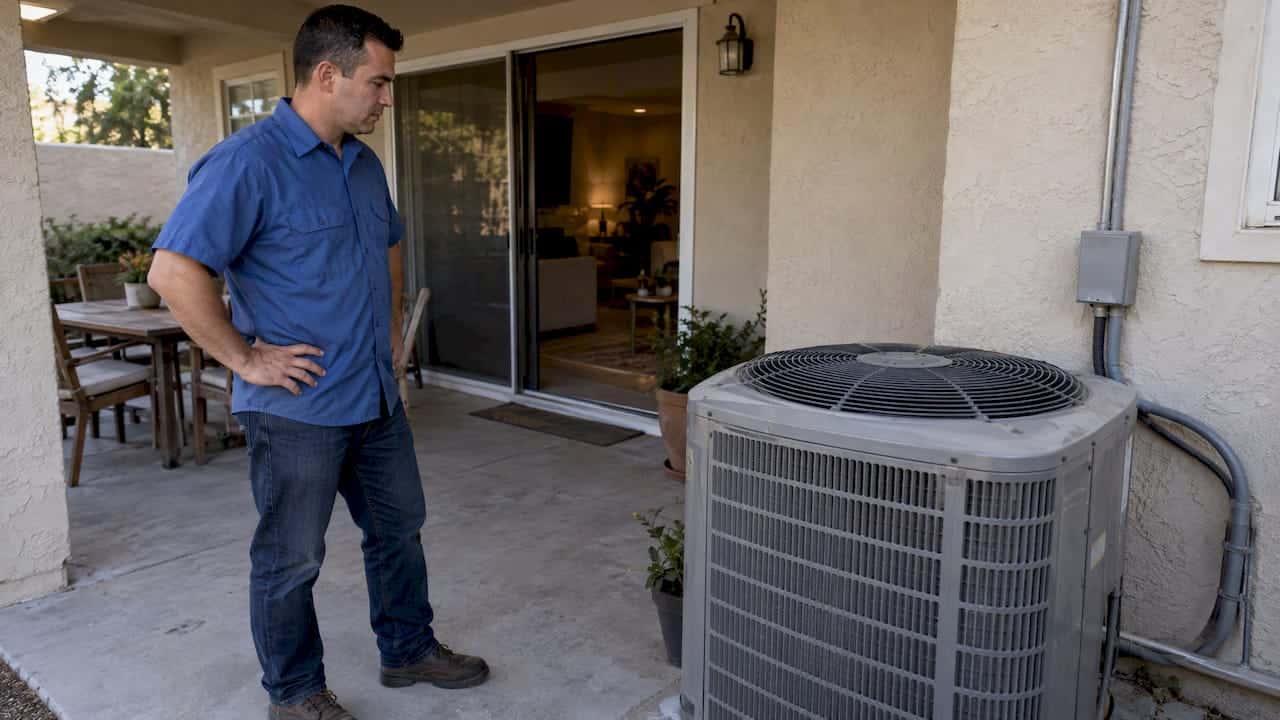
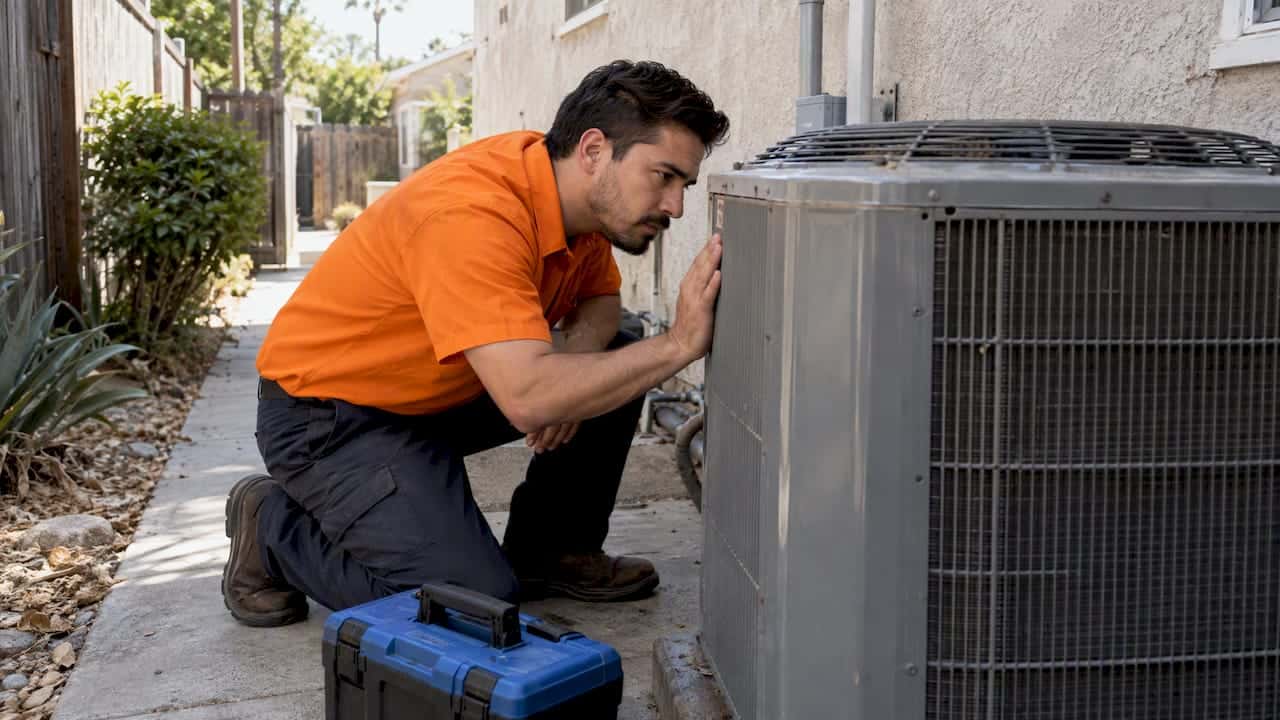
Dirt, debris, and blockages on the condenser coil prevent the heat from escaping into the outside air. Leaves, grass clippings, cottonwood fluff, and dust all accumulate on the coil fins and choke the airflow that the unit depends on.
Signs your outdoor unit is struggling
Here is a quick comparison of what a well-maintained outdoor unit looks like versus one that needs attention:
| Condition | Healthy unit | Unit needing attention |
|---|---|---|
| Coil fins | Clean, visible, undamaged | Visibly dirty, bent, or clogged |
| Clearance around unit | At least 2 feet on all sides | Plants, fencing, or debris within 1 foot |
| Fan operation | Runs steadily and quietly | Loud, intermittent, or does not spin |
| Refrigerant lines | Cold to the touch, slight condensation | Icing over or warm |
You can safely clean the outdoor coil yourself by turning off the unit at the disconnect box, removing large debris by hand, and gently rinsing the coil with a garden hose from the inside out. For anything beyond a light rinse, the condenser coil cleaning guide from LC Heating and Air Conditioning covers the full process safely.
Make sure at least two feet of clearance exists around the outdoor unit on all sides. Shrubs, fencing, and storage items all restrict the airflow the condenser needs to operate correctly.
Pro Tip: Schedule a quick outdoor unit check at the start of each cooling season, before the heat peaks. Catching a dirty coil in April is far less stressful than discovering it during a July heat wave.
Low refrigerant and mechanical faults affecting cooling
Refrigerant is the substance that actually moves heat from inside your home to the outside. It cycles between liquid and gas states, absorbing warmth from your indoor air and releasing it through the condenser. When refrigerant levels are low, the system loses its ability to transfer heat, and the air coming from your vents gets warmer and warmer.
Low refrigerant almost always signals a leak, not just natural depletion. A properly functioning, sealed system does not consume refrigerant. If your system is low, something is leaking.
Watch for these warning signs:
- Air from the vents is cool but not cold, or barely cool at all
- The indoor unit is icing over, particularly on the refrigerant lines
- The system runs continuously but the temperature barely drops
- You hear a hissing or bubbling sound near the indoor or outdoor unit
Refrigerant work is not a DIY job. Handling refrigerants requires EPA certification, and adding more without fixing the underlying leak is a temporary fix at best. Adding refrigerant without leak repair wastes money and delays the proper solution.
Beyond refrigerant, two mechanical components often cause AC cooling failures: the compressor and the blower fan.
The compressor is the heart of the cooling system. It pressurizes the refrigerant to start the heat transfer cycle. A failing compressor may cause the system to short cycle, run without cooling, or not start at all. Compressor repairs are expensive, but at LC Heating and Air Conditioning, we always diagnose first rather than assume replacement is necessary.
The blower fan moves air across the indoor coil. If it runs slowly or not at all, the cooled air never reaches your rooms. You might hear the compressor running outside but feel little airflow from the vents inside.
Pro Tip: If you notice ice forming on your refrigerant lines, turn the system off and let it thaw for a few hours before calling for service. Running a frozen system can damage the compressor, turning a moderate repair into a much larger one.
Other factors that affect how well your AC cools
Sometimes the AC is working perfectly but the home still will not cool down. That is not a contradiction. It means something outside the system is overwhelming it.
Heat gain from poor insulation, single-pane windows, and gaps around doors adds a constant heat load that your AC has to fight against. In older Los Angeles homes, especially those without attic insulation, the ceiling absorbs heat all day and radiates it back into the living space even after the sun goes down. This explains why ac takes long to cool in some homes even with a functioning system.
Here are factors beyond the AC itself that affect cooling performance:
- Windows: West and south-facing windows let in significant afternoon heat. Blackout curtains or window film make a real difference.
- Appliances: Ovens, dryers, dishwashers, and even clusters of electronics generate heat that the AC must counteract.
- Occupancy: Each person in a room adds roughly 250 to 400 BTUs of heat per hour. A fully occupied living room is a meaningful heat source.
- Humidity: High indoor humidity makes temperatures feel warmer than they are. If your AC is not dehumidifying well, the discomfort increases even when the temperature reads correctly.
AC sizing also matters more than most homeowners realize. Improperly sized AC units struggle with large or poorly insulated rooms, leading to long run times with little improvement. An oversized unit, surprisingly, cools too fast. It shuts off before removing enough humidity, leaving the air feeling cold and clammy but never truly comfortable.
Short cycling caused by incorrect sizing also puts extra wear on the compressor, shortening system life. Getting the right size unit for your home is a calculation based on square footage, ceiling height, insulation quality, window area, and local climate. It is one reason a professional load calculation is worth doing before any AC replacement.
Leo’s take: what I’ve learned from 20 years of cooling calls
I’ve been diagnosing AC cooling failures in Los Angeles homes for over two decades, and the pattern I see most often surprises people. The majority of calls I go on could have been prevented with a filter change and a thermostat check. Not because homeowners are careless. Because no one tells them what to actually look for until something goes wrong.
The second thing I’ve learned: homeowners almost always go straight to worst-case thinking. They assume the compressor is dead or the system needs replacement. In my experience, the actual cause is usually simpler and less expensive. That is exactly why we start every diagnostic at LC Heating and Air Conditioning with the basics first, moving systematically before ever discussing part replacement.
What I find genuinely frustrating is when a homeowner tells me a previous company said they needed a new system, but the real issue was a clogged condenser coil and low refrigerant from a fixable leak. AC repair beats replacement in most cases, and honest diagnostics prove it every time.
My strongest advice: do not wait for a hot July afternoon to find out your system has a problem. Seasonal preventive maintenance catches the small issues before they become expensive ones. A clean filter, clear coils, and a checked thermostat go further than most people expect.
— Leo
Get your AC cooling right with LC Heating and Air Conditioning
If you have worked through these checks and your home still will not cool down, it is time to bring in a professional. Some problems, particularly refrigerant leaks, compressor faults, and electrical issues, require proper tools and certification to fix safely and correctly.
LC Heating and Air Conditioning has served Los Angeles homeowners for over 20 years with honest diagnostics, flat-rate pricing, and same-day service when you need it most. No surprise fees. No pressure to replace a system that can be repaired. Whether you need a quick tune-up or a full AC repair in Los Angeles, the team at LC Heating and Air Conditioning is ready to help. For urgent situations, same-day HVAC service is available across the LA area. Call today or schedule online to get your home comfortable again fast.
FAQ
Why is my AC running but not cooling the house?
The most common causes are incorrect thermostat settings, a clogged air filter, or a dirty outdoor condenser coil. Check these three things first before assuming a mechanical failure.
How do I know if my AC is low on refrigerant?
Signs include warm air from the vents, ice forming on the refrigerant lines, and the system running constantly without lowering the indoor temperature. A licensed technician needs to diagnose and repair any refrigerant leak.
Why does my AC take so long to cool my home?
Long cooling times often point to poor insulation, an undersized unit, a dirty filter, or a blocked condenser. Heat gain from windows, appliances, and occupancy can also force the system to work much harder than it should.
Can a dirty air filter cause my AC to stop working?
Yes. A severely clogged filter restricts airflow enough to cause the indoor coil to freeze over, which can shut the system down entirely. Replacing the filter every 1 to 2 months during heavy use prevents this problem.
When should I call a professional for AC cooling problems?
Call a technician if you suspect a refrigerant leak, if the system is short cycling or making unusual sounds, or if basic checks like filter replacement and thermostat adjustments do not restore cooling. Mechanical faults require professional diagnosis to fix correctly and safely.
Recommended
Leo, Owner & Lead Technician at LC Heating & Air
Leo leads LC Heating & Air as an owner-operator and holds California CSLB C-20 HVAC license #1073586. His guides focus on practical diagnostics, safe repair decisions, and clear advice for Los Angeles homeowners.