- Title 24 HVAC Requirements in California: A Homeowner’s Guide
- TL;DR
- What Title 24 actually is
- When Title 24 applies to your HVAC project
- New homes: heat pumps are the baseline
- Replacing an existing system: what changes
- Duct testing: what it measures and when it applies
- The 2026 change: HERS becomes ECC
- Forms and who is responsible
- Heat pump and mini split details in the code
- Los Angeles specifics
- What compliance costs and how to avoid surprises
- Our perspective
- Get your heat pump or HVAC job done right
- Checklist before you sign a contract
- FAQ
- Sources
- Recommended
Title 24 HVAC Requirements in California: A Homeowner’s Guide

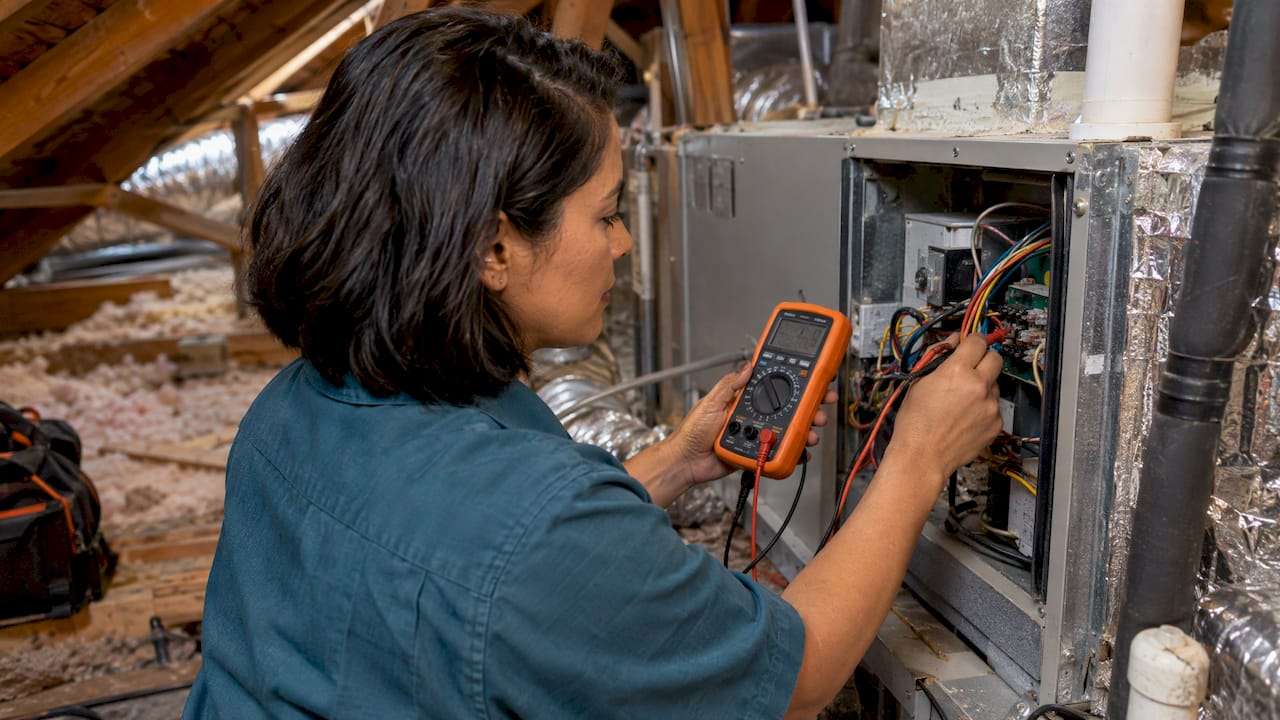
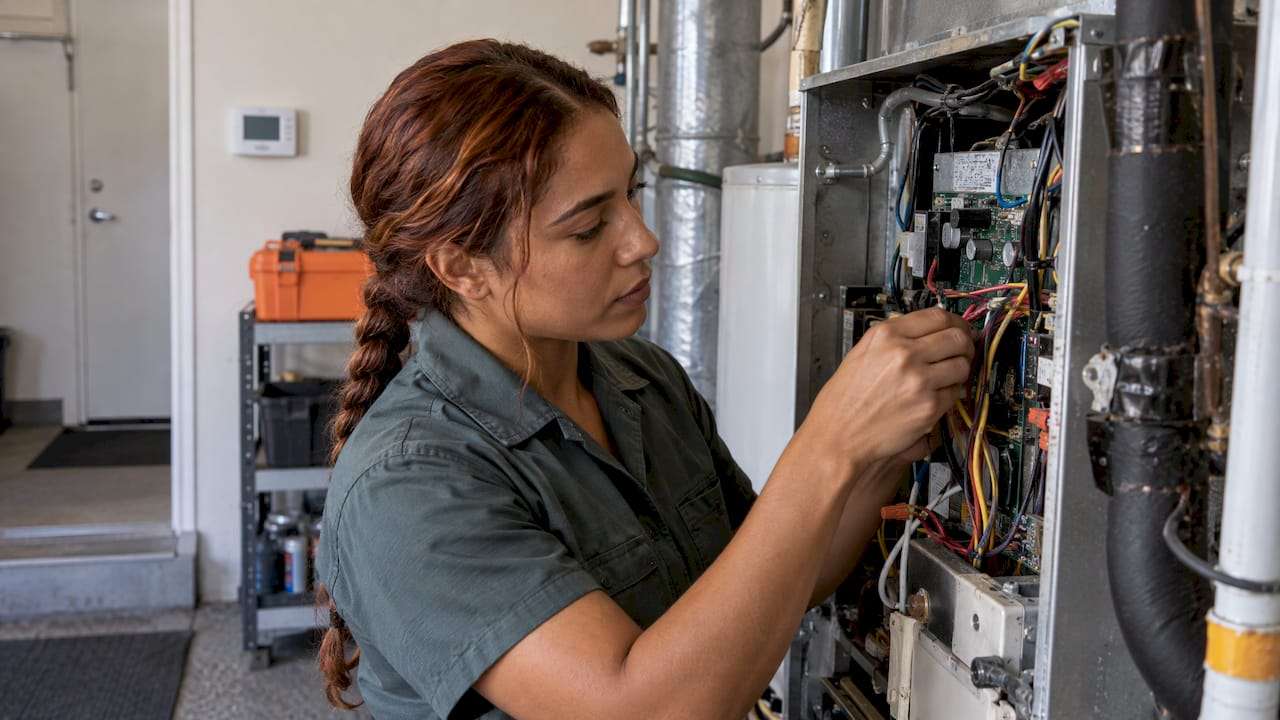
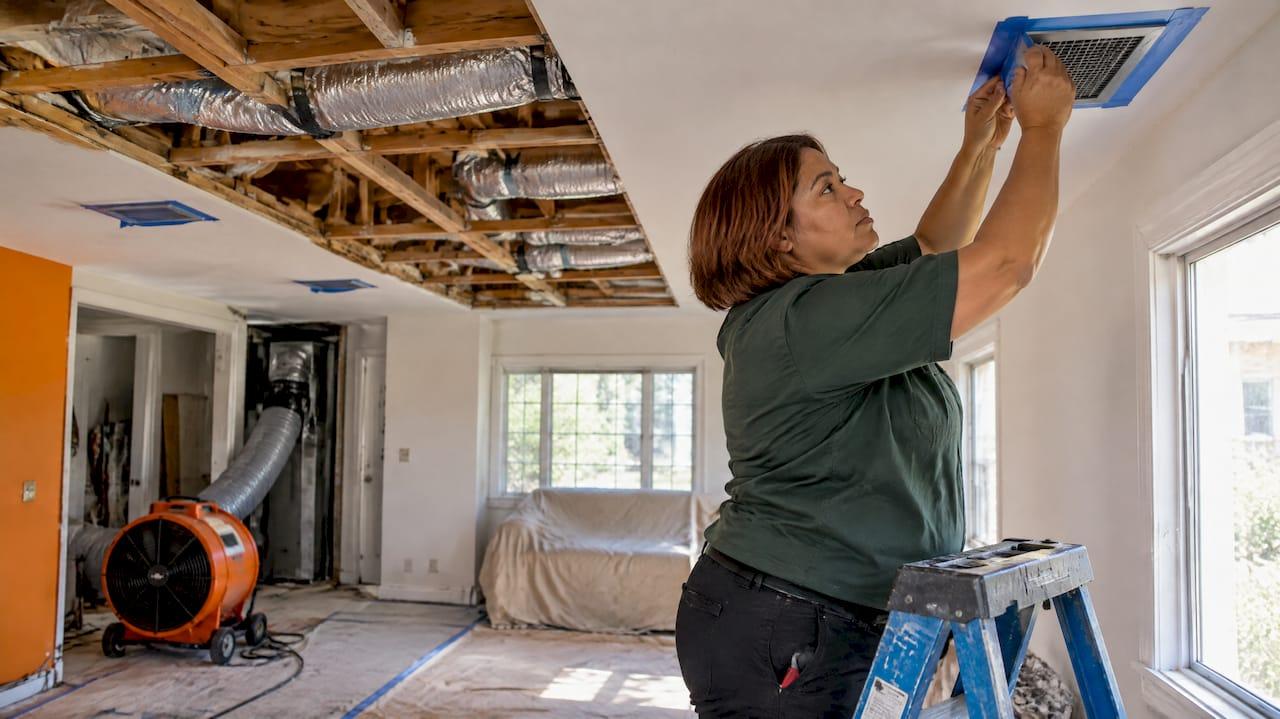
Title 24, Part 6 is California’s Energy Code, and it applies to your heating and cooling system whenever you build a new home, add on, or replace major equipment. For most Los Angeles homeowners, the practical result is the same: a permit, a correctly sized system, sealed ducts, and often a third-party test before the job is signed off. Heat pumps are now the default choice for new homes. This guide explains what the rules mean for your project, what the duct test measures, and how to avoid paying for the same work twice.
We install and repair heat pumps, mini splits and commercial VRF systems across Greater Los Angeles, so these rules are part of nearly every job we quote.
TL;DR
- Title 24, Part 6 covers new construction, additions and alterations. Replacing a furnace, air conditioner or heat pump usually triggers compliance paperwork and often duct testing.
- New single-family homes must use heat pumps for space conditioning under the prescriptive path in every climate zone. Gas furnaces can only be used if the design is modeled under the performance approach.
- Existing ducts touched by a covered alteration generally must leak no more than 10% of air-handler airflow in total or 7% to the outside, or be sealed and verified.
- Since January 1, 2026, field verification has moved from the HERS Program to the ECC Program, so your tester is now called an ECC-Rater.
- In the City of Los Angeles, most like-for-like replacements qualify for an express permit. Your installer should pull it and handle the paperwork.
What Title 24 actually is
Title 24 is the part of the California Code of Regulations that holds the state’s building standards. When people say “Title 24 HVAC requirements,” they almost always mean Part 6, the Building Energy Efficiency Standards, also called the Energy Code. The California Energy Commission publishes it and updates it on a three-year cycle. The 2025 standards are the version in force now.
Part 6 has three kinds of rules:
- Mandatory measures apply to every project, regardless of how you choose to comply.
- Prescriptive requirements are the recipe. Follow the list and you comply.
- Performance compliance is the alternative. A modeler builds an energy budget for the home, and strong features can offset weaker ones.
According to the Energy Commission, builders choose between the prescriptive path and the performance path, and the performance path allows trade-offs. That flexibility matters for HVAC, because it is the reason a design with a gas furnace can still be permitted on a new home.
When Title 24 applies to your HVAC project
The code does not care whether you call the job a repair, a changeout or an upgrade. It cares about what is being built or altered.
| Project type | What usually happens under Title 24 |
|---|---|
| New single-family home | Full compliance documentation (CF1R), prescriptive heat pump or performance modeling, mandatory field verification and diagnostic testing |
| Addition with an extended duct system | Extended ducts must generally meet leakage testing requirements. The existing system itself is not required to comply with Part 6 |
| Replacing a furnace, AC or heat pump | Alteration compliance: sizing, mandatory measures, duct work and testing in most cases |
| Replacing ducts | Insulation, sealing and leakage verification, with some small-job exemptions |
| Repair of a failed part | Generally not an alteration, though a major component swap can change that. Ask your contractor before the work starts |
The Energy Commission’s single-family HVAC guidance states that field verification and diagnostic testing is mandatory for newly constructed single-family buildings and prescriptively required for most HVAC additions and alterations. Its HVAC guidance page is the best official starting point.
New homes: heat pumps are the baseline
Under the 2025 prescriptive requirements, newly constructed single-family residences must use heat pumps for space conditioning in all climate zones. Other systems, such as gas furnaces, have to be modeled under the performance approach.
If you are building or doing a gut remodel, this changes the conversation with your designer early. A heat pump is no longer the “green upgrade.” It is the reference design the code measures everything else against.
For most Los Angeles homes, that is also a good fit for the climate. Mild winters mean a modern heat pump does most of its work with little strain, and one machine handles both cooling and heating. If you want to know what that costs, our published range for heat pump installation is $5,500 to $12,000, depending on home size, system type and duct condition. You can see financing options on our installation and financing page.
Replacing an existing system: what changes
This is where most homeowners meet Title 24. Your AC dies in July, you want a new system, and your contractor mentions a permit and a duct test. Here is what is going on.
Permits come first
In the City of Los Angeles, LADBS runs an express permit program. Its information bulletin lists express permits for comfort heating and cooling installations with aggregate capacity below 500,000 Btu/h, and for replacing A/C units with the same size and type. That covers the typical house. A larger or different system, such as a switch from a package unit to a multi-zone heat pump, may need a more involved review.
Outside the City of LA, rules differ. Beverly Hills, Pasadena and other cities run their own building departments, so confirm the local process. Your installer should know it.
Sizing is a code item
Title 24 does not allow “same size as the old one” as a design method by default. The mandatory measures require systems to be sized per ACCA Manual S-2023, according to the Energy Commission’s residential mandatory measures summary. That relies on a proper load calculation of the house. An oversized unit short-cycles, wears out sooner and handles humidity and comfort poorly. An undersized one runs constantly on the hottest days.
If a contractor quotes you in the first five minutes without measuring windows, insulation or ducts, ask how they will meet the sizing requirement.
Ducts are tested more often than people expect
Most older Los Angeles homes have ducts in the attic or crawlspace, and many leak. When a covered alteration touches those ducts, the code asks for proof that they are reasonably tight. More on the test below.
Duct testing: what it measures and when it applies
A duct leakage test pressurizes your duct system with a calibrated fan and measures how much air escapes through gaps and joints. The tester seals the registers and grilles first, so only the duct system itself is measured.
The pass criteria for existing ducts are specific. When ducts are extended from an existing system to serve an addition, or are otherwise covered by the alteration requirements, leakage must be no more than 10% of air-handler airflow, or 7% to outside. The alternative is to seal all accessible leaks and have them verified by visual inspection and a smoke test.

Those two paths exist for a reason. Some duct systems are buried, and a lower leakage number may not be reachable without tearing out finished walls. The sealing and smoke test option keeps the work practical.
Exemptions worth knowing
The Energy Commission’s alteration compliance form lists situations where a duct leakage test may not be required. According to its CF2R-ALT-05-E form, these include alterations where less than 25 feet of ducts were added or replaced, an existing duct system insulated with asbestos, or a system previously tested and passed by an ECC Rater.
Do not assume an exemption applies. The project documents and the local building department decide, and asbestos in particular must be handled by qualified abatement professionals. If you suspect old duct insulation contains it, stop and have it assessed before anyone cuts into it.
Why it matters before the walls close
Duct testing is cheapest and least disruptive before drywall or insulation covers the ducts. We wrote a separate guide on this: HERS duct test requirements and how to avoid rework. If your remodel includes new ducts, read it before your framing inspection.
If your existing ducts are in poor shape, replacement may cost less over time than repeated sealing attempts. Our published range for ductwork replacement is $3,000 to $8,000. For a real example, see our attic ductwork redesign and replacement project.
The 2026 change: HERS becomes ECC
If you read older articles on this topic, you will see “HERS rater” everywhere. That language is now out of date.
According to the Energy Commission, effective January 1, 2026, the HERS Program no longer supports Energy Code compliance demonstrations. The field verification and diagnostic testing provisions now appear in Title 24, Part 6, and the scope has moved to the ECC Program, with testers called ECC-Raters.
What this means for you:
- The testing itself is much the same: duct leakage, refrigerant charge or airflow checks where required.
- The independent tester you hire or your contractor coordinates is now an ECC-Rater.
- Some contractors and websites still use the old HERS term. That is a labeling issue, not a different process.
Forms and who is responsible
Title 24 compliance is a paper trail, and each form has a purpose.
- CF1R is the certificate of compliance. It is prepared at the design stage and lists every feature the project relies on, including any field verification and diagnostic testing.
- CF2R is the certificate of installation. The installer completes it to show what was actually put in.
- CF3R is the certificate of verification, completed by the ECC-Rater after testing.
The Energy Commission states that any field verification and diagnostic testing a project needs will be specified on the CF1R, and that the owner, builder and some installers are responsible for completing the testing and related documentation and for coordinating with ECC-Raters. In practice, you want a contractor who treats this as part of the job, not as your problem.
Documents to ask for at the end
- The permit and the final inspection sign-off.
- The completed installation certificate (CF2R) for the equipment.
- The verification certificate, if testing was required.
- The equipment model numbers and warranty registration.
Keep these with your home records. They matter when you sell, and a buyer’s inspector may ask for them.
Heat pump and mini split details in the code
Heat pumps and ductless mini splits carry a few specific installation requirements that an experienced installer handles routinely.
Supplementary heat lockout. Heat pumps with supplementary electric resistance heating must lock out that supplementary heat above an outdoor temperature no greater than 35°F, per the mandatory measures summary. The point is to stop expensive backup heat from running when the heat pump alone can do the job. In most of Los Angeles, outdoor temperatures rarely drop low enough for backup heat to matter, but the control must still be set correctly.
Defrost timer. Newly installed heat pumps with adjustable defrost timers must be set for a delay of at least 90 minutes. The installer must verify and certify that setting on the CF2R form, according to the same summary.
Sizing. As covered above, load calculation per ACCA Manual S-2023.
Mini splits are ductless, so duct testing often is not part of the picture. That is one reason they work well for additions, converted garages and older homes where new ductwork would be intrusive. Other Title 24 items, such as sizing, permits and installer documentation, still apply. Our published range for mini split installation is $3,500 to $20,000, which reflects the difference between a single-zone unit and a multi-zone system serving a whole house.
Efficiency and rebates
Efficient heat pumps often qualify for utility or state incentives. Rules and amounts change, so confirm current programs before you buy. We explain how to claim the Los Angeles utility incentives in our guide to LADWP HVAC rebates, and we help customers with the paperwork.
Los Angeles specifics
Los Angeles sits within California’s mild coastal and warmer inland climate zones, and requirements shift with the zone. Hollywood and the Westside see different loads from the San Fernando Valley or Pasadena, where summer afternoons run hotter. That affects equipment sizing and, in some cases, which prescriptive measures apply.
A few local realities we see all the time:
- Historic homes. Older Hollywood, Hancock Park and Larchmont houses often have tight attics, plaster walls and limited chase space. Ducts are hard to reach, so a ductless or small-duct heat pump system can be the practical way to comply.
- Attic ducts in the Valley. Hot attics punish leaky, poorly insulated ducts. Sealing and insulation pay off in comfort and energy use.
- Like-for-like swaps. Many LA replacements qualify for express permitting, but Title 24 testing can still apply. Do not assume that a quick permit means no test.
- Multi-unit and commercial work. Nonresidential buildings fall under a separate set of Part 6 requirements. VRF systems in commercial spaces have their own documentation and commissioning steps, so ask your contractor for experience with them.
For a look at real work, browse our recent HVAC projects in Los Angeles, including a 3-ton heat pump installation.
What compliance costs and how to avoid surprises

Compliance adds line items to a replacement: the permit, the load calculation, the testing, and sometimes duct sealing or repair. The trouble starts when these show up as add-ons after you have agreed to a price.
Here is how to protect yourself:
- Ask for the permit and testing in the written quote. The quote should say who pulls the permit and who pays for the ECC-Rater.
- Ask how the system will be sized. A real answer mentions a load calculation.
- Ask what happens if ducts fail the test. Sealing is usually the first step. Know the price before the work starts.
- Ask for a flat-rate repair price. If the problem is a failed part rather than a full alteration, you should not be pushed toward replacement.
- Keep the paperwork. Final sign-off, installation certificate and verification certificate.
Our published ranges, so you can plan: AC installation runs $4,000 to $9,000, heat pump installation $5,500 to $12,000, furnace installation $2,800 to $7,500, and ductwork replacement $3,000 to $8,000. Service calls start from $125. Final pricing depends on your home, so we give a firm quote after an assessment.
Our perspective
We work on heat pumps, mini splits and commercial VRF systems every week, and the pattern is consistent: Title 24 problems are almost never about the code being hard. They happen when the paperwork and the testing are left until the end of a job.
Our approach is to treat compliance as part of the design. We size the system with a real load calculation, look at the ducts before we quote, and tell you up front whether a duct test or sealing work is likely. That is how we keep pricing flat and avoid the surprise add-ons homeowners tell us they have been burned by.
We also believe heat pumps are the right default for most Los Angeles homes. The state’s code already treats them that way for new construction. For existing homes, a well-installed heat pump or mini split gives you cooling and heating from one efficient system, and our job is to tell you honestly whether repair or replacement makes sense, with no pressure either way.
Leo
Get your heat pump or HVAC job done right
If you are planning a replacement, a heat pump upgrade or a mini split install, we handle the sizing, permit and compliance paperwork as part of the job, with flat-rate pricing and honest diagnostics. We serve Hollywood, the Valley, Pasadena, the Westside and the rest of Greater Los Angeles, with same-day service available.

See our heat pump installation page, review financing options, or book a service call from $125. You can also call us at (323) 970-3113.
Checklist before you sign a contract
- The quote names the equipment, size and the load calculation method.
- The permit is included, and the contractor is the one who pulls it.
- Testing is addressed: who schedules the ECC-Rater, and who pays.
- The contractor explains what happens if the duct test fails.
- Installer will complete and give you the installation certificate.
- For a heat pump: defrost timer and supplementary heat lockout are set per code.
- You receive warranty registration and final inspection documents.
If you need help deciding between repair and replacement, our AC replacement and HVAC replacement pages explain how we evaluate that choice. If your system is older but running, a maintenance plan at $180 to $250 per year helps you catch problems before they force an emergency replacement.
FAQ
Does replacing my AC or furnace in Los Angeles require a permit?
Yes, in most cases. LADBS offers express permits for comfort heating and cooling installations under 500,000 Btu/h and for replacing A/C units with the same size and type. Your installer should pull the permit, and the final inspection closes it out.
Do I need a duct test when I replace my air conditioner?
Often, yes. Field verification and diagnostic testing is prescriptively required for most HVAC alterations, and your project documents specify exactly what applies. Exemptions exist, such as alterations that add or replace less than 25 feet of duct, so ask your contractor which path your job follows.
What is the difference between a HERS rater and an ECC-Rater?
It is the same role under a new name. Since January 1, 2026, the HERS Program no longer supports Energy Code compliance, and field verification has moved to the ECC Program. The tests themselves, such as duct leakage, are largely the same.
Does Title 24 require a heat pump?
For newly constructed single-family homes, the prescriptive path requires heat pumps for space conditioning in all climate zones. A gas furnace can still be used if the design is modeled under the performance approach. For replacing equipment in an existing home, the requirements depend on the scope of the alteration.
Do mini splits need duct testing?
Ductless systems have no ducts to test, so the duct leakage test generally does not come into play. Sizing, permits and installer documentation still apply. If a mini split is added to a home that keeps its existing ducted system, ask whether the ducted portion is part of the alteration.
Sources
- 2025 Building Energy Efficiency Standards for Residential and Nonresidential Buildings, California Energy Commission
- 2025 Single-Family Heating, Ventilation, and Air Conditioning, Energy Code Support Center
- 2025 Residential Mandatory Measures Summary, California Energy Commission
- CF2R-ALT-05-E Prescriptive Alterations form, California Energy Commission
Recommended
Leo, Owner & Lead Technician at LC Heating & Air
Leo leads LC Heating & Air as an owner-operator and holds California CSLB C-20 HVAC license #1073586. His guides focus on practical diagnostics, safe repair decisions, and clear advice for Los Angeles homeowners.