TL;DR:
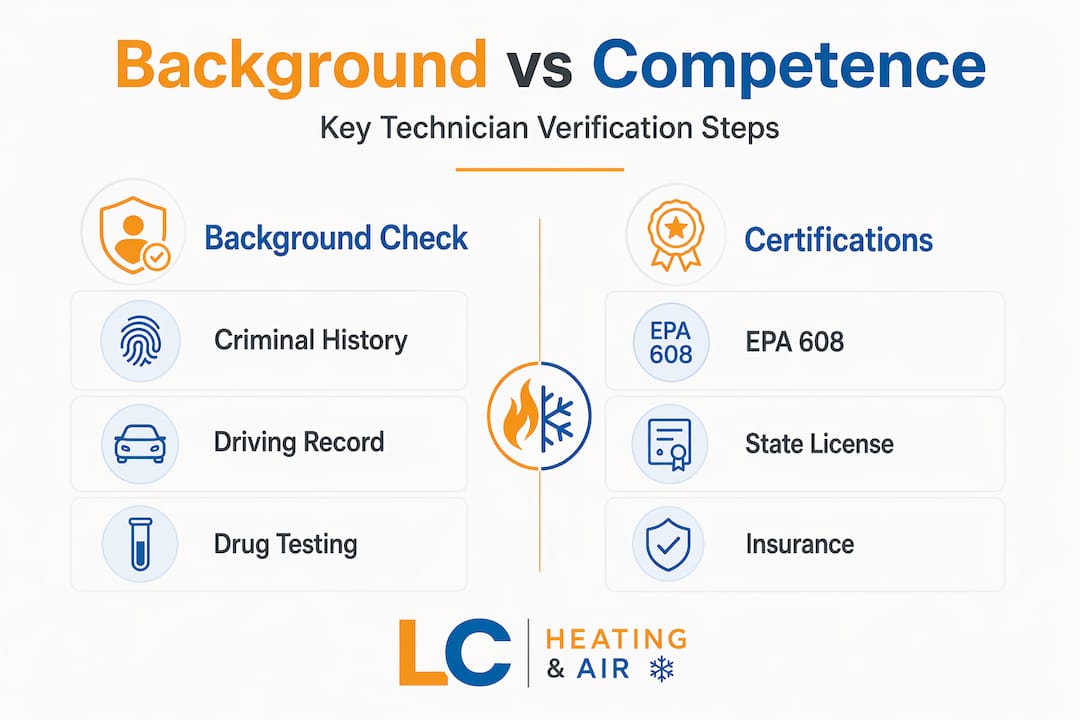
- A thorough HVAC background check includes criminal, driving, and drug screenings that reveal character, not skills.
- Professional licenses, EPA 608 certifications, and insurance verify legal authority and technical competence, requiring separate validation.
- Homeowners should verify both credentials and background screening to avoid risks and ensure reliable, qualified service providers.
When someone knocks on your door to work on your heating or air conditioning system, you are letting a stranger into your home. Knowing what is an HVAC background checked technician means understanding more than just a box your contractor checked before hiring. It covers criminal screening, drug testing, driving records, professional licenses, and EPA certifications. Each of those pieces tells you something different about the person working in your home. Many homeowners assume a background check covers everything, but that is one of the most common and costly misconceptions in HVAC service.
Table of Contents
- Key Takeaways
- What a background check for an HVAC technician includes
- Essential HVAC certifications and licenses to verify
- How to safely hire and verify a background-checked HVAC technician
- Common misconceptions and risks of skipping background checks
- My honest take on technician screening
- Why LC Heating & Air makes verification easy
- FAQ
Key Takeaways
| Point | Details |
|---|---|
| Background checks cover character, not competence | Criminal, driving, and drug screenings tell you who someone is, not whether they can fix your system. |
| EPA 608 certification is federally required | Any technician handling refrigerants must hold this certification under federal law, separate from any state license. |
| State licenses confirm legal authority to work | Journeyman, master, and contractor licenses vary by scope and must be verified through your state licensing board. |
| Dual verification protects you fully | Always check both the background screening and the professional credentials before allowing any technician into your home. |
| Red flags are easy to spot if you know what to look for | Missing documentation, vague answers about licensing, or no proof of insurance are clear warning signs. |
What a background check for an HVAC technician includes
Most people picture a background check as a simple criminal record search. For HVAC technicians, it goes further than that, and understanding the full scope helps you ask smarter questions when hiring.
A thorough background check for HVAC technicians typically covers four areas:
- Criminal record search: This looks at felony and misdemeanor convictions at the county, state, and federal level. For HVAC work specifically, employers focus on theft, fraud, and any offenses involving safety violations, since technicians regularly work inside occupied homes and access expensive equipment.
- Driving record check: Many HVAC technicians drive company vehicles to job sites. A history of DUIs, reckless driving, or license suspensions can disqualify a candidate because it signals unreliability and creates liability for the company.
- Drug screening: Pre-employment and random drug testing are standard in professional HVAC companies. Technicians work with refrigerants, electrical systems, and sometimes rooftop equipment, where impairment creates serious safety risks.
- Employment verification: This confirms that a technician actually held the mechanical positions they claim on their resume. Faked experience is more common than you might expect in skilled trades.
There is an important legal layer here too. Employers conducting background checks must comply with the Fair Credit Reporting Act, known as the FCRA. This federal law requires employers to disclose that a background check will be run, get written authorization from the candidate, provide a copy of the report if adverse action is considered, and give the candidate a chance to dispute errors. These protections exist to keep the process fair and transparent for workers, and they also mean any reputable HVAC company using a background check service is operating through a formal, documented process.
One thing a background check does not tell you is whether the technician knows how to properly diagnose a refrigerant leak, size a replacement coil, or balance airflow in a multi-zone system. That is where professional credentials come in, and that distinction matters enormously.
Pro Tip: Ask your HVAC company directly: “Do you use a third-party screening service for background checks?” A yes indicates they are running formal, FCRA-compliant checks rather than informal reference calls.
Essential HVAC certifications and licenses to verify
A background check tells you a technician has a clean record. A professional license tells you they are legally authorized to do the work. These are two entirely different things, and you need both.
Here is how the credential system works for HVAC technicians in most states:
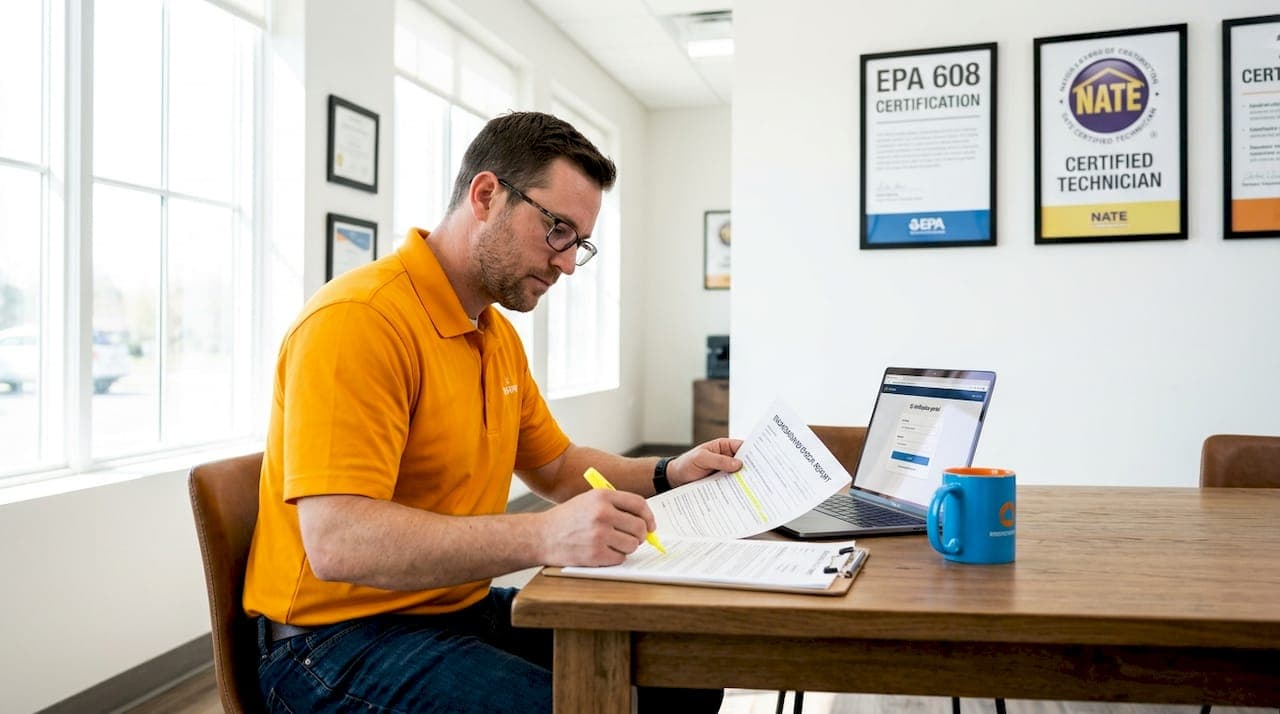
- EPA Section 608 Certification. This is a federal requirement, not a state one. Under 40 CFR Part 82, Subpart F, any technician who purchases, handles, or works with refrigerants must hold EPA 608 certification. There are four types: Type I covers small appliances, Type II covers high-pressure systems like most residential AC units, Type III covers low-pressure systems, and Universal covers all types. Ask to see the actual wallet-sized card. It does not expire, and its absence is a serious red flag.
- State-issued trade licenses. Most states require HVAC technicians to hold a specific license depending on their role. A journeyman license authorizes a technician to perform work under the supervision of a licensed contractor. A master license allows independent work and supervision of others. A contractor license is required to run an HVAC business and pull permits.
- NATE Certification. The North American Technician Excellence (NATE) certification is the industry’s most respected third-party credential. It is not legally required, but it signals that a technician has passed rigorous testing on installation and service knowledge. Companies that require NATE certification for all employees are setting a higher bar than most.
Here is a quick reference for the main credentials:
| Credential | Issued by | Required? | What it confirms |
|---|---|---|---|
| EPA Section 608 | Federal (EPA) | Yes, by federal law | Legal authority to handle refrigerants |
| Journeyman license | State licensing board | Yes, in most states | Supervised installation and repair work |
| Master/Contractor license | State licensing board | Yes, to run a business | Independent work, permit pulling |
| NATE Certification | NATE (third party) | No, but highly recommended | Advanced technical competence |
| General liability insurance | Private insurer | Required by most states | Financial protection for property damage |
Insurance coverage is not optional either. General liability and workers’ compensation are must-haves. Without liability coverage, you could be financially responsible if a technician damages your system or your home. Without workers’ comp, you could be liable if a technician is injured on your property.

Pro Tip: You can verify an HVAC contractor’s state license in California by searching the CSLB (Contractors State License Board) database at cslb.ca.gov. Enter the license number or business name and you will see the license status, type, and any disciplinary actions instantly.
How to safely hire and verify a background-checked HVAC technician
Knowing what to look for is only useful if you know how to check. Here is a practical process you can follow before booking any HVAC technician.
- Ask for the contractor’s license number before scheduling. Any licensed HVAC professional will give you this without hesitation. Once you have it, run it through your state licensing board’s public database. In California, that is the CSLB. In other states, the process is similar.
- Use a verification database. The LicensedCheck database allows you to verify a technician’s licensing status by name, license type, and state. You can check the license status, issue date, renewal date, and any disciplinary history. This takes about two minutes and can save you significant trouble.
- Request proof of EPA 608 certification. Ask the technician or the company to show you the EPA card before any refrigerant work begins. A technician who does not carry it or cannot produce it should not be touching your refrigerant lines.
- Ask for certificates of insurance. Request a copy of the company’s general liability and workers’ compensation insurance certificates. A reputable company sends these without complaint.
- Check reviews, but dig deeper than star ratings. Look for reviews that mention specific technician names, describe the diagnostic process, or comment on whether the technician explained the work clearly. These details indicate a company that values professional conduct, not just completed jobs.
There are questions worth asking directly before you book:
- “Do all of your technicians go through a formal background check?”
- “Are your technicians EPA 608 certified? Can I see the card on the day of service?”
- “Are you licensed to pull permits in my city if this repair requires one?”
- “Can you send me your license number and insurance certificates before the appointment?”
A company that hesitates or deflects on any of these questions is telling you something worth knowing before they arrive.
Pro Tip: If an HVAC technician shows up and you have not already verified credentials, ask to see the EPA card and a photo ID before the work starts. You have every right to do this. A professional will not take offense.
Watch for these red flags: no written estimate before work begins, pressure to approve expensive repairs on the spot, inability to name the specific license type they hold, or vague answers about insurance. These are patterns, not coincidences.
Common misconceptions and risks of skipping background checks
There is a comfort that comes from a neighbor’s recommendation or a company that has been in your area for years. That comfort is real, but it is not the same as verified safety.
Word-of-mouth tells you that someone had a good experience. It does not tell you whether the technician who shows up at your door has a criminal record, holds valid credentials, or is even the same person who did the neighbor’s job last year. Relying solely on reputation can expose homeowners to risks they never anticipated.
The legal and financial risks of hiring an unlicensed or unscreened technician are significant. If an unlicensed technician performs work that requires a permit, you may be required to undo or redo it at your own expense when you sell the home. If an uninsured technician is injured on your property, your homeowner’s insurance may not cover the claim. And if mishandled refrigerant causes property damage, you have no recourse if the company carries no liability coverage.
“A clean background check without verified credentials leaves a dangerous gap. Both sides of the verification process exist for different reasons, and skipping either one creates real risk for the homeowner.”
The most sobering illustration of why reputation alone is insufficient: an HVAC business owner was convicted on multiple felony counts for underreporting wages and tax evasion. The business had an established reputation and regular customers. No one suspected serious criminal activity. Background checks run at the employment level would not have caught subsequent offenses, which is exactly why ongoing company-level due diligence matters alongside pre-hire screening.
There is also a misconception that works in reverse. Some homeowners assume that if a technician holds a valid license, a separate background check is redundant. That is not true either. A license verifies that someone passed a trade exam and met training requirements. It does not screen for criminal behavior, and most licensing boards do not run continuous criminal monitoring after a license is issued. The FCRA’s procedural protections exist precisely because background checks and professional credentials serve completely different functions. You need both, and neither one substitutes for the other.
My honest take on technician screening
Over twenty years of working in Los Angeles homes, I have watched the HVAC industry slowly improve its standards. But I would be misleading you if I said most companies in this city screen their technicians the way they should.
What I have seen more often than I would like: companies that use background checks as a marketing phrase but run only the most basic public record search. They call it “background checked” and move on. Meanwhile, they never verify EPA certifications or confirm that a new hire actually holds the license type they listed on their application. The gap between claimed and verified is where most of the risk lives.
The dual verification approach, checking both character and competence, is not the industry norm. It should be, but it is not. When you ask a company “what does your background check actually include?” and they cannot answer with specifics, that is your answer.
My personal view: the homeowners who have the best long-term experiences with HVAC service are the ones who ask the uncomfortable questions before booking. They are not rude about it. They are just specific. They want the license number, the insurance certificate, and confirmation that the tech carries an EPA card. Companies that respond well to those questions are the ones worth hiring. Companies that get defensive or vague are telling you something important.
Property managers especially should build this verification step into their contractor approval process. A fifteen-minute check before the first job can prevent years of liability exposure.
— lc
Why LC Heating & Air makes verification easy
When you book with Lahvaclc, you are not hoping the technician is qualified. You are working with a company where every technician is NATE-certified, EPA 608 certified, and has passed a formal background check before their first day on the job. Lahvaclc holds California CSLB #1073586, carries full general liability and workers’ compensation insurance, and has maintained a 5.0-star rating across 300 verified reviews over more than twenty years of honest HVAC work in Los Angeles.
If you want to do some research on your own first, the HVAC troubleshooting guides at Lahvaclc cover common issues homeowners can diagnose before calling for service. And when you are ready for a verified, background-checked technician who will give you a flat-rate estimate with no surprises, the team is available seven days a week, including emergency calls. Reach out through the website or give us a call. Peace of mind comes standard.
FAQ
What is an HVAC background checked technician?
An HVAC background checked technician is a professional whose employer has screened them for criminal history, driving record, drug offenses, and employment verification before they are authorized to work in customer homes. Background checks confirm character and trustworthiness, while separate credential checks confirm technical qualifications.
Does an EPA 608 certification expire?
No. EPA 608 certifications do not expire and are considered permanent proof of a technician’s legal authority to handle refrigerants. Always ask to see the physical or digital card before refrigerant work begins.
Can I verify an HVAC technician’s license myself?
Yes. You can use your state licensing board’s public database or a service like LicensedCheck to verify a technician’s license status, type, issue date, and any disciplinary history. In California, the CSLB database is free and available at cslb.ca.gov.
Is a background check enough to confirm an HVAC technician is qualified?
No. A background check screens for criminal and personal history but does not confirm technical competence or legal authority to perform HVAC work. You must also verify state trade licenses and EPA 608 certification separately, as each covers a completely different aspect of the technician’s qualifications.
What are the risks of hiring an unlicensed HVAC technician?
Hiring an unlicensed or unverified technician can result in unpermitted work that must be redone at your expense, liability for injuries on your property if the technician is uninsured, and no legal recourse if the work causes property damage. Insurance coverage including general liability and workers’ compensation is a minimum requirement for any reputable HVAC contractor.
Recommended
- HVAC Troubleshooting & How-To Guides | LC Heating & Air | LC Heating & Air
- HVAC Inspection Los Angeles | LC Heating & Air | (323) 970-3113 | LC Heating & Air
- Top-Rated HVAC Repair in Los Angeles | Same-Day AC & Heating Service
- Top-Rated HVAC Service in Hidden Hills, CA | Fast AC & Heating Repair | LC Heating & Air
Leo, Owner & Lead Technician at LC Heating & Air
Leo leads LC Heating & Air as an owner-operator and holds California CSLB C-20 HVAC license #1073586. His guides focus on practical diagnostics, safe repair decisions, and clear advice for Los Angeles homeowners.