- TL;DR
- HRV vs ERV at a glance
- Why a house needs mechanical ventilation at all
- How an HRV works
- How an ERV works
- Energy and humidity: what each one really changes
- How to choose: climate, house and household
- What it means in Los Angeles
- The disadvantages of an ERV, stated plainly
- Filters and maintenance
- Should you leave it running all the time?
- Do you still need a dehumidifier with an ERV?
- Where ventilators meet heat pumps, mini splits and VRF
- A practical way to decide
- Our perspective
- Talk to us about ventilation, heat pumps and mini splits
- FAQ
- Sources
- Recommended

An HRV (heat recovery ventilator) moves heat between the air leaving your home and the fresh air coming in. An ERV (energy recovery ventilator) does the same and also moves moisture. That one difference decides which unit suits your climate, your house and your comfort goals. In general, cold or dry climates lean HRV and humid climates lean ERV, but Southern California homes sit in a gray area that deserves a closer look.
We install and service heat pumps, mini splits and ventilation equipment across Greater Los Angeles, so this guide covers the national rules of thumb and then what they mean for a Hollywood bungalow, a Pasadena Craftsman or a newer Valley home.
TL;DR
- An HRV transfers heat only. An ERV transfers heat and moisture. Both bring in fresh air and push out an equal amount of stale air.
- The usual guidance is an HRV for cold or dry climates and an ERV for humid ones. Neither unit is a dehumidifier or an air conditioner.
- In Los Angeles’s mild climate, a modeled ERV used more energy than simple exhaust ventilation at larger ventilation rates, so the choice here is about comfort and your specific house, not a blanket rule.
- Both are designed to run continuously and need filter care. Plan for accessible filters and a MERV 11 or higher outdoor-air filter.
HRV vs ERV at a glance
| HRV | ERV | |
|---|---|---|
| What it transfers | Heat only | Heat and moisture |
| Best-known fit | Cold or dry climates | Humid climates |
| Summer effect | Recovers cooling from outgoing air | Also reduces moisture in incoming air |
| Winter effect | Recovers heat | Recovers heat and helps keep indoor moisture in |
| Dehumidifies? | No | No |
| Upkeep | Regular filter care | Regular filter care, often more involved |
| Upfront cost | Generally lower | Generally higher |
The first two rows come straight from Building Science Corporation’s guidance on balanced ventilation. The cost and upkeep rows reflect that ERVs offer moisture-control benefits but cost more and need more maintenance, according to the Building America Solution Center.
Why a house needs mechanical ventilation at all
Modern homes, and especially remodeled ones with new windows, insulation and air sealing, leak far less air than older houses. That is good for your energy bill. It also means cooking fumes, moisture, carbon dioxide and the off-gassing from furniture and finishes have nowhere to go.
You could open windows. In practice, most of us don’t when it is 100 degrees, when wildfire smoke is in the air, or when the street is noisy. A ventilator solves this by bringing in a steady, controlled amount of outdoor air and exhausting stale air at the same rate. That balance matters: HRVs and ERVs supply fresh air and exhaust an equal amount of stale air, which helps keep the home’s air pressure steady instead of pulling unfiltered air through cracks in the walls.
The “recovery” part is what separates these units from a bathroom fan. Without it, every cubic foot of air you exhaust takes your conditioned air with it, and the incoming air has to be heated or cooled from scratch.
How an HRV works
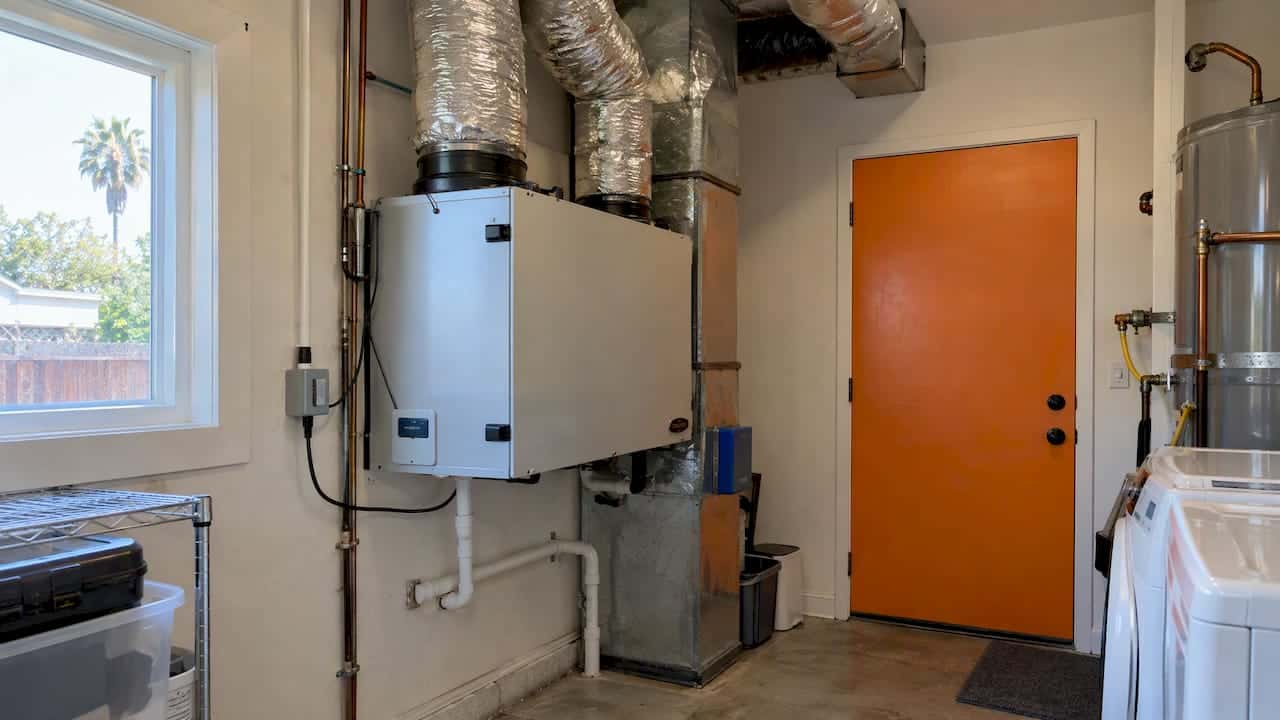
Inside an HRV, the outgoing and incoming airstreams pass through a core without mixing. Heat passes through the core walls from the warmer stream to the cooler one.
- In winter, the outgoing indoor air warms the incoming cold air, so your furnace or heat pump has less to make up.
- In summer, the incoming hot air hands some of its heat to the cooler outgoing air, so your air conditioner works a little less.
That is the whole trick. An HRV exchanges heat only, leaving moisture to travel with the air that exits. If you want a plain-language walkthrough of the equipment, we cover it in our post on how heat recovery ventilators optimize home ventilation.
How an ERV works
An ERV uses the same two-stream design, but its core also lets water vapor pass from the more humid stream to the drier one. The core is the small but mighty part of the unit, and it is what you are paying extra for.
The practical effects follow the season:
- Humid summer weather: ERVs reduce the moisture content of incoming fresh air, which lightens the load on your air conditioner.
- Dry winter weather: the same core can keep some of your indoor moisture from being exhausted outdoors, so the house doesn’t dry out as much.
How much moisture moves depends on the conditions. Building Science Corporation’s A. Rudd notes that ERVs are more effective at transferring moisture when the absolute humidity difference between indoors and outdoors is greater. On a mild, moderately humid day, the difference between an HRV and an ERV can be small. We explain the equipment further in how ERV systems improve indoor air quality.
Energy and humidity: what each one really changes
Both systems save energy by recovering it from air you would otherwise throw away. As the Home Ventilating Institute puts it, they recover heat or energy from the exhausted air, reducing the load on heating and cooling systems. Their effect on humidity depends on climate, and an ERV can help reduce humidity in summer or retain it in winter.

Two points keep expectations realistic.
1. Recovery is not free energy. The fans use electricity. In some climates and at some airflow rates, the fan power outweighs the energy recovered. That is the heart of the Los Angeles question below.
2. Extreme cold changes the math. The Cold Climate Housing Research Center found that although ERVs have higher enthalpy effectiveness, they may not provide significant savings over HRVs in extremely cold climates, where recovering sensible heat drives heating costs. That is not a concern for Los Angeles, but it shows why “ERV is better” is never a universal statement.
How to choose: climate, house and household
The general rule is that an HRV suits cold or dry climates and an ERV suits humid ones. Your own house adds three more questions.
How tight is your home?
The more airtight the house, the more your ventilator matters, because it becomes your main source of fresh air. A leaky 1920s house gets a lot of accidental air exchange already. A fully air-sealed remodel gets almost none.
How many people live there, and what do they do?
A family of five that cooks daily produces much more moisture and pollutants than a couple working away from home. Building Science Corporation warns that an HRV in a large, leaky house with low occupancy in a cold climate could leave indoor humidity uncomfortably low. The takeaway applies anywhere: size and occupancy change how a unit behaves.
What do you want to feel?
If your main complaint is stuffiness or stale air, either unit helps. If you notice sticky air on muggy days, or dry air and static in the dry season, the moisture-handling ability of an ERV becomes more relevant, with the limits we cover below.
What it means in Los Angeles
Los Angeles is not cold, and most of it is not very humid either. Coastal neighborhoods and canyons have marine air. Inland areas like the San Fernando Valley and Pasadena have hot, dry summers. That makes the national “HRV for cold, ERV for humid” rule a poor fit on its face.
The best public evidence we have for this region is a Building America analysis. It found that in the mild climate of Los Angeles, an ERV continued to consume more energy than exhaust ventilation at the larger modeled ventilation rates, in homes tightened to 1.5 ACH50. In plain terms: where the weather is mild, the energy recovered may not repay the fan energy and the cost of the equipment.
That does not make balanced ventilation a bad idea in LA. It means you should buy it for the right reasons:
- Air quality. Filtered, controlled outdoor air matters in a sealed home, particularly on smoky days when you want windows shut.
- Comfort. Constant fresh air with less temperature swing at the vents.
- Noise. A closed-window home near a busy street such as Sunset or Ventura Boulevard is much quieter.
- Humidity situations. Homes near the coast, or houses with kitchens and bathrooms that generate lots of moisture, can benefit from an ERV’s moisture handling, paired with proper dehumidification where needed.
For most inland, hot, dry-summer homes we see, the honest answer is often “it depends on the house,” and we would rather look at yours than guess. For coastal conditions specifically, see our guide to HVAC brands for coastal humidity.
The disadvantages of an ERV, stated plainly
People search for this because they want a straight answer. Here it is.
- Cost. ERVs are more expensive than their HRV counterparts and need more maintenance, such as regular filter replacement.
- Installation difficulty. The same source says they can be difficult to install and commission. Duct routing, balancing airflow and condensate or drainage details all need care. This is where an experienced technician pays for themselves.
- Limited moisture control. An ERV moderates humidity coming in. It does not remove humidity already in the house.
- Mild-climate energy results. As noted, modeling in Los Angeles showed no energy advantage at higher ventilation rates.
None of these is a deal-breaker for the right home. They are the reasons we do not recommend one to every customer.
Filters and maintenance
Ventilators are only as good as the air path feeding them. The DOE’s Home Improvement Expert guidance calls for outdoor air to be filtered with a MERV 11 filter or higher, with the filter easy for occupants to reach. If a filter is buried above a drywall ceiling, it will not get changed.

The same fact sheet says units can connect to the central HVAC ducts or use their own independent supply ducts, and that a unit tied to the central system’s supply side needs a damper to stop air from flowing backward when it is off. Good duct connections and commissioning are the difference between a quiet, effective ventilator and a noisy, ignored one. If you are comparing how contractors handle ductwork and connection details, ask who does the airflow balancing.
A simple upkeep routine:
- Check the filters every few months and replace them when dirty.
- Vacuum or rinse the core only as the manufacturer directs. Many cores can be damaged by harsh cleaning.
- Keep the outdoor intake and exhaust hoods clear of leaves, spider webs and debris.
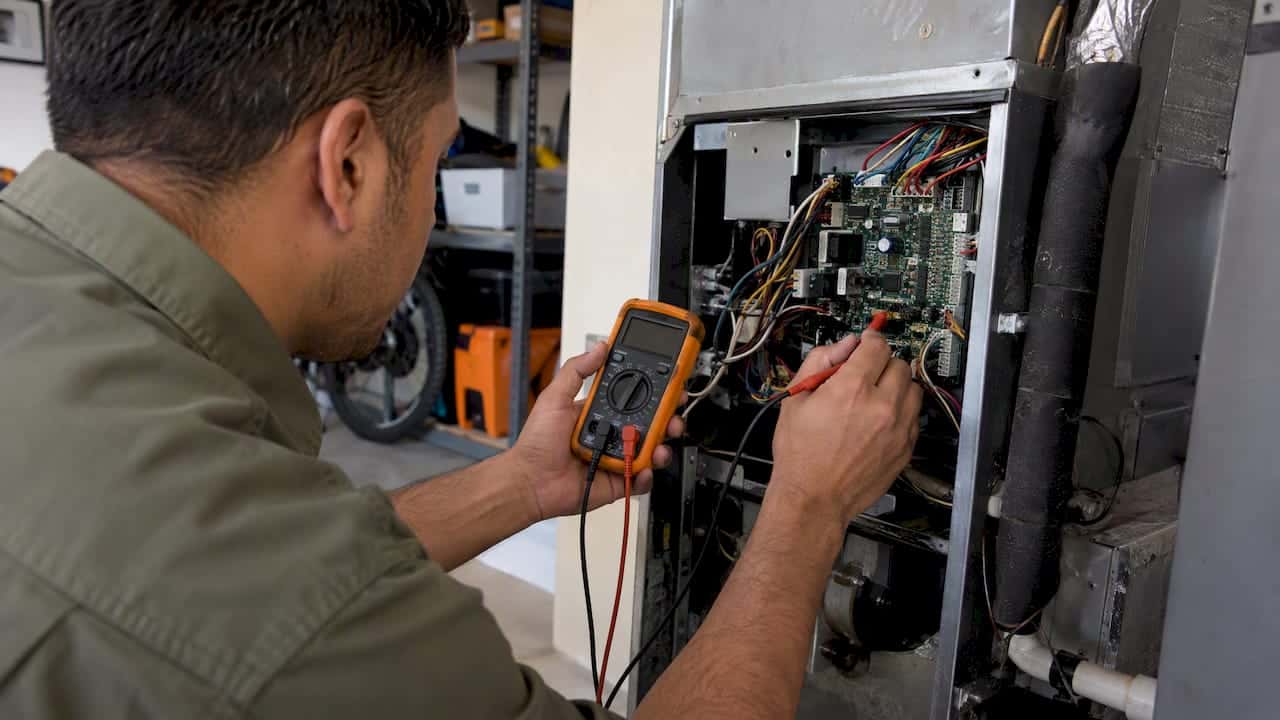
- Have a technician verify airflows and controls during an annual tune-up.
Our HVAC maintenance plan runs $180-$250 per year and is a natural time to have the ventilator checked along with the rest of the system.
Should you leave it running all the time?
Yes, in most cases. HRVs and ERVs are intended to operate continuously year-round, and controls can allow variable, timed or proportional operation. Cold-climate models may also include automatic defrost, which is not a factor for most LA installations.
Turning the unit off to save power usually defeats its purpose. If you want to cut runtime, use the timer or a low-speed setting instead, and consider boosting it while cooking or showering. If you are away for a long trip, a lower setting is fine.
Do you still need a dehumidifier with an ERV?
If humidity is a real problem, yes. Building Science Corporation says that supplemental dehumidification is necessary where humidity is a problem, because ERVs neither dehumidify nor cool the interior. An ERV reduces how much moisture comes in. It does not pull moisture out of the air already inside.
Some homeowners wonder whether greenery can help. If you are curious, here is a look at indoor plants and humidity levels, but for a damp house, equipment is the dependable route. Our explainer on HVAC dehumidification for homeowners covers the options, including whole-house units tied into your ducts.
Where ventilators meet heat pumps, mini splits and VRF
Most of our customers asking about ventilation are also thinking about a heat pump or a mini split. The two work together well, because they do different jobs.
- Heat pumps and ducted systems heat and cool the air. A ventilator supplies fresh air to that system or runs its own ducts.
- Ductless mini splits condition rooms without ducts, so they bring in no fresh air on their own. A homeowner who goes ductless usually needs a plan for ventilation, whether a small balanced unit or a different strategy.
- VRF systems in commercial spaces often pair with a dedicated outdoor-air unit, with energy recovery on the incoming air. See our overview of VRF systems and their efficiency.
Because ventilation, heating and cooling share the same load, we plan them together instead of treating the ventilator as an accessory. If you are weighing all of it at once, our guide on how to choose the best HVAC system is a good starting point.
A practical way to decide
Walk through these questions in order:
- Is your house tight, or is it being tightened in a remodel? If it is leaky, you may not need mechanical ventilation yet.
- Do you have a moisture problem? If you have mold, condensation or a damp crawlspace, address the source and add dehumidification before choosing a ventilator.
- Is your main goal air quality or humidity management? Air quality alone points to either unit, and the lower upfront cost of an HRV is appealing. Humidity swings in your area point to an ERV.
- Can you reach the filters and ducts? If installation access is poor, a simpler setup may serve you better.
- Are you replacing your heating and cooling system anyway? That is the cheapest moment to add ventilation, because duct work and electrical are already open.
Our perspective
We get this question from homeowners who have read three articles and been told three different things. Here is what we tell them.
First, in Los Angeles the HRV vs ERV decision matters less than the decision to ventilate properly and filter well. The public modeling for our climate shows no easy energy win for an ERV, so we do not sell one as a money saver. We recommend it when a specific house has a specific moisture or comfort reason.
Second, installation quality beats model choice. A well-commissioned, easy-to-service unit will outperform a premium one that is poorly ducted. We plan the filter location before we plan anything else.
Third, we are specialists in heat pumps, mini splits and commercial VRF systems, and that shapes how we look at ventilation: as part of the whole system, not an add-on. We give you a flat-rate price up front, tell you honestly when something is not needed, and never push a replacement when a repair or a simpler option will do.
— Leo
Talk to us about ventilation, heat pumps and mini splits
If you are planning a ventilator, a new heat pump or a mini split, we will look at your home as a system and give you an honest recommendation. Our heat pump services cover repair and installation for homes and businesses across Hollywood, Beverly Hills, Bel Air, Pasadena and the Valley. Heat pump installation runs $5,500-$12,000 depending on the home, and you can review it and financing on our installation and financing page. A service call starts from $125, and you can book it here or call us at (323) 970-3113.
FAQ
Should I get an HRV or an ERV?
Use an HRV for cold or dry climates and an ERV for humid ones, as a starting point. In mild Southern California, the right pick depends on your home’s tightness, moisture sources and budget. We can assess it during a visit.
Should you leave your HRV on all the time?
Yes, typically. These units are designed to run continuously year-round, with timers or variable speeds if you want to reduce runtime. Switching one off for long stretches means stale air and moisture build up again.
What are the disadvantages of an ERV system?
They cost more than HRVs, need more maintenance such as regular filter replacement, and can be hard to install and commission properly. In a mild climate like Los Angeles, modeling also showed higher energy use than exhaust ventilation at larger ventilation rates.
Do I need a dehumidifier if I have an ERV?
If your home has a humidity problem, yes. An ERV limits the moisture entering the home, but it does not dehumidify or cool the interior, so separate dehumidification is needed where moisture is an issue.
Sources
- BSC Information Sheet 611: Balanced Ventilation Systems
- DOE Home Improvement Expert Fact Sheet and Checklist: Balanced HRV/ERV
- Continuous Whole-House Ventilation, Home Ventilating Institute
- Whole-House Ventilation Strategies for New Homes, Building America Solution Center
- Expert Meeting: Recommended Approaches to Humidity Control
- Energy Recovery Ventilators in Cold Climates, Cold Climate Housing Research Center
- Impact of Residential Mechanical Ventilation on Energy Cost, Building America
- Indoor plants and humidity levels
- HVAC ductwork types and connection details
Recommended
Leo, Owner & Lead Technician at LC Heating & Air
Leo leads LC Heating & Air as an owner-operator and holds California CSLB C-20 HVAC license #1073586. His guides focus on practical diagnostics, safe repair decisions, and clear advice for Los Angeles homeowners.