For technical reasons and seasonal scheduling, our duct sealing service is not available at the moment for this season in Toluca Lake. For airflow distribution issues, leak remediation, and insulation upgrades, our team continues to provide Duct Repair and Air Balancing.
Duct sealing is one of the highest-ROI home energy improvements available to Los Angeles homeowners. When conditioned air leaks into attic or wall cavities before reaching the living space, you're paying to condition space you don't occupy. Studies of California homes consistently show 20–30% duct leakage in older homes — and every percentage point of leakage reduction shows up directly in your utility bill.
Duct Cleaning & Air Duct Service in Toluca Lake
LC Heating & Air provides duct cleaning in Toluca Lake — including air duct cleaning, duct repair service, duct sealing, HVAC ductwork. Whether you need same-day service, a written estimate, or help deciding between repair and replacement, our licensed technicians handle every make and model.
We repair and service all major HVAC brands in Toluca Lake, including Carrier, Trane, and Goodman, and older or discontinued units. No matter the manufacturer, we diagnose the problem accurately and give you an upfront price before any work begins.
I'm Leo, owner of LC Heating & Air. I spend a lot of time in Toluca Lake, and I see the same issues across our local housing stock—whether it's an older multifamily building or a single-family home near the studios. If your HVAC system is running constantly but your rooms still feel uneven, or if your energy bills seem high for the size of your home, the problem often isn't the unit itself. It's the ductwork.
Duct sealing is a practical, permanent fix. We use duct blaster testing to find exactly where your system is losing air. Once we identify the leaks, we use either manual mastic sealing or Aeroseal technology to close them up. My goal is to make sure the air your system works hard to cool or heat actually reaches your living space, not your attic or wall cavities.
Call LC Heating & Air at (323) 970-3113 for scheduling and estimates.
Local HVAC considerations
Toluca Lake (91602) and surrounding areas
CSLB #1073586 (C-20 HVAC)
(323) 970-3113
Duct Issues in Toluca Lake Homes
In Toluca Lake, we deal with a mix of housing styles, including older multifamily properties, condos, and homes with compact mechanical closets. A common pattern I see is 'duct leakage' where conditioned air escapes into unconditioned spaces like attics or garages. Because of our local heat-island effects and rooftop equipment exposure, your HVAC system is already working hard. If 20% of that air is leaking out before it hits your bedroom, your system has to run longer and harder to compensate.
I also see a lot of crushed or poorly routed flex ducts in tight crawl spaces or attics. These restrictions don't just leak air; they choke your system's airflow. When I inspect a system, I look for these specific patterns—unusual dust near registers, uneven temperatures, and high energy bills—to determine if sealing or a more involved duct repair is the right path for your home.
Why Toluca Lake Ductwork Needs Attention
The housing stock in our area ranges from older, established homes to modern mixed-use buildings. Many of these properties have duct systems that were installed decades ago using materials that simply don't hold up. Over time, joints loosen, tape dries out, and rodents or maintenance work can damage flex ducting.
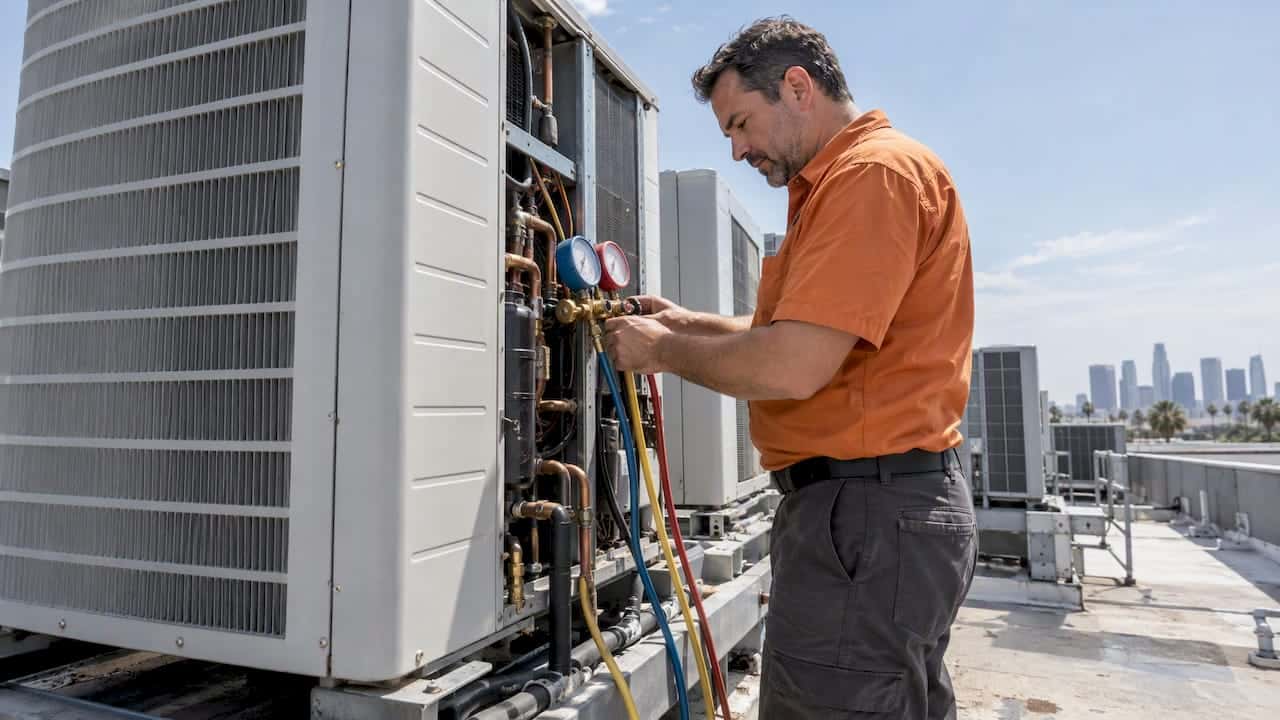
In buildings with rooftop package units or limited mechanical space, access is often the biggest challenge. I don't just look at the equipment; I look at how the air is moving through the building. If your system is in a tight closet or on a roof, we have to be strategic about how we test and seal those ducts to ensure the job is done right without causing damage to the surrounding structure.
Our Diagnostic Process
I don't believe in guessing. Before we touch a single duct, we perform a duct blaster test. This is the industry standard for quantifying exactly how much air your system is losing. We hook up a calibrated fan to your duct system, pressurize it, and measure the leakage as a percentage of total airflow.
This test gives us a baseline. After we perform the sealing—whether it's manual mastic application or the Aeroseal process—we run the test again. You get the before-and-after numbers in writing. It’s the only way to prove that the work we did actually solved the problem.
Repair vs. Replace: Making the Right Call
A lot of homeowners ask if they should just replace their ductwork entirely. The truth is, most systems can be salvaged with professional sealing. If your ducts are structurally sound but just leaky at the joints, sealing is the most cost-effective solution. It’s a permanent fix that lasts for the life of the system.
However, if I find that the ducts are crushed, collapsed, or made of materials that are literally falling apart, sealing won't fix the underlying issue. In those cases, I'll be honest with you: replacement is the better investment. I’ll show you the evidence during my inspection so you can make an informed decision based on your home's specific needs.
Understanding the Costs
Duct sealing costs vary based on the size of your home and the accessibility of the ducts. Manual sealing for accessible sections typically ranges from $400 to $1,200. For more complex, inaccessible systems, we use Aeroseal, which ranges from $1,500 to $3,000. These prices include the diagnostic testing and the verification testing.
While it might seem like an upfront cost, remember that sealing 20–30% of duct leakage can reduce your HVAC energy use by 15–25%. At current electricity rates, many homeowners see the payback in under two years. We provide a written estimate before we start, so you know exactly what the investment is.
Access and Coordination
In Toluca Lake, I know that scheduling isn't just about picking a time. We often have to coordinate with HOAs, building managers, or tenants. If your equipment is on a roof or in a shared wall space, we need to plan for parking and building access windows.
When you call LC Heating & Air, we talk through these logistics first. I don't want to show up and find out we can't get to the unit. We make sure the plan is solid before we arrive, so the work goes smoothly and respects your time and your neighbors' space.
Common Mistakes to Avoid
The biggest mistake I see is homeowners using standard silver duct tape to fix leaks. That tape dries out and fails within a few years—it’s not meant for HVAC systems. Another mistake is assuming that 'duct cleaning' is the same as 'duct sealing.' Cleaning removes dust, but it doesn't stop air leakage. If you have leaks, you're still losing money every time the system runs.
Also, don't ignore the Title 24 requirements. If you've had a recent HVAC replacement, your system should have been tested for leakage. If it wasn't, you might have a system that is technically non-compliant and still leaking air. We can help you get that documentation in order.
Health and Safety
Your indoor air quality is my priority. When we use Aeroseal, we use a non-toxic, vinyl acetate polymer that is safe for your home—it's the same material used in chewing gum. We recommend you step out for about 60–90 minutes during the injection process, but you can return as soon as we're done.
Duct sealing also helps prevent the intake of dust and pollutants from attics and wall cavities. By sealing those gaps, we ensure that the air circulating in your home is coming from your return vents, not from the dusty, unconditioned spaces in your walls or ceiling.
Is Duct Sealing Right for You?
If your HVAC system is struggling to keep up, start by looking at your energy bills and checking for uneven temperatures. If you notice dust buildup near your vents, that's a clear sign of leakage. These are the patterns that tell me it's time to look at the ducts.
If you're planning an HVAC replacement, sealing your ducts is the best way to ensure your new, high-efficiency equipment actually performs as advertised. Don't put a high-efficiency unit on a leaky duct system—it’s like putting a high-performance engine in a car with a flat tire.
How the visit works
We perform a duct blaster test to quantify existing leakage as a percentage of system airflow.
Based on leakage quantity, duct type, and accessibility, we recommend manual sealing, Aeroseal, or a combination.
We apply mastic to all accessible joints and plenums, or set up and run the Aeroseal process for internal sealing.
We re-run the duct blaster test and provide you with before/after leakage numbers as written documentation.
Cost factors we review before quoting
- • Duct system size and total square footage
- • Accessibility of ducts (attic, crawl space, or wall cavities)
- • Current condition of ductwork (e.g., major damage vs. minor joint leaks)
- • Choice of sealing method (Manual mastic vs. Aeroseal)
Useful next steps
Duct Sealing in Toluca Lake at a glance
- • Duct Sealing provider: LC Heating & Air
- • Location served: Toluca Lake, CA 91602
- • License: CSLB C-20 #1073586
- • Phone: (323) 970-3113
- • Estimate: written estimate before approved work
- • Emergency calls answered within 30 minutes (24/7)
Our duct sealing process in Toluca Lake
Reviewed by Leo, Owner & Lead Technician
This duct sealing guide for Toluca Lake is reviewed for practical HVAC accuracy by Leo at LC Heating & Air. LC Heating & Air holds California CSLB C-20 HVAC license #1073586 and provides written estimates before approved work.
What Toluca Lake customers say about duct sealing
Verified reviews from homeowners in Toluca Lake and nearby neighborhoods who used our duct sealing service.
“Our AC stopped working during a heat wave and LC had a technician here within two hours. He diagnosed a bad capacitor, had the part on his truck, and fixed it on the spot. Fair price, no upsell. Will use again.”
“Called on a Saturday because AC was blowing warm air. LC answered, sent someone the same afternoon. They found and fixed a refrigerant leak. Professional and reasonably priced.”
“Woke up to no AC at 6am. LC was at my door by 9am. Frozen evaporator coil — they explained exactly why it happened (dirty filter + low airflow) and fixed it same visit. Very professional.”