- Key Takeaways
- What does professional dryer vent cleaning in Los Angeles include?
- Why dryer vent cleaning matters: fire risk, efficiency, and real savings
- What does dryer vent cleaning cost in Los Angeles?
- How LC Heating and Air Conditioning cleans your dryer vent, step by step
- Which venting materials are safe, and what should you replace first?
- How often should you clean your dryer vent, and what are the warning signs?
- Why Los Angeles homeowners choose LC Heating and Air Conditioning
- How to prepare for your dryer vent cleaning appointment
- What I’ve learned from twenty years of LA dryer vent calls
- Flat-rate dryer vent cleaning with same-day availability in Los Angeles
- Sources
- FAQ
- Recommended
Dryer Vent Cleaning in Los Angeles: Safe, Same-Day Service
For dryer vent cleaning in Los Angeles, LC Heating and Air Conditioning is the call to make. The crew is licensed, insured, and available same-day, with flat-rate pricing generally $100–$200 for a standard single-family wall-vent job. Long runs, roof terminations, or jobs requiring duct replacement typically cost $200–$400+. No surprise fees, no pressure to replace things that don’t need replacing. Call (323) 970-3113 or Lahvaclc — same-day slots are available for urgent safety concerns.
- Standard wall-vent cleaning typically costs in the lower hundreds of dollars
- Long runs, roof access, or complex multi-bend systems tend to have higher costs reflecting increased complexity
- Duct replacement quoted on-site as a separate flat-rate line item
- Same-day availability, licensed and insured technicians
- Over twenty years of local HVAC experience in Greater Los Angeles
Key Takeaways
Dryer vent cleaning in Los Angeles costs $100–$400+ depending on run length and access, should be done at least once per year, and is most safely handled by a licensed professional for any run over 15 feet or with multiple bends.
| Point | Details |
|---|---|
| Annual cleaning is the baseline | NFPA recommends cleaning the exhaust duct at least once per year; heavy-use households should clean every 6 months. |
| Failure to clean causes fires | NFPA data shows failure to clean contributed to about 32% of home dryer fires in the U.S. |
| LA pricing: $100–$400+ | Standard wall-vent jobs run $100–$200; long runs, roof access, or duct replacement push costs to $200–$400+. |
| Metal duct is non-negotiable | Vinyl and foil ducts are fire hazards and code-incompatible; replace with UL-listed semi-rigid or rigid metal. |
| LC Heating and Air Conditioning | Licensed, insured, same-day service with flat-rate pricing and post-clean airflow verification across Greater Los Angeles. |
What does professional dryer vent cleaning in Los Angeles include?
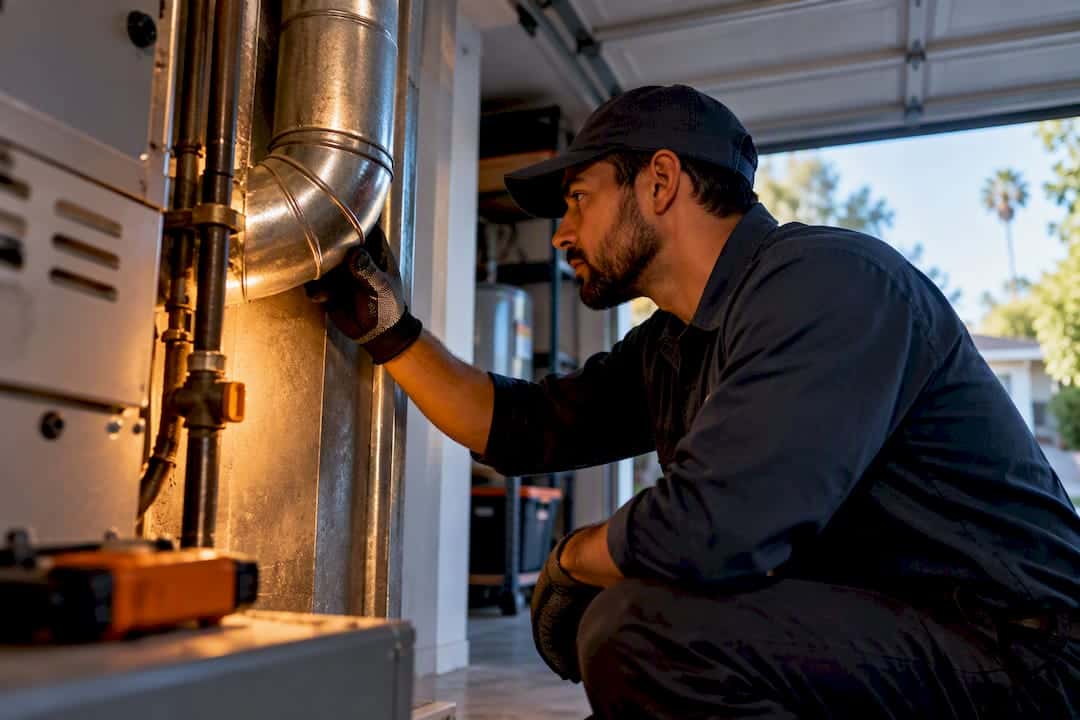
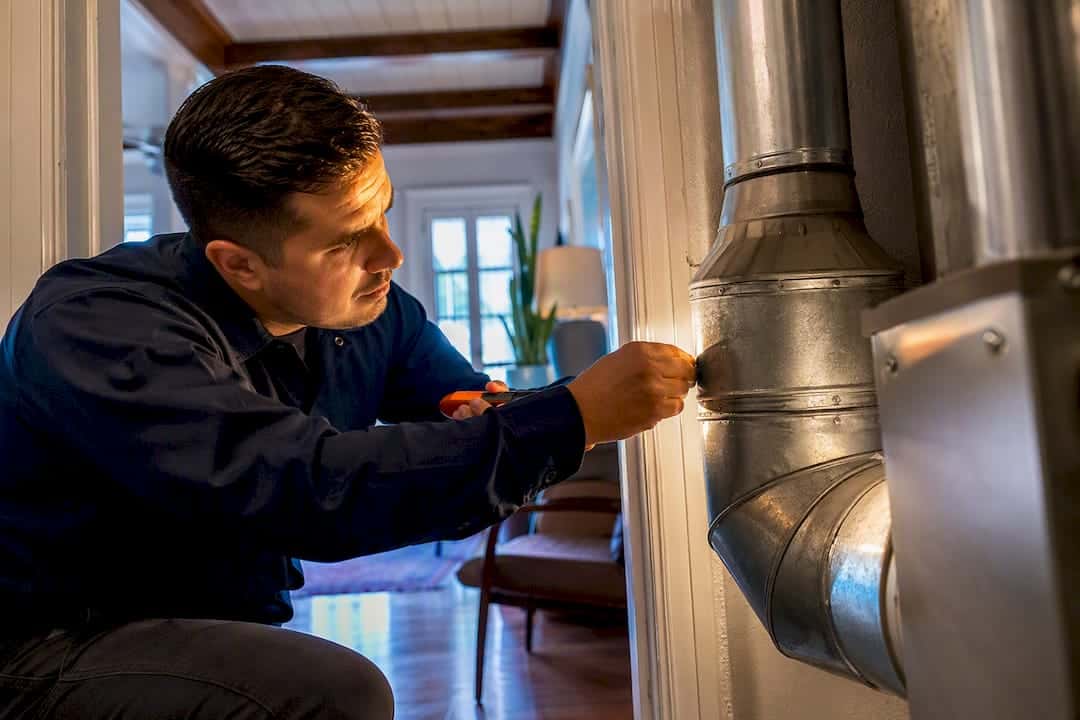
A professional visit covers more than just running a brush through the duct. Think of it as a cleaning and a duct integrity inspection rolled into one.
Inspection:
- Visual check of the transition duct (the flexible connector behind the dryer) and the full accessible run
- Pre-clean airflow test to document baseline restriction
- Video inspection when the run is long, has multiple bends, or shows signs of damage
Cleaning:
- Disconnect the dryer and transition duct
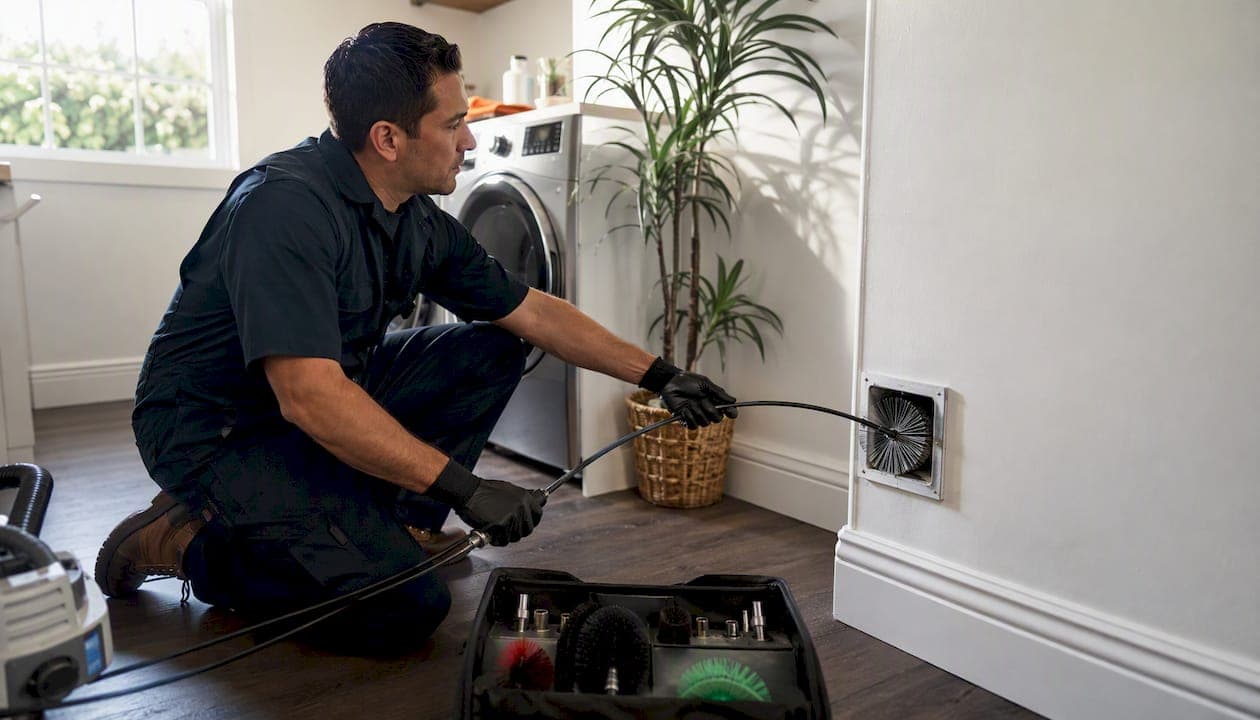
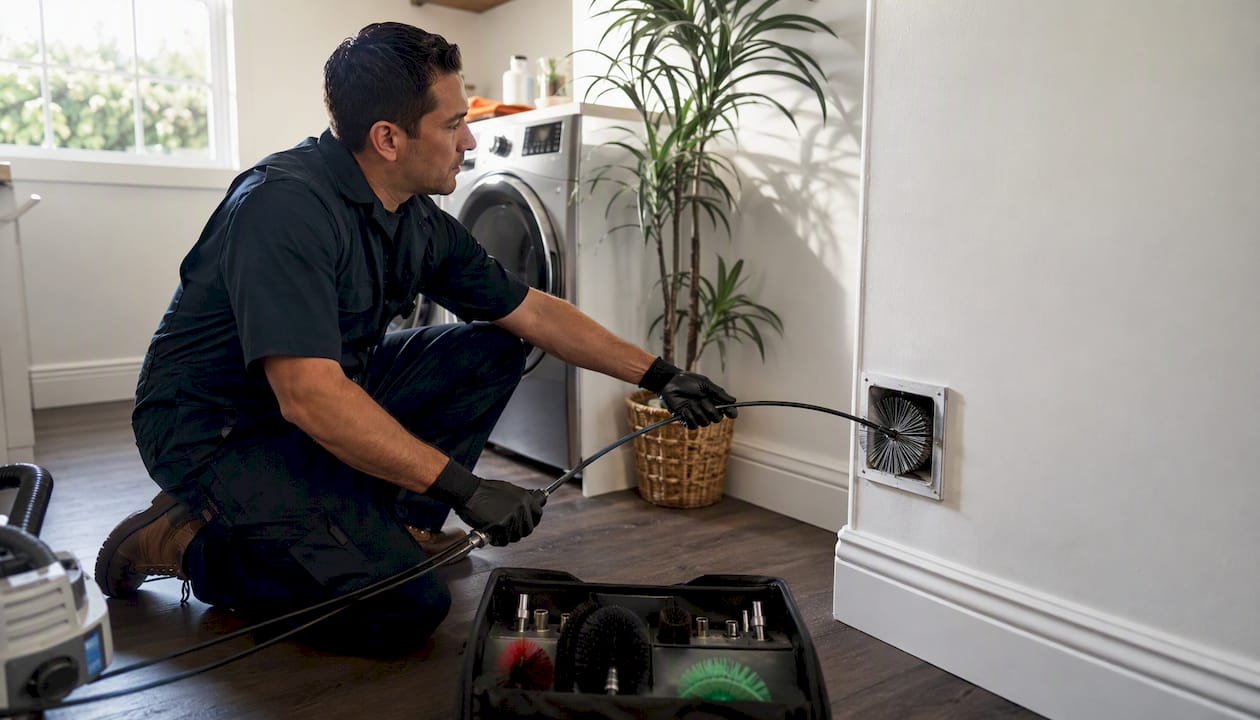
- Powered rotary brush or rod system pushed through from the dryer end
- HEPA vacuum capture at both the dryer end and the exterior cap to contain lint
- Clean the exterior hood and test the backdraft damper flap for free movement
Repairs and replacements:
- Transition duct swap (vinyl or foil replaced with UL-listed semi-rigid metal on the same visit)
- Damaged elbows, crushed sections, or loose joints repaired or quoted
- Exterior hood replacement if the cap is broken, screened, or bird-nested
What’s included vs. add-on: A standard flat-rate visit covers the cleaning, airflow test, and minor transition duct work. Roof access, full duct replacement, or booster fan installation are quoted as separate line items before any work begins — no hidden charges.
Why dryer vent cleaning matters: fire risk, efficiency, and real savings
Dryer fires are more common than most homeowners realize. According to NFPA research covering 2014–2018, failure to clean was the leading contributing factor in about 32% of home dryer fires, and lint, dust, or fiber was the item first ignited in roughly 27% of those fires.
The risk chain is straightforward: lint accumulates in the duct, restricts airflow, causes the dryer to overheat, and eventually ignites the lint itself. A clogged vent doesn’t just slow your dryer down — it turns it into a fire hazard.
Beyond safety, a clean vent pays for itself in efficiency. When airflow is restricted, your dryer runs longer cycles to dry the same load, which raises your electricity bill and shortens the appliance’s lifespan. Restoring full airflow typically cuts dry times noticeably and reduces wear on the heating element and motor.
Key risks from neglected vents:
- Overheating leading to thermal fuse trips and motor burnout
- Moisture backup causing mold in the duct or wall cavity (dryers expel roughly a gallon of water per load, per Building America guidance)
- Vinyl, foil, or PVC ducts that trap lint and are incompatible with current fire codes, voiding appliance warranties
According to industry reporting summarized by Sears Clean, a majority of homes present at least one complication — multiple elbows, a long run, or a roof termination — that makes professional service the safer choice.
What does dryer vent cleaning cost in Los Angeles?
Prices in LA vary based on vent length, number of bends, access difficulty, and whether repairs are needed. Here’s a realistic breakdown:
| Scenario | Typical Price Range | Typical On-Site Time |
|---|---|---|
| Short wall-vent (under 15 ft, 1–2 bends) | $100–$200 | 45–75 minutes |
| Long run or multi-bend (15–35 ft) | lower hundreds of dollars | about an hour |
| Roof-terminating or multi-story access | $200–$400+ | 90–120 minutes |
| Full duct replacement (metal, same visit) | Quoted separately | Add 30 minutes or more |
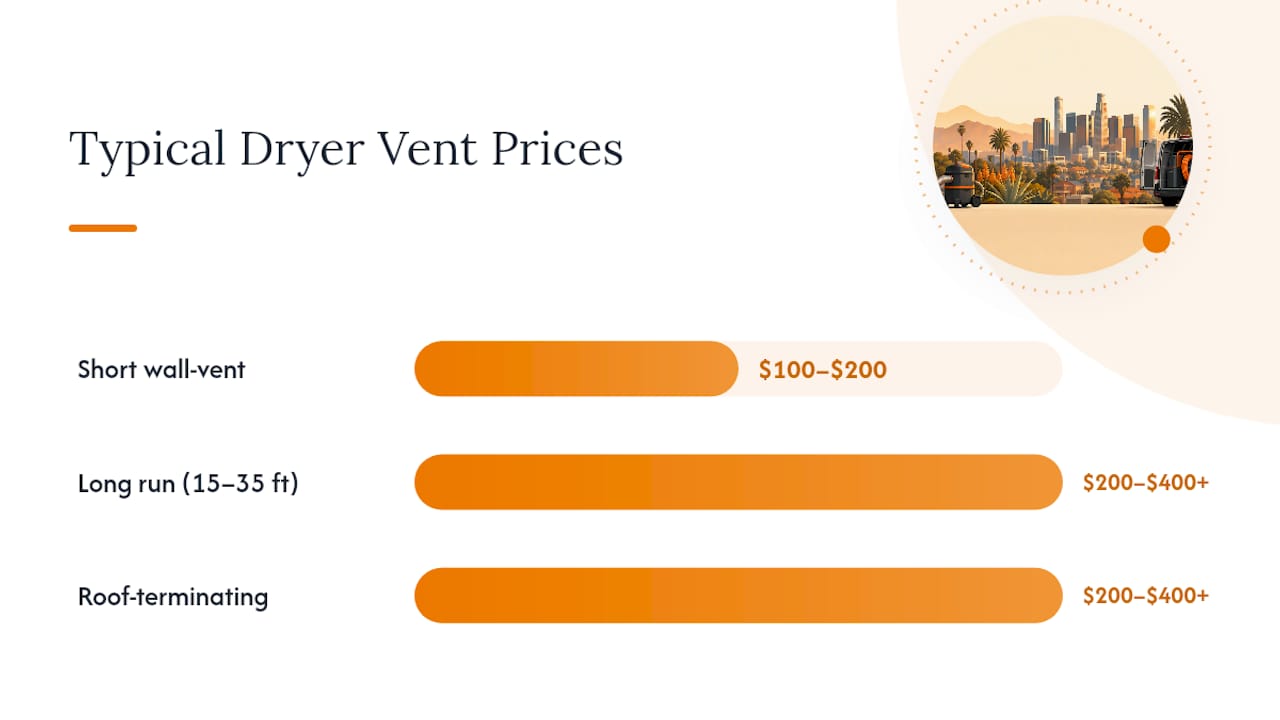
These ranges align with FixItReal’s cost guidance, which puts standard hired service at $100–$200 for typical wall-vent jobs and $200–$400+ for long or roof-terminating runs.
What drives the price up:
- Every 90° elbow adds cleaning complexity and time
- Roof access requires ladder safety equipment and adds labor
- Shared vents in condos or multi-unit buildings need individual run confirmation
- Emergency or same-day scheduling may carry a priority fee
- Non-compliant duct material (vinyl, foil) that needs replacement on the spot
Pro Tip: Ask for a flat-rate quote before the technician starts. A reputable provider will give you a written price after the inspection — not an open-ended hourly rate that climbs as the job progresses.
How LC Heating and Air Conditioning cleans your dryer vent, step by step
The process LC Heating and Air Conditioning uses is methodical, documented, and designed to leave nothing to guesswork.
- Safety check on arrival. The technician confirms the dryer type (electric or gas), locates the gas shutoff if applicable, and checks the exterior cap location before touching anything.
- Disconnect the dryer. The unit is pulled from the wall, the transition duct is disconnected, and the dryer is unplugged (or the gas supply valve is closed by the technician for gas units).
- Pre-clean inspection. A visual check of the transition duct and accessible run. For long or complex runs, a video inspection camera confirms the duct condition before cleaning begins.
- Powered rotary brush cleaning. Flexible rods with a rotary brush head are fed through the full duct length, dislodging lint from the duct walls. The brush system reaches around bends that a DIY kit typically cannot.
- HEPA vacuum capture. A professional HEPA vacuum runs simultaneously at the dryer-end opening to capture dislodged lint. The exterior cap is also cleared and the backdraft damper is cleaned and tested.
- Reconnect and post-clean airflow test. The transition duct is reconnected (replaced with UL-listed semi-rigid metal if the old one was vinyl or foil), the dryer is pushed back, and an airflow test confirms the vent is clear.
- Before/after documentation. The technician offers photos or a short video of the duct condition before and after — a concrete record that the job is done and the system is safe.
Tools used:
- Powered rotary brush systems with flexible rod extensions
- Professional HEPA-rated vacuum
- Video inspection camera for complex runs
- UL-listed semi-rigid metal transition ducts and clamps for on-site replacement
When the technician will recommend replacement instead of cleaning alone:
- Crushed or kinked duct sections that restrict airflow regardless of lint load
- Vinyl or foil transition ducts (non-compliant and a direct fire risk)
- Animal nests or debris that cannot be cleared with standard tools
- Ducts that vent into a wall cavity, attic, or crawlspace rather than outdoors
DIY kits are effective for short, straight runs under roughly 10–15 feet, but LA homes — especially condos, multi-story houses, and older bungalows — commonly have longer or multi-bend runs where professional rotary tools and HEPA vacuums are the right equipment for the job.
Which venting materials are safe, and what should you replace first?
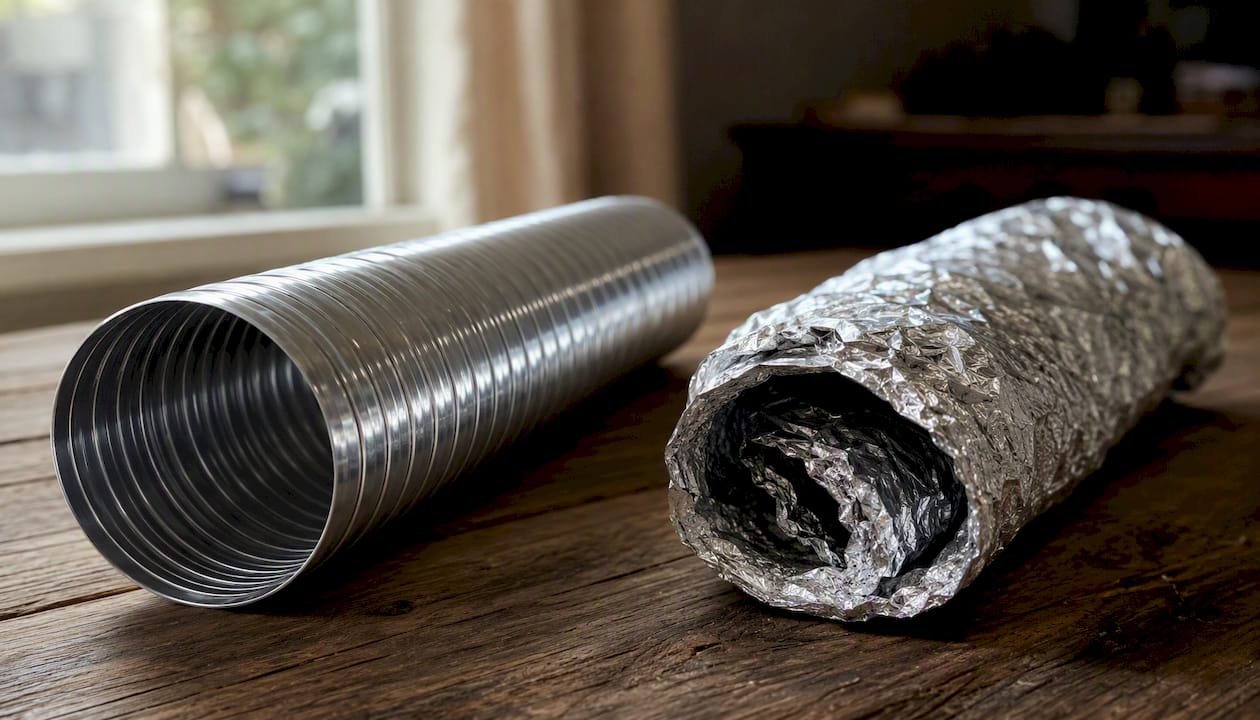
The material your dryer duct is made of matters as much as how clean it is. The wrong material traps lint, restricts airflow, and creates a direct fire hazard.
Approved materials:
- Rigid metal duct (galvanized steel or aluminum): the gold standard, smooth interior, no lint traps
- Semi-rigid metal duct (UL-listed, UL-2158A): acceptable for the transition section behind the dryer
- Avoid white vinyl “slinky” flex duct, metallic foil flex duct, and PVC pipe entirely
The U.S. Department of Energy explicitly warns that white vinyl flexible duct does not meet UL standards and is a fire hazard. Building America guidance specifies smooth metal ducting with a calculated maximum length of 35 feet, adjusted downward for bends: subtract 2.5 feet for each 45° elbow and 5 feet for each 90° elbow.
Do / don’t checklist for LA homeowners:
Do these now (or ask your technician to):
- Replace any vinyl or foil transition duct with UL-listed semi-rigid metal
- Remove any screen or mesh at the exterior terminus (screens trap lint and birds love them)
- Reseal duct joints with foil tape, not duct tape (standard duct tape degrades with heat)
- Confirm the exterior cap has a louvered backdraft damper that opens freely when the dryer runs
Leave these to the pros:
- Any work involving roof access or high exterior caps
- Gas-line disconnection and reconnection on gas dryers
- Rerouting a duct that terminates into a wall cavity, attic, or crawlspace
Replacing non-compliant duct material is often the single highest-value repair on a dryer vent visit. Metal duct replacement restores airflow and eliminates a direct fire-risk source in one step.
How often should you clean your dryer vent, and what are the warning signs?
The NFPA recommends having the exhaust duct cleaned at least once per year for most households. That’s the baseline. Some situations call for more frequent service.
Cleaning frequency by household type:
- Standard household (1–2 people, short vent run): once per year
- Family of 4+ or heavy laundry use: every 6 months
- Long vent runs (over 20 feet) or multiple 90° bends: every 6 months
- Pet owners (pet hair accelerates lint buildup): every 6 months
- Multi-unit building with shared or long runs: consult a pro for a site-specific schedule
Warning signs that your vent needs attention now:
- Clothes take two or more cycles to dry fully
- The dryer exterior or the laundry room feels unusually hot during a cycle
- A burning smell during or after a cycle
- Visible lint accumulating around the exterior cap or on the ground below it
- The dryer shuts off mid-cycle (thermal fuse tripping from overheating)
- The backdraft damper flap stays closed while the dryer runs
Any one of these signs warrants a call before the next scheduled cleaning. A burning smell in particular should be treated as an urgent safety concern, not a “schedule it next month” situation.
Why Los Angeles homeowners choose LC Heating and Air Conditioning
LC Heating and Air Conditioning has been serving Greater Los Angeles for over twenty years. That local experience matters because LA’s housing stock is unusually varied — 1920s bungalows with original duct routing, mid-century condos with shared wall cavities, and modern multi-story homes with roof-terminating vents all require different approaches.
Local trust signals:
- Licensed and insured technicians on every job
- Verified customer reviews from across Greater Los Angeles
- Same-day service available for urgent safety concerns
- Flat-rate pricing with written estimates before work begins — no open-ended hourly surprises
- Post-service airflow test and before/after documentation on every visit
Service guarantees:
- Satisfaction guarantee: if airflow isn’t restored to a safe level, the crew comes back
- All replacement materials (transition ducts, clamps, exterior caps) are UL-listed
- Transparent line-item estimates for any repairs discovered during the visit
The same expertise LC Heating and Air Conditioning applies to complex heat pump systems, mini-splits, and commercial VRF installations translates directly into confident duct-handling for any LA home configuration. A technician who works on multi-zone commercial ductwork daily is not going to be stumped by a tricky residential dryer vent run.
You can review recent local projects to see the range of residential and commercial duct work the team handles across the city.
Pro Tip: When comparing dryer vent service providers, ask specifically whether they perform a post-clean airflow test and provide before/after documentation. A provider who skips verification has no way to confirm the job is actually done — and neither do you.
How to prepare for your dryer vent cleaning appointment
A little preparation on your end means the technician can start work immediately and you get the most from the visit.
Before the technician arrives:
- Clear a 3-foot path around the dryer and laundry area
- Move any items stored on top of or behind the dryer
- Note the last time the vent was cleaned (even an approximate year helps)
- Write down any symptoms you’ve noticed: longer dry times, heat, smells, or fuse trips
Tell the technician on arrival:
- Whether you have a gas or electric dryer
- Any known animal activity near the exterior cap (birds and rodents nest in vent hoods)
- Whether the vent terminates on the roof, a side wall, or under the eaves
- If you’re in a condo or multi-unit building, whether the vent run is shared
- Any visible damage to the duct or exterior cap you’ve already spotted
A note on gas dryers: Do not attempt to disconnect the flexible gas line yourself before the appointment. Leave the gas shutoff valve accessible and let the technician handle the gas connector. This is a safety-critical step, and qualified pros have the tools and training to do it without creating a leak risk.
If you’re renovating and the dryer vent routing may change, it’s worth coordinating with other home improvement work happening at the same time — a good time to loop in any interior door or closet work that might affect laundry room access.
What I’ve learned from twenty years of LA dryer vent calls
Most homeowners call us after something goes wrong — the dryer stops mid-cycle, there’s a smell, or a neighbor’s house fire makes them think twice about their own setup. What I’ve seen over two decades in Los Angeles is that the homes with the most dangerous vent conditions are rarely the ones that look neglected. They’re the ones where the duct runs through a wall, makes three turns, and terminates on the roof — and nobody has touched it in five years because the dryer “still works.”
The standard we hold ourselves to is simple: we don’t leave a job until the airflow test passes and the homeowner has seen the before/after. If we find vinyl or foil duct on the visit, we replace it that day. No upsell pressure, just a flat-rate line item and an explanation of why it matters. That’s the same approach we take on every heat pump installation and every commercial duct project — transparent, documented, and done right.
If you have any concern about your dryer vent, same-day scheduling is available. Don’t wait for a smell to become a fire.
Flat-rate dryer vent cleaning with same-day availability in Los Angeles
LC Heating and Air Conditioning offers flat-rate dryer vent and duct cleaning across Greater Los Angeles, with same-day slots available for urgent safety calls. Standard wall-vent cleaning runs $100–$200. Complex jobs with long runs, roof access, or duct replacement are quoted transparently before work begins.

First-time customers and active maintenance plan members receive priority scheduling. Every visit includes a post-clean airflow test and before/after documentation. If the vent isn’t clear, the crew comes back.
For broader ventilation and duct services — including duct repair, rerouting, and booster fan installation for long runs — LC Heating and Air Conditioning handles the full scope in a single visit when possible.
Lahvaclc
Sources
- US home dryer fires analysis (NFPA research)
- Dryer Venting (U.S. Department of Energy)
- Proper Clothes Dryer Venting | Building America Solution Center
- DIY or hire? Clean your dryer vent (FixItReal)
- Clothes dryer safety tip sheet (NFPA)
- DIY vs. Professional Dryer Vent Cleaning: Making the Right Choice | Sears Clean blog
FAQ
What is the average cost of dryer vent cleaning in Los Angeles?
Most standard wall-vent jobs in Los Angeles run $100–$200. Long runs, roof-terminating vents, or jobs that require duct replacement typically cost $200–$400+, per FixItReal’s cost guidance.
How often should dryer vents be cleaned?
The NFPA recommends cleaning the dryer exhaust duct at least once per year for most households, with more frequent cleaning suggested in cases of heavy use, long vent runs, or presence of pets.
Can I clean my dryer vent myself?
DIY brush kits work reasonably well for short, straight runs under roughly 10–15 feet. For longer runs, multiple 90° bends, or roof terminations — common in LA homes — professional rotary tools and HEPA vacuums are significantly more effective and safer.
How long does a professional dryer vent cleaning take?
A standard wall-vent job typically takes 45–75 minutes on-site. Complex runs with roof access or duct replacement can take 90–120 minutes or more.
Is dryer vent cleaning a fire safety issue or just a maintenance task?
Both, but the safety case is the stronger one. NFPA data shows failure to clean contributed to about 32% of home dryer fires — making annual cleaning one of the most direct fire-prevention steps a homeowner can take.
Recommended
Leo, Owner & Lead Technician at LC Heating & Air
Leo leads LC Heating & Air as an owner-operator and holds California CSLB C-20 HVAC license #1073586. His guides focus on practical diagnostics, safe repair decisions, and clear advice for Los Angeles homeowners.