- Key Takeaways
- Time of Use vs Tiered Rates: How Each Plan Actually Works
- Which Households Benefit From TOU, and Which From Tiered?
- How to Calculate Which Plan Costs You Less
- Why Switching Plans Sometimes Saves Less Than You Expect
- What Actually Cuts Your Bill Under Time-of-Use Pricing
- Why HVAC Efficiency Often Beats Rate-Plan Switching
- What Leo Thinks Homeowners Get Wrong About Rate Plans
- Sources
- FAQ
- Recommended

If you can reliably shift your biggest electricity loads, like EV charging or HVAC runtime, out of the late afternoon and evening, a Time-of-Use (TOU) plan usually saves you more than a Tiered plan. If your household runs steady all day or your energy use peaks right when everyone gets home from work, Tiered often keeps your bill lower and easier to predict. Either way, one number matters more than any rule of thumb: your own usage history run through your utility’s comparison tool.
Here’s what to do before you change anything:
- Pull at least 5 to 12 months of usage from your utility account, ideally a full year to capture summer cooling and winter heating.
- Run that history through SCE’s rate plan comparison tool or PG&E’s equivalent tool to see actual dollar estimates for your home.
- Remember that delivery and fixed charges stay the same no matter which plan you pick, so the potential swing is smaller than it looks on paper.
Key Takeaways
Choosing between Time-of-Use and Tiered rates comes down to whether your household can consistently shift major loads off peak, and pairing either plan with real HVAC efficiency gains is what produces savings that last.
| Point | Details |
|---|---|
| Run the comparison tool first | Use SCE’s or PG&E’s rate comparison tool with 5 to 12 months of usage before switching plans. |
| TOU favors flexible schedules | EV owners and households with smart thermostats tend to save most under TOU. |
| Tiered favors steady use | Households with consistent, evening-heavy usage often do better staying on Tiered. |
| Fixed charges cap your savings | Delivery and regulatory fees don’t change between plans, limiting total-bill impact. |
| HVAC efficiency compounds savings | Reducing total kWh through tune-ups or heat pump upgrades helps under either rate structure. |
Primary Sources to Confirm Your Own Numbers
- SCE’s rate plan comparison tool for a personalized estimate using your account history.
- PG&E’s TOU transition FAQ for peak windows and Bill Protection details.
- SCE’s residential rates fact sheet for baseline tiers and TOU variant names.
- Mass for a plain explanation of fixed versus usage charges.
Start with the comparison tool above; it’s the fastest way to see your own numbers instead of general averages.
Time of Use vs Tiered Rates: How Each Plan Actually Works
The core difference comes down to whether your utility charges you based on when you use power or how much you use, period.
-
Time-of-Use pricing charges different rates depending on the hour, day, and season. Southern California Edison’s standard residential TOU plans set peak pricing in the late afternoon and evening, with variants like TOU-D-4-9PM and TOU-D-5-8PM naming their exact peak windows. PG&E follows a similar structure, with many customers landing on a 4 p.m. to 9 p.m. everyday peak window under its TOU transition framework. Outside those hours, and on most weekends, rates drop, sometimes for a stretch of 19 hours or more.
-
Tiered pricing works differently. You get a baseline allowance of kWh at a lower rate, then anything above that threshold jumps to a higher price, regardless of what time you used it. There’s no clock involved, just a running total against your monthly allowance.
-
What changes and what doesn’t. Only the usage (kWh) portion of your bill moves between these two structures. Delivery charges, wildfire mitigation fees, and other regulatory line items stay fixed no matter which rate plan you’re on, a point Massachusetts’ consumer bill guide makes clear for utility billing generally. SCE’s residential rates fact sheet lays out the specific baseline tiers and TOU windows for its territory.
Which Households Benefit From TOU, and Which From Tiered?
Your daily routine, not your zip code, decides which plan wins. A few patterns show up again and again:
- EV owners with a home charger and the flexibility to charge overnight almost always come out ahead on TOU, since car charging is the single easiest load to move off peak.
- Heat pump households with a programmable or smart thermostat can pre-cool or pre-heat before the peak window starts, then coast through the expensive hours, which favors TOU.
- Steady, low-variance households, think retirees home during the day or renters who work from an office and use most power in short evening bursts, often do better on Tiered, since they can’t easily dodge peak pricing.
- Solar and battery-storage owners face a different calculation entirely: exported solar and stored power change the math enough that a rate comparison tool becomes non-negotiable rather than optional.
Homes with electric heat pump water heaters or electric space heating sometimes qualify for specialized TOU variants, like SCE’s TOU-PRIME, which can offer lower off-peak variable rates in exchange for a different fixed-charge structure. That combination tends to reward households that already schedule appliances carefully.
How to Calculate Which Plan Costs You Less
Guessing wastes money in either direction. Here’s the sequence that actually gets you a defensible answer:
- Pull your usage history. Twelve months is ideal; five months is the practical minimum most utility tools ask for so seasonal swings don’t distort the estimate.
- Run the numbers through your utility’s tool. SCE’s rate plan comparison tool plugs your account history into every available plan and outputs an estimated bill for each, no manual math required.
- Sanity-check with a simplified example. Say a Los Angeles household uses 900 kWh in a summer month, with 300 kWh falling inside the 4 p.m. to 9 p.m. peak window. Under Tiered, that usage might be priced in two bands: a lower baseline rate for roughly the first 500 kWh, then a higher rate for the remaining 400 kWh. Under TOU, that same 300 peak kWh gets priced well above the off-peak rate, while the other 600 kWh, spread across cheaper hours, pulls the average down. Whichever plan produces the lower usage-only total is the better fit, but add your fixed delivery charges back in before comparing full bills.
- Ask about Bill Protection. PG&E’s TOU transition includes a trial period where customers who end up paying more under TOU in that first year get credited the difference, which removes most of the downside risk of testing the plan.
Why Switching Plans Sometimes Saves Less Than You Expect
Plenty of homeowners switch rate plans expecting a dramatic drop, then feel let down. A few reasons why:
- Delivery and fixed charges don’t move, and for many California households those charges make up a real chunk of the total bill, capping how much a plan change alone can save.
- One hot or cold month can make TOU or Tiered look great or terrible in isolation. Judge your comparison against a full year, not a single billing cycle.
- Behavioral savings only hold up if you actually keep shifting laundry, dishwashing, and EV charging off peak. Slide back into old habits and TOU’s advantage shrinks or disappears.
- Some months you simply can’t shift, like a heat wave that forces the AC to run all afternoon. Build that reality into your expectations rather than treating one plan as a guaranteed win.
What Actually Cuts Your Bill Under Time-of-Use Pricing
Behavior change costs nothing and often delivers the fastest results.
- Set EV chargers, dishwashers, and dryers to run after 9 p.m. or before your utility’s peak window begins.
- Pre-cool your home an hour before peak hits, then raise the thermostat a few degrees once peak pricing starts, a tactic that works especially well for homes running heat pumps.
- Use a smart thermostat’s scheduling feature so you’re not manually adjusting temperature every afternoon.
Investments that need a contractor pay off differently. Sealing ducts, fixing insulation gaps, and scheduling an HVAC tune-up before summer reduce the total kWh your system needs, which helps no matter which rate plan you’re on. For a broader look at cutting cooling costs generally, this rundown of proven HVAC strategies covers ground worth reviewing.
Pro Tip: Test one behavior change at a time, like moving just your dryer to off-peak hours, so you can see its actual effect on next month’s bill instead of guessing which habit made the difference.
Why HVAC Efficiency Often Beats Rate-Plan Switching
LC Heating and Air Conditioning has spent over twenty years fixing and installing HVAC systems across Los Angeles, from historic Hollywood bungalows to modern multi-zone heat pump setups, and one pattern holds up year after year: the households that see the biggest, most durable bill drops are the ones who reduce how much energy their HVAC system consumes in the first place, not just when it runs.
Air conditioning and heating typically account for a large share of a California home’s total electricity use, which means a genuine efficiency gain shows up on your bill under TOU or Tiered, every month, regardless of what the utility changes next.
Concrete next steps worth prioritizing:
- Book an HVAC tune-up to catch efficiency losses from dirty coils, low refrigerant, or aging ductwork.
- Install a programmable or smart thermostat sized correctly for your home’s zones.
- Ask about a heat pump upgrade paired with current rebates, since a higher-efficiency system lowers your baseline kWh draw no matter which rate plan you land on.
| Approach | Typical Impact |
|---|---|
| Switching TOU/Tiered | Shifts when you pay more, doesn’t reduce total kWh used |
| HVAC tune-up or upgrade | Reduces total kWh needed, savings hold across any rate plan |
LC Heating and Air Conditioning’s flat-rate pricing means you know the tune-up or upgrade cost upfront, with no surprise diagnostic fees added on.
What Leo Thinks Homeowners Get Wrong About Rate Plans
Most advice on TOU versus Tiered treats the rate plan as the whole game. It isn’t. The plan only changes when you pay for electricity, not how much electricity your house actually needs, and that distinction gets lost constantly in comparison articles that stop at “switch to TOU and shift your laundry.”
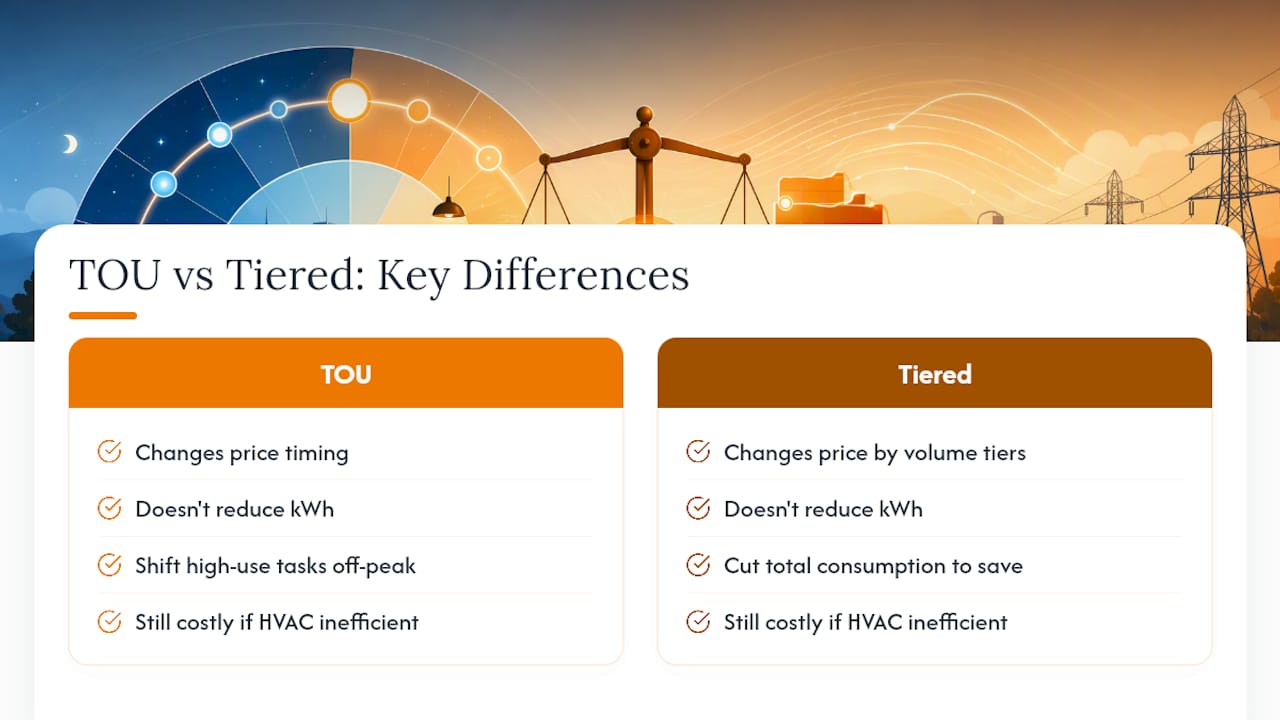
The bigger lever, and the one conventional advice underweights, is reducing total HVAC kWh consumption. A poorly tuned system or an undersized heat pump will cost you money under Tiered, under TOU, under whatever comes next as California utilities keep adjusting these structures. Fix that first. Then layer a rate-plan decision on top of a system that’s already running efficiently, and the comparison tools will give you a cleaner, more honest answer.
My advice: run the utility comparison tool, yes, but don’t stop there. Book an HVAC assessment before you commit to a plan switch. If your ducts leak or your system is fifteen years old, that’s costing you more than any rate structure ever will.
— Leo
Sources
FAQ
What’s the difference between PG&E’s tiered rates and TOU rates?
PG&E’s Tiered rates charge a flat price up to a baseline allowance, then a higher price above it, with no time variation. PG&E’s TOU rates charge more during a set peak window, often 4 p.m. to 9 p.m., and less the rest of the day.
What are the differences between SCE’s tiered and TOU rate plans?
SCE’s Tiered plan uses a baseline kWh allowance with a higher rate above that threshold, regardless of time. SCE’s TOU plans, like TOU-D-4-9PM and TOU-D-5-8PM, price electricity based on the hour of use instead.
What is a tiered rate?
A tiered rate charges you a lower price for electricity up to a set baseline amount each month, then a higher price for any usage beyond that threshold, no matter what time you used it.
Is time of use better than a flat or tiered rate?
It depends entirely on your household’s flexibility. TOU tends to save money if you can shift EV charging, laundry, and HVAC runtime out of peak hours; Tiered tends to work better for steady, evening-centric usage patterns.
How do I know which plan will save me money?
Run your last 5 to 12 months of usage through SCE’s rate comparison tool or PG&E’s equivalent, since your actual usage pattern matters more than any general rule.
Recommended
Leo, Owner & Lead Technician at LC Heating & Air
Leo leads LC Heating & Air as an owner-operator and holds California CSLB C-20 HVAC license #1073586. His guides focus on practical diagnostics, safe repair decisions, and clear advice for Los Angeles homeowners.