TL;DR Summary for Those in a Hurry:
- Window AC units bring fresh air only in limited cases — most standard models primarily recirculate indoor air and don’t actively pull fresh outdoor air inside.
- While window units cool and filter the room air, they usually don’t have a dedicated fresh-air intake like ventilation or HVAC systems.
- Some models with ventilation or “fresh air” settings can open a small vent to let in outdoor air, but this is not typical for all units.
- For true fresh air exchange, use separate ventilation solutions or combine cooling with open windows when outdoor conditions are suitable.
It’s a common belief that your window AC unit is like a magical portal, pulling in fresh summer air and making it cold. The truth is, most ACs are more like bouncers at a club—they work with who’s already inside. Their primary job is to cool and recirculate the same air that’s already in your room.
Does that explain why your window ac makes room feel stuffy even when it’s running full blast? You’re not imagining it. That lack of new air is why a chilled bedroom can feel stale after a long night or why cooking smells seem to linger forever, even when the temperature is perfect.
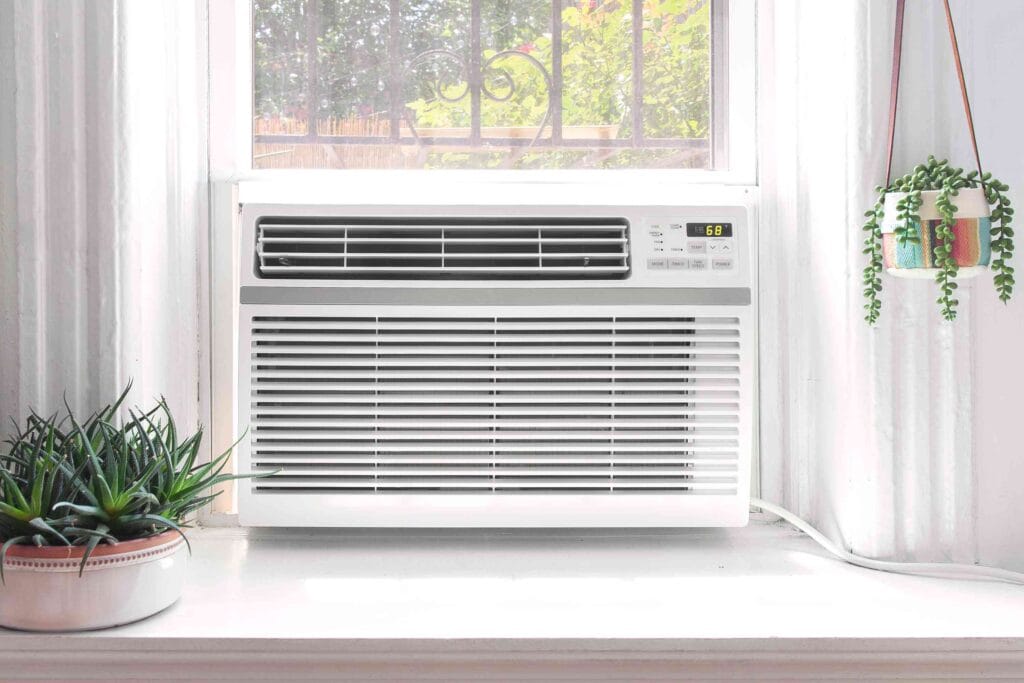
This guide explains what that little “vent” lever really does and provides a clear plan for managing your window ac unit’s fresh air exchange. You’ll learn how to get a room that feels both perfectly cool and genuinely fresh.
Summary
Most window AC units recirculate indoor air and do not bring in significant fresh air. The “Vent/Fresh Air” lever only allows a small trickle of outside air that can reduce cooling efficiency, so keep it closed during hot, humid, or poor-air-quality conditions and open it briefly in mild weather to reduce stuffiness or odors. For true ventilation, rely on windows, cross-breezes, or exhaust fans rather than the AC vent. The simple plan: default closed, use strategically, and ventilate separately for air that’s both cool and fresh.
The Big Secret: Your AC is an Air Recycler, Not an Air Exchanger
It’s easy to assume your window unit works like a car’s AC, constantly pulling in outside air to cool it down. In reality, the opposite is true. For almost all of its runtime, your window AC is simply recirculating, pulling in the air already in your room, cooling it, and pushing it right back out. It’s a closed loop designed to work with the air it has, not to introduce new air from outside.
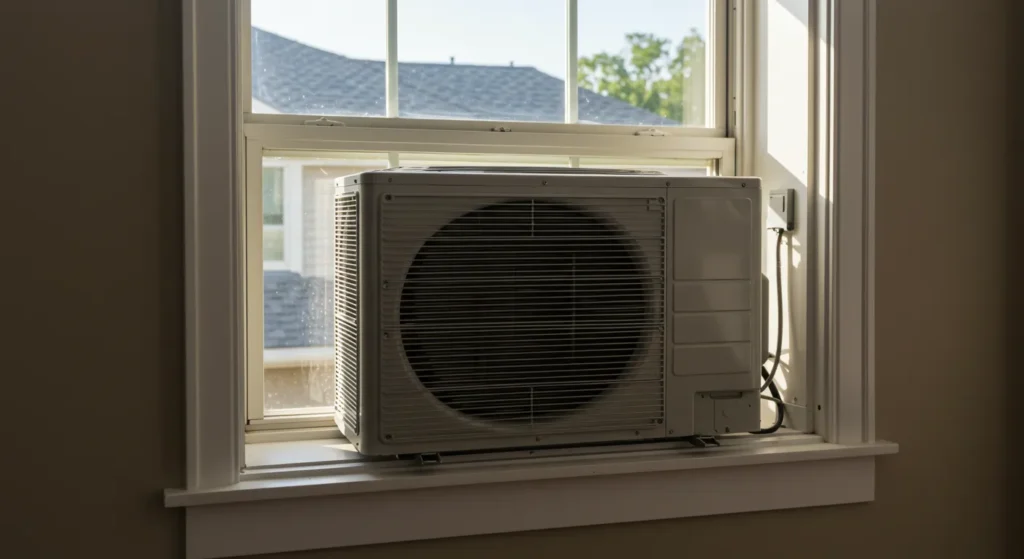
So how does it make that room air colder? Instead of “creating” cold, your AC’s real job is heat transfer. Imagine it as a refrigerator for your room: the indoor side of the unit absorbs warmth from the air, and the outdoor side releases that captured heat into the outside world. That constant humming is the sound of your AC working hard to transport heat from inside your home to the great outdoors.
This design isn’t a flaw; it’s a feature built for efficiency. Cooling the same 78-degree air down to 72 is far easier—and uses much less electricity—than constantly trying to cool scorching 95-degree outside air from scratch. By recycling the air, your AC can maintain a comfortable temperature without sending your energy bill through the roof. But this focus on cooling comes with a trade-off: it does nothing to freshen up the air you’re breathing.
“Cool But Stuffy”: Why Recirculated Air Becomes Stale Air
Have you ever walked into a room that’s perfectly cool but still feels heavy or stale? Since your AC is just reusing the same air over and over, your room effectively becomes a sealed box. While this is fantastic for efficient cooling, it means nothing new is coming in and, more importantly, nothing old is getting out.
Over hours of recirculation, all the things we generate just by living get trapped and concentrated. Think about what’s accumulating in the air with you:
- Carbon Dioxide (CO2): Every breath you exhale releases CO2. In a sealed room, it has nowhere to go, leading to that classic stale, sleepy feeling.
- Odors: Lingering smells from last night’s dinner, pets, or even perfumes get stuck in the loop, circulating again and again.
- Household Fumes: Subtle vapors from air fresheners, cleaning products, and even new furniture also get trapped.
Ultimately, this highlights a crucial distinction: cooling the air isn’t the same as cleaning it. Your air conditioner is a master of temperature, not a master of freshness. It makes the air cold, but it does little to remove these built-up pollutants. This brings us to the “Vent” or “Fresh Air” lever you might have on your unit.
What Is That “Vent” or “Fresh Air” Lever on My AC?
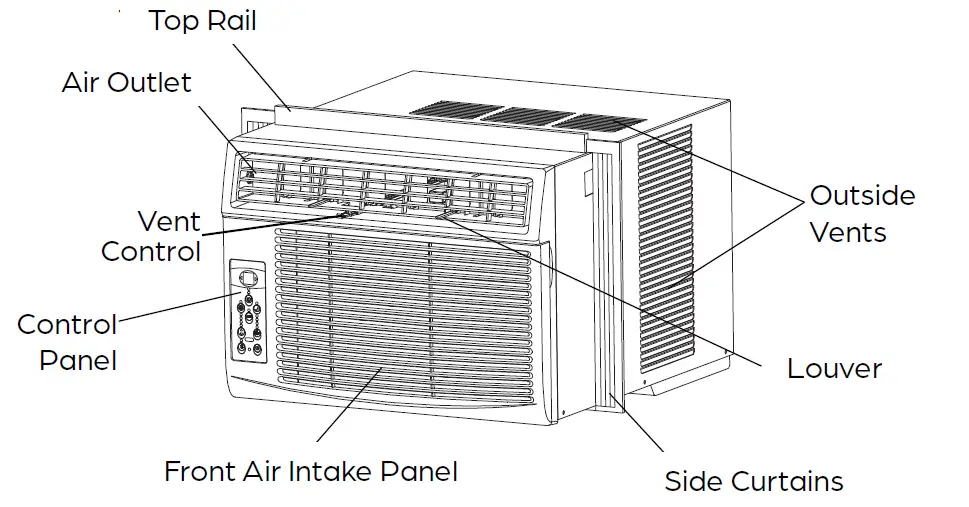
Seeing a lever on your AC labeled “Vent” or “Fresh Air,” you might think you’ve found the perfect solution to stale air. This control is indeed designed to help combat the stuffiness of a sealed room. When deciding if your window air conditioner vent should be open or closed, it’s crucial to understand what it’s actually doing.
When you slide that lever to “Open,” you’re not turning on a powerful intake fan. You are simply opening a small flap inside the unit that creates a pathway to the outside. As your AC’s main fan draws your room’s air in to be cooled, it now also passively pulls a small amount of outside air along for the ride. It’s a simple mechanical door, not a sophisticated ventilation system.
Think of it like cracking a car window an inch versus rolling it all the way down. Using the window AC fresh air setting allows only a trickle of outside air to mix into the much larger volume being recirculated. It can certainly help lessen that stuffy feeling over time, but it won’t instantly flush the room with freshness. And inviting even a little hot air inside comes with a hidden cost.
The Efficiency Trap: When to Keep Your Fresh Air Vent CLOSED
That trickle of outside air from the fresh air vent comes with a significant trade-off. Imagine trying to cool down a pot of soup while someone keeps adding splashes of hot water—your stove has to work constantly just to keep up. It’s the same for your AC. When you open the vent, you’re forcing your unit to cool down hot, often humid, outside air from scratch. This extra workload makes your AC run longer and harder, which leads to a noticeable increase in your electricity bill.
An air conditioner works most efficiently in a closed loop, a process called recirculation. Introducing hot outside air breaks this efficient cycle. This not only costs more money but can also reduce your unit’s cooling power on the days you need it most. On a sweltering afternoon, your AC might struggle to hit your target temperature if it’s also battling incoming heat.
For this reason, knowing when the window air conditioner vent should be closed is crucial. You should always keep the vent shut in a few key situations: on extremely hot and humid days, during allergy season when pollen counts are high, or when outdoor air quality is poor due to smoke or pollution. In these cases, using the vent actively works against you, making the room less comfortable and bringing pollutants inside.
Ultimately, you’re choosing between your AC’s maximum cooling power and a small amount of ventilation. Keeping it closed prioritizes a cool room and lower energy use.
The Right Way to Ventilate: When to Open the Fresh Air Vent
After all that caution, you might think the fresh air vent is just a gimmick. Far from it. While not meant for constant use, it’s a valuable tool for solving specific, short-term comfort problems. Think of it less as a ventilation system and more as a “quick refresh” button for your room’s atmosphere. Used strategically, your window AC with ventilation can make your space feel significantly more pleasant.
So, when does this feature actually shine? The trick is to use it for brief periods when the outside air isn’t working against your AC.
Good Times to Open the Vent:
- On milder days (e.g., 75-80°F) when you just need a little cooling and want to prevent stuffiness.
- For 15-30 minutes to help clear out a stubborn odor, like from cooking or burnt toast.
- To reduce stuffiness in a bedroom on a cool, clear night before you go to sleep.
The key is to think of the window AC fresh air setting as a temporary fix. By opening it deliberately to solve a problem and then closing it again, you get the best of both worlds: a quick infusion of fresh air without forcing your AC to work overtime.
Beyond the Vent: Truly Effective Ways to Get Fresh Air
While the fresh air vent offers a small boost, what happens when your room feels seriously stale? The most powerful way of improving indoor air quality isn’t about relying on one little lever. It’s about using your window AC as part of a simple, strategic team with your windows and fans.

For a true air refresh that a small vent can’t match, try one of these highly effective methods:
- Cool Down, Then Ventilate: On hot days, run your AC to get the room comfortable. Then, turn it off and open the windows for 15 minutes. This lets you air out the space without making your AC fight the heat.
- Create a Cross-Breeze: During cooler evenings or mornings, turn off the AC and open windows on opposite sides of your room or home to let a natural breeze flow through.
- Use an Exhaust Fan: To actively remove stale air, place a box fan in an open window, facing out. This powerfully pulls old air from the room, and fresh air will naturally flow in from other open windows to replace it.
The key takeaway is that your AC and your windows don’t have to be enemies. By using them at different times, you can enjoy an environment that is both cool and genuinely fresh.
Your 3-Step Plan for Cool, Fresh Air
You now understand that your window air conditioner is an expert at cooling, not a specialist in ventilation. This distinction puts you in control, empowering you to create a room that’s not just cold, but genuinely fresh and comfortable.
Your AC Fresh Air Cheat Sheet:
- Default to ‘Closed’: Keep the window air conditioner vent open or closed? Stick with closed 90% of the time for maximum cooling power and efficiency.
- Use Strategically: Briefly open the vent on mild days or to clear out lingering stuffiness and odors.
- Ventilate Separately: For truly fresh air, turn the AC off and open a window for 15 minutes.
By following this simple plan, you can effectively manage both your room’s temperature and its freshness, creating a perfectly comfortable space.
Most window AC units focus on cooling indoor air rather than bringing in fresh outdoor air. If bringing fresh air inside is important, consider supplemental ventilation options.
FAQ:
Do window AC units bring fresh air inside?
Most window AC units primarily recirculate indoor air and cool it; they do not bring in significant outdoor fresh air unless they have a specific fresh-air vent feature.
Can any window AC model pull in outdoor air?
Yes — some window air conditioners include a fresh-air ventilation setting or vent control that allows limited outdoor air to enter, but this feature isn’t standard on all models.
Will running a window AC with a fresh-air vent open lower cooling efficiency?
Yes — allowing outdoor air in can reduce cooling efficiency because the unit must work harder to cool both indoor and incoming outdoor air.
How can I get fresh air into a room with a window AC?
You can slightly open a window or use a separate ventilation fan to bring in fresh air, especially when outdoor temperatures and air quality are favorable.
Are there AC units better suited for fresh air exchange?
Yes — ductless mini splits with ventilation kits, whole-house ventilation systems, or HVAC systems with ERV/HRV units are better designed for fresh air integration.
Does fresh air from a window AC help indoor air quality?
Limited fresh air from certain window AC units can improve air quality somewhat, but for consistent ventilation and better indoor air quality, a dedicated ventilation system is more effective.