TL;DR Summary for Those in a Hurry:
- Capacitor Boosters help improve your air conditioner’s electrical performance by stabilizing voltage and supporting stronger motor starts.
- By enhancing the way power is delivered to your A/C’s motors, these devices can reduce strain and improve overall system efficiency.
- Installing a capacitor booster may lower energy use, extend component life, and help your A/C run more reliably.
- Always consult a qualified HVAC technician to assess compatibility and ensure safe installation.
You’ve spent good money on a powerful car audio system, but when the bass drops, your headlights dim for a split second. It’s a frustrating sign that your system is being stretched to its limit, but what you’re seeing isn’t a sign of a bad battery.
Most drivers assume their battery is failing, but in practice, this is a momentary “power traffic jam.” Your battery has plenty of energy, but it’s built for endurance, not a sudden, explosive sprint of power. This temporary car amplifier voltage drop is the real reason your lights flicker.
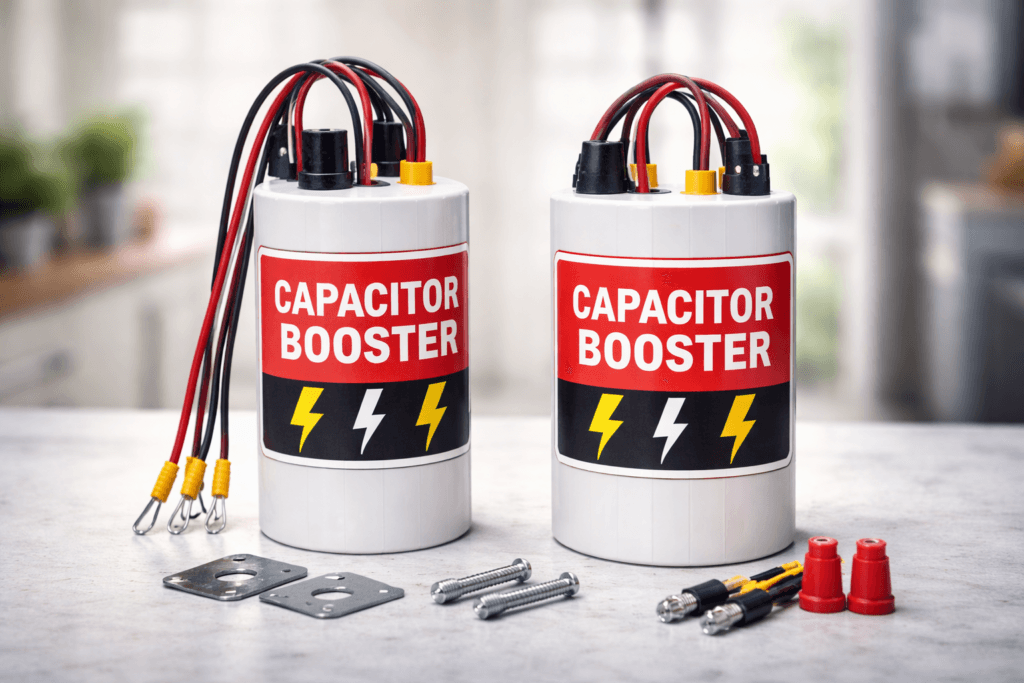
The solution is a simple car audio system power upgrade designed specifically to handle these peaks. A device called a capacitor acts as a tiny, lightning-fast power reservoir. It’s not about having more power, but delivering it instantly—the perfect way to fix dimming headlights with bass for good.
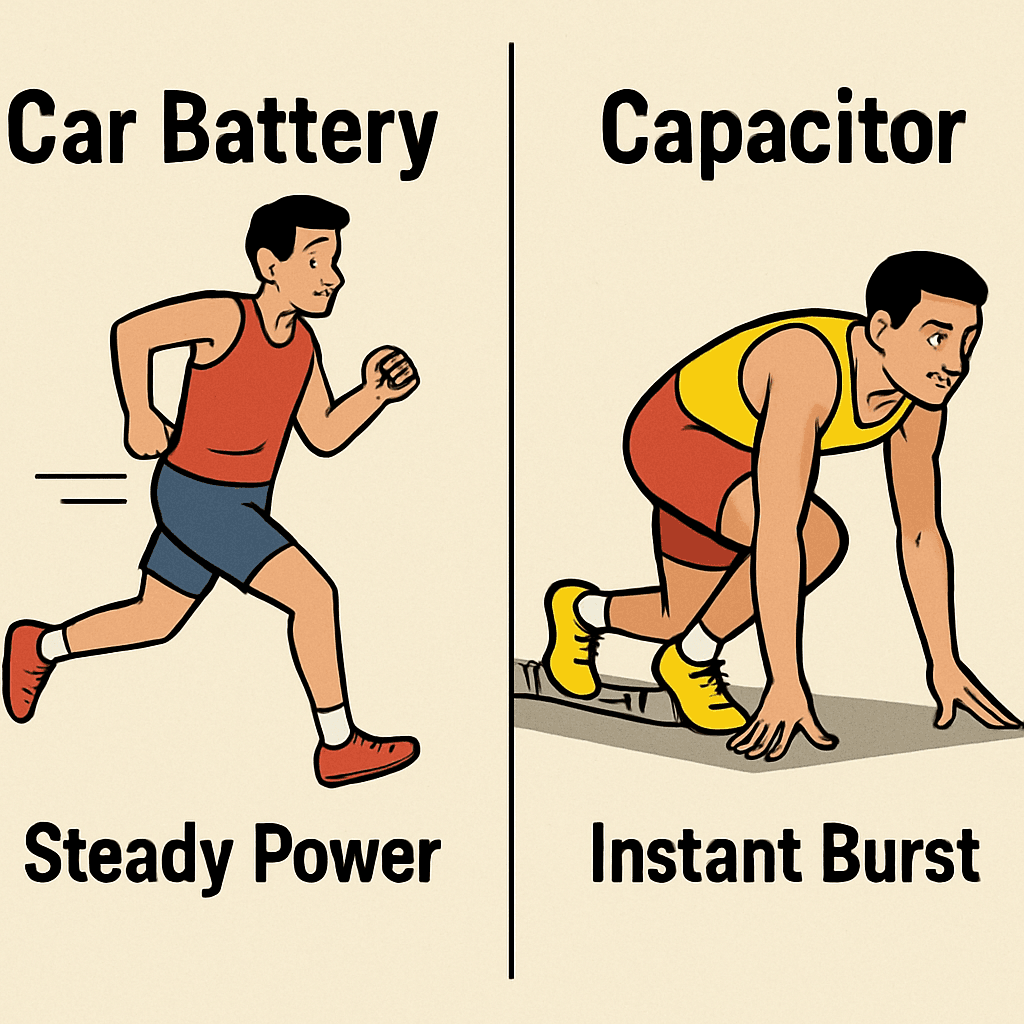
Your Battery is a Marathon Runner; A Capacitor is a Sprinter
Think of your car’s battery as a marathon runner. It has incredible stamina and can provide steady, reliable power for a very long time, but it isn’t built for sudden bursts of speed. A capacitor, on the other hand, is a world-class sprinter. It holds much less energy overall, but its one and only specialty is delivering its entire supply in an explosive, instantaneous burst. The fundamental difference isn’t how much power they hold, but how fast they can release it to deal with a momentary power bottleneck.
This difference in speed comes from how they store energy. Your battery relies on a relatively slow chemical reaction to release its power—think of it like wood burning in a bonfire. A capacitor, however, stores its energy electrostatically, essentially holding it in a “ready-to-go” state. The brilliant, instant pop of a camera flash is a perfect example of a capacitor at work. There’s no delay, just an immediate, massive discharge of power.
Because of this, a capacitor doesn’t replace your battery; it helps it. They form an electrical tag team. The battery handles the marathon of running your car’s systems, while the capacitor sits alongside it, ready to unleash a sprint of power whenever there’s a sudden, massive demand. This teamwork is the key to providing the instant energy your system is starving for.
The Real Reason Your System is Starving for Power
So what’s really happening when your headlights dim with a heavy bass note? It’s not that your battery is weak; it’s that your electrical system can’t deliver power everywhere at once. Think of your car’s wiring as a plumbing system. When your powerful car amplifier suddenly demands a huge gulp of electricity for a deep bass note, it’s like flushing every toilet in the house simultaneously. The water pressure drops everywhere else for a moment, causing the flow to your lights to dip. In the electrical world, this temporary dip is called a voltage drop.
The main culprit behind this power struggle is almost always a high-draw amplifier. Your car’s stock electrical system was engineered to handle the factory-installed components—the engine, the lights, the radio. It was never designed for the massive, instantaneous power demands of a competition-grade subwoofer. When your amp calls for that sudden surge, it momentarily starves the rest of the system, causing instability that shows up as dimming lights or even a slight hesitation in the engine’s performance.
Ultimately, your battery—our marathon runner—is simply too slow to react to this split-second crisis. Before its chemical process can ramp up to meet the demand, the bass note is over, and your lights have already flickered. You don’t need more long-term endurance; you need an immediate fix for that amplifier voltage drop. You need a dedicated, lightning-fast power source that can service the amp’s demands without stealing from anything else.
How a Capacitor Becomes Your Amp’s Personal Power Reserve
So, if the battery is too slow to react, how does a capacitor fix the problem? It acts as a small, incredibly fast power reserve placed right next to your power-hungry amplifier. Think of it as a dedicated water tower built exclusively for that one thirsty appliance. This “stiffening” capacitor, as it’s often called in the audio world, stays topped up by the battery during normal operation. But when your amp suddenly screams for power to hit a deep bass note, the capacitor dumps its stored energy instantly—far faster than the battery ever could.
The secret to its effectiveness is proximity. Placing the capacitor as close to the amplifier as possible is critical. Going back to our plumbing analogy, having a high-pressure tank right beside the toilet delivers water instantly. If that tank were in the basement, you’d still have a delay as the water travels through the pipes. By installing the capacitor near the amp, you give it an immediate source to draw from, preventing it from stealing power from the rest of the car.
This immediate power buffering doesn’t just solve one problem; it provides a cascade of benefits that improve your entire audio experience. For anyone wondering if a car audio capacitor is necessary, the improvements are often both seen and heard:
- Stops headlight dimming. By satisfying the amp’s sudden thirst, the capacitor keeps your car’s voltage stable.
- Delivers cleaner, tighter bass. Amps perform best with stable power. The capacitor ensures your subwoofer gets the clean, instantaneous current it needs for accurate, hard-hitting notes.
- Protects your amplifier. Starving an amplifier of power can put a strain on its internal components. A capacitor helps it run cooler and more reliably.
Power Capacitor vs. a Second Battery: Which Do You Need?
Deciding on a car audio system power upgrade often leads to a key question: a big capacitor or a whole second battery? The answer depends entirely on the problem you’re trying to solve. As we’ve seen, a capacitor is a sprinter, built for explosive, split-second bursts of power to prevent things like dimming headlights. It fixes problems related to the speed of your power delivery.
A second battery, on the other hand, is another marathon runner. It doesn’t necessarily deliver power any faster, but it massively increases your system’s overall stamina. It adds to your total energy reserve, allowing you to run powerful equipment for longer periods, especially when the engine is off. It’s a solution for a lack of total capacity, not a lack of speed.
This simple breakdown makes choosing the right car audio electrical system stability upgrade much clearer. For most people dealing with performance hiccups in a running car, a power capacitor is the correct first step.
- Choose a Capacitor for: Quick power bursts to fix dimming lights and tighten up bass response while driving.
- Choose a Second Battery for: Long-term power supply, like playing music for hours with the engine off or running power-hungry accessories like winches.
In extreme, competition-level systems, you’ll often find both working as a team—the second battery providing the endurance, and capacitors providing the instant power. But for your daily driver, picking the right tool for the job saves you money and gets you the result you’re looking for.
How to Wire a Car Audio Capacitor Safely (The 1-Minute Overview)
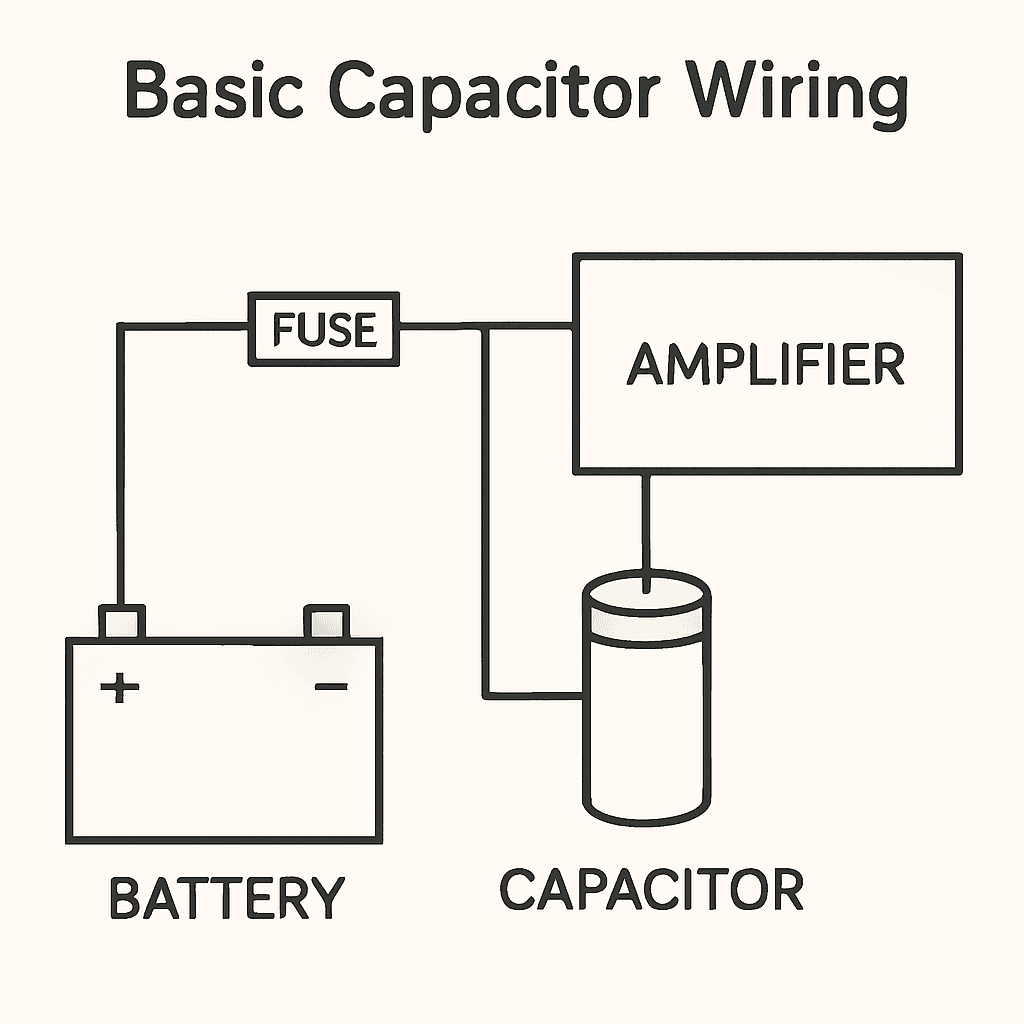
Connecting a capacitor might seem intimidating, but the concept is straightforward. It doesn’t go between your battery and your amp; it works alongside your amp. The capacitor is installed “in parallel,” meaning it shares the same power and ground connections as the amplifier it’s helping. Think of it as adding a small, lightning-fast fuel tank right next to the engine, sharing the same fuel line to handle sudden demands for gas. For this reason, you should always place the capacitor as close to the amplifier as possible—ideally within 18 inches.
Before you make that final connection, however, there is one absolutely critical safety step: pre-charging. A capacitor arrives completely empty, and connecting it directly to your car’s live 12-volt system would be like trying to instantly fill an empty reservoir with a fire hose. The resulting surge of electricity creates a massive, dangerous spark that can weld tools, destroy the capacitor, and damage your amplifier. To prevent this, you use a small resistor (often included with the capacitor) to “trickle-charge” it slowly and safely, filling it up over 30-60 seconds.
Once the capacitor is safely charged, the final connection can be made without a spark. This high-level overview isn’t a replacement for a detailed installation guide, but it demystifies the process. Understanding why you need to place it close and why you must pre-charge are the two most important takeaways for a safe and effective installation. With this knowledge, you can confidently discuss the job with a professional or follow a detailed guide without being caught by surprise.
Is a Capacitor Booster Actually Worth It For You?
The frustrating mystery of dimming headlights or weak bass is a problem you can now diagnose. By understanding the difference between a battery’s endurance and a capacitor’s instant speed, you can pinpoint what your car’s electrical system truly needs.
So, is a car audio capacitor necessary for you? This simple checklist provides the answer.
A Capacitor is a Smart Choice If:
- You have an aftermarket amplifier over 500 watts RMS.
- You see your headlights or dash lights dimming when bass hits.
- You want the absolute best performance and tightest response from your subwoofers.
Ultimately, you can now see a capacitor not as a mandatory upgrade, but as a specialist’s tool for a specific job. Knowing the real benefits of a car power capacitor means you can make a smart car audio power upgrade, investing your money effectively only when your system truly calls for that burst of speed.
Capacitor boosters optimize electrical performance, reduce strain on A/C motors, and can boost efficiency and reliability when properly installed by a pro.
FAQ:
What are capacitor boosters and how do they work in an air conditioner?
Capacitor boosters help provide an extra electrical boost to your A/C’s motors at startup, ensuring the compressor and fan get sufficient power to start smoothly and run efficiently.
Can capacitor boosters improve my A/C’s efficiency?
Yes — by reducing strain on the compressor and helping it start more easily, capacitor boosters can enhance cooling performance and lower energy consumption over time.
Do capacitor boosters reduce wear on HVAC components?
They can — giving the compressor a better electrical start reduces stress on motors and electrical components, which may extend equipment life and decrease the risk of breakdowns.
Is a capacitor booster suitable for every air conditioning system?
Not always — capacitor boosters may not be ideal for all systems, and a professional HVAC technician should evaluate whether one is compatible with your unit before installation.
Will installing a capacitor booster save me money on utility bills?
Because capacitor boosters help your A/C start more efficiently and reduce energy spikes, they can contribute to lower energy use and potentially save on electricity costs.
Should I install a capacitor booster myself or hire a professional?
It’s best to have a licensed HVAC technician install a capacitor booster to ensure correct placement, compatibility with your system, and safe handling of electrical components.